Titanium CNC for surgical instruments: finish before speed
Publication Date
author
In titanium CNC for surgical instruments, surface integrity matters more than cycle time. For enterprise decision-makers balancing ISO 13485 compliance, repeatable tolerances, and supplier qualification risk, the real benchmark is not how fast a part is cut, but how consistently finish quality supports biocompatibility, cleanliness, and downstream performance. This article examines why finish-first machining strategy defines long-term value in medical manufacturing.
Why finish quality matters more than machining speed in surgical titanium
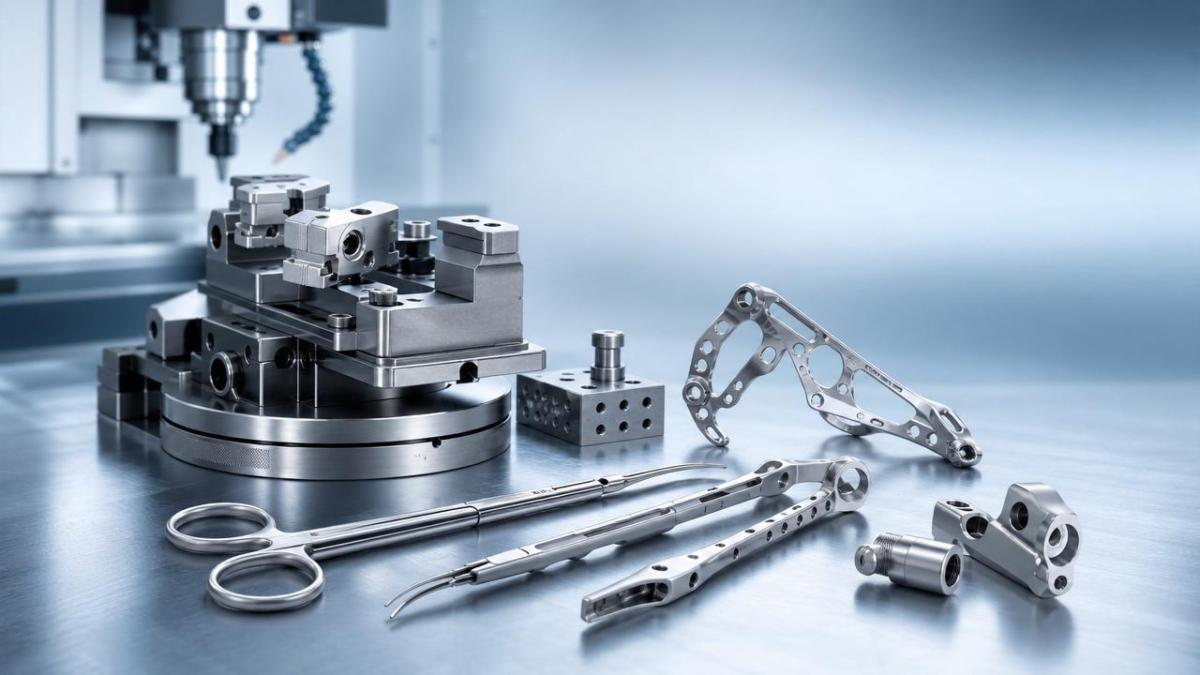
The core search intent behind titanium CNC for surgical instruments is practical evaluation. Decision-makers want to know how to source titanium machining that protects compliance, product performance, and supplier reliability.
They are not searching for generic CNC theory. They are assessing whether a supplier can machine titanium components with consistent surface finish, dimensional control, and process discipline suitable for medical use.
For surgical instruments, finish is not a cosmetic afterthought. Surface quality directly affects cleanability, passivation response, wear behavior, friction, tactile feel, and confidence during inspection and assembly.
In titanium, poor finishing decisions create hidden downstream costs. A faster cycle may look attractive on a quote sheet, but rough surfaces, recast zones, burrs, or tool-induced stress can increase rejection risk later.
That is why a finish-first strategy usually produces stronger enterprise value. It reduces nonconformance, simplifies validation, improves lot consistency, and lowers the probability of supplier-caused delays in regulated production environments.
What enterprise buyers are actually trying to judge
Most enterprise readers care about risk before they care about speed. They need to know whether a machining partner can produce titanium surgical parts repeatedly, document the process, and hold quality across batches.
The buying question is usually not, “Can this shop machine titanium?” The better question is, “Can this shop machine titanium for medical applications without creating avoidable finishing, inspection, or sterilization problems?”
That leads to several concerns. First is repeatability of surface finish across production lots. Second is tolerance stability after deburring, polishing, or blasting. Third is traceability of process controls and inspection records.
They also worry about hidden quality erosion. Some shops deliver acceptable first articles, then lose consistency when tools wear, setups change, operators rotate, or throughput pressure increases near delivery deadlines.
For medical programs, this inconsistency is expensive. It extends qualification cycles, increases incoming inspection burden, and raises the chance that internal engineering teams must spend time correcting preventable supplier variability.
Why titanium is unforgiving in surgical instrument machining
Titanium is attractive for surgical instruments because of its strength-to-weight ratio, corrosion resistance, and biocompatibility. Yet these same applications expose the material’s machining difficulty and finishing sensitivity.
Titanium has low thermal conductivity, so heat tends to stay near the cutting zone. If parameters, tooling, or coolant strategy are not optimized, the result can be smeared surfaces, accelerated wear, and unstable finish quality.
The material also reacts strongly to tool condition and chip evacuation. As tools degrade, edge formation and burr behavior can change quickly, creating micro-defects that are not always obvious in a simple visual check.
In surgical instruments, those defects matter. Surface irregularities can affect joint movement, mating performance, tactile feedback, coating adhesion where used, and cleaning effectiveness in complex geometries or narrow channels.
This is why titanium CNC for surgical instruments should be treated as a controlled process capability question, not merely as a machine availability or hourly rate comparison exercise.
How surface integrity affects compliance, performance, and downstream cost
Surface integrity is broader than Ra alone. It includes roughness, burr condition, micro-tearing, residual stress, heat impact, edge quality, and the consistency of post-machining finishing operations.
From a compliance perspective, poor surface integrity can complicate validation and inspection. If the surface varies between lots, cleaning studies, passivation response, and visual acceptance standards may become harder to stabilize.
From a functional perspective, rough or inconsistent surfaces can increase friction at pivots, degrade fit in assembled instruments, and create localized wear that shortens service life in reusable medical tools.
From a cost perspective, the biggest problem is often not scrap alone. It is the accumulation of secondary labor, rework loops, supplier communication overhead, delayed approvals, and engineering time spent resolving recurring issues.
A slower but controlled process often outperforms a faster unstable process when total cost of quality is measured honestly across sourcing, validation, production, and post-delivery support.
What a finish-first machining strategy looks like in practice
A finish-first strategy begins at process planning, not at the final polishing bench. It means selecting tooling, feeds, speeds, stepovers, coolant approach, and workholding based on final surface requirements.
It also means designing the route so that secondary finishing does not erase dimensional capability. For example, deburring or polishing should be planned with known stock impact and validated tolerance retention.
In strong suppliers, machining engineers define surface-critical zones early. They distinguish cosmetic surfaces from functional contact areas, gripping edges, pivot interfaces, and cleanability-sensitive geometries before production begins.
They also monitor tool wear against finish degradation, not just part count. This is a critical difference. A tool may still cut dimensionally acceptable parts while already producing unstable or unacceptable surface behavior.
For enterprise buyers, this discipline is a strong indicator of maturity. It suggests the supplier understands that finish quality is engineered upstream, measured in process, and protected through final inspection.
How to evaluate a supplier beyond the quote and sample part
Many procurement teams receive polished sample parts that do not reflect steady-state production. Qualification should therefore examine process evidence, not only part appearance or nominal conformance on one batch.
Ask how the supplier defines and measures surface finish for surgical titanium components. Do they rely only on visual checks, or do they use profilometry, documented criteria, and lot-based inspection routines?
Ask how they control burr formation on thin features, slots, and intersecting geometries. Burr management in titanium is a practical signal of process competence because it influences both finish quality and post-processing risk.
Ask what happens when tooling wears. Is there a defined replacement threshold linked to finish drift? Are there control plans for critical surfaces, or does the shop mainly react after defects are found?
Also review their post-machining sequence. Cleaning, passivation support, media use, handling, packaging, and contamination prevention all affect whether good machining results remain acceptable by the time parts reach inspection.
Questions enterprise teams should ask during supplier qualification
Decision-makers need questions that reveal operating discipline quickly. One useful question is: which instrument features are most vulnerable to finish variation, and how is each feature controlled in production?
Another is: what evidence shows repeatability over time? Request multi-lot data, not just one first article report. Stable suppliers can discuss finish consistency across different operators, tools, and machine loads.
Ask whether critical finish requirements are translated into work instructions at the machine level. If the answer stays vague, the supplier may depend too heavily on end-of-line rework instead of process control.
Ask how nonconformances are traced to root cause. Can the supplier distinguish whether a defect came from tool wear, workholding movement, coolant delivery, post-finish handling, or inspection interpretation?
Finally, ask how they support regulated documentation. In medical supply chains, confidence often comes from the combination of process capability, record quality, and responsiveness during deviations or engineering changes.
Which metrics matter most when comparing titanium CNC suppliers
Cycle time and quoted piece price are incomplete metrics. Better comparisons include lot-to-lot finish variation, first-pass yield, dimensional retention after secondary finishing, and nonconformance rate on critical features.
Also valuable are lead-time stability, deviation response speed, and the supplier’s ability to maintain validated outcomes during ramp-up. A fast prototype supplier is not automatically a reliable production supplier.
If your organization tracks total supplier cost, include incoming inspection effort, line disruption risk, corrective action frequency, and time consumed by engineering and quality teams during issue resolution.
For titanium CNC for surgical instruments, the strongest supplier is often the one that appears less aggressive on headline speed but demonstrates stronger statistical control and lower quality volatility over time.
That profile aligns with long-term value, especially where device timelines, audit readiness, and reputation exposure are more important than marginal gains in cycle efficiency.
When speed should matter, and when it should not
Speed still matters in some situations. During urgent prototyping, launch recovery, or low-risk noncritical components, faster turnaround can create meaningful business value if finish requirements remain fully controlled.
But speed should not dominate sourcing decisions for surface-sensitive surgical components, especially when the parts include articulating zones, patient-contact surfaces, or geometries that are difficult to inspect after finishing.
In those cases, prioritizing throughput can shift cost into hidden areas: extra inspection, more supplier oversight, requalification effort, delayed builds, or customer-facing quality events that are far costlier than machine time.
The better executive framework is not speed versus quality as a binary choice. It is identifying where process speed can be increased without compromising surface integrity and where it cannot.
Suppliers worth keeping can explain this boundary clearly. They know which process windows are expandable and which should remain conservative to protect finish, compliance confidence, and repeatable product behavior.
The strategic takeaway for medical manufacturing leaders
For enterprise decision-makers, the real value of titanium CNC for surgical instruments is not found in a fast quote. It is found in predictable finish quality that supports qualification, compliance, and long-term production stability.
A finish-first strategy reduces supplier risk because it aligns machining decisions with the realities of medical manufacturing. It protects cleanability, consistency, downstream assembly, inspection reliability, and total cost of quality.
This is especially important in titanium, where machining difficulty can hide beneath acceptable dimensions until surface-related problems emerge later in validation, sterilization review, or field performance expectations.
When evaluating suppliers, prioritize evidence of controlled surface integrity, repeatable process discipline, and documented response to variation. Those factors matter more than advertised speed when business exposure is high.
In short, finish before speed is not a conservative slogan. It is a practical sourcing standard for organizations that want lower qualification friction, more reliable surgical instrument production, and better long-term manufacturing outcomes.
Search News
Hot Articles
- Carbon Fiber StructuresHow to Specify Aerospace Carbon Fiber Assemblies for Lightweight, Load-Bearing PartsJul 11, 2026
- Machine VisionXiaomi, Alibaba DAMO Academy Drive Open-Source Robotics Model Ecosystem, Lowering Algorithm Development Barriers for Overseas SMEs Adopting Chinese Robotics SolutionsMar 30, 2026
- Cobots & ArmsShanxi 'AI+' Conference Showcases Embodied Intelligence with Multinational Buyer Engagement: Key Industry ImplicationsMar 30, 2026
Popular Tags
Recommended News
 Jul 11, 2026How to Specify Aerospace Carbon Fiber Assemblies for Lightweight, Load-Bearing PartsAerospace carbon fiber assemblies: learn how to specify laminate design, load data, joining methods, and inspection controls for lighter, reliable load-bearing aerospace parts.Elena Rostova (UAV Systems Researcher)
 Mar 30, 2026Xiaomi, Alibaba DAMO Academy Drive Open-Source Robotics Model Ecosystem, Lowering Algorithm Development Barriers for Overseas SMEs Adopting Chinese Robotics SolutionsXiaomi & Alibaba DAMO Academy's open-source robotics models lower algorithm barriers for global SMEs. Boost efficiency in manufacturing, logistics & smart retail with ROS 2 compatible solutions.TSV Data Lab
 Mar 30, 2026Shanxi 'AI+' Conference Showcases Embodied Intelligence with Multinational Buyer Engagement: Key Industry ImplicationsShanxi 'AI+' Conference highlights embodied intelligence with Tesla, Ubtech & Jiantao showcasing multimodal robotics. 40+ global buyers validated tech on-site, creating new B2B channels for industrial automation & AI solutions.Chen Wei (Automation Lead Engineer)
 Mar 30, 2026Zhongguancun Unveils 6G Integrated Sensing-Computing-Intelligence Platform to Empower Embodied Robots for Global Industrial ApplicationsZhongguancun's new 6G platform revolutionizes industrial robotics with <10ms latency, empowering global automotive, logistics & port automation. Discover how this tech boosts China's smart manufacturing exports.TSV Data Lab
 Mar 30, 2026Mech-Mind Tianjin Embodied Intelligence R&D and Production Base Goes Live, Cutting Delivery Time by 20%–30% for Global Customized AMR+Vision SolutionsMech-Mind's Tianjin AMR+Vision production base cuts delivery time by 20%-30% for欧美 & Latin American markets. Discover how this PLd-certified facility accelerates customized robotics solutions for smart manufacturing and logistics.Chen Wei (Automation Lead Engineer)
 Mar 30, 2026Boao Forum Reveals 'Co-evolution of Big and Small Brains' Trend in Humanoid Robots, China's Embodied Intelligence Accelerates Adaptation to Overseas Manufacturing Service ScenariosDiscover how China's humanoid robots, featuring 'Co-evolution of Big and Small Brains,' are revolutionizing global manufacturing. Learn about Embodied Tian Gong 3.0's ISO compliance and overseas deployment at Boao Forum 2026.Chen Wei (Automation Lead Engineer)
 Mar 30, 2026China Railway Industrial Secures Patent for Embodied Robotics in Material Handling, Boosting High-Precision Delivery Capabilities for Overseas Infrastructure and Manufacturing ProjectsChina Railway Industrial's new patent for embodied robotics in material handling boosts high-precision delivery for global infrastructure & manufacturing. Discover how this innovation enhances logistics accuracy in automotive, rail transit & EPC projects.Chen Wei (Automation Lead Engineer)
 Sep 28, 2026Spindle Runout Measurement in Germany: DIN Standards, Methods, and Acceptance LimitsSpindle runout measurement Germany: explore DIN standards, proven methods, acceptance limits, and audit-ready practices for reliable machining quality.Dr. Marcus Vance
 Sep 27, 2026How to Select Wall-Mount Edge Devices for Space-Constrained Factory NetworksWall mount edge devices for space-constrained factories: evaluate workload, thermal design, power resilience, cable access, and network reliability for smarter deployments.TSV Data Lab
 Sep 26, 2026Machining Tolerance Analysis: How to Set Limits That Meet Function and Cost TargetsMachining tolerance analysis: learn how to set functional limits, control tolerance stacks, reduce inspection risk, and balance precision with production cost.Dr. Marcus Vance
 Sep 25, 2026How to Evaluate an Industrial Infrastructure Data Platform for Multi-Site OperationsIndustrial infrastructure data platform evaluation guide for multi-site operations: compare data quality, edge resilience, interoperability, governance, and scalable proof-of-value criteria.Victor Lin (Chief Software Architect)
 Sep 24, 2026How to Select Machine Vision Optics for Accurate Inspection at Different Working DistancesMachine vision optics selection guide for accurate inspection at every working distance. Compare FOV, pixel scale, DOF, distortion, lighting, and telecentric options.TSV Data Lab
 Sep 23, 2026How to Evaluate a Machine Vision System Integrator for High-Speed Inspection LinesChoose a machine vision system integrator with proven expertise in high-speed inspection, reliable reject timing, robust optics, and measurable acceptance criteria.TSV Data Lab
 Sep 28, 2026When is a SCADA API the right choice for connecting plant systems?SCADA API guide: learn when governed plant data integration improves traceability, security, and scalability—without compromising real-time control.Victor Lin (Chief Software Architect)
 Sep 27, 2026How SCADA data integration improves traceability across production linesSCADA data integration connects production-line data to improve traceability, accelerate quality investigations, and strengthen safety decisions.Victor Lin (Chief Software Architect)
 Sep 26, 2026What to define before starting SCADA integration planningSCADA integration planning starts with clear scope, control boundaries, data models, cybersecurity, and testing. Discover the definitions that reduce risk and costly rework.Victor Lin (Chief Software Architect)
 Sep 25, 2026How a smart factory with Industrial IoT reduces production blind spotsDiscover how a smart factory with Industrial IoT turns real-time machine, quality, and workflow data into actionable insights that reduce production blind spots and delivery risks.Victor Lin (Chief Software Architect)
 Sep 24, 2026When does Industrial IoT make smart manufacturing easier to scale?Smart manufacturing Industrial IoT scales when trusted data, interoperable systems, and secure workflows turn connected assets into measurable gains.TSV Data Lab
 Sep 23, 2026What drives ultra-precision machining cost at 1-micron tolerance?Ultra precision machining cost per part at 1 micron tolerance depends on process, material, metrology, and yield. Learn how to compare quotes confidently.Dr. Marcus Vance
 Sep 22, 2026Drone Engine-T550CC Applications: Build the UAV Power System Around the MissionAn application guide for Drone Engine-T550CC integration, covering payload planning, airframe matching, cooling, fuel, vibration, test procedures, documentation, and service preparation.Elena Rostova (UAV Systems Researcher)
 Sep 22, 2026How to Evaluate Industrial Edge Computing Vendors for Factory DeploymentIndustrial edge computing vendor evaluation guide for factories: compare latency, protocol fit, reliability, security, and lifecycle support before deployment.TSV Data Lab
 Sep 21, 2026Drone Payload Integration: Matching Power, Data, and Center of Gravity for Reliable FlightsDrone payload integration made practical: balance power, data, center of gravity, and endurance to build safer, more reliable mission-ready flights.Elena Rostova (UAV Systems Researcher)
 Sep 20, 2026Autonomous Navigation Pricing: Cost Drivers and Budget Benchmarks for AMR ProjectsAutonomous navigation price explained: compare AMR cost drivers, software, sensors, integration, safety, and lifecycle budgets to build a scalable project plan.Chen Wei (Automation Lead Engineer)
 Sep 19, 2026How to Scope Automation Integration Services for Multi-System Factory ProjectsAutomation integration services: learn how to scope multi-system factory projects with clear workflows, interface contracts, safety boundaries, and acceptance criteria.Victor Lin (Chief Software Architect)