Brass Instruments Wholesale: MOQ, Quality Checks, and Supplier Questions Before You Order
Publication Date
author
Why does brass instruments wholesale require more than a price comparison?
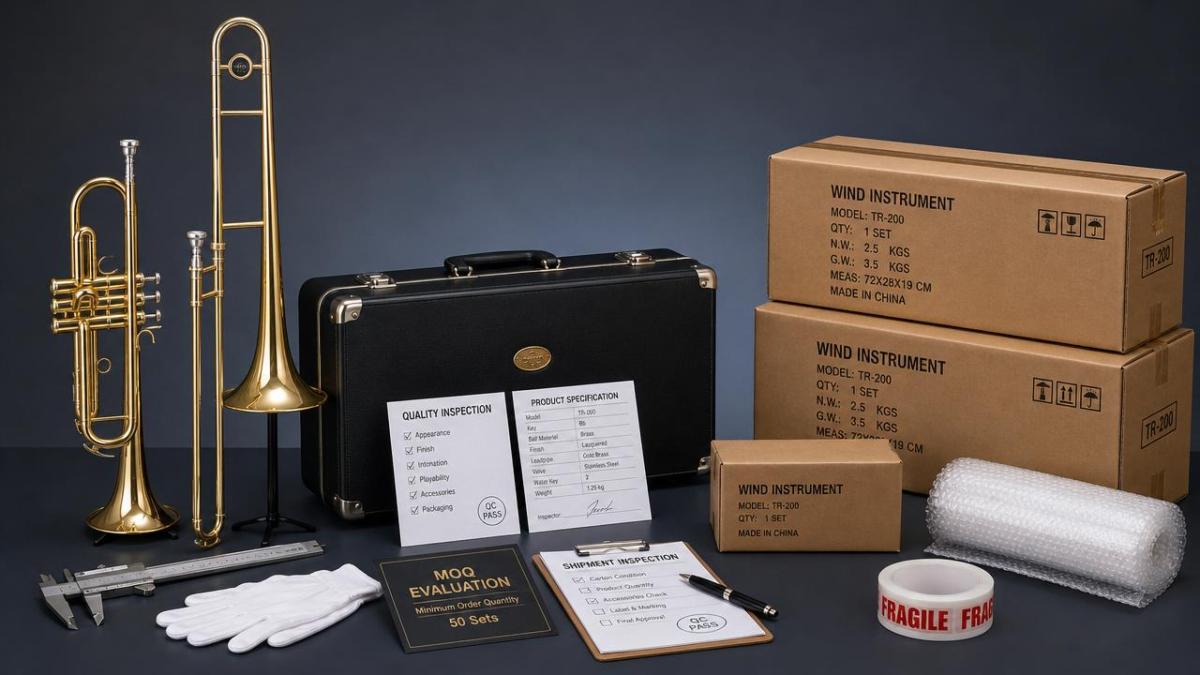
In brass instruments wholesale, the real decision starts before quotation review. Unit price matters, but batch stability matters more when returns, repairs, and delayed shipments enter the picture.
That is why MOQ, quality checks, and supplier screening should be treated as one connected process. If one part is weak, the total landed value usually drops.
A practical sourcing approach also fits the broader TSV view of industrial procurement. Marketing language is rarely enough. Measurable facts, repeatable checks, and traceable production data are what reduce uncertainty.
For brass instruments wholesale, that means asking about alloy consistency, lacquer performance, tuning accuracy, assembly repeatability, packaging protection, and after-sales handling before an order is confirmed.
Put simply, the best supplier is not always the one with the lowest number on the first quote. It is the one that can prove stable output over multiple production runs.
How should MOQ be interpreted in brass instruments wholesale?
MOQ in brass instruments wholesale is often misunderstood as a fixed barrier. In reality, it is usually a signal about tooling efficiency, labor planning, material purchasing, and packaging setup.
A higher MOQ does not always mean a rigid supplier. Sometimes it reflects custom engraving, private labeling, special finishes, or mixed model assembly complexity.
The more useful question is this: what exactly drives the MOQ? Once that answer is clear, negotiation becomes more realistic.
Common MOQ drivers in brass instruments wholesale include:
- Bell, valve, or slide component batching
- Surface finish processes such as lacquer or plating
- Custom cases, accessories, and carton printing
- Inspection setup for mixed models
- Export packaging and pallet optimization
In actual sourcing, a flexible path is often available. A supplier may accept a lower trial order if finishes are standardized, packaging stays neutral, or model variations are reduced.
This is also where data-minded evaluation helps. Instead of pushing only for lower MOQ, compare the cost impact of MOQ against defect risk, freight efficiency, and reorder timing.
A quick MOQ judgment table
Before accepting MOQ terms, it helps to break the issue into operational causes rather than broad assumptions.
What quality checks actually matter before placing a wholesale order?
Quality control in brass instruments wholesale should go beyond a polished sample. A single approved piece does not prove factory repeatability across a full batch.
More reliable evaluation starts with checkpoints tied to function, finish, and transport risk. That is closer to the TSV principle that parameters, not slogans, should drive decisions.
For brass instruments wholesale, the most useful pre-order checks usually include:
- Pitch and tuning consistency across random units
- Valve action or slide smoothness after repeated use
- Solder joint cleanliness and stability
- Bell shape symmetry and dent resistance
- Lacquer or plating adhesion under handling
- Case fit, internal padding, and drop protection
Needless to say, not every order needs laboratory-level testing. Still, the supplier should be able to explain inspection points in clear terms and show how defects are recorded.
A stronger signal is process evidence. Ask whether valves are tested before assembly, whether finish defects are graded, and whether outgoing cartons are checked by sampling or one hundred percent review.
If the answers stay vague, the risk is usually not just cosmetic. It may indicate weak production discipline, unstable subcontracting, or inconsistent final inspection.
Which supplier questions reveal real capability, not just sales confidence?
The best questions in brass instruments wholesale are specific enough that a capable supplier can answer quickly, but a weak one cannot hide behind general claims.
Instead of asking, “Do you have good quality?” ask questions that require operational detail.
Useful examples include:
- Which parts are made in-house, and which are outsourced?
- How is tuning checked before packing?
- What is the defect threshold for lacquer flaws?
- Can serial or batch codes trace production dates?
- How are replacement parts handled after shipment?
- What changed between the sample and bulk unit?
These questions matter because brass instruments wholesale often involves hidden variation. One factory may assemble well but outsource key metal components to different workshops with changing consistency.
Another useful sign is document discipline. A serious supplier can usually provide inspection records, packaging specs, sample confirmation notes, or a basic corrective action flow.
That level of traceability aligns well with TSV’s broader hard-tech philosophy. Whether the product is a flight controller or a trumpet, dependable sourcing starts with verifiable process control.
Where do wholesale orders usually go wrong?
Most brass instruments wholesale problems appear before shipping, even if they are discovered later. The root cause is often a missing definition, not a dramatic factory failure.
A common mistake is approving a sample without recording acceptable variation. Color tone, engraving position, valve feel, and case hardware can shift in bulk production.
Another problem comes from unclear packaging assumptions. Instruments may pass factory inspection yet arrive with dents because carton strength, internal supports, or pallet handling standards were never specified.
Lead time also causes confusion. In brass instruments wholesale, quoted production days may not include component shortages, finish curing time, peak-season congestion, or rework for rejected units.
A short prevention list helps:
- Freeze sample details in writing
- Define cosmetic and functional acceptance rules
- Confirm packaging test expectations
- Separate sample lead time from bulk lead time
- Agree on spare parts and claims handling
In practice, clear documentation often saves more money than aggressive price negotiation. It narrows interpretation gaps before they become disputes.
How can you compare brass instruments wholesale suppliers with confidence?
A useful comparison method is to score suppliers on evidence, not presentation. Attractive catalogs are easy to produce. Stable manufacturing signals are harder to fake.
When reviewing brass instruments wholesale options, look at four areas together: technical consistency, commercial flexibility, delivery realism, and traceable quality control.
This kind of structured comparison is simple, but effective. It reflects the same logic seen across advanced manufacturing analysis: trust grows when claims can be checked against process evidence.
Before moving ahead, build a short supplier checklist from your own priorities. Include target MOQ, acceptable defect levels, packaging standards, lead time assumptions, and service terms for replacements.
That step turns brass instruments wholesale from a broad search into a controlled sourcing exercise. It also makes supplier conversations faster, clearer, and easier to compare.
If the next order is still in review, start by tightening the specification sheet and listing the questions that require measurable answers. Better decisions usually begin with better definitions.
Search News
Hot Articles
- Carbon Fiber StructuresHow to Specify Aerospace Carbon Fiber Assemblies for Lightweight, Load-Bearing PartsJul 11, 2026
- Machine VisionXiaomi, Alibaba DAMO Academy Drive Open-Source Robotics Model Ecosystem, Lowering Algorithm Development Barriers for Overseas SMEs Adopting Chinese Robotics SolutionsMar 30, 2026
- Cobots & ArmsShanxi 'AI+' Conference Showcases Embodied Intelligence with Multinational Buyer Engagement: Key Industry ImplicationsMar 30, 2026
Popular Tags
Recommended News
 Jul 11, 2026How to Specify Aerospace Carbon Fiber Assemblies for Lightweight, Load-Bearing PartsAerospace carbon fiber assemblies: learn how to specify laminate design, load data, joining methods, and inspection controls for lighter, reliable load-bearing aerospace parts.Elena Rostova (UAV Systems Researcher)
 Mar 30, 2026Xiaomi, Alibaba DAMO Academy Drive Open-Source Robotics Model Ecosystem, Lowering Algorithm Development Barriers for Overseas SMEs Adopting Chinese Robotics SolutionsXiaomi & Alibaba DAMO Academy's open-source robotics models lower algorithm barriers for global SMEs. Boost efficiency in manufacturing, logistics & smart retail with ROS 2 compatible solutions.TSV Data Lab
 Mar 30, 2026Shanxi 'AI+' Conference Showcases Embodied Intelligence with Multinational Buyer Engagement: Key Industry ImplicationsShanxi 'AI+' Conference highlights embodied intelligence with Tesla, Ubtech & Jiantao showcasing multimodal robotics. 40+ global buyers validated tech on-site, creating new B2B channels for industrial automation & AI solutions.Chen Wei (Automation Lead Engineer)
 Mar 30, 2026Zhongguancun Unveils 6G Integrated Sensing-Computing-Intelligence Platform to Empower Embodied Robots for Global Industrial ApplicationsZhongguancun's new 6G platform revolutionizes industrial robotics with <10ms latency, empowering global automotive, logistics & port automation. Discover how this tech boosts China's smart manufacturing exports.TSV Data Lab
 Mar 30, 2026Mech-Mind Tianjin Embodied Intelligence R&D and Production Base Goes Live, Cutting Delivery Time by 20%–30% for Global Customized AMR+Vision SolutionsMech-Mind's Tianjin AMR+Vision production base cuts delivery time by 20%-30% for欧美 & Latin American markets. Discover how this PLd-certified facility accelerates customized robotics solutions for smart manufacturing and logistics.Chen Wei (Automation Lead Engineer)
 Mar 30, 2026Boao Forum Reveals 'Co-evolution of Big and Small Brains' Trend in Humanoid Robots, China's Embodied Intelligence Accelerates Adaptation to Overseas Manufacturing Service ScenariosDiscover how China's humanoid robots, featuring 'Co-evolution of Big and Small Brains,' are revolutionizing global manufacturing. Learn about Embodied Tian Gong 3.0's ISO compliance and overseas deployment at Boao Forum 2026.Chen Wei (Automation Lead Engineer)
 Mar 30, 2026China Railway Industrial Secures Patent for Embodied Robotics in Material Handling, Boosting High-Precision Delivery Capabilities for Overseas Infrastructure and Manufacturing ProjectsChina Railway Industrial's new patent for embodied robotics in material handling boosts high-precision delivery for global infrastructure & manufacturing. Discover how this innovation enhances logistics accuracy in automotive, rail transit & EPC projects.Chen Wei (Automation Lead Engineer)
 Oct 21, 2026China’s Industrial Robot Exports Near RMB 10 Billion in First Nine Months of 2026China’s industrial robot exports neared RMB 10 billion in January–September 2026, with value rising faster than volume. Explore the data and what it could mean for suppliers.Chen Wei (Automation Lead Engineer)
 Oct 21, 2026Low-Latency Industrial Data Processing: Pricing and Key Cost DriversExplore industrial data latency price drivers, from edge hardware to integration and support. Learn how to compare quotes, verify performance, and avoid unnecessary costs.TSV Data Lab
 Oct 20, 2026KUKA Launches iiQKA.AI Vision to Simplify Industrial Image ProcessingKUKA iiQKA.AI Vision simplifies industrial image processing with controller-based 2D and 3D vision. Explore drag-and-drop setup for vision-guided automation.TSV Data Lab
 Oct 20, 2026Smart Industrial Edge Devices: Key Criteria for Legacy PLC IntegrationChoose smart industrial edge devices for legacy PLC integration. Discover key criteria for compatibility, data quality, security, and reliable collection without disrupting control.TSV Data Lab
 Oct 19, 2026Choosing a Radar Sensor by Application: Range, Resolution, and Field of ViewSimplify radar sensor application based product selection. Compare range, resolution, and field of view to avoid blind spots and choose with confidence. Explore the guide.TSV Data Lab
 Oct 18, 2026Comparing Material Options for Procurement: Specs, Costs, and Supply RisksExplore procurement oriented technical content on material options, specs, costs, and supply risks. Compare alternatives to cut hidden expenses and make confident sourcing decisions.Dr. Marcus Vance
 Oct 17, 20265-Axis CNC Positioning Accuracy: How to Interpret ISO 230-2 Test ResultsAssess 5 axis CNC machining positioning accuracy with ISO 230-2. Learn to interpret repeatability, reversal error, and test conditions to compare suppliers and make confident acceptance decisions.Dr. Marcus Vance
 Oct 16, 2026Choosing a Rugged Edge AI Box Supplier: Thermal Tests and Lifecycle SupportChoose a rugged edge AI box supplier with proven thermal performance and reliable lifecycle support. Discover the tests and commitments to verify before you buy.TSV Data Lab
 Oct 15, 2026R&D Cost Reduction Services: How to Evaluate Fees, Savings, and ROIEvaluate R&D cost reduction services with confidence. Compare fees, verify savings, and calculate ROI without compromising performance. Discover how to choose a provider that delivers real value.Chen Wei (Automation Lead Engineer)
 Oct 20, 2026How Do You Measure Industrial IoT Gateway Latency Under Load?Measure industrial IoT gateway latency under load with reliable timestamps, realistic traffic, and tail-latency analysis. Discover how to expose bottlenecks and choose the right gateway.TSV Data Lab
 Oct 19, 2026How Do You Verify That Precision Machined Parts Meet Tolerances?Master precision machining tolerance verification with the right tools, datum setups, and acceptance rules. Learn how to validate parts confidently and reduce costly inspection errors.Dr. Marcus Vance
 Oct 18, 2026What Should an AS9100 Machining Supplier Checklist Include?Build an AS9100 machining supplier checklist that verifies capability, traceability, inspection, and outsourced processes. Discover what to check before approving your next aerospace supplier.Dr. Marcus Vance
 Oct 17, 2026How Should You Interpret Industrial Robot Repeatability Specs?Decode industrial robot repeatability specifications, understand ISO 9283 test conditions, and avoid costly selection mistakes. Learn how to verify performance for your process.Chen Wei (Automation Lead Engineer)
 Oct 16, 2026How Can You Fairly Compare MTBF Across Industrial Servo Motors?Make a fair industrial servo motor MTBF comparison with matched operating profiles, failure criteria, and confidence bounds. Discover how to assess reliability beyond advertised numbers.Chen Wei (Automation Lead Engineer)
 Oct 15, 2026How Should You Compare TechStat Vanguard 5-Axis CNC Tolerances?TechStat Vanguard 5-axis CNC tolerance comparison: learn how to verify part accuracy, assess inspection evidence, and choose suppliers that reliably meet your drawing requirements.Dr. Marcus Vance
 Oct 14, 2026Drone Frame Composites: Carbon Fiber vs. Fiberglass for Weight and StiffnessExplore drone structural materials composites: compare carbon fiber and fiberglass for weight, stiffness, cost, and antenna compatibility. Find the right material for your drone frame.Elena Rostova (UAV Systems Researcher)
 Oct 13, 2026Smart Cameras vs. PC-Based Machine Vision: Which Fits High-Speed Inspection?This industrial product comparison for machine vision weighs smart cameras vs. PC-based systems on latency, throughput, and cost. Discover your best fit for high-speed inspection.TSV Data Lab