7075 vs 6061 for Aerospace Use: Strength, Machinability, and Cost Trade-Offs
Publication Date
author
In aerospace sourcing, the debate around 7075 vs 6061 for aerospace use is rarely settled by headline strength alone.
Material choice affects structural margin, machining cycle time, scrap risk, coating strategy, and the credibility of supplier data.
That is why 7075 vs 6061 aerospace use remains a live issue across aircraft interiors, UAV structures, support tooling, and precision-machined components.
For a market shaped by compressed lead times and tighter qualification standards, the better alloy is the one that fits the actual load case and production reality.
Why this comparison still matters
The current hard-tech supply chain has a data problem as much as a capacity problem.
Specs are often presented with broad claims, while decision quality depends on exact values, process history, and traceable test conditions.
This is especially true in aerospace, where a small material assumption can change fatigue life, maintenance intervals, or part certification effort.
TechStat Vanguard was built around that gap.
The useful question is not which alloy sounds stronger, but which alloy produces the most reliable program outcome under controlled parameters.
Seen that way, 7075 vs 6061 aerospace use becomes a business case, not just a materials lecture.
The baseline difference between 7075 and 6061
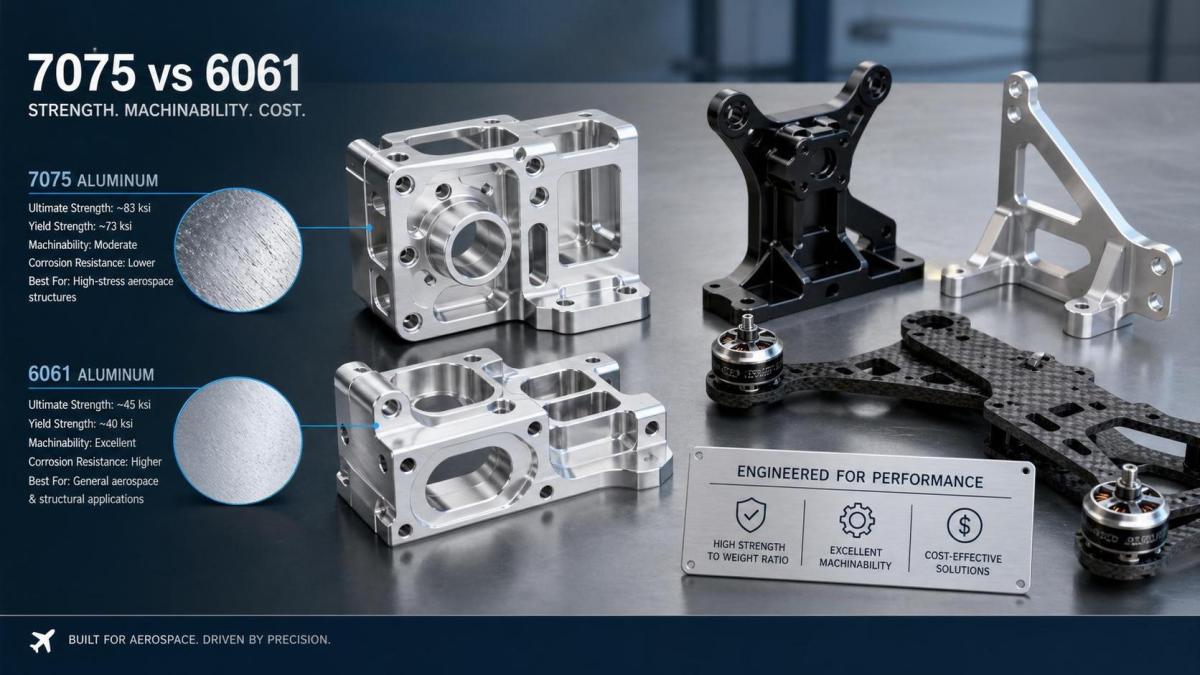
Both are heat-treatable aluminum alloys, but they sit in different performance and cost zones.
6061 is the more general-purpose option.
It offers balanced strength, good corrosion resistance, broad availability, and relatively predictable machining behavior.
7075 is the higher-strength choice.
It is often selected when designers want steel-like mechanical performance at far lower weight, especially in highly stressed structures.
A simplified comparison helps frame the issue:
In short, 6061 buys versatility, while 7075 buys performance margin.
The trade-off is that performance margin is never free.
Strength is important, but not the whole decision
The strongest argument for 7075 is obvious.
Its tensile and yield properties are substantially higher than 6061 in common aerospace tempers.
That can support thinner sections, lower mass, or improved stiffness-to-weight performance in brackets, fittings, and airframe-adjacent structures.
Yet in many real programs, the part is not strength-limited.
It may be limited by geometry, tolerance stack-up, vibration, corrosion exposure, or the economics of volume production.
If the load case leaves substantial reserve in 6061, upgrading to 7075 can add cost without creating measurable system value.
That is a common blind spot in 7075 vs 6061 aerospace use discussions.
Aerospace programs do not benefit from excess material performance that the design never uses.
Where 7075 earns its place
7075 is usually justified when every gram matters and stress levels are high enough to monetize weight reduction.
That includes UAV structural members, heavily loaded fixtures, actuator-related housings, and flight-critical secondary structures.
In those cases, the stronger alloy may reduce section size, simplify the assembly, or preserve fatigue margin.
Where 6061 often wins quietly
6061 tends to perform well in housings, interior support parts, frames, covers, tooling, and components with moderate mechanical demand.
It also fits mixed-priority programs where corrosion resistance, weldability, and supply flexibility matter as much as pure strength.
Machining reality changes the economics
For sourcing decisions, machinability is not just a shop-floor issue.
It directly affects quoting accuracy, yield, delivery confidence, and the amount of supplier process control required.
Both alloys machine well compared with many metals, but they do not behave identically in production.
6061 is more forgiving across a wider range of suppliers.
It usually supports stable cutting, cleaner post-processing decisions, and fewer surprises in lower-complexity parts.
7075 can machine efficiently too, especially in capable aerospace CNC environments.
However, thin-wall features, residual stress, and dimensional stability after aggressive material removal deserve closer attention.
This matters in five-axis machining, where part deformation can turn a strong alloy into an expensive scrap event.
For TSV-style evaluation, the question is practical: which alloy allows the supplier to hit tolerance repeatedly, not once.
- Ask for process capability data on similar geometries, not only generic alloy claims.
- Review stock condition, stress-relief practice, and inspection checkpoints.
- Compare final yield after anodizing, coating, and rework, not just machine time.
Cost extends beyond the price per kilogram
The visible cost gap between 7075 and 6061 is only the first layer.
In aerospace programs, total landed cost includes material sourcing, lot traceability, machining yield, finishing, testing, and documentation overhead.
7075 often carries a premium in raw stock and may introduce additional caution around corrosion management and qualification review.
6061 usually reduces cost pressure through easier availability and broader supplier familiarity.
That does not mean it is automatically cheaper in every finished part.
If 7075 enables significant weight reduction, fewer fasteners, or a smaller assembly envelope, the program-level economics may shift.
This is why 7075 vs 6061 aerospace use should be modeled at part and system levels together.
Typical aerospace use cases by decision logic
The better material decision usually becomes clearer when tied to mission profile.
For commercial UAV platforms, 7075 may support lighter structural members where endurance and payload ratio drive value.
For cabin-adjacent hardware or non-critical mounting structures, 6061 often makes more sense.
Ground support tooling is another important category.
Many tooling applications do not need 7075, even when buyers assume aerospace work requires the highest-strength alloy by default.
That assumption inflates cost and complicates procurement without improving function.
In contrast, compact brackets, load transfer parts, and structural interfaces may justify 7075 when fatigue margin is tight.
The practical lesson in 7075 vs 6061 aerospace use is to classify the part before debating the alloy.
How to evaluate suppliers and specifications
Material selection quality depends on spec quality.
If the drawing, qualification path, and finishing requirements are vague, even the right alloy choice can fail in execution.
A more disciplined review should cover the following points:
- Confirm the governing load case, not just a general structural label.
- Match alloy temper to performance and downstream processing.
- Review corrosion environment, coating compatibility, and maintenance exposure.
- Check whether the part is tolerance-driven, fatigue-driven, or weight-driven.
- Request traceable inspection and machining history for comparable aerospace work.
This approach fits the broader TSV principle that parameters matter more than promotional language.
For 7075 vs 6061 aerospace use, that means fewer assumptions and more benchmarkable evidence.
A useful next step for material selection
The most reliable way to decide between 7075 and 6061 is to build a short decision matrix around load, environment, geometry, finish, and supplier capability.
That keeps alloy selection tied to measurable program outcomes instead of habit or overdesign.
When the numbers show real benefit from higher strength, 7075 deserves serious consideration.
When the design is better served by flexibility, corrosion behavior, and lower process burden, 6061 is often the smarter aerospace choice.
For any serious 7075 vs 6061 aerospace use review, the next move is clear: validate the alloy against the part, the process, and the evidence trail.
Search News
Hot Articles
- Carbon Fiber StructuresHow to Specify Aerospace Carbon Fiber Assemblies for Lightweight, Load-Bearing PartsJul 11, 2026
- Machine VisionXiaomi, Alibaba DAMO Academy Drive Open-Source Robotics Model Ecosystem, Lowering Algorithm Development Barriers for Overseas SMEs Adopting Chinese Robotics SolutionsMar 30, 2026
- Cobots & ArmsShanxi 'AI+' Conference Showcases Embodied Intelligence with Multinational Buyer Engagement: Key Industry ImplicationsMar 30, 2026
Popular Tags
Recommended News
 Jul 11, 2026How to Specify Aerospace Carbon Fiber Assemblies for Lightweight, Load-Bearing PartsAerospace carbon fiber assemblies: learn how to specify laminate design, load data, joining methods, and inspection controls for lighter, reliable load-bearing aerospace parts.Elena Rostova (UAV Systems Researcher)
 Mar 30, 2026Xiaomi, Alibaba DAMO Academy Drive Open-Source Robotics Model Ecosystem, Lowering Algorithm Development Barriers for Overseas SMEs Adopting Chinese Robotics SolutionsXiaomi & Alibaba DAMO Academy's open-source robotics models lower algorithm barriers for global SMEs. Boost efficiency in manufacturing, logistics & smart retail with ROS 2 compatible solutions.TSV Data Lab
 Mar 30, 2026Shanxi 'AI+' Conference Showcases Embodied Intelligence with Multinational Buyer Engagement: Key Industry ImplicationsShanxi 'AI+' Conference highlights embodied intelligence with Tesla, Ubtech & Jiantao showcasing multimodal robotics. 40+ global buyers validated tech on-site, creating new B2B channels for industrial automation & AI solutions.Chen Wei (Automation Lead Engineer)
 Mar 30, 2026Zhongguancun Unveils 6G Integrated Sensing-Computing-Intelligence Platform to Empower Embodied Robots for Global Industrial ApplicationsZhongguancun's new 6G platform revolutionizes industrial robotics with <10ms latency, empowering global automotive, logistics & port automation. Discover how this tech boosts China's smart manufacturing exports.TSV Data Lab
 Mar 30, 2026Mech-Mind Tianjin Embodied Intelligence R&D and Production Base Goes Live, Cutting Delivery Time by 20%–30% for Global Customized AMR+Vision SolutionsMech-Mind's Tianjin AMR+Vision production base cuts delivery time by 20%-30% for欧美 & Latin American markets. Discover how this PLd-certified facility accelerates customized robotics solutions for smart manufacturing and logistics.Chen Wei (Automation Lead Engineer)
 Mar 30, 2026Boao Forum Reveals 'Co-evolution of Big and Small Brains' Trend in Humanoid Robots, China's Embodied Intelligence Accelerates Adaptation to Overseas Manufacturing Service ScenariosDiscover how China's humanoid robots, featuring 'Co-evolution of Big and Small Brains,' are revolutionizing global manufacturing. Learn about Embodied Tian Gong 3.0's ISO compliance and overseas deployment at Boao Forum 2026.Chen Wei (Automation Lead Engineer)
 Mar 30, 2026China Railway Industrial Secures Patent for Embodied Robotics in Material Handling, Boosting High-Precision Delivery Capabilities for Overseas Infrastructure and Manufacturing ProjectsChina Railway Industrial's new patent for embodied robotics in material handling boosts high-precision delivery for global infrastructure & manufacturing. Discover how this innovation enhances logistics accuracy in automotive, rail transit & EPC projects.Chen Wei (Automation Lead Engineer)
 Oct 10, 2026How to Select a Machine Performance Monitoring Platform for OEE and Downtime ReductionMachine performance monitoring platform selection guide: validate machine states, OEE data, downtime reasons, integrations, and scalability to reduce losses with confidence.TSV Data Lab
 Oct 08, 2026How to Machine Inconel 625 Blades Without Heat Cracks or Edge ChippingInconel 625 blade machining guide: prevent heat cracks, edge chipping, chatter, and work hardening with proven tooling, cooling, fixturing, and inspection strategies.Dr. Marcus Vance
 Oct 07, 2026How to Evaluate an HMI Panel Distributor for Industrial Automation ProjectsHMI panel distributor evaluation guide: verify technical compatibility, traceability, supply reliability, lifecycle support, and total cost for automation projects.Victor Lin (Chief Software Architect)
 Oct 06, 2026Navigation Fault Tolerance Standards for AMRs: What Safety Teams Must VerifyNavigation fault tolerance standards: learn what AMR safety teams must verify, from localization loss and sensor faults to stopping distance, safe restart, and site-specific validation.Chen Wei (Automation Lead Engineer)
 Oct 05, 2026Calculating Edge Computing Total Cost of Ownership Across Distributed SitesEdge computing ownership cost explained: calculate deployment, energy, connectivity, security, remote support, and refresh costs across distributed sites.TSV Data Lab
 Oct 04, 2026CAD/CAM Benchmarking in the GCC: What Manufacturers Should Ask a ConsultantCAD CAM benchmark consultant GCC guide: learn the key questions manufacturers should ask to validate post-processors, workflows, machine performance, and production risk.Victor Lin (Chief Software Architect)
 Oct 03, 2026Selecting Automotive Radar Sensor Modules for ADAS Range, Resolution, and IntegrationAutomotive radar sensor module selection guide for ADAS: compare range, resolution, field of view, latency, and integration to build safer, reliable vehicle systems.TSV Data Lab
 Oct 02, 2026How to Qualify Machined Parts Suppliers for Hard Tech ProgramsHard tech supply chain machined parts demand rigorous supplier qualification. Learn how to assess capability, traceability, quality controls, and delivery resilience.Dr. Marcus Vance
 Oct 01, 2026How to Select an Outdoor Security Radar Sensor for Perimeter Detection?Outdoor security radar sensor selection guide: compare range, accuracy, false-alarm control, integration, and field testing for reliable perimeter detection.TSV Data Lab
 Sep 30, 2026How to Evaluate Solid-State LiDAR Hardware for Outdoor Autonomous VehiclesSolid state LiDAR hardware evaluation guide for outdoor autonomous vehicles—compare range, point-cloud quality, environmental resilience, integration, and safety.TSV Data Lab
 Sep 29, 2026ISO 9283 Repeatability: How to Evaluate Cobot Positioning PerformanceISO 9283 cobot repeatability explained: learn how payload, reach, approach direction, and test conditions affect positioning performance and cell capability.Chen Wei (Automation Lead Engineer)
 Oct 10, 2026When does the cost of industrial robots pay back in high-volume production?Cost of industrial robots: discover how high-volume manufacturers calculate payback through uptime, cycle time, labor, quality, and integration before investing.Chen Wei (Automation Lead Engineer)
 Oct 09, 2026What does a manufacturing robot really cost beyond the purchase price?Manufacturing robot cost goes far beyond the purchase price. Explore integration, tooling, safety, uptime, and total ownership factors for smarter automation investments.Chen Wei (Automation Lead Engineer)
 Oct 08, 2026AGV vs. AMR: Which Is Better for Frequently Changing Routes?Which is better for changing routes? Compare AGVs and AMRs for flexible navigation, docking precision, traffic control, and faster facility reconfiguration.Chen Wei (Automation Lead Engineer)
 Oct 07, 2026How Much Does an Automated Guided Vehicle Cost in 2026?How much does an automated guided vehicle cost in 2026? Explore AGV price ranges, hidden deployment costs, and smart buying factors for stronger ROI.Chen Wei (Automation Lead Engineer)
 Oct 06, 2026Are Collaborative Robots Safe Enough to Operate Without Fencing?Are collaborative robots safe enough to work without fencing? Explore risk assessment, safeguarding options, and practical guidance for safer, productive cobot cells.Chen Wei (Automation Lead Engineer)
 Oct 05, 2026What Causes Machine Vision Systems to Miss Small Defects?What causes machine vision systems to miss small defects? Discover how lighting, optics, motion, and AI thresholds affect detection—and prevent costly escapes.TSV Data Lab