Why Medical Device Parts Push 5-Axis CNC Process Limits
Publication Date
author
In medical manufacturing, precision is not a slogan—it is a regulatory, functional, and patient-safety requirement. That is exactly why 5-axis CNC machining for medical devices continues to push process limits, from micron-level tolerances and complex geometries to demanding surface finishes and traceable material control. For project leaders, understanding these limits is essential to reducing qualification risk, shortening development cycles, and selecting suppliers that can deliver engineering truth instead of marketing claims.
For most project managers and engineering leads, the core question is not whether 5-axis machining is advanced. It is whether a supplier can consistently use that capability to produce compliant parts, control variation, and keep a development or transfer program on schedule. Medical parts stretch 5-axis CNC processes because they combine tight tolerances, difficult materials, miniature features, and validation demands that leave little room for process drift.
This article examines why that happens, where the real process limits appear, and how decision-makers can evaluate 5-axis CNC machining for medical devices based on measurable capability rather than generic claims. The practical goal is simple: help you make better sourcing, planning, and risk decisions.
Why medical device parts are fundamentally harder than “normal” precision parts
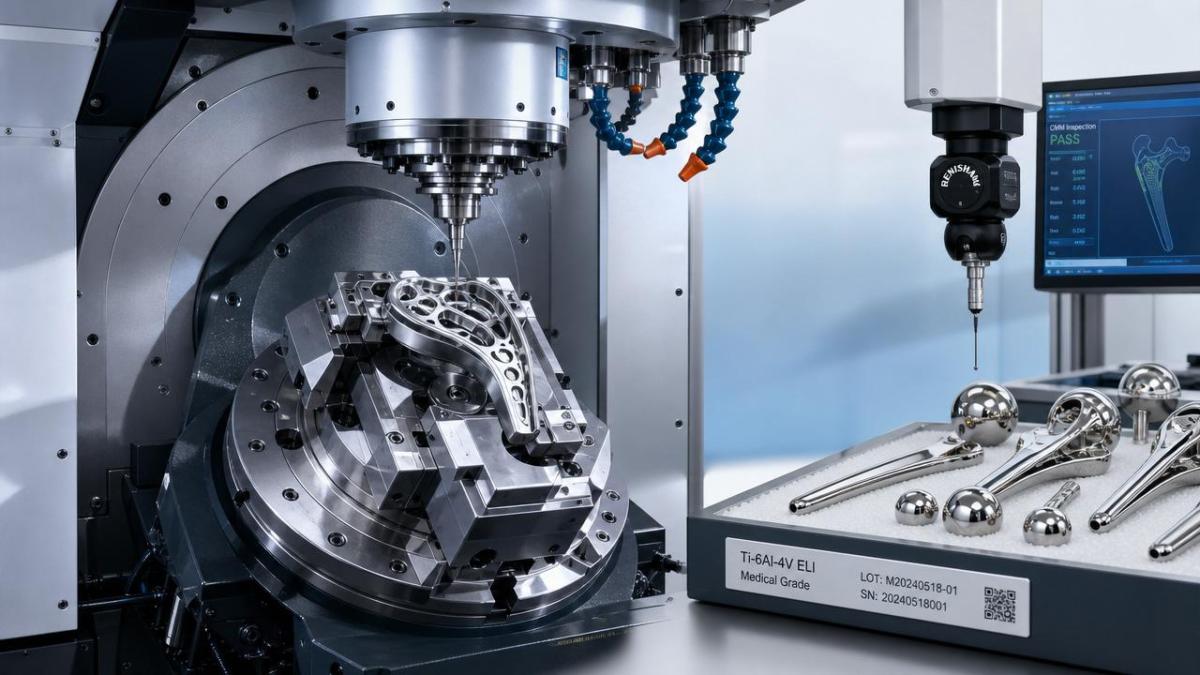
Medical components are often described as high precision, but that phrase alone hides the real challenge. A medical part is rarely judged on dimensional accuracy only. It must also satisfy biocompatibility expectations, traceable material requirements, cleanability, burr control, surface integrity, and in many cases regulatory documentation. That combination pushes machining far beyond standard job-shop complexity.
Consider common categories such as orthopedic implants, surgical instrument components, robotic surgery housings, dental parts, and diagnostic device hardware. Many of these parts include freeform surfaces, tiny internal radii, angled holes, thin walls, or contoured interfaces that are difficult to fixture and harder to inspect. In a 3-axis setup, those geometries may require multiple operations, each adding stack-up error. A 5-axis platform reduces setups, but it also introduces more variables in tool orientation, collision avoidance, thermal stability, and CAM strategy.
From a project perspective, this is why medical work pushes process limits: every dimension matters, but so does everything around the dimension. Surface finish can affect wear, sterilization, fluid interaction, and tissue response. Edge condition can affect assembly safety or surgeon handling. Material certification and lot traceability can determine whether a part is acceptable for validation. The process must therefore be precise, repeatable, and documentable at the same time.
Why 5-axis CNC machining for medical devices is often the only practical route
Many medical parts are manufacturable in theory with simpler methods, but not at the quality, speed, or repeatability required for commercial production. That is where 5-axis CNC machining for medical devices becomes less of a premium option and more of a practical necessity.
The first advantage is access. Simultaneous or indexed 5-axis motion allows the tool to approach complex surfaces from optimal angles. This improves reach into contoured features and reduces the need for awkward extended tools that chatter, deflect, or leave poor finishes. Better tool access also supports shorter cutters, which usually means higher rigidity and more stable cutting conditions.
The second advantage is fewer setups. Every time a part is removed and re-fixtured, the program introduces risk: datum shift, operator variation, clamping distortion, and scheduling delay. Medical parts with six or more critical faces benefit strongly from machining in fewer operations. Reducing setup count is not just about cycle time. It is a direct way to protect geometric relationships and improve first-pass yield.
The third advantage is surface quality on complex forms. Ball-end and tapered tools following optimized 5-axis toolpaths can maintain better contact conditions across curved surfaces than a simpler machine strategy. For implants, surgical components, and high-end instrument bodies, this may reduce hand finishing, preserve geometry, and lower the risk of inconsistent cosmetic or functional outcomes.
However, 5-axis capability alone does not guarantee success. The same flexibility that makes it powerful also makes it easier to hide poor process control behind an impressive machine specification. For project leaders, the right question is not “Do you have 5-axis machines?” It is “Can you demonstrate stable capability on parts with similar geometry, material, and regulatory expectations?”
The real process limits: where medical parts stress the machine, tooling, and process window
When suppliers say a part is challenging, the difficulty usually comes from a small number of technical realities. Understanding them helps non-machining decision-makers ask better questions during supplier evaluation.
One major limit is tolerance accumulation on complex geometry. A flat plane with a modest profile tolerance may be easy to hold. A sculpted surface that must align with other mating features while maintaining contour, thickness, and positional accuracy is much harder. In medical components, these requirements often appear together, forcing tight control of machine kinematics, tool wear, probing accuracy, and workholding repeatability.
Another limit is material behavior. Common medical-grade materials such as titanium alloys, cobalt-chrome, 17-4 PH stainless steel, PEEK, and high-performance polymers behave very differently under the cutter. Titanium can generate heat and accelerate tool wear. Cobalt-chrome is extremely demanding on tooling and can punish unstable parameters. Polymers may move with heat or clamping pressure. Each material narrows the acceptable process window.
Miniaturization is also a serious constraint. As features become smaller, tool diameters shrink, and tool fragility rises. Micro-tools are more sensitive to runout, spindle condition, chip evacuation, and vibration. A process that looks stable at larger scale may fail when a tiny channel, slot, or radius is introduced. In medical manufacturing, miniature features are common in minimally invasive devices, instrument tips, and precision assemblies.
Then there is surface integrity. A supplier may hit dimensional targets while still creating recast-like smearing, burrs, residual stress, or undesirable tool marks. For parts that contact tissue, interface with fluids, or require repeated sterilization, these surface issues can become quality and performance risks. The process limit is therefore not just geometric; it includes the condition of the machined surface itself.
Finally, process stability over time is a hidden limit. Producing five good samples is not the same as sustaining output across lots, operators, tools, and shifts. Project managers should care deeply about this distinction, because qualification success often masks later scaling problems if process capability is not mature.
What project leaders should evaluate beyond the machine specification
If you are responsible for supplier selection, NPI planning, or transfer risk, the machine model is one of the least useful standalone indicators. What matters is the production system around it.
Start with part-family evidence. Ask whether the supplier has made components similar in geometry, material, and tolerance logic, not just similar in industry label. A shop that machines aerospace brackets may still struggle with a tiny medical implant feature set, despite owning advanced equipment. Comparable process history is more meaningful than broad claims of cross-industry capability.
Next, review the manufacturing strategy. How many setups are required? What datums are used? How is distortion controlled? Is in-process probing used to correct variation? How are tools monitored for wear? Mature suppliers can explain the process logic clearly. If the answer relies on generalities like “our operators are very experienced,” that is not enough for high-risk medical work.
Inspection capability is equally critical. The supplier should be able to measure what they machine with confidence. That may include CMM inspection, optical systems, surface roughness measurement, thread verification, and application-specific gauges. For complex freeform parts, ask how profile and positional relationships are validated. If the metrology plan is weak, the machining claim is incomplete.
Material control and documentation should also be scrutinized early. For medical projects, lot traceability, certification flow, revision management, and nonconformance handling are often as important as cycle time. A technically capable shop can still become a program risk if its documentation discipline is poor or its change control is informal.
Lastly, ask for evidence of process capability, not just sample success. This can include first article results, Cp/Cpk on critical dimensions where appropriate, scrap trends, GR&R discipline, and preventive maintenance records for key equipment. You do not need every metric in every situation, but you do need proof that the supplier understands variation as a managed system.
How 5-axis complexity affects timelines, cost, and qualification risk
One reason project leaders search for information on 5-axis CNC machining for medical devices is that these programs often become schedule-sensitive quickly. The difficult truth is that advanced machining can reduce overall program time while still increasing early-stage planning demands.
For example, a well-developed 5-axis process can shorten production lead time by reducing setups, secondary handling, and manual finishing. But before that benefit appears, the supplier may need more CAM programming effort, more simulation, more fixture development, and more process prove-out than with simpler parts. If this work is underestimated, launch schedules slip.
Cost follows a similar pattern. 5-axis machining usually carries higher hourly rates, but that does not automatically mean a higher total part cost. In medical work, the real cost drivers often include yield loss, inspection burden, validation repeats, engineering change delays, and supplier requalification. A more capable 5-axis process may cost more per hour and still deliver lower total landed cost by preventing these downstream failures.
Qualification risk is where the business case becomes clearest. When a part has tight geometric relationships, critical surfaces, or difficult materials, an unstable machining process can trigger repeated FAI failures, drawing interpretation disputes, and production holds. These events are expensive not only in money but also in organizational attention. Engineering, quality, sourcing, and program teams all get pulled into avoidable firefighting.
That is why decision-makers should assess 5-axis suppliers in terms of risk-adjusted delivery, not nominal quote price alone. A cheap quote on a part that requires repeated corrective action is usually the most expensive option in the portfolio.
Common sourcing mistakes when buying medical CNC parts
A frequent mistake is buying on equipment count instead of capability fit. A supplier may advertise multiple 5-axis machines, but if their process engineering, fixturing discipline, and inspection systems are weak, the machine fleet will not protect your program. Medical projects reward controlled execution, not showroom specifications.
Another mistake is accepting tolerance claims without context. A statement such as “we hold ±0.005 mm” sounds impressive, but what feature, in what material, over what geometry, and at what production volume? Capability must be linked to a defined feature set and validated process conditions. Otherwise, the number has little decision value.
Some teams also underestimate DFM collaboration. Medical components are often designed around functional and regulatory priorities, not machining efficiency. That is understandable, but small geometry changes can dramatically improve manufacturability without changing function. Early supplier input on corner radii, tool access, stock condition, and datum logic can reduce both cost and schedule risk.
A fourth mistake is treating prototype success as evidence of production readiness. Prototype lots may receive extra attention, slower feeds, more manual inspection, and selective tool changes that are not sustainable in routine manufacturing. Project leaders should distinguish between “can make” and “can repeatedly make at scale under controlled conditions.”
A practical checklist for evaluating a 5-axis medical machining partner
For teams that need a clearer screening framework, a structured checklist is more useful than general vendor presentations. Start with these questions.
Can the supplier show proven experience with similar medical-grade materials and comparable geometries? Can they explain the number of setups, datum strategy, and expected variation risks? Do they use process simulation and in-process verification to reduce collision and alignment errors? Can they demonstrate metrology alignment with the drawing’s critical features?
Also ask whether the supplier supports formal quality systems relevant to your program, such as ISO 13485-aligned controls where applicable, and whether documentation packages match your submission needs. Review how nonconformances are escalated, how revisions are controlled, and how lot traceability is maintained from raw material through shipment.
On the commercial side, ask what assumptions are built into the quote. Does pricing include fixture development, programming, validation support, or special inspection? Are long-lead tools or specialty materials part of the timeline? Many sourcing misunderstandings come from hidden scope rather than machining difficulty alone.
The best partners answer these questions with specifics. They do not need to sound promotional. In fact, technically mature suppliers tend to be careful and precise, especially when discussing tolerances, process windows, and production risks. That is usually a good sign.
Conclusion: process limits are not the problem—unknown limits are
Medical device parts push 5-axis CNC process limits because they combine exacting geometry, difficult materials, strict surface expectations, and uncompromising traceability. For project managers and engineering leaders, that does not mean these parts are unmanageable. It means supplier evaluation must be grounded in process evidence, not marketing language.
The strategic value of 5-axis CNC machining for medical devices lies in its ability to reduce setups, improve access, protect geometric relationships, and support complex surfaces. But those benefits only translate into business results when backed by disciplined programming, fixturing, metrology, material control, and repeatable quality systems.
If your team is planning a new medical program, a transfer, or a supplier qualification, the right mindset is simple: define the critical risks, ask for part-specific proof, and evaluate capability as a system. In medical manufacturing, engineering truth is rarely found in broad claims. It is found in the data behind tolerance, repeatability, and control.
Search News
Hot Articles
- Carbon Fiber StructuresHow to Specify Aerospace Carbon Fiber Assemblies for Lightweight, Load-Bearing PartsJul 11, 2026
- Machine VisionXiaomi, Alibaba DAMO Academy Drive Open-Source Robotics Model Ecosystem, Lowering Algorithm Development Barriers for Overseas SMEs Adopting Chinese Robotics SolutionsMar 30, 2026
- Cobots & ArmsShanxi 'AI+' Conference Showcases Embodied Intelligence with Multinational Buyer Engagement: Key Industry ImplicationsMar 30, 2026
Popular Tags
Recommended News
 Jul 11, 2026How to Specify Aerospace Carbon Fiber Assemblies for Lightweight, Load-Bearing PartsAerospace carbon fiber assemblies: learn how to specify laminate design, load data, joining methods, and inspection controls for lighter, reliable load-bearing aerospace parts.Elena Rostova (UAV Systems Researcher)
 Mar 30, 2026Xiaomi, Alibaba DAMO Academy Drive Open-Source Robotics Model Ecosystem, Lowering Algorithm Development Barriers for Overseas SMEs Adopting Chinese Robotics SolutionsXiaomi & Alibaba DAMO Academy's open-source robotics models lower algorithm barriers for global SMEs. Boost efficiency in manufacturing, logistics & smart retail with ROS 2 compatible solutions.TSV Data Lab
 Mar 30, 2026Shanxi 'AI+' Conference Showcases Embodied Intelligence with Multinational Buyer Engagement: Key Industry ImplicationsShanxi 'AI+' Conference highlights embodied intelligence with Tesla, Ubtech & Jiantao showcasing multimodal robotics. 40+ global buyers validated tech on-site, creating new B2B channels for industrial automation & AI solutions.Chen Wei (Automation Lead Engineer)
 Mar 30, 2026Zhongguancun Unveils 6G Integrated Sensing-Computing-Intelligence Platform to Empower Embodied Robots for Global Industrial ApplicationsZhongguancun's new 6G platform revolutionizes industrial robotics with <10ms latency, empowering global automotive, logistics & port automation. Discover how this tech boosts China's smart manufacturing exports.TSV Data Lab
 Mar 30, 2026Mech-Mind Tianjin Embodied Intelligence R&D and Production Base Goes Live, Cutting Delivery Time by 20%–30% for Global Customized AMR+Vision SolutionsMech-Mind's Tianjin AMR+Vision production base cuts delivery time by 20%-30% for欧美 & Latin American markets. Discover how this PLd-certified facility accelerates customized robotics solutions for smart manufacturing and logistics.Chen Wei (Automation Lead Engineer)
 Mar 30, 2026Boao Forum Reveals 'Co-evolution of Big and Small Brains' Trend in Humanoid Robots, China's Embodied Intelligence Accelerates Adaptation to Overseas Manufacturing Service ScenariosDiscover how China's humanoid robots, featuring 'Co-evolution of Big and Small Brains,' are revolutionizing global manufacturing. Learn about Embodied Tian Gong 3.0's ISO compliance and overseas deployment at Boao Forum 2026.Chen Wei (Automation Lead Engineer)
 Mar 30, 2026China Railway Industrial Secures Patent for Embodied Robotics in Material Handling, Boosting High-Precision Delivery Capabilities for Overseas Infrastructure and Manufacturing ProjectsChina Railway Industrial's new patent for embodied robotics in material handling boosts high-precision delivery for global infrastructure & manufacturing. Discover how this innovation enhances logistics accuracy in automotive, rail transit & EPC projects.Chen Wei (Automation Lead Engineer)
 Sep 28, 2026Spindle Runout Measurement in Germany: DIN Standards, Methods, and Acceptance LimitsSpindle runout measurement Germany: explore DIN standards, proven methods, acceptance limits, and audit-ready practices for reliable machining quality.Dr. Marcus Vance
 Sep 27, 2026How to Select Wall-Mount Edge Devices for Space-Constrained Factory NetworksWall mount edge devices for space-constrained factories: evaluate workload, thermal design, power resilience, cable access, and network reliability for smarter deployments.TSV Data Lab
 Sep 26, 2026Machining Tolerance Analysis: How to Set Limits That Meet Function and Cost TargetsMachining tolerance analysis: learn how to set functional limits, control tolerance stacks, reduce inspection risk, and balance precision with production cost.Dr. Marcus Vance
 Sep 25, 2026How to Evaluate an Industrial Infrastructure Data Platform for Multi-Site OperationsIndustrial infrastructure data platform evaluation guide for multi-site operations: compare data quality, edge resilience, interoperability, governance, and scalable proof-of-value criteria.Victor Lin (Chief Software Architect)
 Sep 24, 2026How to Select Machine Vision Optics for Accurate Inspection at Different Working DistancesMachine vision optics selection guide for accurate inspection at every working distance. Compare FOV, pixel scale, DOF, distortion, lighting, and telecentric options.TSV Data Lab
 Sep 23, 2026How to Evaluate a Machine Vision System Integrator for High-Speed Inspection LinesChoose a machine vision system integrator with proven expertise in high-speed inspection, reliable reject timing, robust optics, and measurable acceptance criteria.TSV Data Lab
 Sep 28, 2026When is a SCADA API the right choice for connecting plant systems?SCADA API guide: learn when governed plant data integration improves traceability, security, and scalability—without compromising real-time control.Victor Lin (Chief Software Architect)
 Sep 27, 2026How SCADA data integration improves traceability across production linesSCADA data integration connects production-line data to improve traceability, accelerate quality investigations, and strengthen safety decisions.Victor Lin (Chief Software Architect)
 Sep 26, 2026What to define before starting SCADA integration planningSCADA integration planning starts with clear scope, control boundaries, data models, cybersecurity, and testing. Discover the definitions that reduce risk and costly rework.Victor Lin (Chief Software Architect)
 Sep 25, 2026How a smart factory with Industrial IoT reduces production blind spotsDiscover how a smart factory with Industrial IoT turns real-time machine, quality, and workflow data into actionable insights that reduce production blind spots and delivery risks.Victor Lin (Chief Software Architect)
 Sep 24, 2026When does Industrial IoT make smart manufacturing easier to scale?Smart manufacturing Industrial IoT scales when trusted data, interoperable systems, and secure workflows turn connected assets into measurable gains.TSV Data Lab
 Sep 23, 2026What drives ultra-precision machining cost at 1-micron tolerance?Ultra precision machining cost per part at 1 micron tolerance depends on process, material, metrology, and yield. Learn how to compare quotes confidently.Dr. Marcus Vance
 Sep 22, 2026Drone Engine-T550CC Applications: Build the UAV Power System Around the MissionAn application guide for Drone Engine-T550CC integration, covering payload planning, airframe matching, cooling, fuel, vibration, test procedures, documentation, and service preparation.Elena Rostova (UAV Systems Researcher)
 Sep 22, 2026How to Evaluate Industrial Edge Computing Vendors for Factory DeploymentIndustrial edge computing vendor evaluation guide for factories: compare latency, protocol fit, reliability, security, and lifecycle support before deployment.TSV Data Lab
 Sep 21, 2026Drone Payload Integration: Matching Power, Data, and Center of Gravity for Reliable FlightsDrone payload integration made practical: balance power, data, center of gravity, and endurance to build safer, more reliable mission-ready flights.Elena Rostova (UAV Systems Researcher)
 Sep 20, 2026Autonomous Navigation Pricing: Cost Drivers and Budget Benchmarks for AMR ProjectsAutonomous navigation price explained: compare AMR cost drivers, software, sensors, integration, safety, and lifecycle budgets to build a scalable project plan.Chen Wei (Automation Lead Engineer)
 Sep 19, 2026How to Scope Automation Integration Services for Multi-System Factory ProjectsAutomation integration services: learn how to scope multi-system factory projects with clear workflows, interface contracts, safety boundaries, and acceptance criteria.Victor Lin (Chief Software Architect)