PLC vs PAC performance comparison for lines with constant changeovers
Publication Date
author
For project managers overseeing production lines with frequent product switches, a clear plc vs pac performance comparison is essential to balancing flexibility, downtime, and long-term cost. This article examines how each control architecture performs under constant changeovers, helping decision-makers align engineering reality with throughput targets, integration demands, and scalable automation planning.
For lines with constant changeovers, the real question is not “which is better,” but “which reduces disruption at acceptable cost”

On production lines that switch recipes, formats, SKUs, tooling, or inspection logic several times per shift, control performance is measured less by theoretical scan speed alone and more by how quickly the line can recover, reconfigure, and run stably after every change. That is why a practical plc vs pac performance comparison must focus on changeover behavior, not just controller category labels.
In general, a traditional PLC is often the stronger fit when the process is deterministic, the machine sequence is well defined, and changeovers are limited to a manageable set of known states. A PAC becomes more attractive when changeovers affect multiple subsystems at once, require heavier data handling, involve frequent recipe variation, or must integrate vision, motion, traceability, and higher-level software without adding excessive engineering complexity.
For project managers, the takeaway is straightforward: if changeovers are constant and growing in complexity, PAC-based architectures usually provide better long-term operational flexibility. If changeovers are frequent but structurally simple, a well-designed PLC solution can still deliver better value with lower initial cost and lower maintenance burden.
The right decision depends on four factors: how often the line changes, how many variables change each time, how much coordination is required across devices, and how expensive downtime is to the business. Those factors matter more than vendor marketing claims about “smart manufacturing readiness.”
What project managers actually need from a control platform during frequent changeovers
Engineering teams may compare instruction sets, scan cycles, and software environments. Project managers usually care about a different performance layer: how the control platform affects schedule risk, throughput loss, commissioning effort, operator error, and future expansion. Those are the metrics that turn a control decision into a business outcome.
On a high-mix line, every changeover creates opportunity for delay. Parameters may need to be loaded, servo positions adjusted, HMI prompts updated, inspection thresholds changed, and downstream systems informed. If this process is fragile, even a technically capable machine will underperform. The controller architecture must therefore support repeatable, low-friction transitions between product states.
Most project leaders also care about maintainability under real staffing conditions. A platform may be powerful, but if troubleshooting requires niche software expertise that the plant cannot support across shifts, that power becomes a risk. In practice, the best control platform is one that can be understood, supported, and scaled by the organization that owns it.
This is where many evaluations fail. Buyers compare hardware capability in isolation, but the true issue is control-system behavior across the full lifecycle: programming, integration, recipe governance, diagnostics, supportability, and future modifications. In a line with constant changeovers, lifecycle behavior is performance.
PLC performance in constant-changeover environments: where it excels and where it starts to strain
A PLC remains highly effective for many discrete manufacturing applications, especially where machine logic is repeatable and timing requirements are strict. PLCs are proven, robust, and familiar to maintenance teams. They are often easier to standardize across plants, and in many organizations they fit existing electrical design conventions, spare parts strategy, and technician skill sets.
In frequent changeover scenarios, a PLC performs well when product variation is constrained. For example, if each SKU change mainly involves selecting predefined recipes, adjusting a limited number of machine setpoints, and sequencing familiar tooling actions, a PLC can manage this reliably. Changeovers can be fast if the software is structured well, the HMI is clear, and interlocks are designed around repeatable transitions.
PLCs also tend to be advantageous where uptime discipline matters more than advanced orchestration. Many project managers prefer PLC-based designs because they reduce perceived implementation risk. The platform is mature, service teams know it, and machine builders can commission it quickly. This lowers short-term project uncertainty, particularly in brownfield environments where the rest of the plant already runs on PLC-centric architecture.
However, PLCs can become strained when frequent changeovers trigger wider system complexity. If a line must manage large recipe structures, coordinate multiple servo axes, connect vision systems, log high volumes of traceability data, and exchange contextual data with MES or ERP layers, engineering the system entirely in a traditional PLC style may become cumbersome. The issue is not that a PLC cannot do it, but that it may do so with more custom logic, more fragmented integration, and more maintenance overhead.
That strain often appears during expansion. The first few changeover modes are manageable. By the time the plant adds more product variants, more sensors, more exception handling, and more reporting requirements, software complexity rises sharply. For a project manager, that means future modifications may take longer, validation may become harder, and downtime due to edge cases may increase.
PAC performance in constant-changeover environments: why flexibility often improves, but simplicity may decline
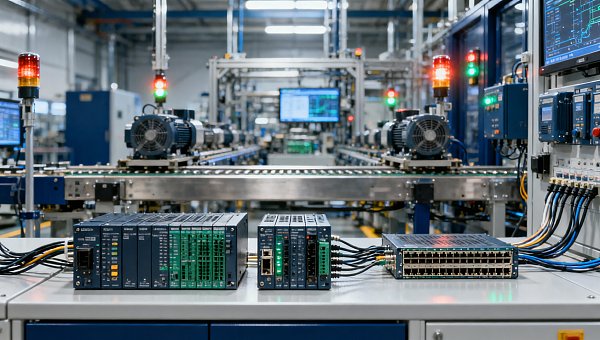
A PAC is generally positioned between traditional control and more software-centric automation needs. In a practical plc vs pac performance comparison, PACs stand out when the line must handle more data, more modular logic, and more coordinated subsystems without turning every feature addition into a custom engineering project.
On lines with constant changeovers, this often matters because every product switch affects not only machine logic but also recipe structures, motion profiles, inspection criteria, communication with drives, and production reporting. A PAC architecture can make these interactions easier to organize, particularly when the project requires tag-rich programming, modular software design, integrated motion, and stronger interoperability with external systems.
PACs also tend to support better scalability for high-mix manufacturing. If the business expects increasing SKU proliferation, shorter product lifecycles, more adaptive machine behavior, or tighter digital integration, PACs usually age better. They allow engineering teams to add logic layers and data functions without forcing the system into awkward workarounds.
That said, a PAC is not automatically the better choice. More flexibility can introduce more system design responsibility. The software environment may be broader, the architecture may require stronger standards discipline, and the troubleshooting process may demand a higher skill level from controls engineers. If the plant lacks that support structure, the PAC’s advantages can be underused while complexity costs remain very real.
For project managers, the key is to separate capability from usable capability. A PAC may offer a stronger technical path for frequent changeovers, but only if the integrator, OEM, and end-user team can manage the architecture consistently over time.
The most important performance criteria in a plc vs pac performance comparison
When evaluating controllers for constant-changeover lines, project managers should avoid broad claims and compare a small set of operational metrics that directly affect output and risk.
1. Changeover execution time. Measure how long the line takes to complete a controlled transition from one product state to another. Include recipe loading, axis repositioning, I/O validation, HMI confirmation, and restart. PACs may reduce this time when the transition logic is multi-layered. PLCs can match or exceed PAC performance when transitions are simpler and tightly engineered.
2. Recovery from abnormal transitions. Many losses happen not during ideal changeovers but during failed ones. Which platform makes it easier to detect incomplete parameter loads, tooling mismatch, device communication faults, or operator sequence errors? Better diagnostics often matter more than nominal speed.
3. Recipe and version management. If the line runs many variants, recipe structure becomes central. PAC-based systems often handle larger and more complex recipe sets more elegantly. PLC-based systems may remain sufficient for smaller or more fixed product families.
4. Coordination across subsystems. If every changeover affects conveyors, robots, drives, inspection devices, barcode systems, and plant software, coordination quality matters. PACs often offer architectural advantages here. For isolated machine cells, PLCs may still be the cleaner choice.
5. Engineering effort for future changes. Ask how much time it takes to add one new SKU, one new inspection path, or one new motion profile. This is one of the most revealing indicators of long-term fit. A low initial hardware price can be offset quickly by expensive software changes later.
6. Supportability at the plant level. Which platform can your team troubleshoot at 2 a.m. during a production stop? That answer should carry real weight. The best architecture on paper can fail commercially if plant support is weak.
Where the cost difference really shows up: not only in hardware, but in downtime, engineering hours, and expansion
Many teams begin the plc vs pac performance comparison by looking at acquisition cost. That is understandable, but incomplete. For constant-changeover lines, the larger cost gap often appears later in the form of change implementation effort, debugging time, line stoppages, and rework during scale-up.
A PLC solution may carry lower upfront hardware and programming cost, especially when the machine concept is stable. If the line will remain within a narrow operating envelope for years, that can be the best financial choice. Simpler architecture often means faster procurement, faster FAT, and easier maintenance handover.
A PAC solution may cost more initially, but this premium can be justified if the business model involves recurring product introductions, customer-specific configurations, or regular process revisions. In those cases, flexibility is not a luxury. It is a cost-control mechanism. Reducing future software refactoring, shortening change implementation time, and preventing integration bottlenecks can create a stronger total cost position over the lifecycle.
Project managers should therefore quantify the cost of one hour of downtime, one engineering day of revalidation, and one delayed product introduction. Once these figures are visible, the controller decision becomes less abstract. In many high-mix operations, the economic argument for PACs emerges from avoided operational friction rather than raw controller performance.
Best-fit scenarios: when to choose PLC and when to choose PAC
Choose a PLC when: the line is discrete and deterministic, changeovers are frequent but involve limited parameter variation, plant maintenance teams are strongly PLC-centric, integration with higher-level systems is modest, and capital discipline outweighs the need for future functional expansion.
Choose a PAC when: changeovers alter multiple machine behaviors simultaneously, recipe complexity is high, motion and data layers are tightly coupled, traceability and external system integration are important, and the business expects product variety to increase over time.
There is also a middle ground. Some organizations use PLC-based control for core machine sequencing while assigning higher-level coordination, recipe orchestration, or analytics to more capable control layers. This hybrid approach can work well if interfaces are clearly defined and lifecycle ownership is not fragmented.
What should be avoided is selecting a controller based on terminology alone. In the market, PLC and PAC labels can overlap depending on vendor positioning. Project managers should examine actual capability, architecture, programming model, support ecosystem, and long-term change cost instead of relying on category branding.
A practical decision framework for project managers evaluating changeover-heavy lines
First, map the changeover event in detail. Identify everything that changes during a SKU switch: machine logic, motion parameters, inspection settings, material handling, user prompts, labels, data logging, and system-to-system communication. This reveals the real control burden.
Second, count how often changes occur and how likely that frequency is to increase. A line that changes six times per day today may change twenty times per day after product mix expansion. Controller decisions should reflect the future operating model, not only current output.
Third, evaluate software maintainability. Ask integrators to demonstrate how a new product variant would be added, tested, and deployed. This is often more informative than a generic feature list. A platform that looks efficient in a presentation may prove cumbersome in a real change request.
Fourth, test fault recovery. Simulate interrupted or incorrect changeovers and assess operator guidance, alarm granularity, and restart logic. Stable recovery is one of the clearest indicators of production readiness in high-change environments.
Finally, calculate total lifecycle impact. Include initial controls cost, engineering development, training, expected modification work, and downtime exposure. The strongest choice is the one that preserves throughput while keeping future change manageable.
Conclusion: the best plc vs pac performance comparison is the one tied to changeover reality
For project managers responsible for output, deadlines, and automation ROI, the most useful plc vs pac performance comparison is grounded in operational behavior under frequent product change. A PLC is often the right answer for structured, repeatable, and relatively bounded changeovers. A PAC is often the stronger long-term answer when changeovers are data-rich, system-wide, and expected to grow in complexity.
The decision should not be driven by buzzwords or by a generic preference for old versus new control platforms. It should be driven by measurable factors: transition time, fault recovery, engineering effort, integration depth, supportability, and lifecycle cost.
If your line changes constantly, control flexibility is not an abstract technical feature. It directly affects downtime, staffing pressure, schedule reliability, and the economics of future product variation. Choose the architecture that your operation can sustain, expand, and troubleshoot with confidence. That is where engineering truth becomes project value.
Search News
Hot Articles
- Carbon Fiber StructuresHow to Specify Aerospace Carbon Fiber Assemblies for Lightweight, Load-Bearing PartsJul 11, 2026
- Machine VisionXiaomi, Alibaba DAMO Academy Drive Open-Source Robotics Model Ecosystem, Lowering Algorithm Development Barriers for Overseas SMEs Adopting Chinese Robotics SolutionsMar 30, 2026
- Cobots & ArmsShanxi 'AI+' Conference Showcases Embodied Intelligence with Multinational Buyer Engagement: Key Industry ImplicationsMar 30, 2026
Popular Tags
Recommended News
 Jul 11, 2026How to Specify Aerospace Carbon Fiber Assemblies for Lightweight, Load-Bearing PartsAerospace carbon fiber assemblies: learn how to specify laminate design, load data, joining methods, and inspection controls for lighter, reliable load-bearing aerospace parts.Elena Rostova (UAV Systems Researcher)
 Mar 30, 2026Xiaomi, Alibaba DAMO Academy Drive Open-Source Robotics Model Ecosystem, Lowering Algorithm Development Barriers for Overseas SMEs Adopting Chinese Robotics SolutionsXiaomi & Alibaba DAMO Academy's open-source robotics models lower algorithm barriers for global SMEs. Boost efficiency in manufacturing, logistics & smart retail with ROS 2 compatible solutions.TSV Data Lab
 Mar 30, 2026Shanxi 'AI+' Conference Showcases Embodied Intelligence with Multinational Buyer Engagement: Key Industry ImplicationsShanxi 'AI+' Conference highlights embodied intelligence with Tesla, Ubtech & Jiantao showcasing multimodal robotics. 40+ global buyers validated tech on-site, creating new B2B channels for industrial automation & AI solutions.Chen Wei (Automation Lead Engineer)
 Mar 30, 2026Zhongguancun Unveils 6G Integrated Sensing-Computing-Intelligence Platform to Empower Embodied Robots for Global Industrial ApplicationsZhongguancun's new 6G platform revolutionizes industrial robotics with <10ms latency, empowering global automotive, logistics & port automation. Discover how this tech boosts China's smart manufacturing exports.TSV Data Lab
 Mar 30, 2026Mech-Mind Tianjin Embodied Intelligence R&D and Production Base Goes Live, Cutting Delivery Time by 20%–30% for Global Customized AMR+Vision SolutionsMech-Mind's Tianjin AMR+Vision production base cuts delivery time by 20%-30% for欧美 & Latin American markets. Discover how this PLd-certified facility accelerates customized robotics solutions for smart manufacturing and logistics.Chen Wei (Automation Lead Engineer)
 Mar 30, 2026Boao Forum Reveals 'Co-evolution of Big and Small Brains' Trend in Humanoid Robots, China's Embodied Intelligence Accelerates Adaptation to Overseas Manufacturing Service ScenariosDiscover how China's humanoid robots, featuring 'Co-evolution of Big and Small Brains,' are revolutionizing global manufacturing. Learn about Embodied Tian Gong 3.0's ISO compliance and overseas deployment at Boao Forum 2026.Chen Wei (Automation Lead Engineer)
 Mar 30, 2026China Railway Industrial Secures Patent for Embodied Robotics in Material Handling, Boosting High-Precision Delivery Capabilities for Overseas Infrastructure and Manufacturing ProjectsChina Railway Industrial's new patent for embodied robotics in material handling boosts high-precision delivery for global infrastructure & manufacturing. Discover how this innovation enhances logistics accuracy in automotive, rail transit & EPC projects.Chen Wei (Automation Lead Engineer)
 Sep 28, 2026Spindle Runout Measurement in Germany: DIN Standards, Methods, and Acceptance LimitsSpindle runout measurement Germany: explore DIN standards, proven methods, acceptance limits, and audit-ready practices for reliable machining quality.Dr. Marcus Vance
 Sep 27, 2026How to Select Wall-Mount Edge Devices for Space-Constrained Factory NetworksWall mount edge devices for space-constrained factories: evaluate workload, thermal design, power resilience, cable access, and network reliability for smarter deployments.TSV Data Lab
 Sep 26, 2026Machining Tolerance Analysis: How to Set Limits That Meet Function and Cost TargetsMachining tolerance analysis: learn how to set functional limits, control tolerance stacks, reduce inspection risk, and balance precision with production cost.Dr. Marcus Vance
 Sep 25, 2026How to Evaluate an Industrial Infrastructure Data Platform for Multi-Site OperationsIndustrial infrastructure data platform evaluation guide for multi-site operations: compare data quality, edge resilience, interoperability, governance, and scalable proof-of-value criteria.Victor Lin (Chief Software Architect)
 Sep 24, 2026How to Select Machine Vision Optics for Accurate Inspection at Different Working DistancesMachine vision optics selection guide for accurate inspection at every working distance. Compare FOV, pixel scale, DOF, distortion, lighting, and telecentric options.TSV Data Lab
 Sep 23, 2026How to Evaluate a Machine Vision System Integrator for High-Speed Inspection LinesChoose a machine vision system integrator with proven expertise in high-speed inspection, reliable reject timing, robust optics, and measurable acceptance criteria.TSV Data Lab
 Sep 28, 2026When is a SCADA API the right choice for connecting plant systems?SCADA API guide: learn when governed plant data integration improves traceability, security, and scalability—without compromising real-time control.Victor Lin (Chief Software Architect)
 Sep 27, 2026How SCADA data integration improves traceability across production linesSCADA data integration connects production-line data to improve traceability, accelerate quality investigations, and strengthen safety decisions.Victor Lin (Chief Software Architect)
 Sep 26, 2026What to define before starting SCADA integration planningSCADA integration planning starts with clear scope, control boundaries, data models, cybersecurity, and testing. Discover the definitions that reduce risk and costly rework.Victor Lin (Chief Software Architect)
 Sep 25, 2026How a smart factory with Industrial IoT reduces production blind spotsDiscover how a smart factory with Industrial IoT turns real-time machine, quality, and workflow data into actionable insights that reduce production blind spots and delivery risks.Victor Lin (Chief Software Architect)
 Sep 24, 2026When does Industrial IoT make smart manufacturing easier to scale?Smart manufacturing Industrial IoT scales when trusted data, interoperable systems, and secure workflows turn connected assets into measurable gains.TSV Data Lab
 Sep 23, 2026What drives ultra-precision machining cost at 1-micron tolerance?Ultra precision machining cost per part at 1 micron tolerance depends on process, material, metrology, and yield. Learn how to compare quotes confidently.Dr. Marcus Vance
 Sep 22, 2026Drone Engine-T550CC Applications: Build the UAV Power System Around the MissionAn application guide for Drone Engine-T550CC integration, covering payload planning, airframe matching, cooling, fuel, vibration, test procedures, documentation, and service preparation.Elena Rostova (UAV Systems Researcher)
 Sep 22, 2026How to Evaluate Industrial Edge Computing Vendors for Factory DeploymentIndustrial edge computing vendor evaluation guide for factories: compare latency, protocol fit, reliability, security, and lifecycle support before deployment.TSV Data Lab
 Sep 21, 2026Drone Payload Integration: Matching Power, Data, and Center of Gravity for Reliable FlightsDrone payload integration made practical: balance power, data, center of gravity, and endurance to build safer, more reliable mission-ready flights.Elena Rostova (UAV Systems Researcher)
 Sep 20, 2026Autonomous Navigation Pricing: Cost Drivers and Budget Benchmarks for AMR ProjectsAutonomous navigation price explained: compare AMR cost drivers, software, sensors, integration, safety, and lifecycle budgets to build a scalable project plan.Chen Wei (Automation Lead Engineer)
 Sep 19, 2026How to Scope Automation Integration Services for Multi-System Factory ProjectsAutomation integration services: learn how to scope multi-system factory projects with clear workflows, interface contracts, safety boundaries, and acceptance criteria.Victor Lin (Chief Software Architect)