Profinet vs Ethernet IP speed: the lab result is not the factory result
Publication Date
author
When engineers compare profinet vs ethernet/ip speed, the lab result is often only the starting point—not the decision point. In real factories, jitter, controller scan behavior, topology, device load, and fault recovery can reshape performance far beyond brochure claims. This article examines why benchmark numbers diverge from production reality and what technical evaluators should measure before choosing an industrial network.
Why a checklist is the right way to judge profinet vs ethernet/ip speed
For technical evaluators, the biggest mistake in profinet vs ethernet/ip speed analysis is treating network speed as a single number. A vendor may cite update rate, raw bandwidth, or protocol efficiency, but plant performance depends on a chain of interacting variables. One fast benchmark can hide slow device response, overloaded switch paths, uneven controller scheduling, or unstable recovery after a fault. That is why a checklist-based method is more reliable than a headline comparison.
In practice, factories do not buy packets per second. They buy deterministic machine behavior, stable control loops, acceptable alarm response, maintainable topology, and predictable restart behavior. In other words, the useful question is not “Which protocol is faster in a lab?” but “Which architecture delivers the needed motion, I/O, diagnostics, and recovery performance under my real constraints?”
Start with these five decision anchors before comparing speed claims
- Define the control task first. High-speed motion synchronization, standard discrete I/O, process skids, and machine-to-machine data exchange do not stress a network in the same way.
- Separate bandwidth from determinism. Two systems can use the same physical Ethernet rate but produce very different timing behavior.
- Measure end-to-end performance, not protocol overhead alone. Include controller cycle, device processing, switch latency, and HMI or SCADA traffic.
- Test under load. A nearly idle line may make profinet vs ethernet/ip speed look similar, while a busy line with diagnostics, vision traffic, and alarms exposes major differences.
- Include failure conditions. Recovery time after cable pulls, device replacement, or power cycling can matter more than nominal update speed.
The core evaluation checklist for profinet vs ethernet/ip speed
Use the following checks as a practical framework. This is the minimum set a serious evaluation team should review before selecting an industrial network.
1. Check application class and timing target
First confirm whether the machine requires standard cyclic I/O, coordinated motion, safety messaging, or mixed traffic with large diagnostic data sets. A packaging line with synchronized axes has a different timing profile than a water treatment skid. In profinet vs ethernet/ip speed comparisons, this distinction changes everything because determinism requirements drive the acceptable jitter window. A protocol that looks adequate for discrete sensors may be unacceptable for tightly synchronized drives.
2. Measure update time together with jitter
Average cycle time is not enough. If one network delivers fast average updates but wide jitter under load, control quality can degrade. Technical evaluators should ask for minimum, average, maximum, and 99th percentile timing. This is especially important when comparing profinet vs ethernet/ip speed in multi-axis systems, where timing consistency often matters more than an isolated best-case figure.
3. Inspect controller scan behavior and task scheduling
Network performance is inseparable from the PLC or PAC architecture. Controller task priority, scan segmentation, communication servicing, and motion task scheduling all shape real throughput. Many lab reports compare protocol stacks in isolation, but factories run actual applications with logic, alarms, trending, recipe handling, and remote access. In a realistic profinet vs ethernet/ip speed evaluation, controller behavior must be logged alongside network timing.
4. Map the topology, not just the protocol
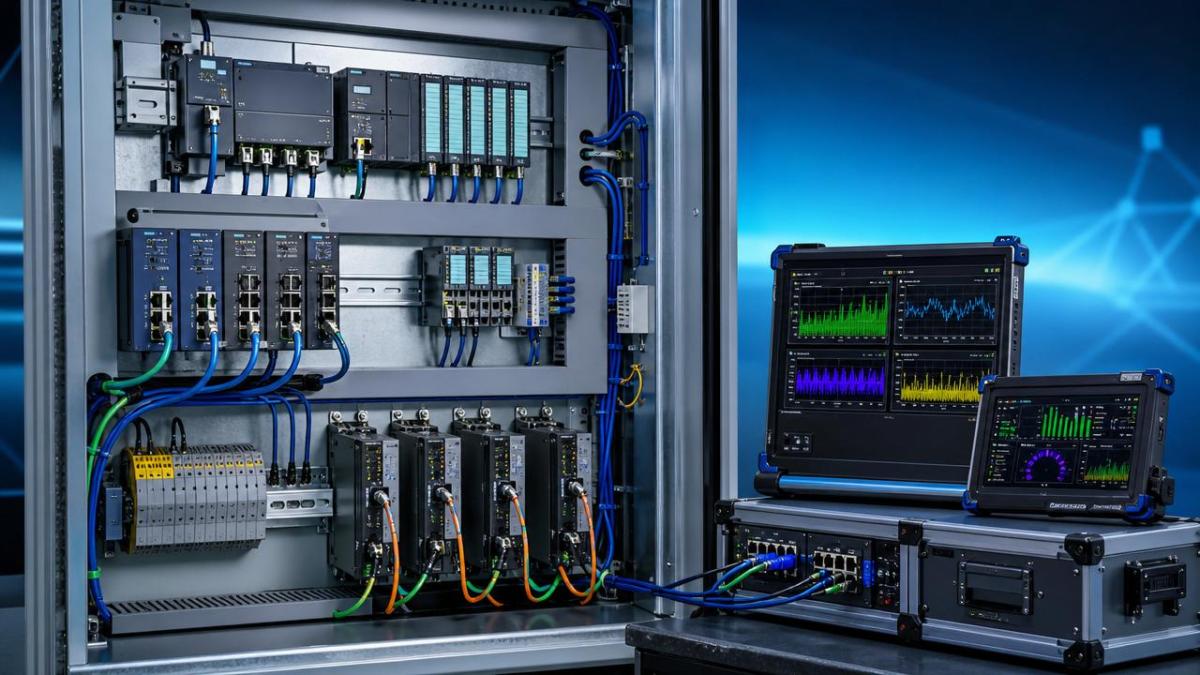
Line, star, ring, and segmented architectures produce different latency and resilience characteristics. Managed switch features, store-and-forward behavior, port loading, uplink oversubscription, and VLAN design all influence speed in operation. A fair profinet vs ethernet/ip speed comparison must be performed on the intended topology, not on a simplified bench setup with minimal hops.
5. Identify device-side processing limits
Drives, remote I/O blocks, vision sensors, valve islands, and safety relays each have their own internal processing delays. A fast network cannot compensate for slow device firmware or overloaded embedded processors. Evaluators should ask suppliers for device update limits, supported packet rates, buffer behavior, and fallback modes during overload. This often explains why lab and factory outcomes diverge.
6. Test mixed traffic conditions
Real plants rarely carry only cyclic control traffic. Engineering access, historians, HMIs, diagnostics, machine vision, and condition monitoring all share infrastructure. The right profinet vs ethernet/ip speed test should introduce realistic background traffic and verify whether control packets still meet timing targets. Without this step, the result may look clean but have little predictive value.
7. Verify startup and fault recovery time
Production lines lose money during startup delays, not during perfect idle-state packet transfer. Measure device discovery, network convergence, controller reconnect, I/O restoration, and full machine readiness after faults. If profinet vs ethernet/ip speed is evaluated only during steady-state operation, decision-makers may miss a major source of downtime risk.
A practical comparison table for technical evaluators
Use this table as a screening tool before running a deeper benchmark plan.
Scenario-based checks: where profinet vs ethernet/ip speed should be judged differently
High-speed packaging and synchronized motion
Prioritize deterministic update timing, drive coordination, and recovery after micro-stoppages. Here, profinet vs ethernet/ip speed should be evaluated with axes active, safety enabled, and realistic cam or gearing sequences running. A protocol decision based only on idle I/O exchange is incomplete.
Process skids and distributed utility systems
For pumps, valves, analyzers, and remote panels, the decisive factors may be diagnostics, integration ease, and maintainability rather than ultra-low cycle time. Technical evaluators should still review profinet vs ethernet/ip speed, but they should weight fault isolation, commissioning simplicity, and device ecosystem support more heavily.
Hybrid lines with vision, robotics, and edge data collection
This is where mixed-traffic resilience becomes critical. If machine vision streams, robot cells, and historian uploads share parts of the infrastructure, then profinet vs ethernet/ip speed must be tested with traffic shaping, switch policy, and uplink congestion in place. A network that looks fine in isolated cells may fail under converged architectures.
Common blind spots that distort comparison results
- Using a small node count, then extrapolating to a full production line without measurement.
- Ignoring switch configuration, QoS behavior, or unmanaged network segments.
- Comparing vendor demo hardware instead of the actual controller and device mix planned for deployment.
- Focusing on nominal packet rate while overlooking startup, alarms, and maintenance traffic.
- Assuming a protocol advantage will compensate for poorly structured logic or overloaded controllers.
- Failing to test degraded conditions such as EMI exposure, cable reroutes, or intermittent link events.
How to run a factory-relevant benchmark plan
A robust benchmark for profinet vs ethernet/ip speed should be short, repeatable, and tied to machine risk. Start with a reference architecture that matches the intended controller family, switch layout, device count, and application logic. Then run at least four test states: idle, nominal production, peak event load, and fault recovery. Capture not only packet timing but also controller scan variance, device response delay, alarm propagation time, and machine restart duration.
If possible, require suppliers or system integrators to provide timestamped logs rather than summarized charts. Raw data reveals whether a network occasionally misses targets even when average performance looks acceptable. For organizations aligned with the TSV principle that engineering truth comes from measured parameters, this discipline is essential. The goal is not to prove one protocol universally superior, but to identify which architecture performs more predictably in the intended operating envelope.
Execution advice: what technical evaluators should prepare before supplier discussions
Before requesting quotations or design proposals, prepare a concise data pack. Include required cycle time, maximum acceptable jitter, expected node count, topology preference, fault recovery target, anticipated background traffic, and any motion or safety constraints. Also define the environmental context, such as EMI severity, cabinet distribution, and remote diagnostics policy. This forces vendors to respond with measurable commitments instead of generic claims about profinet vs ethernet/ip speed.
It is also wise to ask how each proposed system scales. Can the same timing be maintained when adding vision stations, additional drives, or cross-line data collection? Does recovery behavior change when redundant paths are enabled? Can maintenance staff diagnose bottlenecks without protocol specialists? These questions convert a speed debate into a lifecycle decision.
FAQ for real-world profinet vs ethernet/ip speed decisions
Is faster lab performance enough to choose a protocol?
No. Lab performance is useful, but only if the test mirrors the real controller, devices, topology, and traffic profile. Otherwise, it is a partial indicator, not a procurement basis.
What matters more: bandwidth or deterministic timing?
For most control applications, deterministic timing and low jitter matter more than raw bandwidth. High throughput without predictability can still produce poor machine behavior.
How should mixed traffic affect profinet vs ethernet/ip speed testing?
It should be included from the start. HMI, engineering access, historians, and diagnostics can materially change timing, especially in converged industrial Ethernet environments.
Final decision guide
The most useful way to evaluate profinet vs ethernet/ip speed is to treat speed as one outcome inside a larger control-performance checklist. Start with the application, validate timing under realistic load, inspect topology and controller behavior, and measure recovery after faults. Technical evaluators who follow this sequence are far less likely to be misled by clean lab numbers that disappear on the factory floor.
If your team needs to move from comparison to implementation, the next step is to gather the exact parameters that shape real performance: control cycle target, node count, traffic mix, topology, motion profile, recovery requirement, supplier ecosystem, and maintenance expectations. With those inputs, it becomes possible to judge not just which option looks faster on paper, but which one will deliver stable, measurable engineering value in production.
Search News
Hot Articles
- Carbon Fiber StructuresHow to Specify Aerospace Carbon Fiber Assemblies for Lightweight, Load-Bearing PartsJul 11, 2026
- Machine VisionXiaomi, Alibaba DAMO Academy Drive Open-Source Robotics Model Ecosystem, Lowering Algorithm Development Barriers for Overseas SMEs Adopting Chinese Robotics SolutionsMar 30, 2026
- Cobots & ArmsShanxi 'AI+' Conference Showcases Embodied Intelligence with Multinational Buyer Engagement: Key Industry ImplicationsMar 30, 2026
Popular Tags
Recommended News
 Jul 11, 2026How to Specify Aerospace Carbon Fiber Assemblies for Lightweight, Load-Bearing PartsAerospace carbon fiber assemblies: learn how to specify laminate design, load data, joining methods, and inspection controls for lighter, reliable load-bearing aerospace parts.Elena Rostova (UAV Systems Researcher)
 Mar 30, 2026Xiaomi, Alibaba DAMO Academy Drive Open-Source Robotics Model Ecosystem, Lowering Algorithm Development Barriers for Overseas SMEs Adopting Chinese Robotics SolutionsXiaomi & Alibaba DAMO Academy's open-source robotics models lower algorithm barriers for global SMEs. Boost efficiency in manufacturing, logistics & smart retail with ROS 2 compatible solutions.TSV Data Lab
 Mar 30, 2026Shanxi 'AI+' Conference Showcases Embodied Intelligence with Multinational Buyer Engagement: Key Industry ImplicationsShanxi 'AI+' Conference highlights embodied intelligence with Tesla, Ubtech & Jiantao showcasing multimodal robotics. 40+ global buyers validated tech on-site, creating new B2B channels for industrial automation & AI solutions.Chen Wei (Automation Lead Engineer)
 Mar 30, 2026Zhongguancun Unveils 6G Integrated Sensing-Computing-Intelligence Platform to Empower Embodied Robots for Global Industrial ApplicationsZhongguancun's new 6G platform revolutionizes industrial robotics with <10ms latency, empowering global automotive, logistics & port automation. Discover how this tech boosts China's smart manufacturing exports.TSV Data Lab
 Mar 30, 2026Mech-Mind Tianjin Embodied Intelligence R&D and Production Base Goes Live, Cutting Delivery Time by 20%–30% for Global Customized AMR+Vision SolutionsMech-Mind's Tianjin AMR+Vision production base cuts delivery time by 20%-30% for欧美 & Latin American markets. Discover how this PLd-certified facility accelerates customized robotics solutions for smart manufacturing and logistics.Chen Wei (Automation Lead Engineer)
 Mar 30, 2026Boao Forum Reveals 'Co-evolution of Big and Small Brains' Trend in Humanoid Robots, China's Embodied Intelligence Accelerates Adaptation to Overseas Manufacturing Service ScenariosDiscover how China's humanoid robots, featuring 'Co-evolution of Big and Small Brains,' are revolutionizing global manufacturing. Learn about Embodied Tian Gong 3.0's ISO compliance and overseas deployment at Boao Forum 2026.Chen Wei (Automation Lead Engineer)
 Mar 30, 2026China Railway Industrial Secures Patent for Embodied Robotics in Material Handling, Boosting High-Precision Delivery Capabilities for Overseas Infrastructure and Manufacturing ProjectsChina Railway Industrial's new patent for embodied robotics in material handling boosts high-precision delivery for global infrastructure & manufacturing. Discover how this innovation enhances logistics accuracy in automotive, rail transit & EPC projects.Chen Wei (Automation Lead Engineer)
 Sep 29, 2026ISO 9283 Repeatability: How to Evaluate Cobot Positioning PerformanceISO 9283 cobot repeatability explained: learn how payload, reach, approach direction, and test conditions affect positioning performance and cell capability.Chen Wei (Automation Lead Engineer)
 Sep 28, 2026Spindle Runout Measurement in Germany: DIN Standards, Methods, and Acceptance LimitsSpindle runout measurement Germany: explore DIN standards, proven methods, acceptance limits, and audit-ready practices for reliable machining quality.Dr. Marcus Vance
 Sep 27, 2026How to Select Wall-Mount Edge Devices for Space-Constrained Factory NetworksWall mount edge devices for space-constrained factories: evaluate workload, thermal design, power resilience, cable access, and network reliability for smarter deployments.TSV Data Lab
 Sep 26, 2026Machining Tolerance Analysis: How to Set Limits That Meet Function and Cost TargetsMachining tolerance analysis: learn how to set functional limits, control tolerance stacks, reduce inspection risk, and balance precision with production cost.Dr. Marcus Vance
 Sep 25, 2026How to Evaluate an Industrial Infrastructure Data Platform for Multi-Site OperationsIndustrial infrastructure data platform evaluation guide for multi-site operations: compare data quality, edge resilience, interoperability, governance, and scalable proof-of-value criteria.Victor Lin (Chief Software Architect)
 Sep 24, 2026How to Select Machine Vision Optics for Accurate Inspection at Different Working DistancesMachine vision optics selection guide for accurate inspection at every working distance. Compare FOV, pixel scale, DOF, distortion, lighting, and telecentric options.TSV Data Lab
 Sep 23, 2026How to Evaluate a Machine Vision System Integrator for High-Speed Inspection LinesChoose a machine vision system integrator with proven expertise in high-speed inspection, reliable reject timing, robust optics, and measurable acceptance criteria.TSV Data Lab
 Sep 28, 2026When is a SCADA API the right choice for connecting plant systems?SCADA API guide: learn when governed plant data integration improves traceability, security, and scalability—without compromising real-time control.Victor Lin (Chief Software Architect)
 Sep 27, 2026How SCADA data integration improves traceability across production linesSCADA data integration connects production-line data to improve traceability, accelerate quality investigations, and strengthen safety decisions.Victor Lin (Chief Software Architect)
 Sep 26, 2026What to define before starting SCADA integration planningSCADA integration planning starts with clear scope, control boundaries, data models, cybersecurity, and testing. Discover the definitions that reduce risk and costly rework.Victor Lin (Chief Software Architect)
 Sep 25, 2026How a smart factory with Industrial IoT reduces production blind spotsDiscover how a smart factory with Industrial IoT turns real-time machine, quality, and workflow data into actionable insights that reduce production blind spots and delivery risks.Victor Lin (Chief Software Architect)
 Sep 24, 2026When does Industrial IoT make smart manufacturing easier to scale?Smart manufacturing Industrial IoT scales when trusted data, interoperable systems, and secure workflows turn connected assets into measurable gains.TSV Data Lab
 Sep 23, 2026What drives ultra-precision machining cost at 1-micron tolerance?Ultra precision machining cost per part at 1 micron tolerance depends on process, material, metrology, and yield. Learn how to compare quotes confidently.Dr. Marcus Vance
 Sep 22, 2026Drone Engine-T550CC Applications: Build the UAV Power System Around the MissionAn application guide for Drone Engine-T550CC integration, covering payload planning, airframe matching, cooling, fuel, vibration, test procedures, documentation, and service preparation.Elena Rostova (UAV Systems Researcher)
 Sep 22, 2026How to Evaluate Industrial Edge Computing Vendors for Factory DeploymentIndustrial edge computing vendor evaluation guide for factories: compare latency, protocol fit, reliability, security, and lifecycle support before deployment.TSV Data Lab
 Sep 21, 2026Drone Payload Integration: Matching Power, Data, and Center of Gravity for Reliable FlightsDrone payload integration made practical: balance power, data, center of gravity, and endurance to build safer, more reliable mission-ready flights.Elena Rostova (UAV Systems Researcher)
 Sep 20, 2026Autonomous Navigation Pricing: Cost Drivers and Budget Benchmarks for AMR ProjectsAutonomous navigation price explained: compare AMR cost drivers, software, sensors, integration, safety, and lifecycle budgets to build a scalable project plan.Chen Wei (Automation Lead Engineer)