How to Evaluate Cybersecurity-Compliant Automation Systems for Regulated Plants
Publication Date
author
How to Evaluate Cybersecurity-Compliant Automation Systems for Regulated Plants
Selecting cybersecurity compliant automation systems for regulated plants is rarely a checkbox exercise. In pharmaceuticals, food and beverage, medical device manufacturing, chemical processing, and other controlled environments, the automation layer has to do two things at once: keep the plant running and stand up to audits, validation, and incident scrutiny. A system that looks strong in a sales presentation can still become a weak point once remote access, patching delays, legacy PLCs, and quality records enter the picture.
That is why technical evaluation should start from engineering evidence, not marketing language. Certifications matter, but they are not enough on their own. What matters more is whether the supplier can explain how the architecture behaves under realistic plant conditions: segmented networks, validated software baselines, limited maintenance windows, strict change control, and mixed fleets of old and new assets. This is the same discipline that data-driven engineering groups such as TechStat Vanguard advocate across hard-tech sourcing: parameters, thresholds, traceability, and documentation are more useful than broad claims about being “secure by design.”
Start with the regulatory environment, not the product brochure
“Regulated plant” can mean very different things depending on the site. A batch pharmaceutical line concerned with electronic records and validated recipes is not evaluating risk the same way as an aerospace composites facility or a food plant with sanitation-driven downtime constraints. Before comparing platforms, define the compliance boundaries of the project.
Usually that means asking a few practical questions early:
- Will the automation system create, modify, transmit, or store quality-relevant records?
- Is it part of a validated manufacturing process, or adjacent to one?
- Will remote vendor support be allowed, and under what controls?
- Does the site operate under internal cybersecurity policies aligned with ISA/IEC 62443, NIST guidance, or sector-specific requirements?
- How much legacy equipment must remain in service?
If those answers are vague, the evaluation often drifts into generic feature comparison. That is where bad decisions start. A technically impressive platform can still be a poor fit if every patch requires revalidation, every user role needs SOP revision, or the network design assumes flat plant connectivity that your site no longer permits.
Look beyond certifications: ask what they actually cover
Many buyers open with certifications, and that is understandable. A vendor may reference ISA/IEC 62443 alignment, secure development practices, code signing, or third-party testing. Those are useful signals. They are not final proof that the deployed system will be cybersecurity-compliant in your plant.
The harder but more revealing question is scope. Is the claim attached to a controller family, a software release, an HMI package, a cloud gateway, or just the vendor’s development lifecycle? Has the exact version being proposed been assessed? Are optional modules included? Are there compensating controls required for compliance?
In regulated facilities, scope gaps become audit problems later. If a supplier says the platform supports secure authentication but the historian connector or engineering workstation still depends on shared local accounts, the compliance story is already weaker than it appears.
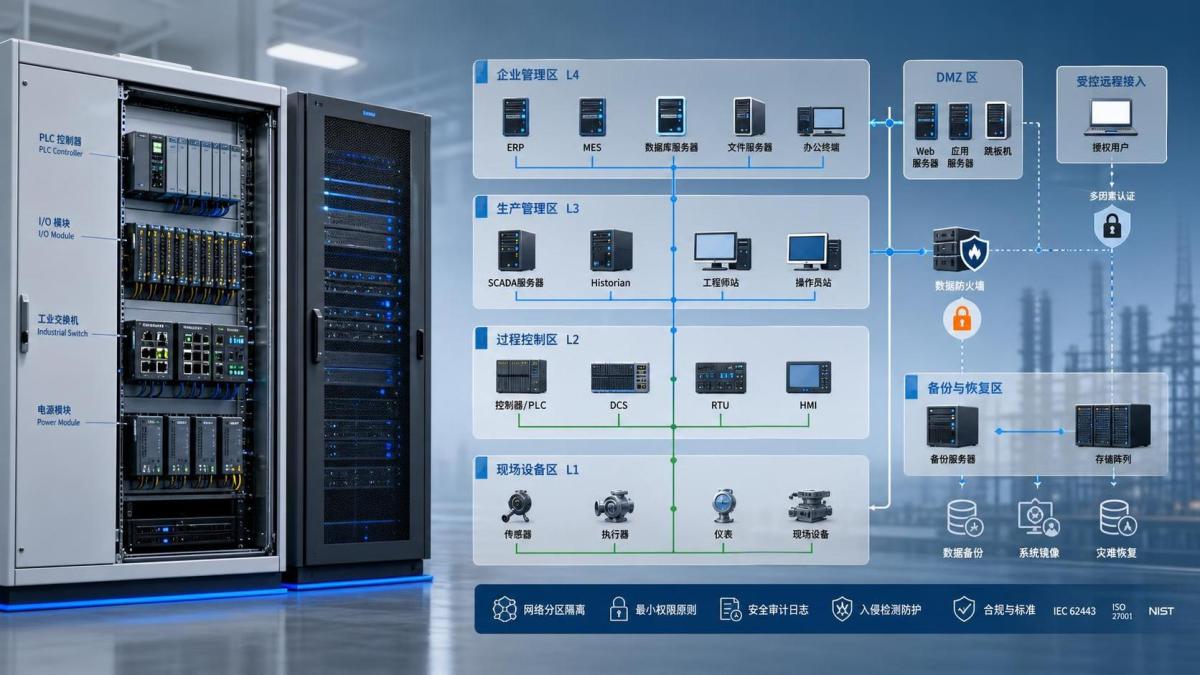
The architecture matters more than the feature list
A lot of cybersecurity risk in industrial automation comes from architecture decisions, not from the PLC itself. When evaluating cybersecurity compliant automation systems, review the proposed network model as seriously as the control logic platform.
At minimum, the supplier should be able to show how the system supports segmentation between enterprise IT, site operations, supervisory layers, and cell or zone-level equipment. If the design assumes unrestricted communication for convenience, that is a warning sign. In a regulated plant, you want clear paths for data flow, restricted conduits, and a defensible method for separating critical process control from less trusted interfaces.
This is especially important when edge analytics, machine vision, remote diagnostics, or IIoT gateways are involved. These add value, but they also add attack surface. TechStat Vanguard’s broader hard-tech perspective is useful here: every added sensor, gateway, or software bridge should be evaluated as an engineering component with latency, failure behavior, and trust boundaries—not just as a digital add-on.
Validate access control in real operating scenarios
User management is one of the first places where vendor promises meet plant reality. A strong evaluation goes past “supports role-based access control” and tests whether the role model actually fits operations, maintenance, quality, and engineering workflows.
For example, can operators acknowledge alarms without gaining recipe editing rights? Can maintenance staff troubleshoot drives without broad system configuration access? Can temporary vendor access be granted, monitored, and removed without local workarounds? Does the platform support centralized identity integration where appropriate, while still handling disconnected or high-availability conditions?
Shared credentials are still more common in plants than people like to admit, especially on legacy HMIs and engineering stations. If the proposed system quietly depends on them during commissioning or support, that should be treated as a design issue, not a training issue.
Patch management and validation need to coexist
This is where many evaluations become unrealistically optimistic. In regulated manufacturing, you cannot assess cybersecurity separately from validation and change control. A patch that closes a vulnerability but breaks a validated interface, device driver, or recipe workflow is not a clean win.
Ask vendors for a clear lifecycle model:
- How are vulnerabilities disclosed?
- How quickly are patches or mitigations issued?
- Are security updates bundled with functional changes, or can they be isolated?
- How long is each software release supported?
- What documentation is provided to support risk assessment and revalidation?
The best suppliers usually provide more than release notes. They provide version traceability, compatibility matrices, backup and rollback procedures, and enough technical detail for quality and validation teams to judge impact. If the answer is “our service team can handle it,” press further. In a regulated environment, undocumented dependency on field service is a risk in itself.
Documentation quality is part of the security posture
A surprising amount can be learned from the documentation package. Good documents usually indicate mature engineering discipline. Weak documents often predict deployment friction, audit exposure, and inconsistent support.
During evaluation, review whether the vendor can provide:
This is one reason independent benchmarking and traceability-focused analysis have become more valuable in advanced manufacturing. In noisy markets, documentation depth often tells you more than a polished demo ever will.
Do not ignore recovery behavior
Plants do not just need prevention; they need recoverability. If an HMI image is corrupted, if a configuration server fails, if a remote access channel is disabled during an incident, how does the line return to a known good state? This is not a theoretical exercise. In regulated operations, unplanned restoration without controlled records can create both production loss and compliance problems.
Ask for practical recovery details: configuration backup granularity, restore time, offline restore capability, integrity checking, and whether audit trails survive recovery events. Systems that depend heavily on internet connectivity or proprietary service access may look modern but can be awkward in sites that require local control and documented fallback procedures.
Evaluate the vendor’s security process, not just the shipped product
A secure product today can become a neglected product tomorrow. For that reason, vendor process maturity matters. Technical evaluators should understand how the supplier handles secure development, vulnerability intake, software maintenance, end-of-life planning, and support for mixed-version fleets. That last point matters more than many teams expect, because real plants do not upgrade everything at once.
It is also reasonable to ask how supply chain components are managed. Industrial automation increasingly depends on embedded operating systems, open-source packages, third-party remote tools, and edge compute modules. A vendor that cannot explain dependency management or software bill of materials practices may still be usable, but the risk picture is less clear and should be priced into the decision.
A practical short list should include trade-offs, not only scores
Selection teams often want a weighted matrix, and that is fine, but do not hide the trade-offs inside a spreadsheet. One system may offer stronger native security controls but require more validation effort. Another may fit the installed base better but rely on compensating network controls. A third may be excellent for isolated cells yet awkward for multi-site governance.
The better decision documents usually include plain-language judgments such as: acceptable if paired with site-managed segmentation; strong for new greenfield deployment but weak for brownfield coexistence; suitable where local administration is tightly controlled; not ideal where vendor remote access must be frequent. Those statements are often more actionable than numeric ratings.
If there is one recurring lesson in evaluating cybersecurity compliant automation systems, it is this: the system is only as compliant as the combined behavior of architecture, operational process, documentation, and lifecycle support. In regulated plants, that combination matters far more than a claim on the front page of a brochure. Ask for evidence, test assumptions against actual plant constraints, and treat every undocumented dependency as a future problem until proven otherwise.
Search News
Hot Articles
- Carbon Fiber StructuresHow to Specify Aerospace Carbon Fiber Assemblies for Lightweight, Load-Bearing PartsJul 11, 2026
- Machine VisionXiaomi, Alibaba DAMO Academy Drive Open-Source Robotics Model Ecosystem, Lowering Algorithm Development Barriers for Overseas SMEs Adopting Chinese Robotics SolutionsMar 30, 2026
- Cobots & ArmsShanxi 'AI+' Conference Showcases Embodied Intelligence with Multinational Buyer Engagement: Key Industry ImplicationsMar 30, 2026
Popular Tags
Recommended News
 Jul 11, 2026How to Specify Aerospace Carbon Fiber Assemblies for Lightweight, Load-Bearing PartsAerospace carbon fiber assemblies: learn how to specify laminate design, load data, joining methods, and inspection controls for lighter, reliable load-bearing aerospace parts.Elena Rostova (UAV Systems Researcher)
 Mar 30, 2026Xiaomi, Alibaba DAMO Academy Drive Open-Source Robotics Model Ecosystem, Lowering Algorithm Development Barriers for Overseas SMEs Adopting Chinese Robotics SolutionsXiaomi & Alibaba DAMO Academy's open-source robotics models lower algorithm barriers for global SMEs. Boost efficiency in manufacturing, logistics & smart retail with ROS 2 compatible solutions.TSV Data Lab
 Mar 30, 2026Shanxi 'AI+' Conference Showcases Embodied Intelligence with Multinational Buyer Engagement: Key Industry ImplicationsShanxi 'AI+' Conference highlights embodied intelligence with Tesla, Ubtech & Jiantao showcasing multimodal robotics. 40+ global buyers validated tech on-site, creating new B2B channels for industrial automation & AI solutions.Chen Wei (Automation Lead Engineer)
 Mar 30, 2026Zhongguancun Unveils 6G Integrated Sensing-Computing-Intelligence Platform to Empower Embodied Robots for Global Industrial ApplicationsZhongguancun's new 6G platform revolutionizes industrial robotics with <10ms latency, empowering global automotive, logistics & port automation. Discover how this tech boosts China's smart manufacturing exports.TSV Data Lab
 Mar 30, 2026Mech-Mind Tianjin Embodied Intelligence R&D and Production Base Goes Live, Cutting Delivery Time by 20%–30% for Global Customized AMR+Vision SolutionsMech-Mind's Tianjin AMR+Vision production base cuts delivery time by 20%-30% for欧美 & Latin American markets. Discover how this PLd-certified facility accelerates customized robotics solutions for smart manufacturing and logistics.Chen Wei (Automation Lead Engineer)
 Mar 30, 2026Boao Forum Reveals 'Co-evolution of Big and Small Brains' Trend in Humanoid Robots, China's Embodied Intelligence Accelerates Adaptation to Overseas Manufacturing Service ScenariosDiscover how China's humanoid robots, featuring 'Co-evolution of Big and Small Brains,' are revolutionizing global manufacturing. Learn about Embodied Tian Gong 3.0's ISO compliance and overseas deployment at Boao Forum 2026.Chen Wei (Automation Lead Engineer)
 Mar 30, 2026China Railway Industrial Secures Patent for Embodied Robotics in Material Handling, Boosting High-Precision Delivery Capabilities for Overseas Infrastructure and Manufacturing ProjectsChina Railway Industrial's new patent for embodied robotics in material handling boosts high-precision delivery for global infrastructure & manufacturing. Discover how this innovation enhances logistics accuracy in automotive, rail transit & EPC projects.Chen Wei (Automation Lead Engineer)
 Sep 26, 2026Machining Tolerance Analysis: How to Set Limits That Meet Function and Cost TargetsMachining tolerance analysis: learn how to set functional limits, control tolerance stacks, reduce inspection risk, and balance precision with production cost.Dr. Marcus Vance
 Sep 25, 2026How to Evaluate an Industrial Infrastructure Data Platform for Multi-Site OperationsIndustrial infrastructure data platform evaluation guide for multi-site operations: compare data quality, edge resilience, interoperability, governance, and scalable proof-of-value criteria.Victor Lin (Chief Software Architect)
 Sep 24, 2026How to Select Machine Vision Optics for Accurate Inspection at Different Working DistancesMachine vision optics selection guide for accurate inspection at every working distance. Compare FOV, pixel scale, DOF, distortion, lighting, and telecentric options.TSV Data Lab
 Sep 23, 2026How to Evaluate a Machine Vision System Integrator for High-Speed Inspection LinesChoose a machine vision system integrator with proven expertise in high-speed inspection, reliable reject timing, robust optics, and measurable acceptance criteria.TSV Data Lab
 Sep 26, 2026What to define before starting SCADA integration planningSCADA integration planning starts with clear scope, control boundaries, data models, cybersecurity, and testing. Discover the definitions that reduce risk and costly rework.Victor Lin (Chief Software Architect)
 Sep 25, 2026How a smart factory with Industrial IoT reduces production blind spotsDiscover how a smart factory with Industrial IoT turns real-time machine, quality, and workflow data into actionable insights that reduce production blind spots and delivery risks.Victor Lin (Chief Software Architect)
 Sep 24, 2026When does Industrial IoT make smart manufacturing easier to scale?Smart manufacturing Industrial IoT scales when trusted data, interoperable systems, and secure workflows turn connected assets into measurable gains.TSV Data Lab
 Sep 23, 2026What drives ultra-precision machining cost at 1-micron tolerance?Ultra precision machining cost per part at 1 micron tolerance depends on process, material, metrology, and yield. Learn how to compare quotes confidently.Dr. Marcus Vance
 Sep 22, 2026Drone Engine-T550CC Applications: Build the UAV Power System Around the MissionAn application guide for Drone Engine-T550CC integration, covering payload planning, airframe matching, cooling, fuel, vibration, test procedures, documentation, and service preparation.Elena Rostova (UAV Systems Researcher)
 Sep 22, 2026How to Evaluate Industrial Edge Computing Vendors for Factory DeploymentIndustrial edge computing vendor evaluation guide for factories: compare latency, protocol fit, reliability, security, and lifecycle support before deployment.TSV Data Lab
 Sep 21, 2026Drone Payload Integration: Matching Power, Data, and Center of Gravity for Reliable FlightsDrone payload integration made practical: balance power, data, center of gravity, and endurance to build safer, more reliable mission-ready flights.Elena Rostova (UAV Systems Researcher)
 Sep 20, 2026Autonomous Navigation Pricing: Cost Drivers and Budget Benchmarks for AMR ProjectsAutonomous navigation price explained: compare AMR cost drivers, software, sensors, integration, safety, and lifecycle budgets to build a scalable project plan.Chen Wei (Automation Lead Engineer)
 Sep 19, 2026How to Scope Automation Integration Services for Multi-System Factory ProjectsAutomation integration services: learn how to scope multi-system factory projects with clear workflows, interface contracts, safety boundaries, and acceptance criteria.Victor Lin (Chief Software Architect)
 Sep 18, 2026Selecting UAV Aerospace Structural Parts for Strength, Weight, and Fatigue LifeUAV aerospace structural parts guide: compare strength, weight, stiffness, fatigue life, joints, and traceability to select reliable flight-ready components.Elena Rostova (UAV Systems Researcher)
 Sep 17, 2026Selecting Commercial Drone Payloads for European Inspection ProjectsCommercial drone payloads Europe: learn how to select RGB, thermal and LiDAR systems for compliant, reliable inspection data and better project outcomes.Elena Rostova (UAV Systems Researcher)
 Sep 16, 2026Machining Tolerance Validation: How to Verify Critical Dimensions Before Production ReleaseMachining tolerance analysis validation: verify critical dimensions, measurement systems, process capability, and tolerance stacks before production release.Dr. Marcus Vance
 Sep 15, 2026AGV Tape Guidance vs Laser Navigation: Which Fits Your Warehouse Layout?AGV tape guidance comparison: discover how tape and laser navigation fit changing warehouse layouts, docking needs, floor conditions, maintenance, and route flexibility.Chen Wei (Automation Lead Engineer)