AGV Tape Guidance vs Laser Navigation: Which Fits Your Warehouse Layout?
Publication Date
author
AGV Tape Guidance vs Laser Navigation: Which Fits Your Warehouse Layout?
An AGV tape guidance comparison with laser navigation should begin with measurable layout constraints—not marketing claims. For technical evaluators, the right choice depends on route stability, required flexibility, floor conditions, expansion frequency, positioning tolerance, and acceptable downtime. Tape-guided AGVs can provide predictable performance on fixed routes, while laser navigation supports dynamic environments with changing storage, traffic, and workflows. The engineering question is not which method is more advanced. It is whether the navigation method matches the actual operating envelope of the warehouse.
This distinction matters because navigation is not an isolated vehicle feature. It affects civil works, commissioning effort, maintenance routines, fleet software, exception handling, safety validation, and the cost of every future layout change. A vehicle that performs well in a clean demonstration route may become difficult to manage if the production floor has frequent staging changes, damaged surfaces, mixed pedestrian traffic, or inconsistent housekeeping.
At TechStat Vanguard, the principle is simple: Engineering Truth Through Data. In automation evaluation, that means replacing broad statements such as “flexible navigation” or “high-precision guidance” with questions that can be tested in the intended facility. What is the allowable lateral deviation at a conveyor handoff? How often does the route change? What happens when dust, pallet overhang, temporary racks, or a blocked aisle interfere with normal travel? The answers usually determine the better architecture long before a supplier comparison reaches pricing.
The Fundamental Difference: Infrastructure Defines the Route—or the Vehicle Interprets It
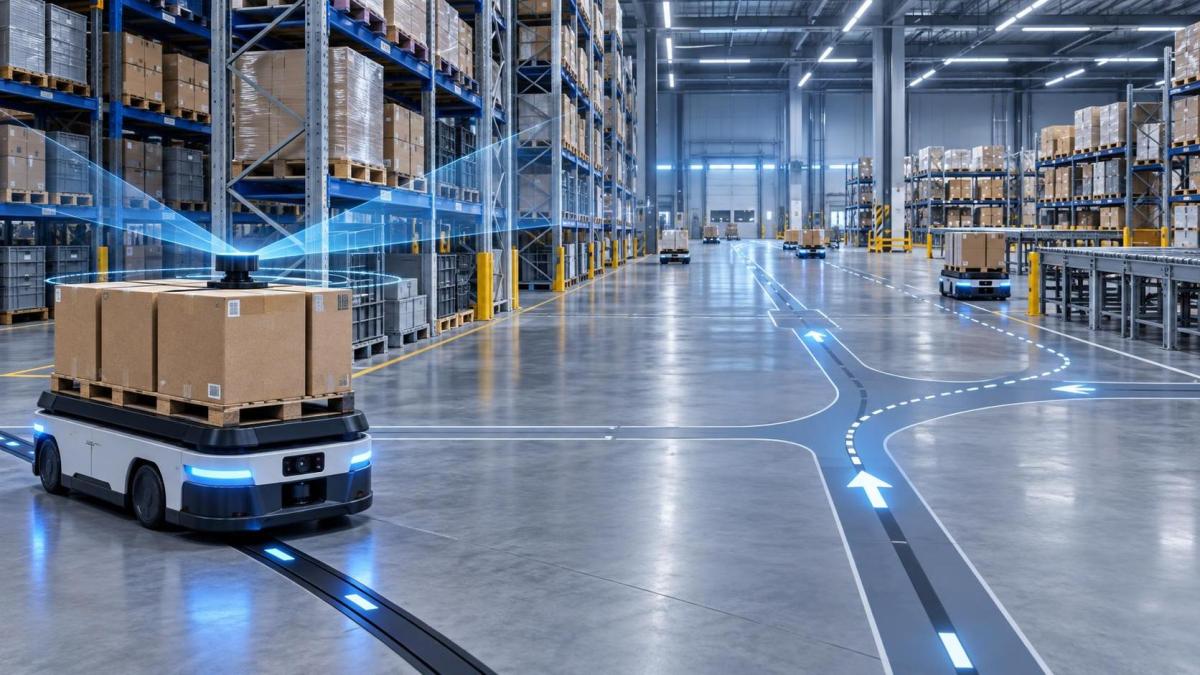
Tape guidance uses a physical path installed on or beneath the floor surface. Depending on the system, the vehicle may follow magnetic tape, colored or reflective tape, an embedded wire, or another guide medium. Sensors detect that reference and continuously steer the vehicle along it. The route is explicit: if the tape runs from receiving to a production cell, the AGV follows that route. Branches, stop points, and logic can be added, but the physical guide remains central to navigation.
Laser navigation is a broader term and should never be accepted in a specification without clarification. It may refer to vehicles that localize against installed reflectors, or to vehicles using laser scanners and a mapped environment—often called natural-feature navigation or SLAM-based localization. These approaches differ in infrastructure requirements and failure modes, even though both are commonly presented as “laser-guided.” A reflector-based vehicle relies on a maintained geometric reference network. A natural-feature system relies on stable environmental features and sufficient sensor visibility.
That difference leads to a practical rule: tape guidance makes the route visible and fixed; laser navigation makes the route software-defined, subject to localization quality, map integrity, traffic rules, and obstacle-management behavior. Neither is inherently superior. Each moves risk to a different part of the system.
When Tape Guidance Is the Rational Choice
Tape-guided AGVs are often dismissed too quickly in discussions dominated by autonomous mobile robots. That can be a mistake in facilities with stable, repetitive material movement. A plant may run the same pallet transfer between a warehouse buffer, a wrapping station, and a dispatch lane for years. A beverage, packaging, assembly, or line-side replenishment process may have tightly controlled flow, limited route variation, and defined stopping locations. In that setting, a visible route can be an operational advantage rather than a limitation.
The strongest case for tape is not merely lower initial complexity. It is determinism. The travel corridor is known, operators can see where the vehicle is intended to go, and route validation is relatively direct. If a process requires repeated collection and delivery at fixed interfaces, the engineering team can focus on load handling, docking geometry, throughput, and safety zones instead of asking the vehicle to solve a navigation problem that the layout has already solved.
Tape systems can also simplify commissioning in buildings where reference conditions for laser localization are poor. Large, open areas with sparse walls, repeated visual geometry, changing racking, highly reflective surfaces, or persistent airborne contamination may require closer scrutiny for any sensor-dependent navigation approach. This does not automatically rule out laser navigation, but it shifts attention to a site survey, sensor placement, map quality, reflector planning, and degraded-mode testing.
The constraint is obvious: the route is only as adaptable as the installed guidance path. Adding a lane, changing an intersection, or moving a delivery point can require floor preparation, tape installation, curing or protection steps where applicable, route revalidation, and planned production disruption. In a facility redesigned every quarter, that operational burden can rapidly outweigh the simplicity gained on day one.
Where Laser Navigation Earns Its Complexity
Laser navigation is usually the stronger fit when the warehouse itself is variable. This includes distribution operations with changing pick faces, seasonal storage reconfiguration, temporary staging, multiple source-and-destination points, or a need to reroute around congestion. In these environments, a software-defined route network can reduce the physical disruption associated with layout changes. A vehicle may be assigned new waypoints, updated travel rules, or alternative paths without placing new guide media across the floor.
Its value is especially clear when fleet management matters. A laser-navigated fleet can be coordinated around shared aisles, charging areas, restricted zones, and priority tasks. Yet technical teams should separate route flexibility from operational certainty. The ability to generate alternate paths does not guarantee that those paths are usable. Aisle widths, turning envelopes, clearance under pallet overhang, pedestrian behavior, fire egress requirements, and loading-dock activity still determine whether rerouting can occur safely and productively.
Laser systems demand disciplined environmental control of a different kind. Maps must be managed. Reflectors, when used, need protection from impact and obstruction. Scanner windows require cleaning. Permanent landmarks should not disappear after a rack reconfiguration. If localization confidence falls, the supplier’s specified response must be understood: does the vehicle slow down, stop, request assistance, relocalize automatically, or switch to another reference method? These are not edge cases; they are part of normal availability engineering.
Positioning Accuracy Is Not a Single Number
A common procurement error is to compare navigation systems using one quoted positioning-accuracy figure. For material handling, what matters is the complete docking result under realistic conditions. A vehicle can navigate a route accurately and still fail to interface reliably with a conveyor, lift, rack, machine door, or pallet stand. Load dimensions, fork deflection, floor flatness, wheel wear, battery state, speed profile, sensor configuration, and the design of the receiving station all contribute to final placement.
The specification should therefore distinguish between route-following tolerance, localization repeatability, docking repeatability, and load-placement tolerance. It should also state the test conditions. Is the requirement measured with or without a load? At what approach speed? On what floor condition? With which pallet type? If the AGV transfers into an automated system, the interface owner should define the usable positional window and the allowed approach angle rather than leaving “precise docking” open to interpretation.
Tape guidance can offer highly repeatable behavior along a well-maintained route, while laser systems can provide robust localization across a broader operating area. But neither label alone establishes docking performance. For this reason, an agv tape guidance comparison should treat the interface test plan as more important than the navigation brochure.
Floor Conditions and Housekeeping Often Decide the Project
The floor is frequently assessed too late. Tape adheres differently across coated concrete, repaired slabs, expansion joints, uneven surfaces, and areas exposed to washdown or aggressive cleaning agents. Forklift crossings, drag marks, abrasive debris, and heavy turning traffic can shorten the service life of exposed floor guidance. A site review should identify not only visible cracks but also cleaning practices, moisture exposure, temperature variation, and planned resurfacing.
Laser-guided vehicles are not exempt from floor-related risk. Surface irregularities affect vehicle stability, stopping distance, mast behavior, load control, and scanner orientation. In addition, warehouses with dust, steam, wrap film, dangling labels, reflective materials, or frequent obstruction of wall features need a realistic sensor assessment. The correct response is not to assume failure; it is to request a documented survey and representative trial conditions.
Maintenance ownership deserves the same attention. Ask who detects tape degradation, who repairs it, who updates digital maps, who approves route changes, and who has access to navigation logs. A technical solution becomes fragile when it relies on undocumented knowledge held by one integrator or one shift supervisor.
Build the Decision Around Change Frequency, Not Vehicle Count
Fleet size is relevant, but it is not the best starting point. A small fleet in a warehouse that changes weekly can justify laser navigation more readily than a large fleet moving on three permanent routes. Conversely, a high-volume but stable manufacturing loop may favor tape guidance because its physical route closely reflects an established process.
Before selecting a technology, map the current operation and the likely layout state over the next planning cycle. Identify fixed points, variable points, temporary zones, high-consequence interfaces, pedestrian crossings, and areas where a blocked lane creates immediate production risk. Then classify each route: permanent, seasonal, frequently revised, or uncertain. The navigation method should fit the dominant route class, not the most impressive future concept presented in a workshop.
Questions That Belong in the Technical Specification
A useful specification does not ask suppliers simply to confirm that their AGV can use tape or laser navigation. It asks them to expose assumptions. The following questions help make competing proposals comparable:
- What exact navigation technology is proposed: magnetic or optical tape, reflector-based laser localization, natural-feature laser localization, or a hybrid method?
- What floor preparation, infrastructure, landmarks, reflectors, or guide media are required, and who is responsible for their installation and acceptance?
- What is the tested docking performance at each critical interface, including load state, speed, floor condition, and allowable approach variation?
- How does the vehicle behave after a blocked route, lost localization event, damaged tape section, or map change?
- Which route changes can trained site personnel make, which require the supplier, and what revalidation is required before production use?
- What diagnostic records are available for navigation faults, safety stops, manual interventions, and recurring delay causes?
The answers should be assessed alongside applicable machine-safety, traffic-management, and local workplace requirements. Compliance obligations depend on jurisdiction and the final system design, so they should be confirmed with qualified project stakeholders rather than assumed from a vehicle data sheet.
Choose the Navigation Method That Makes Failure Visible
For a fixed layout with repeatable material flow, tape guidance may be the more disciplined engineering choice: straightforward, inspectable, and aligned with a stable process. For warehouses where routes, storage zones, and priorities evolve regularly, laser navigation can provide a more workable foundation—provided the facility can support the sensor, mapping, and operational-governance requirements it introduces.
The decision should not be framed as legacy guidance versus intelligent autonomy. It is a choice between two different control philosophies. One anchors the vehicle to a deliberately constructed path. The other asks the vehicle to interpret a managed environment. Technical evaluators should validate both against the same evidence: route-change frequency, floor and environmental conditions, interface tolerance, recovery behavior, maintainability, and measured downtime consequences.
That is the standard worth applying to any AGV navigation decision. Parameters do not lie; tolerances dictate success. A defensible project begins when the warehouse layout is translated into testable requirements before a navigation method is selected.
Search News
Hot Articles
- Carbon Fiber StructuresHow to Specify Aerospace Carbon Fiber Assemblies for Lightweight, Load-Bearing PartsJul 11, 2026
- Machine VisionXiaomi, Alibaba DAMO Academy Drive Open-Source Robotics Model Ecosystem, Lowering Algorithm Development Barriers for Overseas SMEs Adopting Chinese Robotics SolutionsMar 30, 2026
- Cobots & ArmsShanxi 'AI+' Conference Showcases Embodied Intelligence with Multinational Buyer Engagement: Key Industry ImplicationsMar 30, 2026
Popular Tags
Recommended News
 Jul 11, 2026How to Specify Aerospace Carbon Fiber Assemblies for Lightweight, Load-Bearing PartsAerospace carbon fiber assemblies: learn how to specify laminate design, load data, joining methods, and inspection controls for lighter, reliable load-bearing aerospace parts.Elena Rostova (UAV Systems Researcher)
 Mar 30, 2026Xiaomi, Alibaba DAMO Academy Drive Open-Source Robotics Model Ecosystem, Lowering Algorithm Development Barriers for Overseas SMEs Adopting Chinese Robotics SolutionsXiaomi & Alibaba DAMO Academy's open-source robotics models lower algorithm barriers for global SMEs. Boost efficiency in manufacturing, logistics & smart retail with ROS 2 compatible solutions.TSV Data Lab
 Mar 30, 2026Shanxi 'AI+' Conference Showcases Embodied Intelligence with Multinational Buyer Engagement: Key Industry ImplicationsShanxi 'AI+' Conference highlights embodied intelligence with Tesla, Ubtech & Jiantao showcasing multimodal robotics. 40+ global buyers validated tech on-site, creating new B2B channels for industrial automation & AI solutions.Chen Wei (Automation Lead Engineer)
 Mar 30, 2026Zhongguancun Unveils 6G Integrated Sensing-Computing-Intelligence Platform to Empower Embodied Robots for Global Industrial ApplicationsZhongguancun's new 6G platform revolutionizes industrial robotics with <10ms latency, empowering global automotive, logistics & port automation. Discover how this tech boosts China's smart manufacturing exports.TSV Data Lab
 Mar 30, 2026Mech-Mind Tianjin Embodied Intelligence R&D and Production Base Goes Live, Cutting Delivery Time by 20%–30% for Global Customized AMR+Vision SolutionsMech-Mind's Tianjin AMR+Vision production base cuts delivery time by 20%-30% for欧美 & Latin American markets. Discover how this PLd-certified facility accelerates customized robotics solutions for smart manufacturing and logistics.Chen Wei (Automation Lead Engineer)
 Mar 30, 2026Boao Forum Reveals 'Co-evolution of Big and Small Brains' Trend in Humanoid Robots, China's Embodied Intelligence Accelerates Adaptation to Overseas Manufacturing Service ScenariosDiscover how China's humanoid robots, featuring 'Co-evolution of Big and Small Brains,' are revolutionizing global manufacturing. Learn about Embodied Tian Gong 3.0's ISO compliance and overseas deployment at Boao Forum 2026.Chen Wei (Automation Lead Engineer)
 Mar 30, 2026China Railway Industrial Secures Patent for Embodied Robotics in Material Handling, Boosting High-Precision Delivery Capabilities for Overseas Infrastructure and Manufacturing ProjectsChina Railway Industrial's new patent for embodied robotics in material handling boosts high-precision delivery for global infrastructure & manufacturing. Discover how this innovation enhances logistics accuracy in automotive, rail transit & EPC projects.Chen Wei (Automation Lead Engineer)
 Oct 30, 2026Choosing a Procurement Content Provider: Data Quality and CoverageChoose a procurement content provider with confidence. Learn how to assess data quality, supplier coverage, traceability, and verification before you buy.Chen Wei (Automation Lead Engineer)
 Oct 29, 2026Shanghai Plan Targets 8,000 Humanoid Robots in Factories by 2028Shanghai's humanoid robot plan targets 8,000 factory deployments by 2028. Explore what it means for smart manufacturing and robot suppliers.Chen Wei (Automation Lead Engineer)
 Oct 29, 2026Aerospace Aluminum Alloy Strength: 2024-T3 vs. 7075-T6 ComparedCompare aerospace aluminum alloy strength in 2024-T3 vs. 7075-T6. Explore fatigue, corrosion, and weight trade-offs to choose the right alloy for your design.Dr. Marcus Vance
 Oct 28, 2026IDC: Global Quadruped Robot Shipments Rise 92.5% in H1 2026 as Volume and Value DivergeGlobal quadruped robot shipments rose 92.5% in H1 2026, according to IDC. Explore what diverging volume and value trends mean for industrial buyers and manufacturers.Chen Wei (Automation Lead Engineer)
 Oct 28, 2026Interpreting Industrial IoT Latency Data for Monitoring and Real-Time ControlInterpret industrial category latency data to assess jitter, deadline misses, and real-time readiness. Learn how to benchmark IIoT systems and choose monitoring and control solutions.TSV Data Lab
 Oct 27, 2026GXO and Agility Robotics Expand Partnership to Accelerate US Humanoid Robot DeploymentGXO and Agility Robotics plan to expand US humanoid robot deployment with Digit 4 in early 2027. Explore warehouse automation plans, service terms and future Digit 5 upgrades.Chen Wei (Automation Lead Engineer)
 Oct 27, 2026Robotic Automation Costs: Budgeting for Equipment, Integration, and MaintenancePlan your robotics automation cost with confidence. Explore equipment, integration, and maintenance expenses, compare quotes, and build a realistic budget for better ROI.Chen Wei (Automation Lead Engineer)
 Oct 26, 2026AMAXiMAL Releases Open-Source TopMod 3D v3 With Claude AIExplore AMAXiMAL’s free, open-source TopMod 3D v3 with Claude AI assistance, topology-based modeling and plywood fabrication tools that connect complex designs to physical builds.Dr. Marcus Vance
 Oct 26, 2026Choosing a SCADA System Integrator Company: PLC Compatibility and Long-Term SupportChoose a scada system integrator company with proven PLC compatibility and reliable long-term support. Discover what to test, compare, and require before investing.Victor Lin (Chief Software Architect)
 Oct 25, 2026Hesai Leads Global ADAS Main Lidar Shipments in Yole’s 2026 ReportHesai led global ADAS main lidar shipments with a 43% share in 2025, according to Yole’s 2026 report. Explore what this ranking reveals about its automotive market position.TSV Data Lab
 Oct 25, 2026Choosing an Aerospace Materials Manufacturer: Quality and Traceability ChecksChoosing an aerospace materials manufacturer? Learn how to verify certifications, test reports, and lot traceability to qualify suppliers confidently and reduce costly sourcing risks.Dr. Marcus Vance
 Oct 24, 2026Guotai Haitong: Global Entry-Level 3D Printer Shipments Rose 39% in Q1 2026Entry-level 3D printer shipments rose 39% in Q1 2026, Guotai Haitong reports. Explore how AI, multicolor printing and print farms are shaping market growth.Dr. Marcus Vance
 Oct 24, 2026Choosing an Industrial Vision Inspection Supplier: Acceptance Tests That MatterChoose an industrial vision inspection supplier with confidence. Discover acceptance tests for defect detection, false rejects, production speed, and reliable part rejection before you buy.TSV Data Lab
 Oct 23, 2026US Navy Raises Gecko Robotics Contract Ceiling to $300M for Robotic Fleet MaintenanceUS Navy raises Gecko Robotics’ contract ceiling to $300M for Pacific Fleet robotic inspections. Explore potential opportunities for maintenance suppliers and key procurement considerations.Chen Wei (Automation Lead Engineer)
 Oct 23, 2026Choosing Industrial Sensing Systems for Global Plants: Protocol CompatibilityCompare industrial sensing systems international buyers can trust. Explore protocol compatibility, reduce integration risks, and select proven configurations for reliable global plant deployments.TSV Data Lab
 Oct 22, 2026KUKA Showcases Physical AI and iiQKA.AI Vision at NVIDIA GTC BerlinExplore KUKA’s Physical AI showcase at NVIDIA GTC Berlin and discover how iiQKA.AI Vision aims to simplify robotic vision integration and improve 2D and 3D scene recognition.TSV Data Lab
 Oct 22, 2026Robotic Machining of Advanced Composites: What Tolerances Are Achievable?Explore advanced materials machining robotics: discover what drives achievable composite tolerances and how to validate accuracy before investing in your next machining system.Dr. Marcus Vance