What trampoline park cost usually misses in early budgets
Publication Date
author
Early planning often underestimates what trampoline park cost really includes. For finance approvers, the biggest budget risks rarely sit in headline equipment quotes—they hide in compliance, structural upgrades, insurance, maintenance, and utilization assumptions. This article breaks down the overlooked cost drivers behind trampoline park cost so decision-makers can evaluate proposals with clearer benchmarks, lower risk, and stronger long-term capital discipline.
Why trampoline park cost changes so much by scenario
For a finance approver, the first mistake is treating trampoline park cost as a single equipment purchase. In practice, costs differ sharply depending on business model, site condition, user mix, safety positioning, and revenue strategy. A park inside a retrofit retail box faces a different budget profile than one built into a new mixed-use entertainment complex. A children-focused venue has different staffing, padding, supervision, and insurance requirements than a teen-and-adult freestyle concept. Even two proposals with similar square footage can produce very different lifetime economics.
This is why early budgets often look comfortable on paper but become unstable during permitting, construction, and first-year operation. Vendors may quote core attractions, but not always the full cost stack around them. Approvers need to evaluate trampoline park cost in context: what operating scenario is being funded, what assumptions are embedded, and which line items can escalate after commitment.
Common business scenarios where hidden trampoline park cost appears
The easiest way to improve budget accuracy is to classify the project before comparing proposals. Hidden cost drivers usually become visible only when the operating scenario is clear.
Scenario 1: Small family entertainment venue in an existing lease
This scenario often looks affordable because the space already exists and management expects a fast launch. However, older buildings may need slab review, roof clearance verification, fire system upgrades, restroom adjustments, HVAC reinforcement, and acoustic treatment. Trampoline park cost here is frequently underestimated because the team focuses on attraction packages while underfunding landlord conditions, code compliance, and schedule delays tied to approvals.
Scenario 2: Mid-size destination park with party rooms and food service
This is a common growth model, but the budget complexity expands quickly. Revenue is expected from jump tickets, birthdays, snacks, and group bookings, yet each revenue stream adds fit-out and labor requirements. Kitchens, seating, grease management, POS integration, and cleaning routines all affect trampoline park cost. Operators who model only ticket sales may miss the real capital needed to support higher-margin ancillary business.
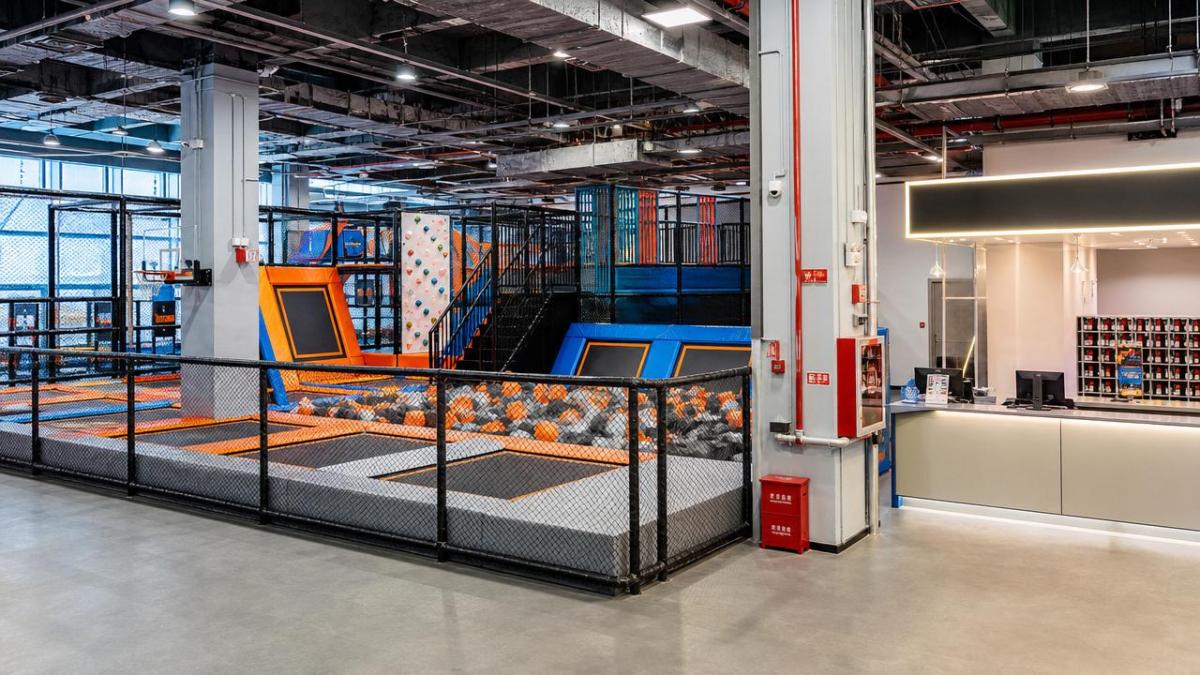
Scenario 3: Large multi-attraction active entertainment center
When trampolines are combined with ninja courses, climbing walls, foam pits, dodgeball courts, or interactive tech zones, trampoline park cost becomes only one component of a larger risk and integration budget. Shared circulation, emergency egress, supervision sightlines, fall-zone separation, and software integration matter as much as equipment price. This scenario often generates stronger revenue potential, but also raises maintenance overhead and replacement reserve requirements.
Scenario 4: Franchise-led model with standardized branding
A franchise can reduce concept risk, but finance teams should not assume it lowers trampoline park cost across the board. Standardized design may require premium finishes, mandatory vendors, technology subscriptions, training fees, local marketing launch spend, and royalty structures. The capex may be more predictable, but the total commitment can still exceed an independent build if the brand package is rigid.
A practical comparison table for finance approvers
Before signing off, compare the scenario rather than the headline quote. The table below shows where trampoline park cost tends to shift.
The cost categories that early trampoline park budgets usually miss
In approval meetings, proposals often emphasize equipment, flooring, and installation. That is rarely enough. A more realistic trampoline park cost model should include the following categories.
Building suitability and structural adaptation
Ceiling height, column spacing, floor tolerance, load distribution, and MEP compatibility all influence whether a selected site can support the planned layout. If the venue needs reinforcement or redesign after lease commitment, costs rise quickly. Finance teams should request pre-lease technical validation, not just a broker summary.
Safety compliance and permitting
Compliance spending is not optional overhead; it is a core part of trampoline park cost. This may include engineered drawings, local authority reviews, fire suppression modifications, emergency signage, occupancy calculations, ADA-related changes, impact attenuation materials, and operational safety documentation. Delays here can also create indirect cost through rent commencement, contractor remobilization, and postponed revenue.
Insurance and risk transfer
Insurance is one of the most commonly underestimated line items. Premiums depend on jurisdiction, claims environment, age group mix, attendance volume, training quality, and attraction intensity. Some operators budget based on optimistic benchmarks that do not reflect their actual risk profile. Approvers should test the insurance estimate using conservative assumptions and ask whether deductibles, incident response procedures, and waiver systems have been fully costed.
Maintenance, inspections, and replacement reserves
A low opening budget can conceal a weak long-term operating model. Mats, pads, springs, netting, foam, sensors, and high-touch finishes wear at different rates. If replacement cycles are ignored, trampoline park cost appears lower only because future capex has been pushed off the spreadsheet. Finance approvers should ask for annual maintenance plans, spare-part assumptions, downtime expectations, and a reserve schedule tied to usage intensity.
Staffing and operational control
A park designed for high throughput but staffed at minimum levels may look efficient in theory and unstable in reality. Court monitors, front desk staff, cleaners, party hosts, shift leads, and managers all affect safe utilization. If the concept relies on peak weekend traffic, then recruitment, training, and turnover management are part of trampoline park cost from day one.
How demand assumptions change the real economics
Finance approvers often review capex and opex separately, but utilization assumptions are where bad projects hide. A proposal may be technically affordable and still financially weak if attendance ramps too slowly or peak periods are too narrow. The real issue is not only what trampoline park cost at opening, but what level of occupancy is required to cover fixed expenses without aggressive discounting.
For example, a suburban family venue may depend heavily on birthdays and school breaks. A destination model in a dense trade area may rely more on weekend footfall and group events. A park with premium attractions may need higher pricing, but that only works if the local market accepts the value proposition. Approvers should stress-test attendance by season, weekday mix, weather sensitivity, and competitive openings nearby. If a model works only at ideal utilization, the budget is too fragile.
Scenario-based approval checks for different decision makers
Not every approver reviews trampoline park cost through the same lens. A stronger process assigns focus areas by role.
For CFOs and finance controllers
Verify contingency levels, reserve policy, debt-service tolerance, and downside attendance modeling. Ask whether the project still performs under slower ramp-up, higher insurance, and delayed opening. The key question is whether the budget contains enough realism to preserve cash discipline.
For procurement and project sponsors
Separate vendor scope from owner scope. Many trampoline park cost misunderstandings come from assuming “turnkey” means everything is included. Confirm exclusions such as permits, utility upgrades, flooring transitions, queue barriers, IT hardware, audio, CCTV, lockers, signage, and training refreshes.
For operators and general managers
Review whether the park can be supervised efficiently and cleaned consistently. A layout that looks exciting in concept art may create labor inefficiency, blind spots, or excessive wear. Operational friction eventually turns into hidden trampoline park cost through injuries, complaints, and lower repeat visits.
Frequent misjudgments that make trampoline park cost look cheaper than it is
- Using equipment quotes as the main budget anchor instead of full project cost.
- Assuming every vacant retail unit is suitable without engineering review.
- Underestimating insurance, legal documentation, and waiver system requirements.
- Ignoring maintenance reserves because the park is new at launch.
- Overestimating attendance based on competitor marketing rather than local demand data.
- Failing to model seasonality, discount pressure, and school-calendar dependence.
FAQ: what finance approvers usually ask about trampoline park cost
Is trampoline park cost mainly driven by park size?
No. Size matters, but site condition, attraction mix, compliance burden, and business model can change cost more than square footage alone. A smaller retrofit project can be more expensive per usable area than a cleaner new-build shell.
What should be included in an early approval budget?
At minimum: equipment, freight, installation, design, permits, structural review, MEP upgrades, life-safety modifications, insurance assumptions, pre-opening payroll, training, marketing launch, technology systems, maintenance reserve, and contingency. Without these, trampoline park cost is incomplete.
How much contingency is reasonable?
That depends on scenario maturity. Retrofit spaces usually require a higher contingency than standardized rollouts in verified sites. If engineering review and permitting are still early, finance teams should avoid thin contingency assumptions.
A disciplined next step for lower-risk approval
The most effective way to evaluate trampoline park cost is not to ask, “What is the quoted build price?” but “Which operating scenario are we funding, and what assumptions make that number credible?” That shift helps approvers filter optimistic proposals before they become expensive commitments.
For stronger approval discipline, require scenario-based budgeting, documented exclusions, independent site validation, utilization sensitivity analysis, and a lifecycle maintenance plan. In complex leisure investments, precision matters more than promotional language. A proposal that survives hard questioning on hidden cost drivers is far more likely to deliver durable returns, safer operations, and a more trustworthy understanding of real trampoline park cost.
Search News
Hot Articles
- Carbon Fiber StructuresHow to Specify Aerospace Carbon Fiber Assemblies for Lightweight, Load-Bearing PartsJul 11, 2026
- Machine VisionXiaomi, Alibaba DAMO Academy Drive Open-Source Robotics Model Ecosystem, Lowering Algorithm Development Barriers for Overseas SMEs Adopting Chinese Robotics SolutionsMar 30, 2026
- Cobots & ArmsShanxi 'AI+' Conference Showcases Embodied Intelligence with Multinational Buyer Engagement: Key Industry ImplicationsMar 30, 2026
Popular Tags
Recommended News
 Jul 11, 2026How to Specify Aerospace Carbon Fiber Assemblies for Lightweight, Load-Bearing PartsAerospace carbon fiber assemblies: learn how to specify laminate design, load data, joining methods, and inspection controls for lighter, reliable load-bearing aerospace parts.Elena Rostova (UAV Systems Researcher)
 Mar 30, 2026Xiaomi, Alibaba DAMO Academy Drive Open-Source Robotics Model Ecosystem, Lowering Algorithm Development Barriers for Overseas SMEs Adopting Chinese Robotics SolutionsXiaomi & Alibaba DAMO Academy's open-source robotics models lower algorithm barriers for global SMEs. Boost efficiency in manufacturing, logistics & smart retail with ROS 2 compatible solutions.TSV Data Lab
 Mar 30, 2026Shanxi 'AI+' Conference Showcases Embodied Intelligence with Multinational Buyer Engagement: Key Industry ImplicationsShanxi 'AI+' Conference highlights embodied intelligence with Tesla, Ubtech & Jiantao showcasing multimodal robotics. 40+ global buyers validated tech on-site, creating new B2B channels for industrial automation & AI solutions.Chen Wei (Automation Lead Engineer)
 Mar 30, 2026Zhongguancun Unveils 6G Integrated Sensing-Computing-Intelligence Platform to Empower Embodied Robots for Global Industrial ApplicationsZhongguancun's new 6G platform revolutionizes industrial robotics with <10ms latency, empowering global automotive, logistics & port automation. Discover how this tech boosts China's smart manufacturing exports.TSV Data Lab
 Mar 30, 2026Mech-Mind Tianjin Embodied Intelligence R&D and Production Base Goes Live, Cutting Delivery Time by 20%–30% for Global Customized AMR+Vision SolutionsMech-Mind's Tianjin AMR+Vision production base cuts delivery time by 20%-30% for欧美 & Latin American markets. Discover how this PLd-certified facility accelerates customized robotics solutions for smart manufacturing and logistics.Chen Wei (Automation Lead Engineer)
 Mar 30, 2026Boao Forum Reveals 'Co-evolution of Big and Small Brains' Trend in Humanoid Robots, China's Embodied Intelligence Accelerates Adaptation to Overseas Manufacturing Service ScenariosDiscover how China's humanoid robots, featuring 'Co-evolution of Big and Small Brains,' are revolutionizing global manufacturing. Learn about Embodied Tian Gong 3.0's ISO compliance and overseas deployment at Boao Forum 2026.Chen Wei (Automation Lead Engineer)
 Mar 30, 2026China Railway Industrial Secures Patent for Embodied Robotics in Material Handling, Boosting High-Precision Delivery Capabilities for Overseas Infrastructure and Manufacturing ProjectsChina Railway Industrial's new patent for embodied robotics in material handling boosts high-precision delivery for global infrastructure & manufacturing. Discover how this innovation enhances logistics accuracy in automotive, rail transit & EPC projects.Chen Wei (Automation Lead Engineer)
 Sep 29, 2026ISO 9283 Repeatability: How to Evaluate Cobot Positioning PerformanceISO 9283 cobot repeatability explained: learn how payload, reach, approach direction, and test conditions affect positioning performance and cell capability.Chen Wei (Automation Lead Engineer)
 Sep 28, 2026Spindle Runout Measurement in Germany: DIN Standards, Methods, and Acceptance LimitsSpindle runout measurement Germany: explore DIN standards, proven methods, acceptance limits, and audit-ready practices for reliable machining quality.Dr. Marcus Vance
 Sep 27, 2026How to Select Wall-Mount Edge Devices for Space-Constrained Factory NetworksWall mount edge devices for space-constrained factories: evaluate workload, thermal design, power resilience, cable access, and network reliability for smarter deployments.TSV Data Lab
 Sep 26, 2026Machining Tolerance Analysis: How to Set Limits That Meet Function and Cost TargetsMachining tolerance analysis: learn how to set functional limits, control tolerance stacks, reduce inspection risk, and balance precision with production cost.Dr. Marcus Vance
 Sep 25, 2026How to Evaluate an Industrial Infrastructure Data Platform for Multi-Site OperationsIndustrial infrastructure data platform evaluation guide for multi-site operations: compare data quality, edge resilience, interoperability, governance, and scalable proof-of-value criteria.Victor Lin (Chief Software Architect)
 Sep 24, 2026How to Select Machine Vision Optics for Accurate Inspection at Different Working DistancesMachine vision optics selection guide for accurate inspection at every working distance. Compare FOV, pixel scale, DOF, distortion, lighting, and telecentric options.TSV Data Lab
 Sep 23, 2026How to Evaluate a Machine Vision System Integrator for High-Speed Inspection LinesChoose a machine vision system integrator with proven expertise in high-speed inspection, reliable reject timing, robust optics, and measurable acceptance criteria.TSV Data Lab
 Sep 28, 2026When is a SCADA API the right choice for connecting plant systems?SCADA API guide: learn when governed plant data integration improves traceability, security, and scalability—without compromising real-time control.Victor Lin (Chief Software Architect)
 Sep 27, 2026How SCADA data integration improves traceability across production linesSCADA data integration connects production-line data to improve traceability, accelerate quality investigations, and strengthen safety decisions.Victor Lin (Chief Software Architect)
 Sep 26, 2026What to define before starting SCADA integration planningSCADA integration planning starts with clear scope, control boundaries, data models, cybersecurity, and testing. Discover the definitions that reduce risk and costly rework.Victor Lin (Chief Software Architect)
 Sep 25, 2026How a smart factory with Industrial IoT reduces production blind spotsDiscover how a smart factory with Industrial IoT turns real-time machine, quality, and workflow data into actionable insights that reduce production blind spots and delivery risks.Victor Lin (Chief Software Architect)
 Sep 24, 2026When does Industrial IoT make smart manufacturing easier to scale?Smart manufacturing Industrial IoT scales when trusted data, interoperable systems, and secure workflows turn connected assets into measurable gains.TSV Data Lab
 Sep 23, 2026What drives ultra-precision machining cost at 1-micron tolerance?Ultra precision machining cost per part at 1 micron tolerance depends on process, material, metrology, and yield. Learn how to compare quotes confidently.Dr. Marcus Vance
 Sep 22, 2026Drone Engine-T550CC Applications: Build the UAV Power System Around the MissionAn application guide for Drone Engine-T550CC integration, covering payload planning, airframe matching, cooling, fuel, vibration, test procedures, documentation, and service preparation.Elena Rostova (UAV Systems Researcher)
 Sep 22, 2026How to Evaluate Industrial Edge Computing Vendors for Factory DeploymentIndustrial edge computing vendor evaluation guide for factories: compare latency, protocol fit, reliability, security, and lifecycle support before deployment.TSV Data Lab
 Sep 21, 2026Drone Payload Integration: Matching Power, Data, and Center of Gravity for Reliable FlightsDrone payload integration made practical: balance power, data, center of gravity, and endurance to build safer, more reliable mission-ready flights.Elena Rostova (UAV Systems Researcher)
 Sep 20, 2026Autonomous Navigation Pricing: Cost Drivers and Budget Benchmarks for AMR ProjectsAutonomous navigation price explained: compare AMR cost drivers, software, sensors, integration, safety, and lifecycle budgets to build a scalable project plan.Chen Wei (Automation Lead Engineer)