Warehouse Automation Software: Key Features, Integration Points, and ROI Metrics
Publication Date
author
Warehouse Automation Software: Key Features, Integration Points, and ROI Metrics
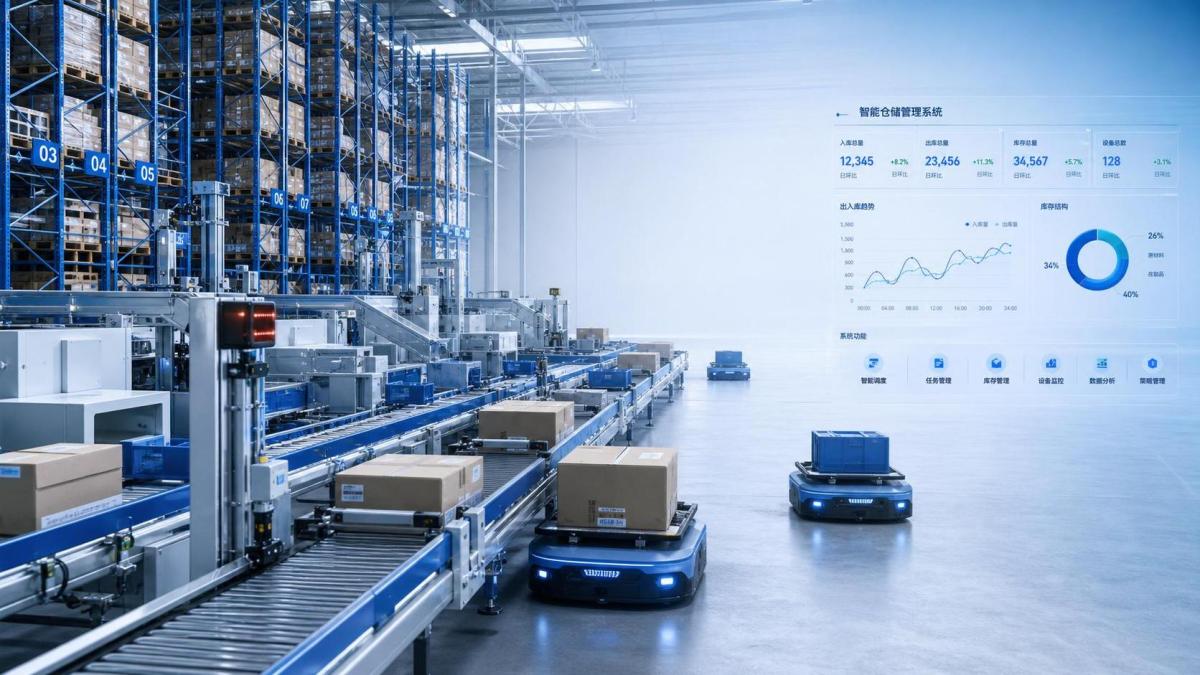
For enterprise decision-makers, warehouse automation software is no longer a tactical tool but a strategic control layer for throughput, accuracy, and cost resilience.
That shift matters because warehouse performance now affects service levels, inventory exposure, and capital efficiency at the same time.
In practice, many software evaluations still fail for one reason.
Teams buy into broad claims instead of testing how warehouse automation software handles real workflows, data quality, and system constraints.
A better approach starts with measurable requirements.
The right platform should improve task orchestration, connect cleanly with upstream and downstream systems, and produce ROI that can be audited.
This is especially relevant in environments using AMRs, AS/RS, conveyors, sortation, goods-to-person stations, and industrial scanning infrastructure.
From a selection standpoint, warehouse automation software should be assessed as an execution layer, not just a dashboard or workflow add-on.
What Warehouse Automation Software Actually Controls
At its core, warehouse automation software coordinates physical movement with digital decisions.
That includes release logic, routing, inventory state changes, exception handling, and labor-machine synchronization.
The strongest platforms make those controls visible in real time.
They also preserve transaction traceability, which becomes critical during audits, recalls, chargebacks, and supplier disputes.
This is where warehouse execution software and warehouse control software often overlap.
Some vendors package both functions together, while others separate orchestration from equipment-level control.
Either model can work, but the operational boundary must be clear before selection.
- Inventory visibility by location, status, and reservation logic
- Task orchestration across people, robots, and material handling equipment
- Exception management for jams, stockouts, scan failures, and route conflicts
- Performance telemetry for throughput, dwell time, and queue conditions
- Rule-based prioritization for service levels, cut-off times, and replenishment
If a platform cannot reliably handle those basics, advanced claims about AI optimization are usually premature.
Key Features That Deserve Close Review
Feature lists are easy to inflate, so selection should focus on operational depth.
The following capabilities usually separate usable warehouse automation software from software that looks strong only in demos.
1. Real-time orchestration
The system should assign, reprioritize, and rebalance tasks continuously.
Static wave logic is rarely enough in high-variability operations.
2. Equipment abstraction
Good warehouse automation software can work across mixed fleets and multiple vendors.
That lowers lock-in risk when AMRs, PLC-driven conveyors, or sorters change over time.
3. Exception-first workflow design
Normal-path automation matters, but recovery logic matters more.
Ask how the platform handles missing inventory, blocked aisles, short picks, and partial machine outages.
4. Configurable business rules
Operations evolve faster than most software release cycles.
That means warehouse automation software should support rule changes without custom code for every adjustment.
5. Decision-grade analytics
Dashboards are useful only when metrics connect to action.
Look for root-cause visibility by zone, process step, equipment type, order profile, and shift pattern.
Integration Points That Determine Long-Term Value
Integration is where many warehouse automation software projects either scale well or stall early.
A polished user interface does not offset weak system connectivity.
From recent deployments, the clearest signal is this.
The best warehouse automation software projects are designed around data contracts, latency expectations, and failure recovery paths from the start.
Core system integrations
- ERP for orders, inventory valuation, purchasing, and financial reconciliation
- WMS for inventory logic, receiving, putaway, picking, and shipping workflows
- TMS for dock scheduling, carrier planning, and departure alignment
- MES when warehouse flows support production staging or line-side replenishment
- PLC, SCADA, or vendor controllers for direct equipment communication
Data and device integrations
- Barcode and RFID infrastructure
- Vision systems for verification and exception capture
- AMR fleet managers and traffic orchestration layers
- Labor management and time systems
- Business intelligence platforms and data lakes
A practical evaluation question is not simply whether integrations exist.
It is whether the warehouse automation software supports stable APIs, event handling, version control, and observable error states.
That also means testing degraded modes.
What happens if ERP data lags, a robot fleet disconnects, or a scanner stream becomes unreliable for ten minutes?
How To Evaluate ROI Without Inflated Assumptions
ROI for warehouse automation software should be tied to operational baselines, not generic vendor calculators.
A sound model usually combines labor, accuracy, capacity, service, and risk variables.
More mature evaluations also include avoided costs.
That may include delayed building expansion, lower temporary labor dependence, and shorter training time for new operators.
Another useful metric is time-to-stable-operations.
If warehouse automation software reaches target performance only after prolonged tuning, projected ROI often slips.
Common Selection Risks and How To Pressure-Test Them
Several risks appear repeatedly during warehouse automation software selection.
- Over-scoping the first phase. Start with the highest-value workflows and prove control stability early.
- Ignoring data readiness. Inventory accuracy, master data quality, and naming discipline shape software performance.
- Confusing interface count with integration quality. Fewer, cleaner interfaces often scale better.
- Underestimating exception handling. Peak periods expose weak recovery logic faster than normal days do.
- Relying on scripted demos. Require scenario-based walkthroughs using your order profiles and failure cases.
In actual operations, the strongest proof usually comes from stress conditions.
Ask vendors to show how their warehouse automation software performs during surge volume, partial downtime, and late inventory updates.
That reveals more than polished presentations ever will.
A Practical Decision Framework
A useful selection framework for warehouse automation software should stay simple, but evidence-based.
- Define the operational bottleneck in measurable terms
- Map current and target workflows at decision-point level
- List required integrations, message timing, and fallback modes
- Quantify ROI with baseline data from a representative period
- Run vendor scenarios against peak, error, and recovery conditions
- Confirm governance for change requests, support, and version upgrades
This also aligns with a more disciplined engineering mindset.
At TechStat Vanguard, the useful question is never who claims leadership.
It is which warehouse automation software proves control accuracy, integration reliability, and measurable business impact under real operating conditions.
When the evaluation stays grounded in data, software selection becomes less about persuasion and more about operational truth.
Search News
Hot Articles
- Carbon Fiber StructuresHow to Specify Aerospace Carbon Fiber Assemblies for Lightweight, Load-Bearing PartsJul 11, 2026
- Machine VisionXiaomi, Alibaba DAMO Academy Drive Open-Source Robotics Model Ecosystem, Lowering Algorithm Development Barriers for Overseas SMEs Adopting Chinese Robotics SolutionsMar 30, 2026
- Cobots & ArmsShanxi 'AI+' Conference Showcases Embodied Intelligence with Multinational Buyer Engagement: Key Industry ImplicationsMar 30, 2026
Popular Tags
Recommended News
 Jul 11, 2026How to Specify Aerospace Carbon Fiber Assemblies for Lightweight, Load-Bearing PartsAerospace carbon fiber assemblies: learn how to specify laminate design, load data, joining methods, and inspection controls for lighter, reliable load-bearing aerospace parts.Elena Rostova (UAV Systems Researcher)
 Mar 30, 2026Xiaomi, Alibaba DAMO Academy Drive Open-Source Robotics Model Ecosystem, Lowering Algorithm Development Barriers for Overseas SMEs Adopting Chinese Robotics SolutionsXiaomi & Alibaba DAMO Academy's open-source robotics models lower algorithm barriers for global SMEs. Boost efficiency in manufacturing, logistics & smart retail with ROS 2 compatible solutions.TSV Data Lab
 Mar 30, 2026Shanxi 'AI+' Conference Showcases Embodied Intelligence with Multinational Buyer Engagement: Key Industry ImplicationsShanxi 'AI+' Conference highlights embodied intelligence with Tesla, Ubtech & Jiantao showcasing multimodal robotics. 40+ global buyers validated tech on-site, creating new B2B channels for industrial automation & AI solutions.Chen Wei (Automation Lead Engineer)
 Mar 30, 2026Zhongguancun Unveils 6G Integrated Sensing-Computing-Intelligence Platform to Empower Embodied Robots for Global Industrial ApplicationsZhongguancun's new 6G platform revolutionizes industrial robotics with <10ms latency, empowering global automotive, logistics & port automation. Discover how this tech boosts China's smart manufacturing exports.TSV Data Lab
 Mar 30, 2026Mech-Mind Tianjin Embodied Intelligence R&D and Production Base Goes Live, Cutting Delivery Time by 20%–30% for Global Customized AMR+Vision SolutionsMech-Mind's Tianjin AMR+Vision production base cuts delivery time by 20%-30% for欧美 & Latin American markets. Discover how this PLd-certified facility accelerates customized robotics solutions for smart manufacturing and logistics.Chen Wei (Automation Lead Engineer)
 Mar 30, 2026Boao Forum Reveals 'Co-evolution of Big and Small Brains' Trend in Humanoid Robots, China's Embodied Intelligence Accelerates Adaptation to Overseas Manufacturing Service ScenariosDiscover how China's humanoid robots, featuring 'Co-evolution of Big and Small Brains,' are revolutionizing global manufacturing. Learn about Embodied Tian Gong 3.0's ISO compliance and overseas deployment at Boao Forum 2026.Chen Wei (Automation Lead Engineer)
 Mar 30, 2026China Railway Industrial Secures Patent for Embodied Robotics in Material Handling, Boosting High-Precision Delivery Capabilities for Overseas Infrastructure and Manufacturing ProjectsChina Railway Industrial's new patent for embodied robotics in material handling boosts high-precision delivery for global infrastructure & manufacturing. Discover how this innovation enhances logistics accuracy in automotive, rail transit & EPC projects.Chen Wei (Automation Lead Engineer)
 Oct 12, 2026How to Verify RoHS Compliance in Industrial Sensing Systems Before DeploymentRoHS compliant sensing systems: learn how to verify materials, supplier declarations, testing, and configuration controls before industrial deployment.TSV Data Lab
 Oct 11, 2026How Procurement-Oriented Content Taxonomy Improves B2B Buying JourneysProcurement-oriented content taxonomy streamlines B2B buying journeys with clearer evidence, supplier comparisons, risk visibility, and faster approvals.TSV Data Lab
 Oct 10, 2026How to Select a Machine Performance Monitoring Platform for OEE and Downtime ReductionMachine performance monitoring platform selection guide: validate machine states, OEE data, downtime reasons, integrations, and scalability to reduce losses with confidence.TSV Data Lab
 Oct 08, 2026How to Machine Inconel 625 Blades Without Heat Cracks or Edge ChippingInconel 625 blade machining guide: prevent heat cracks, edge chipping, chatter, and work hardening with proven tooling, cooling, fixturing, and inspection strategies.Dr. Marcus Vance
 Oct 07, 2026How to Evaluate an HMI Panel Distributor for Industrial Automation ProjectsHMI panel distributor evaluation guide: verify technical compatibility, traceability, supply reliability, lifecycle support, and total cost for automation projects.Victor Lin (Chief Software Architect)
 Oct 06, 2026Navigation Fault Tolerance Standards for AMRs: What Safety Teams Must VerifyNavigation fault tolerance standards: learn what AMR safety teams must verify, from localization loss and sensor faults to stopping distance, safe restart, and site-specific validation.Chen Wei (Automation Lead Engineer)
 Oct 05, 2026Calculating Edge Computing Total Cost of Ownership Across Distributed SitesEdge computing ownership cost explained: calculate deployment, energy, connectivity, security, remote support, and refresh costs across distributed sites.TSV Data Lab
 Oct 04, 2026CAD/CAM Benchmarking in the GCC: What Manufacturers Should Ask a ConsultantCAD CAM benchmark consultant GCC guide: learn the key questions manufacturers should ask to validate post-processors, workflows, machine performance, and production risk.Victor Lin (Chief Software Architect)
 Oct 03, 2026Selecting Automotive Radar Sensor Modules for ADAS Range, Resolution, and IntegrationAutomotive radar sensor module selection guide for ADAS: compare range, resolution, field of view, latency, and integration to build safer, reliable vehicle systems.TSV Data Lab
 Oct 02, 2026How to Qualify Machined Parts Suppliers for Hard Tech ProgramsHard tech supply chain machined parts demand rigorous supplier qualification. Learn how to assess capability, traceability, quality controls, and delivery resilience.Dr. Marcus Vance
 Oct 01, 2026How to Select an Outdoor Security Radar Sensor for Perimeter Detection?Outdoor security radar sensor selection guide: compare range, accuracy, false-alarm control, integration, and field testing for reliable perimeter detection.TSV Data Lab
 Sep 30, 2026How to Evaluate Solid-State LiDAR Hardware for Outdoor Autonomous VehiclesSolid state LiDAR hardware evaluation guide for outdoor autonomous vehicles—compare range, point-cloud quality, environmental resilience, integration, and safety.TSV Data Lab
 Sep 29, 2026ISO 9283 Repeatability: How to Evaluate Cobot Positioning PerformanceISO 9283 cobot repeatability explained: learn how payload, reach, approach direction, and test conditions affect positioning performance and cell capability.Chen Wei (Automation Lead Engineer)
 Oct 11, 2026How payload and reach change the cost of an industrial robotCost of industrial robot systems depends heavily on payload and reach. Learn how sizing, torque, tooling, safety, and lifecycle factors shape smarter automation investments.Chen Wei (Automation Lead Engineer)
 Oct 10, 2026When does the cost of industrial robots pay back in high-volume production?Cost of industrial robots: discover how high-volume manufacturers calculate payback through uptime, cycle time, labor, quality, and integration before investing.Chen Wei (Automation Lead Engineer)
 Oct 09, 2026What does a manufacturing robot really cost beyond the purchase price?Manufacturing robot cost goes far beyond the purchase price. Explore integration, tooling, safety, uptime, and total ownership factors for smarter automation investments.Chen Wei (Automation Lead Engineer)
 Oct 08, 2026AGV vs. AMR: Which Is Better for Frequently Changing Routes?Which is better for changing routes? Compare AGVs and AMRs for flexible navigation, docking precision, traffic control, and faster facility reconfiguration.Chen Wei (Automation Lead Engineer)