MES system API integration latency can quietly break sync
Publication Date
author
MES system API integration latency often looks harmless in a dashboard trend line, but for enterprise manufacturers it can quietly undermine production synchronization, inventory accuracy, traceability, and decision speed. The central issue is not whether latency exists, but whether it is predictable, bounded, and engineered to match the business criticality of each process. For leaders responsible for digital manufacturing performance, the practical question is simple: when data arrives late, which operations become unreliable, and how much risk is accumulating before anyone notices?
The core search intent behind “mes system api integration latency” is diagnostic and strategic. Decision-makers are usually trying to understand whether API delays between MES, ERP, SCADA, PLC, WMS, quality, or analytics platforms are creating hidden operational losses. They are less interested in protocol theory than in business impact, warning signs, root causes, and a realistic path to improvement without disrupting production.
What these readers care about most is whether latency is hurting throughput, causing mismatched records, weakening compliance evidence, or distorting planning decisions. They also want a framework for evaluating vendors, internal teams, and integration architecture. In other words, they need to know what “acceptable latency” actually means, where the biggest risks sit, and how to prioritize fixes based on operational value rather than IT preference.
Why MES system API integration latency becomes a business problem before it becomes an IT incident
In many plants, latency does not trigger an obvious outage. Machines still run, dashboards still update, and orders still close eventually. That is exactly why the problem is dangerous. MES system API integration latency often degrades trust gradually rather than breaking a process all at once. By the time leaders notice the symptoms, the cost has already spread across production, quality, inventory, and planning.
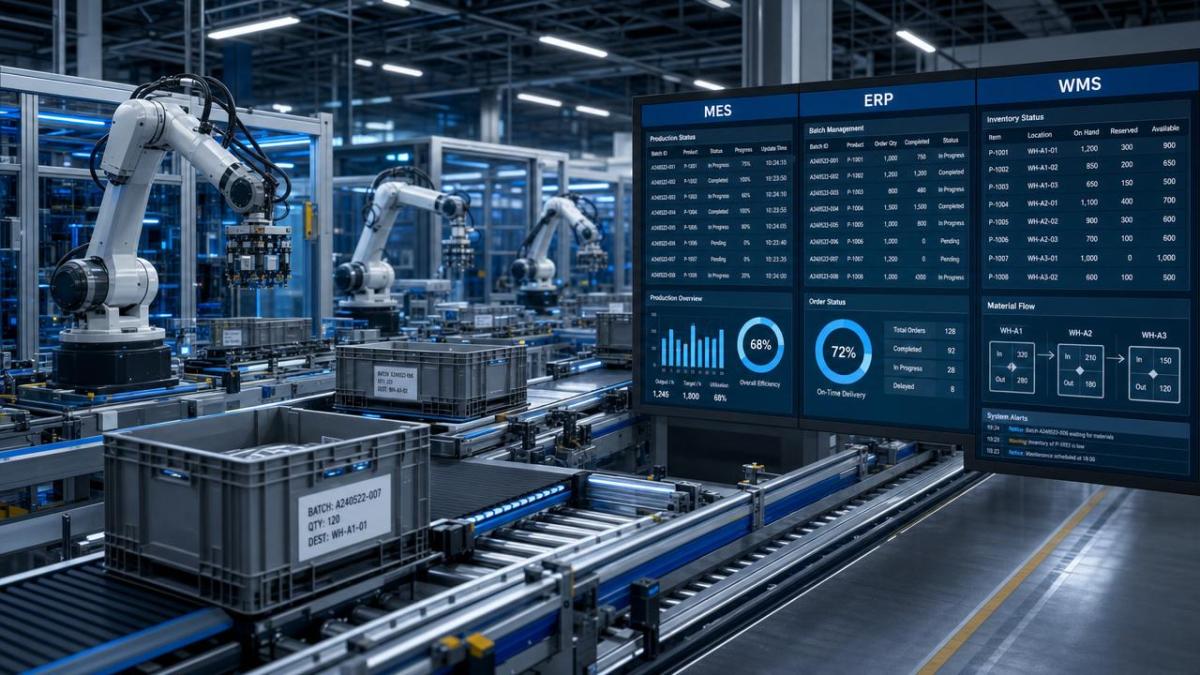
Consider a common scenario: the MES records machine output correctly, but the API push to ERP is delayed by several minutes. Inventory appears lower than reality, replenishment signals arrive late, planners make conservative decisions, and procurement overreacts to what looks like a shortage. Nothing has “failed” in the classic sense, yet the business is operating on stale information.
The same pattern appears in quality management. If inspection results, process deviations, or lot genealogy updates are delayed, nonconforming product may continue moving downstream before containment actions begin. In regulated or high-mix environments, that delay can increase scrap, rework, warranty exposure, and audit risk. The direct technical issue may be milliseconds or seconds, but the business consequence can be measured in hours, batches, or customer complaints.
For enterprise leaders, the first important conclusion is this: latency is not only a speed metric. It is a trust metric. When synchronization between systems becomes inconsistent, users create workarounds, spreadsheets reappear, manual reconciliations increase, and confidence in digital transformation declines. That erosion of trust is often more expensive than the infrastructure fix itself.
Where the latency usually comes from in a modern manufacturing stack
Most organizations initially blame the MES platform, but the source of delay is usually distributed. MES system API integration latency often emerges from the interaction of architecture choices, middleware design, network conditions, data model complexity, and transaction handling rules. Without tracing the full path, teams often optimize the wrong layer.
A frequent cause is excessive middleware orchestration. Many plants connect MES to ERP, WMS, CMMS, historian, and BI tools through iPaaS, ESB, API gateways, brokers, or custom services. Each layer adds validation, transformation, authentication, logging, retry logic, and queueing. None of these functions are unnecessary, but together they can create meaningful delay under load.
Another cause is polling-based integration where event-driven design would be better. If downstream systems only request updates every few minutes, then even a healthy MES cannot provide real-time synchronization. Leaders sometimes approve “real-time” projects that are architecturally limited to near-real-time from the start. That mismatch creates unrealistic expectations and recurring frustration.
Data granularity also matters. Some integrations transmit highly detailed machine, batch, genealogy, and quality data in large payloads. If APIs are not designed for selective updates, compression, batching strategy, or asynchronous processing, latency rises sharply during production peaks. This is especially common in plants that expanded digital capabilities over time without redesigning the data contract between systems.
There is also the issue of competing workloads. MES environments often handle operator transactions, machine connectivity, alarms, reporting, and integrations simultaneously. When compute resources, database performance, or message queues are undersized, API calls can be delayed even though each individual component appears technically “available.” Availability without responsiveness is a misleading comfort.
How latency quietly distorts operational decisions across the plant
Executives usually ask whether latency is a technical nuisance or a financial issue. The answer depends on which decisions are fed by delayed data. MES system API integration latency becomes costly when it affects actions that are time-sensitive, irreversible, or cross-functional. These are the points where stale data compounds into real business loss.
Production scheduling is a clear example. If ERP or APS receives delayed completion status from MES, planners may release work too early, sequence jobs inefficiently, or assume capacity constraints that no longer exist. The result can be excess WIP, unnecessary changeovers, underutilized assets, or avoidable overtime. Again, the API delay may be small, but the scheduling distortion can be large.
Inventory and material traceability present another high-risk area. If consumption confirmations lag behind actual production, inventory positions become temporarily false. That can trigger duplicate picks, delayed replenishment, or confusion over lot status. In sectors where genealogy is critical, delayed synchronization can make it harder to isolate affected product quickly during an investigation or recall event.
Maintenance is also affected. Many predictive and condition-based maintenance workflows depend on timely machine and event data moving from controls or edge systems through MES and into analytics platforms. When integration delays stretch unpredictably, maintenance teams lose confidence in alerts and may revert to preventive schedules. The organization pays twice: once for the digital investment and again for the old inefficiency.
Leadership reporting can be distorted as well. OEE, scrap, labor efficiency, order status, and fulfillment dashboards may appear accurate in aggregate while being misleading in operational time windows. A boardroom KPI can stay green while supervisors are manually correcting the underlying reality. This disconnect is one reason enterprise leaders should not evaluate integration health solely through executive dashboards.
What acceptable latency actually looks like depends on the process, not the platform
One of the biggest mistakes in digital manufacturing programs is discussing latency as a generic target. There is no universal “good” number for mes system api integration latency. The right threshold depends on process criticality, operational cadence, and the business cost of stale data. A packaging line, an aerospace machining cell, and a batch pharmaceutical process may all require different tolerances.
For machine control or closed-loop automation, milliseconds may matter. For production count updates to ERP, a delay of several seconds may be acceptable. For end-of-shift performance reporting, a few minutes may create little business harm. What matters is aligning latency budgets with decision windows. If the business needs a decision in thirty seconds, a five-minute synchronization delay is not a technical detail; it is a design failure.
Leaders should therefore ask teams to classify integrations by business criticality. Which flows are operationally immediate, which are near-real-time, and which are transactional or analytical? This classification helps prevent overengineering low-value connections while exposing the truly dangerous ones. It also creates a more disciplined investment conversation with vendors and internal architects.
A useful governance approach is to define service-level objectives for each major data flow, not just uptime commitments for systems. A plant may have excellent application availability but poor synchronization quality. Service-level objectives should include maximum acceptable delay, consistency expectations, retry behavior, error visibility, and escalation rules when thresholds are breached.
How to evaluate whether your current architecture is creating hidden sync risk
For enterprise decision-makers, the practical challenge is turning a vague concern into a measurable assessment. The best starting point is not a broad platform replacement discussion. It is a focused visibility exercise that maps critical data journeys from source event to business action. Without that map, latency remains anecdotal and politically debatable.
Start with a small number of high-value workflows: production confirmation to ERP, quality hold release, material consumption, downtime event synchronization, and lot genealogy updates. Measure end-to-end elapsed time, not just API response time at a single endpoint. Many teams report a fast API while ignoring queue delays, transformation lag, retries, and downstream commit times.
Next, compare observed latency against business consequences. Ask where users perform manual checks because they do not trust the system to be current. Ask which reconciliations happen daily or weekly between MES, ERP, and inventory records. Ask whether planning or quality decisions are ever delayed “until the system catches up.” These are strong indicators that sync risk already exists.
Then review the architecture for structural friction points. Is the integration heavily dependent on polling? Are there too many sequential transformations? Is every event passing through a centralized hub that becomes a bottleneck? Are payloads larger than they need to be? Is observability limited to system uptime instead of message-level tracing? These questions reveal whether the issue is occasional tuning or foundational design.
Finally, examine organizational ownership. MES system API integration latency often persists because no single team owns the full data journey. OT, IT, ERP, and external integrators each manage a segment, while no one governs end-to-end performance. Enterprise leaders can create immediate value simply by assigning cross-functional accountability to synchronization quality.
What improvement strategies deliver the highest ROI without unnecessary disruption
Not every latency problem requires a major replatforming effort. In many cases, the best returns come from targeted architectural and operational changes. The highest-ROI strategy is usually to fix the most business-critical synchronization paths first rather than launching a broad modernization program that takes too long to show value.
One common improvement is shifting from polling to event-driven integration where justified. Event-based updates reduce avoidable waiting time and improve consistency for workflows that depend on timely status changes. Another is redesigning APIs and payloads around operational purpose, sending only the data required for the downstream action instead of large generalized objects.
Queue and retry strategy should also be reviewed carefully. Resilience mechanisms are essential, but poorly designed retries can amplify congestion during peak loads. Intelligent prioritization is often more valuable than brute-force throughput. For example, quality holds and genealogy events may deserve priority over less time-sensitive reporting traffic.
Edge processing can help in environments with high machine data volumes or unstable connectivity. Rather than forwarding every raw signal upstream immediately, local processing can filter, aggregate, and normalize data before sending business-relevant events into MES and enterprise systems. This reduces traffic, improves responsiveness, and lowers central processing pressure.
Equally important is better observability. Leaders should require timestamping across the full integration chain, message tracing, queue depth monitoring, and alerting tied to business thresholds. If latency cannot be seen end-to-end, it cannot be governed. Visibility often uncovers that the biggest delay is not the API call itself, but a hidden transform, approval, or database commit step elsewhere.
What enterprise leaders should ask vendors and internal teams before approving MES integration investments
When evaluating new MES programs or remediation plans, executives should move beyond generic claims of “real-time integration.” Ask vendors and internal teams to specify latency expectations by workflow, load condition, and failure scenario. A credible partner should explain not only normal response times, but also how synchronization behaves under peak transactions, retries, or partial outages.
Ask for evidence of end-to-end observability. Can the architecture trace a production event from machine or operator action through MES to ERP and back to reporting layers? Can the team isolate whether delay comes from the MES, middleware, database, network, or downstream application? If not, ongoing diagnosis will remain slow and politically difficult.
Ask how the integration prioritizes business-critical messages. Not every event deserves the same treatment. A mature design recognizes that order completion, quality release, and genealogy updates may require tighter guarantees than routine historical uploads. This is where engineering discipline matters more than marketing language.
Also ask what happens when synchronization is late, not just when it fails. Silent degradation is the main risk. Teams should define thresholds that trigger alerts, fallback workflows, and operational responses before delays become systemic. If the only alarms are hard failures, then the organization is blind to the problem described in the article title.
Most importantly, ask for a business-case model. What will better synchronization reduce: inventory variance, unplanned downtime, rework, release delays, compliance effort, or manual reconciliation hours? Enterprise leaders fund latency improvements more confidently when the conversation is tied to measurable operational trust and decision quality.
Conclusion: latency is manageable, but only if it is treated as an operational risk
MES system API integration latency rarely looks dramatic at first glance, which is why it often persists longer than it should. Yet in connected manufacturing environments, small delays can propagate into planning errors, traceability gaps, quality exposure, and declining trust in digital systems. The real issue is not whether systems are connected, but whether they are synchronized at the speed the business actually needs.
For enterprise decision-makers, the clearest path forward is to treat latency as a governed operational risk rather than a background IT metric. Map the critical data flows, define process-based latency thresholds, measure end-to-end behavior, and prioritize the workflows where stale data creates the highest business cost. That approach turns a vague technical concern into a concrete performance program.
In practical terms, the organizations that handle mes system api integration latency best are not the ones with the most marketing claims about real-time manufacturing. They are the ones that align architecture, observability, and service objectives with engineering reality. When synchronization is designed around business-critical decisions, uptime improves, traceability strengthens, and leaders regain confidence that the plant is operating on truth rather than delayed signals.
Search News
Hot Articles
- Carbon Fiber StructuresHow to Specify Aerospace Carbon Fiber Assemblies for Lightweight, Load-Bearing PartsJul 11, 2026
- Machine VisionXiaomi, Alibaba DAMO Academy Drive Open-Source Robotics Model Ecosystem, Lowering Algorithm Development Barriers for Overseas SMEs Adopting Chinese Robotics SolutionsMar 30, 2026
- Cobots & ArmsShanxi 'AI+' Conference Showcases Embodied Intelligence with Multinational Buyer Engagement: Key Industry ImplicationsMar 30, 2026
Popular Tags
Recommended News
 Jul 11, 2026How to Specify Aerospace Carbon Fiber Assemblies for Lightweight, Load-Bearing PartsAerospace carbon fiber assemblies: learn how to specify laminate design, load data, joining methods, and inspection controls for lighter, reliable load-bearing aerospace parts.Elena Rostova (UAV Systems Researcher)
 Mar 30, 2026Xiaomi, Alibaba DAMO Academy Drive Open-Source Robotics Model Ecosystem, Lowering Algorithm Development Barriers for Overseas SMEs Adopting Chinese Robotics SolutionsXiaomi & Alibaba DAMO Academy's open-source robotics models lower algorithm barriers for global SMEs. Boost efficiency in manufacturing, logistics & smart retail with ROS 2 compatible solutions.TSV Data Lab
 Mar 30, 2026Shanxi 'AI+' Conference Showcases Embodied Intelligence with Multinational Buyer Engagement: Key Industry ImplicationsShanxi 'AI+' Conference highlights embodied intelligence with Tesla, Ubtech & Jiantao showcasing multimodal robotics. 40+ global buyers validated tech on-site, creating new B2B channels for industrial automation & AI solutions.Chen Wei (Automation Lead Engineer)
 Mar 30, 2026Zhongguancun Unveils 6G Integrated Sensing-Computing-Intelligence Platform to Empower Embodied Robots for Global Industrial ApplicationsZhongguancun's new 6G platform revolutionizes industrial robotics with <10ms latency, empowering global automotive, logistics & port automation. Discover how this tech boosts China's smart manufacturing exports.TSV Data Lab
 Mar 30, 2026Mech-Mind Tianjin Embodied Intelligence R&D and Production Base Goes Live, Cutting Delivery Time by 20%–30% for Global Customized AMR+Vision SolutionsMech-Mind's Tianjin AMR+Vision production base cuts delivery time by 20%-30% for欧美 & Latin American markets. Discover how this PLd-certified facility accelerates customized robotics solutions for smart manufacturing and logistics.Chen Wei (Automation Lead Engineer)
 Mar 30, 2026Boao Forum Reveals 'Co-evolution of Big and Small Brains' Trend in Humanoid Robots, China's Embodied Intelligence Accelerates Adaptation to Overseas Manufacturing Service ScenariosDiscover how China's humanoid robots, featuring 'Co-evolution of Big and Small Brains,' are revolutionizing global manufacturing. Learn about Embodied Tian Gong 3.0's ISO compliance and overseas deployment at Boao Forum 2026.Chen Wei (Automation Lead Engineer)
 Mar 30, 2026China Railway Industrial Secures Patent for Embodied Robotics in Material Handling, Boosting High-Precision Delivery Capabilities for Overseas Infrastructure and Manufacturing ProjectsChina Railway Industrial's new patent for embodied robotics in material handling boosts high-precision delivery for global infrastructure & manufacturing. Discover how this innovation enhances logistics accuracy in automotive, rail transit & EPC projects.Chen Wei (Automation Lead Engineer)
 Oct 10, 2026How to Select a Machine Performance Monitoring Platform for OEE and Downtime ReductionMachine performance monitoring platform selection guide: validate machine states, OEE data, downtime reasons, integrations, and scalability to reduce losses with confidence.TSV Data Lab
 Oct 08, 2026How to Machine Inconel 625 Blades Without Heat Cracks or Edge ChippingInconel 625 blade machining guide: prevent heat cracks, edge chipping, chatter, and work hardening with proven tooling, cooling, fixturing, and inspection strategies.Dr. Marcus Vance
 Oct 07, 2026How to Evaluate an HMI Panel Distributor for Industrial Automation ProjectsHMI panel distributor evaluation guide: verify technical compatibility, traceability, supply reliability, lifecycle support, and total cost for automation projects.Victor Lin (Chief Software Architect)
 Oct 06, 2026Navigation Fault Tolerance Standards for AMRs: What Safety Teams Must VerifyNavigation fault tolerance standards: learn what AMR safety teams must verify, from localization loss and sensor faults to stopping distance, safe restart, and site-specific validation.Chen Wei (Automation Lead Engineer)
 Oct 05, 2026Calculating Edge Computing Total Cost of Ownership Across Distributed SitesEdge computing ownership cost explained: calculate deployment, energy, connectivity, security, remote support, and refresh costs across distributed sites.TSV Data Lab
 Oct 04, 2026CAD/CAM Benchmarking in the GCC: What Manufacturers Should Ask a ConsultantCAD CAM benchmark consultant GCC guide: learn the key questions manufacturers should ask to validate post-processors, workflows, machine performance, and production risk.Victor Lin (Chief Software Architect)
 Oct 03, 2026Selecting Automotive Radar Sensor Modules for ADAS Range, Resolution, and IntegrationAutomotive radar sensor module selection guide for ADAS: compare range, resolution, field of view, latency, and integration to build safer, reliable vehicle systems.TSV Data Lab
 Oct 02, 2026How to Qualify Machined Parts Suppliers for Hard Tech ProgramsHard tech supply chain machined parts demand rigorous supplier qualification. Learn how to assess capability, traceability, quality controls, and delivery resilience.Dr. Marcus Vance
 Oct 01, 2026How to Select an Outdoor Security Radar Sensor for Perimeter Detection?Outdoor security radar sensor selection guide: compare range, accuracy, false-alarm control, integration, and field testing for reliable perimeter detection.TSV Data Lab
 Sep 30, 2026How to Evaluate Solid-State LiDAR Hardware for Outdoor Autonomous VehiclesSolid state LiDAR hardware evaluation guide for outdoor autonomous vehicles—compare range, point-cloud quality, environmental resilience, integration, and safety.TSV Data Lab
 Sep 29, 2026ISO 9283 Repeatability: How to Evaluate Cobot Positioning PerformanceISO 9283 cobot repeatability explained: learn how payload, reach, approach direction, and test conditions affect positioning performance and cell capability.Chen Wei (Automation Lead Engineer)
 Oct 10, 2026When does the cost of industrial robots pay back in high-volume production?Cost of industrial robots: discover how high-volume manufacturers calculate payback through uptime, cycle time, labor, quality, and integration before investing.Chen Wei (Automation Lead Engineer)
 Oct 09, 2026What does a manufacturing robot really cost beyond the purchase price?Manufacturing robot cost goes far beyond the purchase price. Explore integration, tooling, safety, uptime, and total ownership factors for smarter automation investments.Chen Wei (Automation Lead Engineer)
 Oct 08, 2026AGV vs. AMR: Which Is Better for Frequently Changing Routes?Which is better for changing routes? Compare AGVs and AMRs for flexible navigation, docking precision, traffic control, and faster facility reconfiguration.Chen Wei (Automation Lead Engineer)
 Oct 07, 2026How Much Does an Automated Guided Vehicle Cost in 2026?How much does an automated guided vehicle cost in 2026? Explore AGV price ranges, hidden deployment costs, and smart buying factors for stronger ROI.Chen Wei (Automation Lead Engineer)
 Oct 06, 2026Are Collaborative Robots Safe Enough to Operate Without Fencing?Are collaborative robots safe enough to work without fencing? Explore risk assessment, safeguarding options, and practical guidance for safer, productive cobot cells.Chen Wei (Automation Lead Engineer)
 Oct 05, 2026What Causes Machine Vision Systems to Miss Small Defects?What causes machine vision systems to miss small defects? Discover how lighting, optics, motion, and AI thresholds affect detection—and prevent costly escapes.TSV Data Lab