Digital twin for wind turbine pays off only with clean data
Publication Date
author
A digital twin for wind turbine delivers real ROI only when the underlying data is accurate, complete, and continuously validated. For enterprise decision-makers evaluating asset performance, predictive maintenance, and long-term energy yield, clean data is the foundation that turns simulation into measurable business value. This article examines why data integrity—not platform hype—determines whether digital twin investments reduce risk, improve uptime, and support better engineering decisions.
Why scenario differences matter before investing in a digital twin for wind turbine
For many executives, the phrase digital twin for wind turbine sounds universally beneficial. In practice, value depends on where the twin is used, who relies on its outputs, and how trustworthy the incoming data is. A fleet operator managing offshore assets has different priorities from an OEM validating drivetrain design, and both differ from an independent power producer trying to improve annual energy production. The business case changes with the scenario, but one rule stays constant: poor data quality destroys confidence faster than any software feature can restore it.
This is especially relevant in capital-intensive environments where maintenance windows are narrow, warranty exposure is high, and production losses are expensive. If sensor drift, missing SCADA tags, inconsistent naming conventions, or uncalibrated vibration channels enter the model, the digital representation stops reflecting engineering truth. For enterprise buyers, that means the conversation should not begin with dashboards or AI claims. It should begin with data lineage, validation logic, and operational fit.
Where a digital twin for wind turbine is most commonly applied
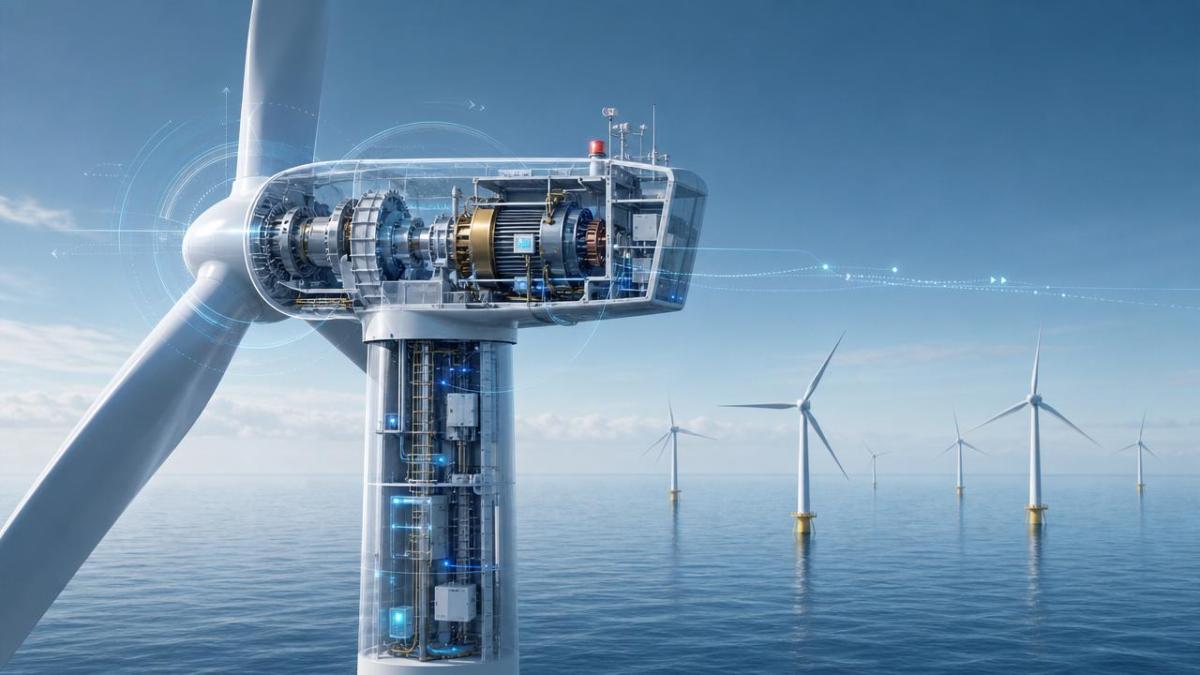
A digital twin for wind turbine typically appears in five high-value business scenarios. Each has a distinct decision objective, a different tolerance for uncertainty, and its own definition of ROI. Understanding these differences helps leaders avoid buying a generic platform for a highly specific problem.
For decision-makers, this table highlights a simple principle: the same digital twin architecture will not serve every objective equally. Clean data is not only a technical requirement; it is a business filter that determines whether the selected use case is realistic.
Scenario 1: Predictive maintenance requires the cleanest operational data
The most common justification for a digital twin for wind turbine is predictive maintenance. The goal is straightforward: detect anomalies before they become costly failures in bearings, gearboxes, generators, converters, blades, or yaw systems. This scenario attracts strong interest because downtime directly affects revenue and service costs.
However, this is also the scenario most vulnerable to noisy data. If vibration sensors are poorly calibrated, maintenance logs are incomplete, or SCADA sampling intervals change over time, the twin may learn the wrong baseline. That leads to two expensive outcomes: unnecessary maintenance triggered by false positives, or delayed intervention caused by false negatives.
A practical buyer question is not “Does the platform support predictive analytics?” but “Can we trust the data stream at the component level?” Enterprises should verify whether the system includes sensor health checks, outlier handling, missing-value logic, and event labeling tied to actual maintenance work orders. Without those controls, predictive maintenance becomes a high-cost experiment rather than a repeatable operating model.
Scenario 2: Energy yield optimization depends on contextual rather than isolated data
Another major application for a digital twin for wind turbine is improving energy yield. In this case, the twin is used to compare expected versus actual performance under changing wind conditions, wake interactions, curtailment rules, ambient temperature, turbulence intensity, and control strategy choices. The value comes from identifying why a turbine underperforms and whether the issue is mechanical, aerodynamic, environmental, or operational.
The data challenge here is subtle. Many organizations collect abundant data, but not enough context. A clean power output signal is not sufficient if wind speed sensors have location bias, nacelle anemometers drift, or curtailment status codes are inconsistently recorded. The twin may show underperformance, yet fail to separate true machine inefficiency from site conditions.
For executives focused on portfolio returns, the relevant question is whether the digital twin can normalize operating conditions well enough to support action. If not, the business risks adjusting controls, renegotiating service arrangements, or escalating supplier issues based on incomplete evidence. In yield optimization, clean data means contextual completeness, not just signal volume.
Scenario 3: Life extension and repowering decisions need historical integrity
A digital twin for wind turbine becomes especially strategic when assets approach the end of their original design life. Operators then need to decide whether to extend service, replace key components, repower the site, or retire specific units. These are board-level decisions because they affect capital allocation, insurance, compliance, and revenue forecasts.
In this scenario, short-term data cleanliness is not enough. The twin must rely on years of trustworthy operational history, load events, maintenance interventions, weather exposure, and fatigue accumulation. If legacy records are fragmented across different systems or if historical tags have changed without documentation, the model may underestimate risk or exaggerate degradation.
This is where disciplined engineering organizations outperform software-first implementations. They treat data governance as an asset management function. For decision-makers, a digital twin for wind turbine is suitable for life extension only when historical data can be reconciled into a defensible engineering narrative. If records are weak, the better investment may be data remediation before digital modeling.
Scenario 4: Warranty disputes and supplier accountability require evidence-grade data
In OEM, EPC, and owner-operator relationships, a digital twin for wind turbine can also support claims analysis. When recurring failures occur, the twin helps reconstruct conditions before an event, compare behavior across similar units, and test probable causes. This is valuable because large warranty disputes often depend on whether damage resulted from design limits, operating conditions, maintenance execution, or grid events.
Not every enterprise needs this use case as a first priority, but those with complex supplier ecosystems should pay attention. Timestamp synchronization, alarm sequence accuracy, firmware version traceability, and maintenance intervention logs become critical. If clocks are misaligned across systems, or alarm definitions changed over time, the twin may still generate attractive visuals while failing as evidence.
For senior procurement and technical leadership, this scenario reinforces the TSV principle that parameters do not lie when traceability is preserved. A digital twin only strengthens accountability if its data chain is auditable from source to conclusion.
How enterprise needs differ by asset owner, OEM, and service provider
The same digital twin for wind turbine will be evaluated differently depending on the buyer’s role in the value chain. This distinction matters because ROI metrics, acceptable data gaps, and deployment urgency vary across organizations.
This role-based view prevents a common mistake: choosing a solution optimized for engineering analysis when the actual need is operational workflow, or vice versa. The better question is not whether the technology is advanced, but whether the data architecture matches the job to be done.
Common misjudgments when selecting a digital twin for wind turbine
Several predictable errors reduce returns. First, companies often overestimate data readiness. They assume because SCADA, CMS, and maintenance systems exist, the information is clean enough for a digital twin. In reality, different sampling rates, missing historical windows, and inconsistent tag dictionaries can undermine model reliability from day one.
Second, some teams start with the most ambitious use case. A fleet-wide, self-learning digital twin for wind turbine sounds attractive, but if governance is immature, a narrower pilot tied to one failure mode or one wind farm usually produces more credible value. Third, organizations may confuse visualization with insight. Rich graphics do not compensate for weak sensor quality, poor metadata, or unverified assumptions.
Finally, buyers sometimes ignore accountability. If no team owns data standards, calibration discipline, and model validation, the twin becomes another IT layer instead of an engineering decision system. In hard-tech environments, ownership matters as much as software capability.
How to judge if your scenario is ready for deployment
Before approving budget, enterprise decision-makers should test readiness against a short set of practical questions. Is the target scenario clear: maintenance, yield, life extension, claims, or benchmarking? Are the required data sources available and time-synchronized? Have critical sensors been calibrated and monitored for drift? Can maintenance records be linked to operating events with enough precision to validate outcomes? And is there a baseline KPI that will prove business value after deployment?
If the answer to several of these questions is no, the right next step is often not more software. It is data cleanup, taxonomy alignment, and workflow discipline. That may feel less exciting than launching a digital transformation initiative, but it is the path that creates durable ROI. Clean data is not a preliminary task to rush through; it is the asset that makes a digital twin for wind turbine commercially credible.
FAQ: scenario-based questions from enterprise buyers
Is a digital twin for wind turbine worth it for smaller fleets?
Yes, if the business case is focused. Smaller fleets often benefit most from targeted applications such as gearbox anomaly detection or power curve deviation analysis. The key is not fleet size alone, but whether clean enough data exists to support a decision with measurable cost impact.
Which scenario usually delivers the fastest ROI?
Predictive maintenance often delivers the quickest visible return, especially when one failure mode causes repeated downtime. But it only works when condition monitoring, maintenance records, and operating context are reliable. Fast ROI and clean data are inseparable.
What is the biggest warning sign during vendor evaluation?
Any proposal that emphasizes AI outputs without detailing data validation, source reconciliation, and model verification should be treated cautiously. For a digital twin for wind turbine, credibility starts below the dashboard layer.
Final decision guidance for enterprise leaders
A digital twin for wind turbine is not a universal answer; it is a scenario-specific decision tool whose value rises or falls with data integrity. For maintenance-heavy operations, clean condition data drives uptime. For energy optimization, contextual completeness matters most. For life extension and claims analysis, historical traceability is essential. The smartest buyers therefore do not ask only what the platform can simulate. They ask what their data can honestly support.
For organizations committed to engineering truth through data, the path is clear: define the business scenario first, audit data quality second, and scale the digital twin only after the evidence proves it can guide action. That is how digital modeling moves from technology promise to operational payoff.
Search News
Hot Articles
- Carbon Fiber StructuresHow to Specify Aerospace Carbon Fiber Assemblies for Lightweight, Load-Bearing PartsJul 11, 2026
- Machine VisionXiaomi, Alibaba DAMO Academy Drive Open-Source Robotics Model Ecosystem, Lowering Algorithm Development Barriers for Overseas SMEs Adopting Chinese Robotics SolutionsMar 30, 2026
- Cobots & ArmsShanxi 'AI+' Conference Showcases Embodied Intelligence with Multinational Buyer Engagement: Key Industry ImplicationsMar 30, 2026
Popular Tags
Recommended News
 Jul 11, 2026How to Specify Aerospace Carbon Fiber Assemblies for Lightweight, Load-Bearing PartsAerospace carbon fiber assemblies: learn how to specify laminate design, load data, joining methods, and inspection controls for lighter, reliable load-bearing aerospace parts.Elena Rostova (UAV Systems Researcher)
 Mar 30, 2026Xiaomi, Alibaba DAMO Academy Drive Open-Source Robotics Model Ecosystem, Lowering Algorithm Development Barriers for Overseas SMEs Adopting Chinese Robotics SolutionsXiaomi & Alibaba DAMO Academy's open-source robotics models lower algorithm barriers for global SMEs. Boost efficiency in manufacturing, logistics & smart retail with ROS 2 compatible solutions.TSV Data Lab
 Mar 30, 2026Shanxi 'AI+' Conference Showcases Embodied Intelligence with Multinational Buyer Engagement: Key Industry ImplicationsShanxi 'AI+' Conference highlights embodied intelligence with Tesla, Ubtech & Jiantao showcasing multimodal robotics. 40+ global buyers validated tech on-site, creating new B2B channels for industrial automation & AI solutions.Chen Wei (Automation Lead Engineer)
 Mar 30, 2026Zhongguancun Unveils 6G Integrated Sensing-Computing-Intelligence Platform to Empower Embodied Robots for Global Industrial ApplicationsZhongguancun's new 6G platform revolutionizes industrial robotics with <10ms latency, empowering global automotive, logistics & port automation. Discover how this tech boosts China's smart manufacturing exports.TSV Data Lab
 Mar 30, 2026Mech-Mind Tianjin Embodied Intelligence R&D and Production Base Goes Live, Cutting Delivery Time by 20%–30% for Global Customized AMR+Vision SolutionsMech-Mind's Tianjin AMR+Vision production base cuts delivery time by 20%-30% for欧美 & Latin American markets. Discover how this PLd-certified facility accelerates customized robotics solutions for smart manufacturing and logistics.Chen Wei (Automation Lead Engineer)
 Mar 30, 2026Boao Forum Reveals 'Co-evolution of Big and Small Brains' Trend in Humanoid Robots, China's Embodied Intelligence Accelerates Adaptation to Overseas Manufacturing Service ScenariosDiscover how China's humanoid robots, featuring 'Co-evolution of Big and Small Brains,' are revolutionizing global manufacturing. Learn about Embodied Tian Gong 3.0's ISO compliance and overseas deployment at Boao Forum 2026.Chen Wei (Automation Lead Engineer)
 Mar 30, 2026China Railway Industrial Secures Patent for Embodied Robotics in Material Handling, Boosting High-Precision Delivery Capabilities for Overseas Infrastructure and Manufacturing ProjectsChina Railway Industrial's new patent for embodied robotics in material handling boosts high-precision delivery for global infrastructure & manufacturing. Discover how this innovation enhances logistics accuracy in automotive, rail transit & EPC projects.Chen Wei (Automation Lead Engineer)
 Sep 28, 2026Spindle Runout Measurement in Germany: DIN Standards, Methods, and Acceptance LimitsSpindle runout measurement Germany: explore DIN standards, proven methods, acceptance limits, and audit-ready practices for reliable machining quality.Dr. Marcus Vance
 Sep 27, 2026How to Select Wall-Mount Edge Devices for Space-Constrained Factory NetworksWall mount edge devices for space-constrained factories: evaluate workload, thermal design, power resilience, cable access, and network reliability for smarter deployments.TSV Data Lab
 Sep 26, 2026Machining Tolerance Analysis: How to Set Limits That Meet Function and Cost TargetsMachining tolerance analysis: learn how to set functional limits, control tolerance stacks, reduce inspection risk, and balance precision with production cost.Dr. Marcus Vance
 Sep 25, 2026How to Evaluate an Industrial Infrastructure Data Platform for Multi-Site OperationsIndustrial infrastructure data platform evaluation guide for multi-site operations: compare data quality, edge resilience, interoperability, governance, and scalable proof-of-value criteria.Victor Lin (Chief Software Architect)
 Sep 24, 2026How to Select Machine Vision Optics for Accurate Inspection at Different Working DistancesMachine vision optics selection guide for accurate inspection at every working distance. Compare FOV, pixel scale, DOF, distortion, lighting, and telecentric options.TSV Data Lab
 Sep 23, 2026How to Evaluate a Machine Vision System Integrator for High-Speed Inspection LinesChoose a machine vision system integrator with proven expertise in high-speed inspection, reliable reject timing, robust optics, and measurable acceptance criteria.TSV Data Lab
 Sep 28, 2026When is a SCADA API the right choice for connecting plant systems?SCADA API guide: learn when governed plant data integration improves traceability, security, and scalability—without compromising real-time control.Victor Lin (Chief Software Architect)
 Sep 27, 2026How SCADA data integration improves traceability across production linesSCADA data integration connects production-line data to improve traceability, accelerate quality investigations, and strengthen safety decisions.Victor Lin (Chief Software Architect)
 Sep 26, 2026What to define before starting SCADA integration planningSCADA integration planning starts with clear scope, control boundaries, data models, cybersecurity, and testing. Discover the definitions that reduce risk and costly rework.Victor Lin (Chief Software Architect)
 Sep 25, 2026How a smart factory with Industrial IoT reduces production blind spotsDiscover how a smart factory with Industrial IoT turns real-time machine, quality, and workflow data into actionable insights that reduce production blind spots and delivery risks.Victor Lin (Chief Software Architect)
 Sep 24, 2026When does Industrial IoT make smart manufacturing easier to scale?Smart manufacturing Industrial IoT scales when trusted data, interoperable systems, and secure workflows turn connected assets into measurable gains.TSV Data Lab
 Sep 23, 2026What drives ultra-precision machining cost at 1-micron tolerance?Ultra precision machining cost per part at 1 micron tolerance depends on process, material, metrology, and yield. Learn how to compare quotes confidently.Dr. Marcus Vance
 Sep 22, 2026Drone Engine-T550CC Applications: Build the UAV Power System Around the MissionAn application guide for Drone Engine-T550CC integration, covering payload planning, airframe matching, cooling, fuel, vibration, test procedures, documentation, and service preparation.Elena Rostova (UAV Systems Researcher)
 Sep 22, 2026How to Evaluate Industrial Edge Computing Vendors for Factory DeploymentIndustrial edge computing vendor evaluation guide for factories: compare latency, protocol fit, reliability, security, and lifecycle support before deployment.TSV Data Lab
 Sep 21, 2026Drone Payload Integration: Matching Power, Data, and Center of Gravity for Reliable FlightsDrone payload integration made practical: balance power, data, center of gravity, and endurance to build safer, more reliable mission-ready flights.Elena Rostova (UAV Systems Researcher)
 Sep 20, 2026Autonomous Navigation Pricing: Cost Drivers and Budget Benchmarks for AMR ProjectsAutonomous navigation price explained: compare AMR cost drivers, software, sensors, integration, safety, and lifecycle budgets to build a scalable project plan.Chen Wei (Automation Lead Engineer)
 Sep 19, 2026How to Scope Automation Integration Services for Multi-System Factory ProjectsAutomation integration services: learn how to scope multi-system factory projects with clear workflows, interface contracts, safety boundaries, and acceptance criteria.Victor Lin (Chief Software Architect)