Embedded AI module supplier quality is harder to verify remotely
Publication Date
author
For procurement teams, evaluating an embedded ai module supplier is no longer just about price sheets or polished presentations. Remote qualification often hides critical gaps in firmware stability, thermal performance, lifecycle support, and traceable test data. In high-stakes industrial sourcing, verifying real engineering capability from a distance has become harder—and more important—than ever.
That difficulty is not a temporary procurement inconvenience. It reflects a larger shift across advanced manufacturing, edge computing, industrial automation, UAV systems, smart sensing, and machine vision deployments. As embedded intelligence moves closer to the edge, buyers are no longer sourcing a simple board or component. They are evaluating a tightly coupled stack of silicon selection, power design, firmware maturity, thermal engineering, compliance discipline, and long-term support capacity. In this environment, the old remote audit model is showing its limits.
For sourcing leaders, this change matters because supplier qualification errors now travel further into the product lifecycle. A weak embedded ai module supplier may still look credible in a video meeting, present a clean demo, and offer attractive lead times. But under real field conditions, hidden weaknesses can emerge in electromagnetic compatibility, sustained inference load, update reliability, driver support, or component change management. The cost of discovering those issues after design-in is far higher than the cost of deeper verification upfront.
Why remote verification is becoming more difficult now
Several market signals explain why remote supplier validation has become harder. First, embedded AI adoption is expanding from pilot projects into production systems. Buyers are now applying embedded modules in robotics, industrial cameras, edge gateways, inspection equipment, mobile platforms, and aerospace-adjacent electronics. As deployment expands, tolerance for vague technical claims falls sharply. Procurement teams need evidence of sustained performance, not one-time demonstrations.
Second, the supplier landscape itself has changed. More vendors now position themselves as an embedded ai module supplier, but not all of them control the same level of engineering depth. Some are true design houses with board-level expertise, thermal validation capability, BIOS and BSP ownership, and strong lifecycle governance. Others are mostly commercial integrators assembling reference platforms with limited authority over root-cause analysis or long-term roadmap decisions. From a distance, these two profiles can look surprisingly similar.
Third, global procurement has become more distributed. Teams increasingly source across regions, time zones, and regulatory environments. Factory visits, engineering audits, and failure analysis reviews are not always easy to schedule. At the same time, product programs move faster, pushing buyers toward remote assessments that may skip physical inspection of lab capability, test instrumentation, incoming quality control, and document traceability.
Finally, AI workloads are becoming more demanding. It is relatively easy for a supplier to show benchmark screenshots. It is far more meaningful to prove stable inference throughput under thermal saturation, voltage fluctuation, extended uptime, and mixed peripheral loads. That gap between demonstration and deployment is exactly where remote verification often breaks down.
The sourcing trend has shifted from “can it run” to “can it survive production reality”
A major trend shaping buyer behavior is the move from capability screening to resilience screening. In earlier stages of edge AI adoption, buyers often focused on compute specs, interface counts, and unit pricing. Today, more procurement teams ask a harder question: can this embedded ai module supplier support stable production over years, not just a prototype sprint?
This shift is especially visible in industrial and mission-critical use cases. A module that performs well in a lab may fail expectations when exposed to enclosure heat, vibration, dust, intermittent connectivity, or regional component substitutions. As a result, procurement is moving closer to engineering validation. Supplier qualification now depends more on evidence such as thermal derating curves, revision control records, test plans, software maintenance windows, and end-of-life communication discipline.
This trend should not be read as pessimism. It is a sign of procurement maturity. Buyers are recognizing that an embedded ai module supplier must be assessed as a technical risk partner, not only as a catalog vendor.
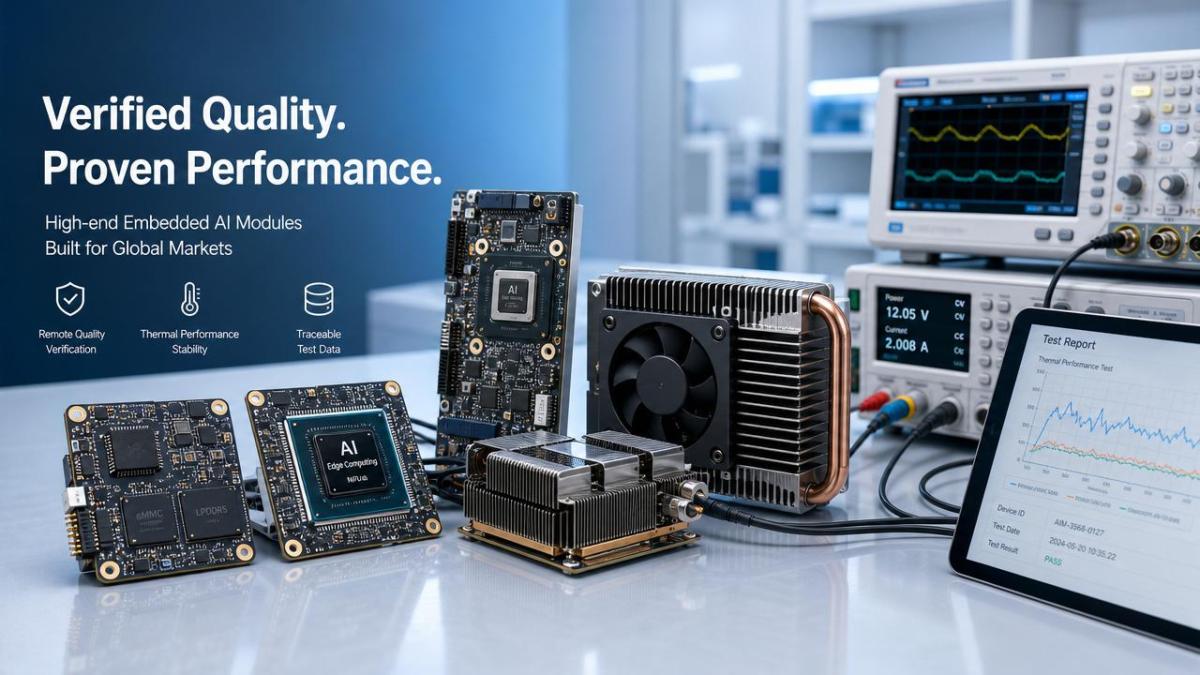
What is driving the verification gap
The verification gap is being driven by a combination of technical complexity, commercial pressure, and documentation inconsistency. One key factor is stack opacity. A module may rely on third-party reference designs, outsourced firmware adaptation, imported key components, or external software packages. If the supplier does not clearly own these dependencies, remote qualification becomes fragile. Buyers may not know where accountability actually sits.
Another factor is presentation asymmetry. In remote settings, suppliers control what the buyer sees. The meeting may highlight a stable demo unit but avoid disclosing test failures, thermal throttling behavior, open issue logs, or component alternates under evaluation. Without disciplined requests for raw evidence, procurement teams can overestimate readiness.
There is also a growing documentation challenge. As products evolve faster, some vendors struggle to maintain synchronized records across hardware revisions, software builds, validation reports, and compliance files. A capable embedded ai module supplier should be able to show version alignment and change history clearly. If not, remote qualification often turns into trust by presentation rather than trust by data.
Who feels the impact most across the buying cycle
The impact of weaker remote verification is not limited to purchasing departments. It spreads across engineering, quality, program management, and after-sales support. Different stakeholders feel the risk in different ways, and that is why supplier decisions should not be based on commercial signals alone.
For sectors with stricter reliability expectations, such as industrial automation, UAV payload systems, machine vision appliances, and edge inference devices deployed in harsh conditions, the consequences are more severe. Small weaknesses in qualification methods can become large warranty, redesign, or compliance costs later.
The strongest market signal: buyers now value traceability over polished claims
One of the clearest trend signals is the rising value of traceability. Procurement teams are increasingly skeptical of generalized claims such as “industrial grade,” “high reliability,” or “long-term supply.” What stands out now is a supplier’s ability to provide traceable engineering evidence. This includes serial-level test correlation, thermal records, validation procedures, software release notes, issue tracking discipline, and formal change communication.
This change aligns with a broader industrial purchasing pattern: credibility is moving from sales language to document integrity. A serious embedded ai module supplier should be prepared to support remote reviews with controlled documentation, recorded test conditions, and engineering-level Q&A. Buyers should treat missing evidence not as a paperwork inconvenience, but as a meaningful risk signal.
How procurement teams should adapt their remote qualification model
The answer is not simply to reject remote qualification. Global sourcing needs remote workflows. The better approach is to upgrade them. Procurement teams should move from presentation-led reviews to evidence-led reviews. Instead of asking only what a module can do, ask how the supplier proved it, under what conditions, and with what revision history.
A practical remote qualification model for an embedded ai module supplier should include three layers. The first layer is capability truth: who owns the hardware design, firmware stack, validation setup, and failure analysis process. The second layer is production truth: how the supplier manages incoming quality, component substitutions, test coverage, and revision release. The third layer is lifecycle truth: how they support software maintenance, field issue closure, and planned obsolescence communication.
It is also wise to request live evidence, not just static PDFs. For example, buyers can ask for a guided remote session showing environmental test records, version control practices, burn-in procedures, issue logs, and sample failure analysis reports. While this still does not replace an on-site audit, it creates a more realistic view of operational discipline.
What signals deserve close watching over the next sourcing cycle
Looking ahead, several signals will matter more when judging an embedded ai module supplier. First is software endurance. As AI modules become part of connected products, long-term patching, BSP updates, and security maintenance will influence supplier value more than one-time hardware cost. Second is thermal transparency. High compute density makes sustained thermal behavior a deciding factor in real deployment success.
Third is supply chain discipline. Procurement teams should monitor how suppliers communicate component risks, alternate qualifications, and product change notices. Fourth is application honesty. Strong suppliers tend to define operating boundaries clearly instead of overextending claims across every use case. Finally, responsiveness should be measured at the engineering level. Fast sales replies are useful, but fast root-cause support is what protects program schedules.
A grounded decision framework for buyers
If your team is selecting an embedded ai module supplier in the current market, the goal is not to find a perfect vendor. It is to reduce uncertainty before design commitment. That means comparing suppliers not only on cost and lead time, but on evidence quality, support ownership, validation maturity, and lifecycle control. In trend terms, the market is moving toward deeper technical scrutiny, whether buyers are fully prepared for it or not.
For organizations aligned with data-first sourcing principles, this shift is healthy. It favors suppliers that can prove engineering truth with test discipline and transparent records. It also helps buyers separate adaptable partners from presentation-driven sellers. In a more complex edge AI market, remote verification will remain challenging, but it does not need to remain shallow.
FAQ for procurement teams evaluating an embedded ai module supplier
Is remote qualification still reliable enough?
Yes, but only when the process is structured around traceable evidence. Remote reviews should include technical ownership checks, validation records, version discipline, and lifecycle commitments, not just introductory presentations.
What is the biggest hidden risk with an embedded ai module supplier?
The biggest risk is often not headline performance. It is the gap between a successful demo and sustained field reliability, especially in thermal behavior, firmware support, and controlled product changes.
Which documents are most useful during early screening?
Look for revision history, validation summaries, thermal test conditions, software maintenance policy, PCN/EOL process, and clarification of what design elements are owned directly by the supplier.
When should buyers escalate from remote review to on-site audit?
Escalation is wise when the module is entering a safety-sensitive, high-volume, harsh-environment, or long-lifecycle application, or when documentation quality does not match the importance of the program.
Closing perspective and next-step questions
The harder it becomes to verify an embedded ai module supplier remotely, the more valuable disciplined qualification becomes. The market is not simply getting noisier; it is becoming more layered, more software-dependent, and more sensitive to hidden engineering weaknesses. Buyers who respond with sharper evidence standards will make better long-term decisions.
If your business wants to judge how these trends affect current sourcing plans, start with a few practical questions: Who truly owns the design and debug path? What proof exists for thermal and long-duration stability? How controlled is the revision and lifecycle process? And if a failure appears six months after deployment, what evidence will your embedded ai module supplier be able to show—immediately, clearly, and with engineering accountability?
Search News
Hot Articles
- Carbon Fiber StructuresHow to Specify Aerospace Carbon Fiber Assemblies for Lightweight, Load-Bearing PartsJul 11, 2026
- Machine VisionXiaomi, Alibaba DAMO Academy Drive Open-Source Robotics Model Ecosystem, Lowering Algorithm Development Barriers for Overseas SMEs Adopting Chinese Robotics SolutionsMar 30, 2026
- Cobots & ArmsShanxi 'AI+' Conference Showcases Embodied Intelligence with Multinational Buyer Engagement: Key Industry ImplicationsMar 30, 2026
Popular Tags
Recommended News
 Jul 11, 2026How to Specify Aerospace Carbon Fiber Assemblies for Lightweight, Load-Bearing PartsAerospace carbon fiber assemblies: learn how to specify laminate design, load data, joining methods, and inspection controls for lighter, reliable load-bearing aerospace parts.Elena Rostova (UAV Systems Researcher)
 Mar 30, 2026Xiaomi, Alibaba DAMO Academy Drive Open-Source Robotics Model Ecosystem, Lowering Algorithm Development Barriers for Overseas SMEs Adopting Chinese Robotics SolutionsXiaomi & Alibaba DAMO Academy's open-source robotics models lower algorithm barriers for global SMEs. Boost efficiency in manufacturing, logistics & smart retail with ROS 2 compatible solutions.TSV Data Lab
 Mar 30, 2026Shanxi 'AI+' Conference Showcases Embodied Intelligence with Multinational Buyer Engagement: Key Industry ImplicationsShanxi 'AI+' Conference highlights embodied intelligence with Tesla, Ubtech & Jiantao showcasing multimodal robotics. 40+ global buyers validated tech on-site, creating new B2B channels for industrial automation & AI solutions.Chen Wei (Automation Lead Engineer)
 Mar 30, 2026Zhongguancun Unveils 6G Integrated Sensing-Computing-Intelligence Platform to Empower Embodied Robots for Global Industrial ApplicationsZhongguancun's new 6G platform revolutionizes industrial robotics with <10ms latency, empowering global automotive, logistics & port automation. Discover how this tech boosts China's smart manufacturing exports.TSV Data Lab
 Mar 30, 2026Mech-Mind Tianjin Embodied Intelligence R&D and Production Base Goes Live, Cutting Delivery Time by 20%–30% for Global Customized AMR+Vision SolutionsMech-Mind's Tianjin AMR+Vision production base cuts delivery time by 20%-30% for欧美 & Latin American markets. Discover how this PLd-certified facility accelerates customized robotics solutions for smart manufacturing and logistics.Chen Wei (Automation Lead Engineer)
 Mar 30, 2026Boao Forum Reveals 'Co-evolution of Big and Small Brains' Trend in Humanoid Robots, China's Embodied Intelligence Accelerates Adaptation to Overseas Manufacturing Service ScenariosDiscover how China's humanoid robots, featuring 'Co-evolution of Big and Small Brains,' are revolutionizing global manufacturing. Learn about Embodied Tian Gong 3.0's ISO compliance and overseas deployment at Boao Forum 2026.Chen Wei (Automation Lead Engineer)
 Mar 30, 2026China Railway Industrial Secures Patent for Embodied Robotics in Material Handling, Boosting High-Precision Delivery Capabilities for Overseas Infrastructure and Manufacturing ProjectsChina Railway Industrial's new patent for embodied robotics in material handling boosts high-precision delivery for global infrastructure & manufacturing. Discover how this innovation enhances logistics accuracy in automotive, rail transit & EPC projects.Chen Wei (Automation Lead Engineer)
 Sep 28, 2026Spindle Runout Measurement in Germany: DIN Standards, Methods, and Acceptance LimitsSpindle runout measurement Germany: explore DIN standards, proven methods, acceptance limits, and audit-ready practices for reliable machining quality.Dr. Marcus Vance
 Sep 27, 2026How to Select Wall-Mount Edge Devices for Space-Constrained Factory NetworksWall mount edge devices for space-constrained factories: evaluate workload, thermal design, power resilience, cable access, and network reliability for smarter deployments.TSV Data Lab
 Sep 26, 2026Machining Tolerance Analysis: How to Set Limits That Meet Function and Cost TargetsMachining tolerance analysis: learn how to set functional limits, control tolerance stacks, reduce inspection risk, and balance precision with production cost.Dr. Marcus Vance
 Sep 25, 2026How to Evaluate an Industrial Infrastructure Data Platform for Multi-Site OperationsIndustrial infrastructure data platform evaluation guide for multi-site operations: compare data quality, edge resilience, interoperability, governance, and scalable proof-of-value criteria.Victor Lin (Chief Software Architect)
 Sep 24, 2026How to Select Machine Vision Optics for Accurate Inspection at Different Working DistancesMachine vision optics selection guide for accurate inspection at every working distance. Compare FOV, pixel scale, DOF, distortion, lighting, and telecentric options.TSV Data Lab
 Sep 23, 2026How to Evaluate a Machine Vision System Integrator for High-Speed Inspection LinesChoose a machine vision system integrator with proven expertise in high-speed inspection, reliable reject timing, robust optics, and measurable acceptance criteria.TSV Data Lab
 Sep 28, 2026When is a SCADA API the right choice for connecting plant systems?SCADA API guide: learn when governed plant data integration improves traceability, security, and scalability—without compromising real-time control.Victor Lin (Chief Software Architect)
 Sep 27, 2026How SCADA data integration improves traceability across production linesSCADA data integration connects production-line data to improve traceability, accelerate quality investigations, and strengthen safety decisions.Victor Lin (Chief Software Architect)
 Sep 26, 2026What to define before starting SCADA integration planningSCADA integration planning starts with clear scope, control boundaries, data models, cybersecurity, and testing. Discover the definitions that reduce risk and costly rework.Victor Lin (Chief Software Architect)
 Sep 25, 2026How a smart factory with Industrial IoT reduces production blind spotsDiscover how a smart factory with Industrial IoT turns real-time machine, quality, and workflow data into actionable insights that reduce production blind spots and delivery risks.Victor Lin (Chief Software Architect)
 Sep 24, 2026When does Industrial IoT make smart manufacturing easier to scale?Smart manufacturing Industrial IoT scales when trusted data, interoperable systems, and secure workflows turn connected assets into measurable gains.TSV Data Lab
 Sep 23, 2026What drives ultra-precision machining cost at 1-micron tolerance?Ultra precision machining cost per part at 1 micron tolerance depends on process, material, metrology, and yield. Learn how to compare quotes confidently.Dr. Marcus Vance
 Sep 22, 2026Drone Engine-T550CC Applications: Build the UAV Power System Around the MissionAn application guide for Drone Engine-T550CC integration, covering payload planning, airframe matching, cooling, fuel, vibration, test procedures, documentation, and service preparation.Elena Rostova (UAV Systems Researcher)
 Sep 22, 2026How to Evaluate Industrial Edge Computing Vendors for Factory DeploymentIndustrial edge computing vendor evaluation guide for factories: compare latency, protocol fit, reliability, security, and lifecycle support before deployment.TSV Data Lab
 Sep 21, 2026Drone Payload Integration: Matching Power, Data, and Center of Gravity for Reliable FlightsDrone payload integration made practical: balance power, data, center of gravity, and endurance to build safer, more reliable mission-ready flights.Elena Rostova (UAV Systems Researcher)
 Sep 20, 2026Autonomous Navigation Pricing: Cost Drivers and Budget Benchmarks for AMR ProjectsAutonomous navigation price explained: compare AMR cost drivers, software, sensors, integration, safety, and lifecycle budgets to build a scalable project plan.Chen Wei (Automation Lead Engineer)
 Sep 19, 2026How to Scope Automation Integration Services for Multi-System Factory ProjectsAutomation integration services: learn how to scope multi-system factory projects with clear workflows, interface contracts, safety boundaries, and acceptance criteria.Victor Lin (Chief Software Architect)