
What Breaks First in a UAV Data Link Under Interference
Publication Date
author
When interference hits a UAV, the first failure is rarely random—it usually starts where link margin, modulation robustness, and onboard recovery logic are weakest. For field maintenance and reliability work, understanding that sequence matters more than memorizing a generic “anti-jamming” claim. In practice, video breakup, control latency, telemetry gaps, and return-link instability do not fail at the same time. This article explains how to judge what breaks first in different operating scenes, what evidence to collect, and what to confirm with a uav data link supplier before a recoverable degradation becomes a mission-ending loss.
When the Operating Scene Changes, the First Broken Layer Changes Too
A UAV data link is not a single pipe. It is a stack of radio frequency margin, antenna geometry, modulation and coding, packet scheduling, encryption overhead, and flight-controller recovery logic. Under interference, the weakest layer depends on the scene. A short-range inspection flight near steel structures behaves differently from a long-range mapping mission over open terrain. The same hardware can fail first in video downlink in one case and uplink command stability in another.
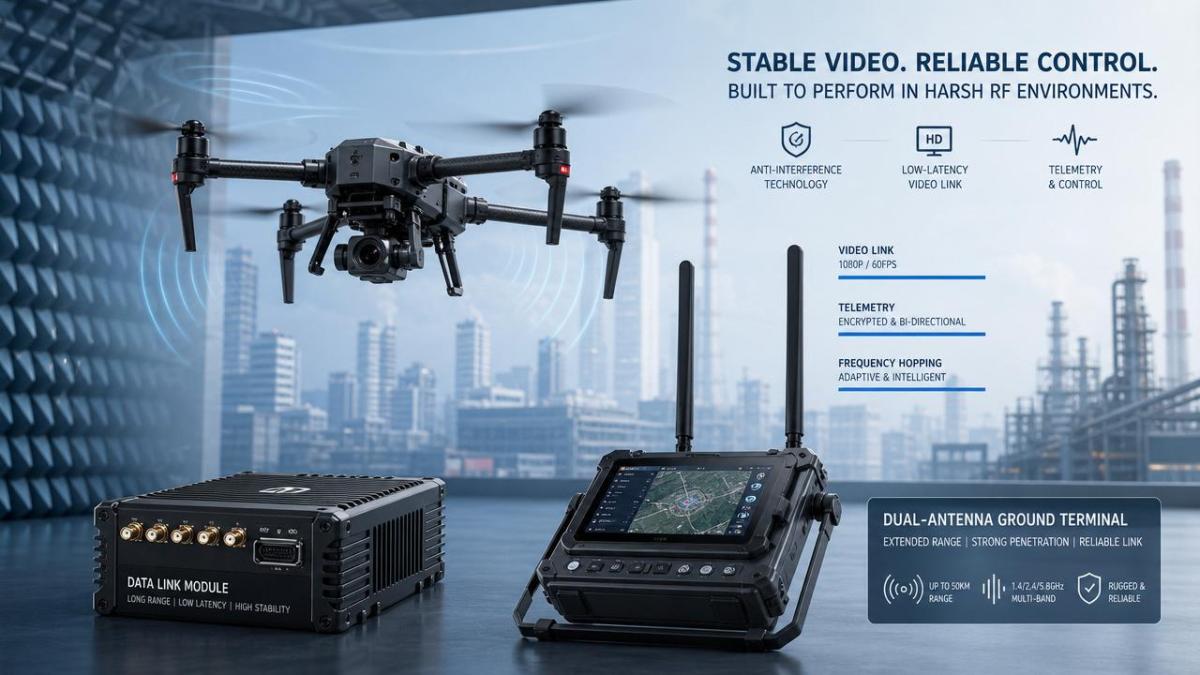
That is why a serious uav data link supplier should provide more than nominal range. Useful validation data includes sensitivity thresholds, packet error rate versus jammer power, handoff delay, forward error correction behavior, and recovery time after burst interference. Without those numbers, maintenance teams are forced to diagnose symptoms instead of causes.
Scene 1: Urban Inspection Usually Breaks Video First, Then Operator Confidence
In dense urban flights, the first visible failure is often not total link loss but unstable video. Reflections from glass, concrete, and metal create multipath fading, while Wi-Fi, private LTE, and industrial wireless systems raise the noise floor. The downlink carrying compressed video typically consumes more bandwidth than telemetry, so it has less tolerance once signal quality drops.
The key judgment point is whether the issue starts as image mosaic, frame freeze, rising latency, or intermittent black screen. If control remains stable while video degrades, the failure is usually at the throughput and modulation layer rather than full RF collapse. In this scene, a reliable uav data link supplier should document adaptive bitrate behavior, MCS fallback steps, and antenna recommendations for side-looking urban routes.
What to verify on site
- RSSI or SNR trend before video breakup, not just at failure.
- Frame latency increase under static hover versus moving turn.
- Antenna masking by payload, landing gear, or battery compartment.
- Whether bitrate adaptation recovers automatically after interference clears.
Scene 2: Long-Range Mapping Often Loses Telemetry Consistency Before Hard Disconnect
In open-area mapping, operators expect cleaner spectrum, but long distance reduces link margin steadily. Here, the first break is often subtle telemetry inconsistency rather than immediate control loss. Position updates may arrive late, health packets may be skipped, and ground-station status may look “good enough” while error correction is already saturated.
This matters because mapping missions depend on timing integrity. If telemetry timestamps drift or packet jitter grows, route confidence falls before the aircraft actually disconnects. Ask any uav data link supplier for sustained link performance at edge-of-range, including packet loss under continuous payload transmission, not only a maximum-distance claim from a clean test corridor.
Core judgment points
Watch for repeated FEC correction spikes, increased retry count, and growing command acknowledgment delay. If these appear while video is still acceptable, telemetry resilience is already being consumed. In many systems, this is the stage where maintenance logs become more valuable than pilot impressions.
Scene 3: Industrial Sites and Ports Can Break the Uplink First
At factories, ports, substations, and logistics yards, interference is often directional and pulsed. Cranes, inverters, radar, microwave backhaul, and switching power equipment can produce short bursts that hit the command uplink at the worst moment. In these environments, the aircraft may still stream video, but stick response or waypoint updates become delayed or ignored.
That distinction is critical. If downlink video looks normal but control response feels soft, the first broken element may be uplink packet reliability or command priority scheduling. A competent uav data link supplier should disclose uplink/downlink asymmetry, command channel redundancy, and whether emergency control packets are isolated from payload congestion.
Scene 4: Mobile or Multi-UAV Operations Expose Recovery Logic Before RF Limits
In convoy tracking, moving-vehicle launch, or multi-UAV operation, the first failure may be neither raw signal nor bandwidth. It may be reconnection logic, channel reselection delay, or poor coexistence between aircraft. Fast topology change stresses synchronization, buffer control, and channel management. A short interference burst can trigger a recovery sequence that takes longer than the actual disturbance.
This is where spec-sheet range becomes almost irrelevant. The more useful questions for a uav data link supplier are: How long does the link need to re-stabilize after a burst jammer event? What happens when two nearby aircraft shift channels simultaneously? Does the system prioritize flight-critical packets during rescan or handoff?
How Different Scenes Change What You Should Measure First
Scene-Based Fit Recommendations Before the Next Field Failure
- For urban operations: prioritize multipath tolerance, directional antenna placement, and tested bitrate adaptation over headline range.
- For long corridors or mapping: require logged edge-of-range telemetry stability and recovery thresholds, not just average throughput.
- For industrial EMI zones: verify command-channel priority, burst-noise resilience, and shielding guidance for onboard installation.
- For moving or networked fleets: focus on reconnection behavior, channel coordination, and latency stability during topology changes.
- For all scenarios: request raw test methodology from the uav data link supplier, including jammer type, distance, antenna orientation, and traffic load during validation.
Common Misjudgments That Hide the Real Failure Point
One common mistake is treating “signal bars” as a full health indicator. Interference failures often begin with rising error correction load and jitter while apparent signal strength still looks usable. Another error is assuming the first visible symptom is the root cause. Video freeze may be a result of retransmission saturation, not a camera or encoder issue.
A third misjudgment is comparing two systems only by power output or nominal kilometers. Link survival under interference depends on receiver sensitivity, coding efficiency, antenna isolation, and recovery software as much as transmitter power. This is exactly where a trustworthy uav data link supplier separates engineering truth from marketing language.
What to Do Next: Build a Failure Sequence Checklist
The practical next step is to document the failure sequence for each operating scene: what degrades first, what metric changes first, and what recovery action works fastest. Use flight logs to correlate SNR, PER, retry count, uplink acknowledgment delay, video latency, and relink time. Then compare those findings with the test evidence from your uav data link supplier.
If supplier data cannot show scene-specific interference behavior, the risk is not just lower performance—it is uncertain maintenance response and repeated field faults. Strong UAV reliability starts with asking sharper questions: which layer breaks first, under what interference pattern, and how quickly the system recovers. That is the level of detail that turns a uav data link supplier from a component source into a dependable engineering partner.
Search News
Hot Articles
- Carbon Fiber StructuresHow to Specify Aerospace Carbon Fiber Assemblies for Lightweight, Load-Bearing PartsJul 11, 2026
- Machine VisionXiaomi, Alibaba DAMO Academy Drive Open-Source Robotics Model Ecosystem, Lowering Algorithm Development Barriers for Overseas SMEs Adopting Chinese Robotics SolutionsMar 30, 2026
- Cobots & ArmsShanxi 'AI+' Conference Showcases Embodied Intelligence with Multinational Buyer Engagement: Key Industry ImplicationsMar 30, 2026
Popular Tags
Recommended News
 Jul 11, 2026How to Specify Aerospace Carbon Fiber Assemblies for Lightweight, Load-Bearing PartsAerospace carbon fiber assemblies: learn how to specify laminate design, load data, joining methods, and inspection controls for lighter, reliable load-bearing aerospace parts.Elena Rostova (UAV Systems Researcher)
 Mar 30, 2026Xiaomi, Alibaba DAMO Academy Drive Open-Source Robotics Model Ecosystem, Lowering Algorithm Development Barriers for Overseas SMEs Adopting Chinese Robotics SolutionsXiaomi & Alibaba DAMO Academy's open-source robotics models lower algorithm barriers for global SMEs. Boost efficiency in manufacturing, logistics & smart retail with ROS 2 compatible solutions.TSV Data Lab
 Mar 30, 2026Shanxi 'AI+' Conference Showcases Embodied Intelligence with Multinational Buyer Engagement: Key Industry ImplicationsShanxi 'AI+' Conference highlights embodied intelligence with Tesla, Ubtech & Jiantao showcasing multimodal robotics. 40+ global buyers validated tech on-site, creating new B2B channels for industrial automation & AI solutions.Chen Wei (Automation Lead Engineer)
 Mar 30, 2026Zhongguancun Unveils 6G Integrated Sensing-Computing-Intelligence Platform to Empower Embodied Robots for Global Industrial ApplicationsZhongguancun's new 6G platform revolutionizes industrial robotics with <10ms latency, empowering global automotive, logistics & port automation. Discover how this tech boosts China's smart manufacturing exports.TSV Data Lab
 Mar 30, 2026Mech-Mind Tianjin Embodied Intelligence R&D and Production Base Goes Live, Cutting Delivery Time by 20%–30% for Global Customized AMR+Vision SolutionsMech-Mind's Tianjin AMR+Vision production base cuts delivery time by 20%-30% for欧美 & Latin American markets. Discover how this PLd-certified facility accelerates customized robotics solutions for smart manufacturing and logistics.Chen Wei (Automation Lead Engineer)
 Mar 30, 2026Boao Forum Reveals 'Co-evolution of Big and Small Brains' Trend in Humanoid Robots, China's Embodied Intelligence Accelerates Adaptation to Overseas Manufacturing Service ScenariosDiscover how China's humanoid robots, featuring 'Co-evolution of Big and Small Brains,' are revolutionizing global manufacturing. Learn about Embodied Tian Gong 3.0's ISO compliance and overseas deployment at Boao Forum 2026.Chen Wei (Automation Lead Engineer)
 Mar 30, 2026China Railway Industrial Secures Patent for Embodied Robotics in Material Handling, Boosting High-Precision Delivery Capabilities for Overseas Infrastructure and Manufacturing ProjectsChina Railway Industrial's new patent for embodied robotics in material handling boosts high-precision delivery for global infrastructure & manufacturing. Discover how this innovation enhances logistics accuracy in automotive, rail transit & EPC projects.Chen Wei (Automation Lead Engineer)
 Sep 29, 2026ISO 9283 Repeatability: How to Evaluate Cobot Positioning PerformanceISO 9283 cobot repeatability explained: learn how payload, reach, approach direction, and test conditions affect positioning performance and cell capability.Chen Wei (Automation Lead Engineer)
 Sep 28, 2026Spindle Runout Measurement in Germany: DIN Standards, Methods, and Acceptance LimitsSpindle runout measurement Germany: explore DIN standards, proven methods, acceptance limits, and audit-ready practices for reliable machining quality.Dr. Marcus Vance
 Sep 27, 2026How to Select Wall-Mount Edge Devices for Space-Constrained Factory NetworksWall mount edge devices for space-constrained factories: evaluate workload, thermal design, power resilience, cable access, and network reliability for smarter deployments.TSV Data Lab
 Sep 26, 2026Machining Tolerance Analysis: How to Set Limits That Meet Function and Cost TargetsMachining tolerance analysis: learn how to set functional limits, control tolerance stacks, reduce inspection risk, and balance precision with production cost.Dr. Marcus Vance
 Sep 25, 2026How to Evaluate an Industrial Infrastructure Data Platform for Multi-Site OperationsIndustrial infrastructure data platform evaluation guide for multi-site operations: compare data quality, edge resilience, interoperability, governance, and scalable proof-of-value criteria.Victor Lin (Chief Software Architect)
 Sep 24, 2026How to Select Machine Vision Optics for Accurate Inspection at Different Working DistancesMachine vision optics selection guide for accurate inspection at every working distance. Compare FOV, pixel scale, DOF, distortion, lighting, and telecentric options.TSV Data Lab
 Sep 23, 2026How to Evaluate a Machine Vision System Integrator for High-Speed Inspection LinesChoose a machine vision system integrator with proven expertise in high-speed inspection, reliable reject timing, robust optics, and measurable acceptance criteria.TSV Data Lab
 Sep 28, 2026When is a SCADA API the right choice for connecting plant systems?SCADA API guide: learn when governed plant data integration improves traceability, security, and scalability—without compromising real-time control.Victor Lin (Chief Software Architect)
 Sep 27, 2026How SCADA data integration improves traceability across production linesSCADA data integration connects production-line data to improve traceability, accelerate quality investigations, and strengthen safety decisions.Victor Lin (Chief Software Architect)
 Sep 26, 2026What to define before starting SCADA integration planningSCADA integration planning starts with clear scope, control boundaries, data models, cybersecurity, and testing. Discover the definitions that reduce risk and costly rework.Victor Lin (Chief Software Architect)
 Sep 25, 2026How a smart factory with Industrial IoT reduces production blind spotsDiscover how a smart factory with Industrial IoT turns real-time machine, quality, and workflow data into actionable insights that reduce production blind spots and delivery risks.Victor Lin (Chief Software Architect)
 Sep 24, 2026When does Industrial IoT make smart manufacturing easier to scale?Smart manufacturing Industrial IoT scales when trusted data, interoperable systems, and secure workflows turn connected assets into measurable gains.TSV Data Lab
 Sep 23, 2026What drives ultra-precision machining cost at 1-micron tolerance?Ultra precision machining cost per part at 1 micron tolerance depends on process, material, metrology, and yield. Learn how to compare quotes confidently.Dr. Marcus Vance
 Sep 22, 2026Drone Engine-T550CC Applications: Build the UAV Power System Around the MissionAn application guide for Drone Engine-T550CC integration, covering payload planning, airframe matching, cooling, fuel, vibration, test procedures, documentation, and service preparation.Elena Rostova (UAV Systems Researcher)
 Sep 22, 2026How to Evaluate Industrial Edge Computing Vendors for Factory DeploymentIndustrial edge computing vendor evaluation guide for factories: compare latency, protocol fit, reliability, security, and lifecycle support before deployment.TSV Data Lab
 Sep 21, 2026Drone Payload Integration: Matching Power, Data, and Center of Gravity for Reliable FlightsDrone payload integration made practical: balance power, data, center of gravity, and endurance to build safer, more reliable mission-ready flights.Elena Rostova (UAV Systems Researcher)
 Sep 20, 2026Autonomous Navigation Pricing: Cost Drivers and Budget Benchmarks for AMR ProjectsAutonomous navigation price explained: compare AMR cost drivers, software, sensors, integration, safety, and lifecycle budgets to build a scalable project plan.Chen Wei (Automation Lead Engineer)























