Automated Palletizing for Food Industry and Washdown Reality
Publication Date
author
In food manufacturing, an automated palletizing system for food industry operations must do more than boost throughput—it must survive aggressive washdown routines, hygiene audits, and nonstop production demands. For enterprise decision-makers, the real question is not automation alone, but whether the system can deliver reliable uptime, sanitary compliance, and measurable engineering performance under harsh plant conditions.
That distinction matters because palletizing sits at the intersection of labor availability, line balance, packaging integrity, and sanitation control. A system that performs well in a dry secondary packaging area may fail prematurely in a high-moisture zone exposed to daily foaming chemicals, 60–90 minute washdown cycles, temperature swings, and bacterial risk controls. In practice, selecting the right automated palletizing system for food industry use requires a broader engineering lens than simple cycle-rate claims.
For plant directors, operations leaders, CTOs, and procurement teams, the most useful evaluation framework is data-first: What ingress protection is required? Which materials can tolerate alkaline and acidic cleaners? How many product changeovers occur per shift? What pallet patterns must be supported? What is the true maintenance interval under wet conditions? These questions determine whether an investment improves OEE over 24 months or turns into a reliability burden after the first quarter.
Why Washdown Reality Changes the Palletizing Decision
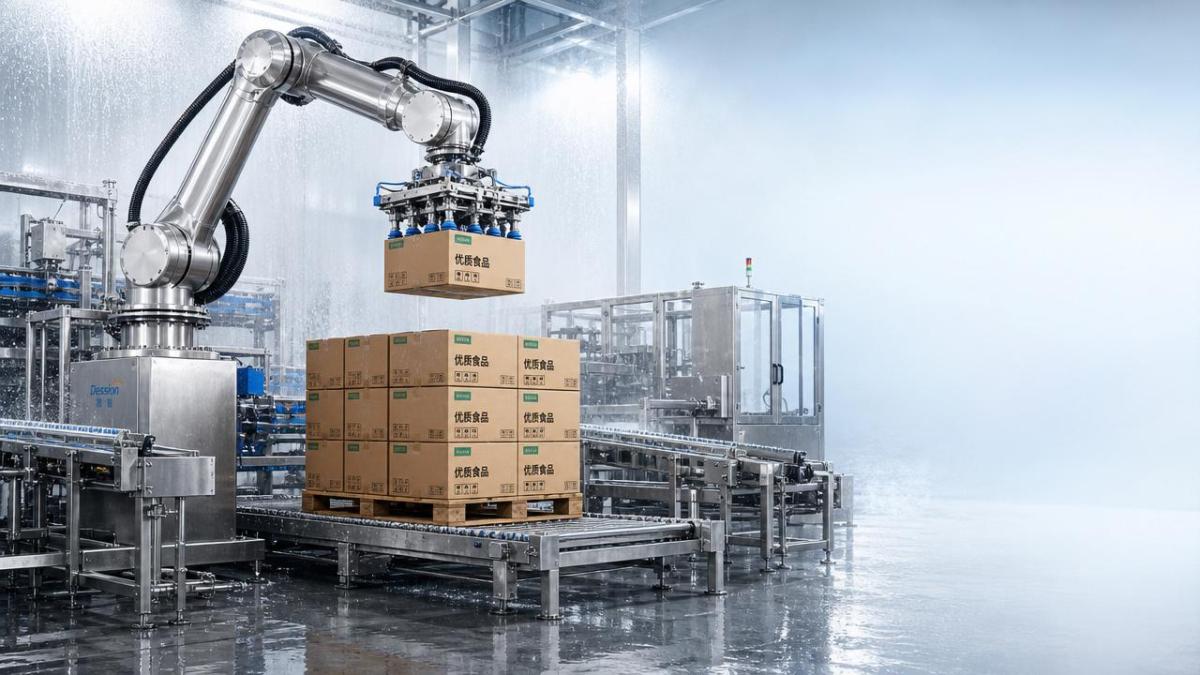
In many food plants, sanitation is not a side requirement; it is a core production constraint. Facilities handling meat, poultry, seafood, dairy, frozen foods, fresh produce, or allergen-sensitive products often run 1 to 3 washdown events per day, with some areas subject to full high-pressure cleaning 5 to 7 days per week. Under those conditions, automation hardware faces water ingress, detergent exposure, condensate formation, and corrosion risk that standard industrial equipment was never designed to absorb.
This is why an automated palletizing system for food industry environments must be evaluated not only by payload and speed, but by hygienic design discipline. Sealed bearings, smooth welds, sloped surfaces, cable management, enclosure integrity, and stainless or coated components all affect long-term survival. If standing water collects on a flat frame member or if a motor housing traps residue, the sanitation team inherits hidden risk and the maintenance team inherits hidden cost.
Typical Environmental Stressors in Food Plants
The harshest palletizing environments usually combine four variables at once: moisture, chemicals, temperature change, and production pressure. Water alone is manageable. Water plus chlorinated foam, pH swings, and thermal cycling is what degrades seals, weakens coatings, and shortens electrical component life. On lines running 40 to 80 cases per minute, even a 20-minute stop can cascade into upstream accumulation, rework, or missed shipment windows.
- Frequent washdown exposure ranging from low-pressure rinse to direct spray
- Chemical contact from alkaline cleaners, sanitizers, and occasional acidic agents
- Ambient temperatures from 2°C chilled areas to 35°C packaging zones
- Condensation and humidity spikes during shift change and sanitation windows
- Mixed packaging formats such as cartons, bags, trays, pouches, and display cases
The table below outlines how washdown severity should influence system architecture decisions. For procurement teams, this is often more useful than a generic “food-grade” claim, because it translates environmental reality into engineering specifications.
The key takeaway is simple: the correct automated palletizing system for food industry applications starts with environmental classification. If buyers evaluate equipment as if all packaging areas are equivalent, they often overspend on dry zones and under-specify in wet zones. Both mistakes reduce ROI.
The Cost of Misalignment Between Sanitation and Automation
A poor fit between washdown requirements and automation design usually shows up in three places within 6 to 18 months: rising unplanned downtime, escalating spare parts use, and sanitation workarounds. Workarounds are especially dangerous because they hide the engineering problem. If a team starts bagging components before washdown, skipping cleaning angles, or avoiding direct spray on certain areas, the system is no longer aligned with plant hygiene reality.
From a business perspective, the issue is not just maintenance spend. It is lost throughput, overtime, delayed trucks, and the opportunity cost of tying technicians to chronic fault recovery. A line designed for 50 cases per minute that loses 30 minutes per shift gives away meaningful annual capacity. In high-volume operations, small reliability losses become major planning issues.
Core Engineering Criteria for a Food-Ready Palletizing System
When evaluating an automated palletizing system for food industry deployment, decision-makers should separate “automation capability” from “food-ready durability.” A vendor may offer good motion performance, but the better question is whether the full system—including robot, gripper, controls, guarding, conveyors, and HMI—has been engineered for washdown-linked service life. The strongest evaluations use a 4-part framework: hygienic design, operational fit, maintainability, and measurable performance.
1. Hygienic Design and Material Selection
Material selection is more than a stainless steel checkbox. Different zones may require different protection strategies depending on direct food contact risk, splash level, and cleaning chemistry. In palletizing, common focus areas include frame members, fasteners, guarding bases, cable conduits, pneumatics, and end-of-arm tooling. Rounded edges, sloped tops, and reduced harborage points matter because they shorten cleaning time and reduce residue retention.
Minimum review points for procurement
- Ingress protection suitability for the actual washdown regime
- Resistance of surfaces and seals to the plant’s standard cleaning agents
- Drainability and absence of water-trap geometry
- Ease of visual inspection during pre-op sanitation checks
- Availability of replacement seals, connectors, and wear parts within 2 to 6 weeks
2. Throughput, Payload, and Product Variability
Not every food line needs the same palletizer profile. Some operations require compact robotic palletizing for 8 to 15 picks per minute; others need high-speed case handling above 25 picks per minute with multiple infeed lanes. Product stability also varies. A shrink-wrapped tray of canned goods behaves very differently from a flexible bag bundle or a case with low compression strength. Throughput must therefore be matched to package integrity, not modeled in isolation.
The most robust specifications document at least 6 variables: case dimensions, weight range, pallet size, stacking pattern count, shift hours, and annual SKU turnover. Without that baseline, the buyer cannot judge whether the proposed system has enough mechanical headroom for future growth or enough control flexibility for seasonal packaging changes.
The comparison below helps procurement and operations teams align solution type with application conditions rather than defaulting to a single technology preference.
For executives, the important point is that “best” depends on line architecture, sanitation protocol, and growth profile. The right automated palletizing system for food industry use is the one that fits the full production context, not the one with the highest nominal speed on paper.
3. Maintainability Under Real Shift Conditions
A food plant rarely has the luxury of long maintenance windows. Many operations run 2 or 3 shifts, and sanitation already consumes a fixed portion of available time. That means maintainability should be engineered around short interventions: tool-less access where possible, simplified spare part lists, fault diagnostics visible at the HMI, and service tasks that can be completed in 10 to 30 minutes rather than half a shift.
Ask vendors to define preventive maintenance frequencies by task category: daily checks, weekly inspections, monthly lubrication review, and quarterly seal inspection. If these intervals are not clearly documented for wet environments, the total cost picture is incomplete.
Implementation Strategy: From Specification to Ramp-Up
Even a well-selected automated palletizing system for food industry operations can underperform if implementation is rushed. The most successful projects treat deployment as a staged engineering program rather than a simple equipment purchase. In practical terms, that means clear requirements capture, line simulation or layout verification, sanitation review, FAT and SAT discipline, operator training, and post-startup performance validation.
A 5-Step Deployment Model
- Define operating envelope: package sizes, weight range, pallets, shift pattern, washdown frequency, and utility constraints.
- Verify layout and interfaces: infeed, pallet dispensing, slip sheets if used, stretch wrapping handoff, and maintenance access zones.
- Validate sanitation design: cleaner compatibility, drain paths, enclosure placement, and access for inspection.
- Run acceptance testing: target throughput, pattern accuracy, fault recovery, and washdown survivability checks.
- Stabilize after startup: measure first 30, 60, and 90 days for downtime causes, spare usage, and operator interventions.
A realistic project timeline for a standard palletizing cell is often 10 to 20 weeks from approved specification to installation, depending on customization level and integration scope. More complex multi-line systems may extend beyond 20 weeks, especially when plant shutdown windows are limited or utility upgrades are required. This is one reason early engineering clarity reduces cost: late layout changes are far more expensive than early specification refinement.
Common Procurement Mistakes
Three mistakes appear repeatedly in food automation buying cycles. First, teams buy to peak speed but ignore sanitation compatibility. Second, they focus on robot brand but overlook cell-level details such as gripper design, guarding bases, and connector placement. Third, they underestimate changeover logic. In a plant with 12 to 30 active SKUs, poor recipe management can erase the labor savings that justified automation in the first place.
Questions that improve vendor comparison quality
- What parts of the system are directly exposed during washdown, and what protection level is proposed?
- Which materials and seals are expected wear items under the plant’s sanitation chemistry?
- How many pallet patterns can operators manage without engineering support?
- What is the expected recovery time after a minor jam or product skew event?
- What spare parts should be held on site for the first 12 months?
- What metrics will be used at SAT: cases per minute, uptime, pattern accuracy, or intervention rate?
How Enterprise Buyers Should Measure ROI and Risk
For senior decision-makers, the business case should extend beyond direct labor reduction. A properly specified automated palletizing system for food industry plants can also reduce ergonomic claims, improve pallet consistency, support traceable production scheduling, and protect shipment quality. But the ROI model must include hidden variables: sanitation downtime, maintenance labor, training hours, spare inventory, utility consumption, and the cost of poor recoverability during peak production periods.
A practical ROI review often uses a 12- to 36-month horizon. Within that window, buyers should track at least 5 metrics: labor redeployment, OEE improvement, unplanned downtime hours, pallet defect rate, and maintenance cost per operating month. This gives a more credible picture than a one-dimensional payback estimate.
The framework below helps leadership teams compare investment value against execution risk before issuing a final purchase order.
This approach aligns with the TSV principle that engineering truth begins with measurable parameters. Buyers do not need broad claims about “smart automation.” They need to know whether the palletizer will hold tolerance in performance, sanitation, and uptime under the actual conditions of the line.
Who Benefits Most From This Investment
The highest-value use cases are usually found in facilities where manual palletizing creates one of three constraints: labor instability, repetitive strain exposure, or output inconsistency. Plants with 2 or more shifts, recurring overtime, and mixed packaging formats often see the strongest operational benefit. That is especially true when downstream warehousing depends on stable pallet geometry for stretch wrapping, AGV transport, or high-bay storage.
For multi-site enterprises, standardizing the selection criteria for an automated palletizing system for food industry programs can also reduce qualification time across plants. A common specification template speeds vendor comparison, simplifies spare strategy, and improves repeatability of commissioning outcomes.
In food manufacturing, palletizing automation only creates durable value when sanitary design, washdown survivability, maintainability, and throughput are engineered as one system. For enterprise buyers, the winning decision is rarely the fastest machine in a brochure; it is the solution that keeps performing after hundreds of washdown cycles, frequent changeovers, and continuous production weeks.
If your team is assessing an automated palletizing system for food industry use, build the decision around plant conditions, not marketing claims. Define the washdown regime, quantify operating demands, document changeover needs, and compare lifecycle support before final approval. To evaluate the right-fit architecture for your facility, contact us to discuss your process requirements, request a tailored solution review, or learn more about data-driven automation strategies for demanding food environments.
Search News
Hot Articles
- Carbon Fiber StructuresHow to Specify Aerospace Carbon Fiber Assemblies for Lightweight, Load-Bearing PartsJul 11, 2026
- Machine VisionXiaomi, Alibaba DAMO Academy Drive Open-Source Robotics Model Ecosystem, Lowering Algorithm Development Barriers for Overseas SMEs Adopting Chinese Robotics SolutionsMar 30, 2026
- Cobots & ArmsShanxi 'AI+' Conference Showcases Embodied Intelligence with Multinational Buyer Engagement: Key Industry ImplicationsMar 30, 2026
Popular Tags
Recommended News
 Jul 11, 2026How to Specify Aerospace Carbon Fiber Assemblies for Lightweight, Load-Bearing PartsAerospace carbon fiber assemblies: learn how to specify laminate design, load data, joining methods, and inspection controls for lighter, reliable load-bearing aerospace parts.Elena Rostova (UAV Systems Researcher)
 Mar 30, 2026Xiaomi, Alibaba DAMO Academy Drive Open-Source Robotics Model Ecosystem, Lowering Algorithm Development Barriers for Overseas SMEs Adopting Chinese Robotics SolutionsXiaomi & Alibaba DAMO Academy's open-source robotics models lower algorithm barriers for global SMEs. Boost efficiency in manufacturing, logistics & smart retail with ROS 2 compatible solutions.TSV Data Lab
 Mar 30, 2026Shanxi 'AI+' Conference Showcases Embodied Intelligence with Multinational Buyer Engagement: Key Industry ImplicationsShanxi 'AI+' Conference highlights embodied intelligence with Tesla, Ubtech & Jiantao showcasing multimodal robotics. 40+ global buyers validated tech on-site, creating new B2B channels for industrial automation & AI solutions.Chen Wei (Automation Lead Engineer)
 Mar 30, 2026Zhongguancun Unveils 6G Integrated Sensing-Computing-Intelligence Platform to Empower Embodied Robots for Global Industrial ApplicationsZhongguancun's new 6G platform revolutionizes industrial robotics with <10ms latency, empowering global automotive, logistics & port automation. Discover how this tech boosts China's smart manufacturing exports.TSV Data Lab
 Mar 30, 2026Mech-Mind Tianjin Embodied Intelligence R&D and Production Base Goes Live, Cutting Delivery Time by 20%–30% for Global Customized AMR+Vision SolutionsMech-Mind's Tianjin AMR+Vision production base cuts delivery time by 20%-30% for欧美 & Latin American markets. Discover how this PLd-certified facility accelerates customized robotics solutions for smart manufacturing and logistics.Chen Wei (Automation Lead Engineer)
 Mar 30, 2026Boao Forum Reveals 'Co-evolution of Big and Small Brains' Trend in Humanoid Robots, China's Embodied Intelligence Accelerates Adaptation to Overseas Manufacturing Service ScenariosDiscover how China's humanoid robots, featuring 'Co-evolution of Big and Small Brains,' are revolutionizing global manufacturing. Learn about Embodied Tian Gong 3.0's ISO compliance and overseas deployment at Boao Forum 2026.Chen Wei (Automation Lead Engineer)
 Mar 30, 2026China Railway Industrial Secures Patent for Embodied Robotics in Material Handling, Boosting High-Precision Delivery Capabilities for Overseas Infrastructure and Manufacturing ProjectsChina Railway Industrial's new patent for embodied robotics in material handling boosts high-precision delivery for global infrastructure & manufacturing. Discover how this innovation enhances logistics accuracy in automotive, rail transit & EPC projects.Chen Wei (Automation Lead Engineer)
 Sep 28, 2026Spindle Runout Measurement in Germany: DIN Standards, Methods, and Acceptance LimitsSpindle runout measurement Germany: explore DIN standards, proven methods, acceptance limits, and audit-ready practices for reliable machining quality.Dr. Marcus Vance
 Sep 27, 2026How to Select Wall-Mount Edge Devices for Space-Constrained Factory NetworksWall mount edge devices for space-constrained factories: evaluate workload, thermal design, power resilience, cable access, and network reliability for smarter deployments.TSV Data Lab
 Sep 26, 2026Machining Tolerance Analysis: How to Set Limits That Meet Function and Cost TargetsMachining tolerance analysis: learn how to set functional limits, control tolerance stacks, reduce inspection risk, and balance precision with production cost.Dr. Marcus Vance
 Sep 25, 2026How to Evaluate an Industrial Infrastructure Data Platform for Multi-Site OperationsIndustrial infrastructure data platform evaluation guide for multi-site operations: compare data quality, edge resilience, interoperability, governance, and scalable proof-of-value criteria.Victor Lin (Chief Software Architect)
 Sep 24, 2026How to Select Machine Vision Optics for Accurate Inspection at Different Working DistancesMachine vision optics selection guide for accurate inspection at every working distance. Compare FOV, pixel scale, DOF, distortion, lighting, and telecentric options.TSV Data Lab
 Sep 23, 2026How to Evaluate a Machine Vision System Integrator for High-Speed Inspection LinesChoose a machine vision system integrator with proven expertise in high-speed inspection, reliable reject timing, robust optics, and measurable acceptance criteria.TSV Data Lab
 Sep 28, 2026When is a SCADA API the right choice for connecting plant systems?SCADA API guide: learn when governed plant data integration improves traceability, security, and scalability—without compromising real-time control.Victor Lin (Chief Software Architect)
 Sep 27, 2026How SCADA data integration improves traceability across production linesSCADA data integration connects production-line data to improve traceability, accelerate quality investigations, and strengthen safety decisions.Victor Lin (Chief Software Architect)
 Sep 26, 2026What to define before starting SCADA integration planningSCADA integration planning starts with clear scope, control boundaries, data models, cybersecurity, and testing. Discover the definitions that reduce risk and costly rework.Victor Lin (Chief Software Architect)
 Sep 25, 2026How a smart factory with Industrial IoT reduces production blind spotsDiscover how a smart factory with Industrial IoT turns real-time machine, quality, and workflow data into actionable insights that reduce production blind spots and delivery risks.Victor Lin (Chief Software Architect)
 Sep 24, 2026When does Industrial IoT make smart manufacturing easier to scale?Smart manufacturing Industrial IoT scales when trusted data, interoperable systems, and secure workflows turn connected assets into measurable gains.TSV Data Lab
 Sep 23, 2026What drives ultra-precision machining cost at 1-micron tolerance?Ultra precision machining cost per part at 1 micron tolerance depends on process, material, metrology, and yield. Learn how to compare quotes confidently.Dr. Marcus Vance
 Sep 22, 2026Drone Engine-T550CC Applications: Build the UAV Power System Around the MissionAn application guide for Drone Engine-T550CC integration, covering payload planning, airframe matching, cooling, fuel, vibration, test procedures, documentation, and service preparation.Elena Rostova (UAV Systems Researcher)
 Sep 22, 2026How to Evaluate Industrial Edge Computing Vendors for Factory DeploymentIndustrial edge computing vendor evaluation guide for factories: compare latency, protocol fit, reliability, security, and lifecycle support before deployment.TSV Data Lab
 Sep 21, 2026Drone Payload Integration: Matching Power, Data, and Center of Gravity for Reliable FlightsDrone payload integration made practical: balance power, data, center of gravity, and endurance to build safer, more reliable mission-ready flights.Elena Rostova (UAV Systems Researcher)
 Sep 20, 2026Autonomous Navigation Pricing: Cost Drivers and Budget Benchmarks for AMR ProjectsAutonomous navigation price explained: compare AMR cost drivers, software, sensors, integration, safety, and lifecycle budgets to build a scalable project plan.Chen Wei (Automation Lead Engineer)
 Sep 19, 2026How to Scope Automation Integration Services for Multi-System Factory ProjectsAutomation integration services: learn how to scope multi-system factory projects with clear workflows, interface contracts, safety boundaries, and acceptance criteria.Victor Lin (Chief Software Architect)