
VTOL drone for pipeline inspection: fixed wing or hybrid
Publication Date
author
Choosing the right VTOL drone for pipeline inspection is not a branding exercise—it is an engineering decision shaped by range, endurance, sensor payload, and operational risk. This guide compares fixed-wing and hybrid platforms through real-world metrics, including vtol transition phase aerodynamics, drone thermal camera resolution comparison, and tethered uav continuous flight time, helping operators, buyers, and technical leaders make data-driven procurement choices.
For long linear assets such as oil, gas, water, and chemical pipelines, the aircraft is only one part of the inspection system. The full decision must account for corridor length, launch and recovery constraints, terrain variation, wind profile, communication links, data processing speed, and crew training. A platform that looks efficient on paper can become expensive in the field if transition stability, payload integration, or maintenance cycles are poorly matched to the mission.
This matters to four different stakeholder groups at once. Operators care about safe takeoff, sensor usability, and mission continuity. Researchers and technical evaluators want measurable flight performance and data quality. Procurement teams need lifecycle cost visibility, spare-part risk, and supplier transparency. Executive decision-makers need a platform that reduces inspection delay, avoids false negatives, and scales across multiple sites without constant reconfiguration.
In a data-driven procurement environment, the fixed-wing versus hybrid question should be answered with mission metrics, not generic marketing claims. The right benchmark starts with understanding where each architecture creates value and where it introduces operational penalties.
How VTOL drone architecture changes pipeline inspection outcomes
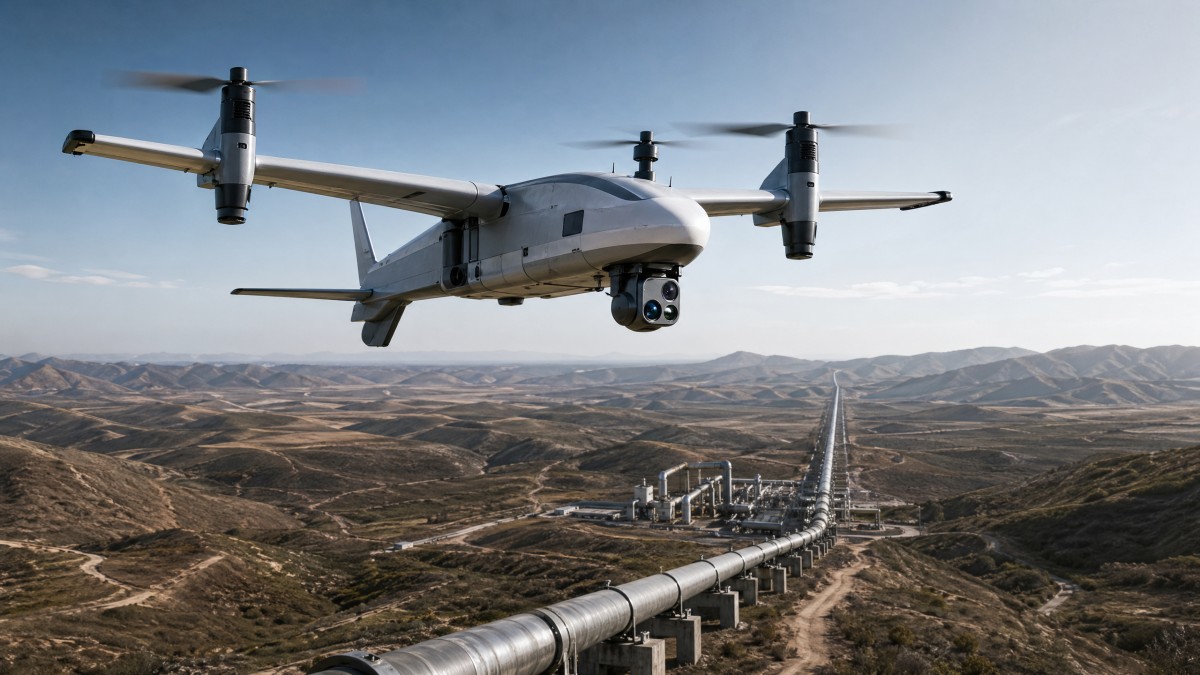
Pipeline inspection missions are unusual compared with point inspection or short-range mapping. A typical route may cover 20 km, 50 km, or more in a single operating day, often with repeated passes over pump stations, valves, road crossings, vegetation encroachment zones, or thermal anomalies. That means endurance and cruise efficiency matter, but so do precision hover, low-speed data collection, and safe vertical recovery near restricted access points.
A fixed-wing VTOL drone typically prioritizes efficient forward flight. After vertical takeoff, it transitions into wing-borne cruise, where aerodynamic lift reduces power draw compared with multi-rotor-only systems. In practical terms, this can support longer corridor coverage per battery cycle, often in the 60–150 minute range depending on payload, wind, and reserve margin. For sparse infrastructure and long rural routes, this architecture often produces the lowest inspection cost per kilometer.
A hybrid VTOL drone, in contrast, is usually selected when operators need stronger mission flexibility. The term “hybrid” may refer to a combined lift-and-cruise design, a tilt-rotor or tilt-wing arrangement, or an energy hybrid using fuel plus battery systems. In pipeline work, the key advantage is not novelty but controllability: better station-keeping over localized defects, smoother transitions between long transit and detailed inspection, and more tolerance for mixed mission profiles that include both corridor scanning and point-based diagnostics.
The tradeoff is complexity. More moving parts, more flight modes, and more integration layers can increase maintenance planning, software validation requirements, and pilot training hours. For teams operating 3–5 aircraft across multiple regions, even a small increase in pre-flight checks or spare-part dependency can materially affect annual utilization.
Where fixed-wing designs usually lead
- Long straight corridors where cruise efficiency is more important than prolonged hover.
- Large inspection blocks requiring 40 km to 120 km of daily coverage with minimal landing cycles.
- Operations in open terrain where launch and recovery clearances are predictable.
- Programs that prioritize lower energy consumption per kilometer and simpler airframe logic.
Where hybrid platforms usually lead
- Mixed missions combining corridor patrol, leak verification, thermal anomaly review, and close visual inspection.
- Congested or irregular terrain where precise repositioning and repeated low-speed passes are common.
- Sites with wind shifts, uneven landing conditions, or intermittent need for hover-based sensor confirmation.
- Programs that accept somewhat higher system complexity in exchange for wider mission adaptability.
The table below frames the architectural difference from a pipeline operations perspective rather than a general UAV marketing perspective.
The practical conclusion is straightforward: if your inspection program is dominated by distance, fixed-wing VTOL often wins. If the same team must frequently switch between area coverage and precision local review, hybrid systems deserve closer consideration despite their higher integration burden.
Flight performance metrics that matter more than brochure claims
Most selection errors occur because buyers compare top-level specifications without examining the conditions behind them. Endurance may be quoted at zero wind, nominal payload, and low-cruise speed. Transition performance may be demonstrated in calm weather but not crosswind conditions. For pipeline inspection, the more useful question is how stable the aircraft remains during climb, transition, low-altitude follow, and return-to-vertical landing under real field loads.
The phrase vtol transition phase aerodynamics is not academic jargon. It directly affects inspection reliability. During the 5–20 second transition window from rotor-supported lift to wing-borne flight, the aircraft can experience pitch oscillation, temporary altitude loss, or increased power draw. If a platform transitions poorly with a thermal camera and gimbal installed, the result can be blurred data, aborted flights, or stricter weather limits that reduce operational days per month.
For field teams, a useful benchmark is not just maximum wind resistance but stable mission wind range. A drone rated for 12 m/s may still deliver clean data only up to 8–10 m/s when carrying a dual EO/IR payload. Likewise, a nominal 90-minute aircraft may produce only 55–70 minutes of safe operational endurance once 20% battery reserve, headwind exposure, and repeated station checks are included.
This is why TSV-style evaluation prioritizes measurable envelopes: usable endurance, transition repeatability, landing footprint tolerance, and payload-specific stability. These values are more decision-relevant than peak specifications because they influence sortie completion rate and re-fly probability.
Core flight metrics to request from suppliers
- Usable endurance with inspection payload installed, including a 15%–25% reserve margin.
- Transition time and altitude variation during VTOL-to-cruise and cruise-to-VTOL phases.
- Crosswind tolerance during landing, ideally expressed as an operational range rather than a peak claim.
- Cruise speed range, such as 16–28 m/s, and the speed at which thermal and visual data remain usable.
- Maximum climb rate and safe loiter capability near towers, crossings, or elevated rights-of-way.
The next table translates these metrics into a procurement-friendly comparison framework.
When these four metrics are documented under the same payload and weather assumptions, aircraft comparisons become far more reliable. Without that normalization, two systems with similar brochure numbers can perform very differently in daily pipeline operations.
Sensor payload, thermal imaging, and data quality tradeoffs
Pipeline inspection value is ultimately created by the sensor stack, not by airframe design alone. For most programs, the baseline payload includes an EO camera, thermal imager, stabilized gimbal, onboard storage, and telemetry link. More advanced configurations may add methane detection, LiDAR, multispectral imaging, or edge AI for anomaly triage. Every added gram affects endurance, center of gravity, and transition behavior.
A common buyer mistake is to ask only whether a drone can “carry thermal.” The better question is whether it can carry a thermal payload at the resolution and frame stability needed for the defect class being targeted. Drone thermal camera resolution comparison is therefore essential. A 320 × 256 thermal sensor may be sufficient for broad hotspot detection, but for small leak signatures, insulation irregularities, or long-stand-off inspection, many teams now prefer 640 × 512-class sensors or better, provided the gimbal and flight profile can maintain image usability.
This is where hybrid platforms can show an advantage. If the mission includes both corridor sweep and close thermal verification, the ability to slow down or hold position near a suspicious segment can reduce the need for a second sortie. However, if the inspection objective is primarily route-level screening with later confirmation by ground crew, a fixed-wing VTOL with well-optimized cruise imaging may be the more efficient asset.
Payload integration should also be tested at the electrical and software layers. Questions worth asking include video latency, trigger synchronization, gimbal jitter under crosswind, data export format, and whether metadata remains aligned with coordinates after transition events. A technically adequate sensor can still produce weak inspection value if the integration chain is fragile.
Thermal payload selection checklist
- Define whether the goal is route screening, leak verification, thermal trend analysis, or emergency response.
- Match sensor resolution to stand-off distance; 640 × 512 typically provides a stronger inspection margin than entry-level thermal arrays.
- Confirm total payload mass, power draw, and flight time penalty under real mission conditions.
- Check whether the gimbal remains stable during transition and at low-speed crosswind tracking.
- Review data output workflow, including geotagging, video storage, and inspection reporting compatibility.
The table below summarizes how payload needs can shift the fixed-wing versus hybrid decision.
The key takeaway is that payload fit should be evaluated as a mission system problem. The aircraft, sensor, gimbal, power budget, and data workflow must be assessed together, ideally in a supplier demo that reflects your actual inspection altitude and wind profile.
Procurement criteria: cost, reliability, and deployment model
From a procurement standpoint, the wrong VTOL drone is rarely the one with the highest purchase price. The more common problem is buying a platform with hidden operational friction: long maintenance cycles, poor field repairability, narrow payload compatibility, or limited training support. Over a 12–36 month period, these factors can outweigh the initial capital difference between fixed-wing and hybrid options.
One underused comparison factor is mission economics per kilometer. If one aircraft covers 70 km per day with two battery rotations, while another covers 45 km but reduces repeat sorties for anomaly verification, the better value depends on the defect rate and confirmation workflow. Buyers should model at least 3 scenarios: routine patrol, suspected leak escalation, and mixed-terrain inspection. This produces a more realistic total cost view than a single endurance number.
Another point often missed is the role of tethered and persistent systems. Tethered uav continuous flight time can extend into hours rather than tens of minutes, which is valuable for stationary monitoring near compressor stations, construction zones, or security-sensitive nodes. However, tethered solutions are not substitutes for corridor inspection aircraft. They belong in a different deployment model focused on persistent observation within a limited radius.
A disciplined sourcing process should therefore separate mobile corridor inspection from stationary persistent surveillance. Mixing these use cases under one procurement brief often leads to overcomplicated requirements and poor vendor comparison.
Five procurement checks before issuing an RFQ
- Define daily corridor target in kilometers and acceptable re-fly rate, such as less than 10% under normal wind conditions.
- Set minimum payload and data requirements, including EO, IR, storage, and metadata export standards.
- Specify operating envelope: wind, temperature, altitude, and launch-site constraints.
- Request maintenance intervals, spare-part lead times, and recommended operator training hours.
- Evaluate whether a two-platform model is more efficient than forcing one aircraft to do every task.
The table below helps procurement teams translate technical performance into sourcing criteria.
For many enterprises, the most robust answer is not fixed-wing or hybrid in isolation, but a clearly segmented fleet strategy. A long-range corridor aircraft can handle routine patrol, while a second system supports close verification or persistent monitoring. That approach often reduces compromise and improves inspection reliability.
Implementation risks, field mistakes, and how to choose the right platform
Even technically strong platforms fail in deployment when organizations skip mission definition. The first risk is buying against a generic “pipeline inspection” label without specifying corridor length, sensor objectives, launch constraints, and inspection frequency. A weekly 80 km rural patrol is not the same as a daily mixed industrial route with repeated thermal checks around complex facilities.
The second risk is overlooking field logistics. Battery charging, transport cases, antenna setup, geofencing, and operator workload can consume more time than flight itself. A system that saves 15 minutes in setup and 1 battery swap per mission may create more annual value than a platform that advertises slightly higher top speed. For teams running 4 flights per day over 220 operating days, those savings compound quickly.
The third risk is treating supplier demonstrations as proof of production readiness. A valid evaluation should include at least one test under realistic payload, one in moderate wind, and one mission that reproduces your data workflow from capture to report export. If possible, require a corridor sample of 10–20 km rather than a short airfield loop. That is where transition consistency, communication quality, and imaging usability become visible.
For most organizations, the best selection process follows a sequence: define mission classes, assign payload priorities, normalize test conditions, compare usable endurance and data quality, then estimate 12-month operating friction. This approach supports both technical rigor and commercial discipline.
Practical decision guide
Choose fixed-wing VTOL when:
- Your dominant requirement is long-distance corridor coverage with limited need for hover confirmation.
- Daily route lengths are high and cost per kilometer is a core KPI.
- Payload mass is moderate and imaging is primarily pass-based rather than stationary.
Choose hybrid VTOL when:
- Your missions regularly combine transit, thermal confirmation, and close visual review in one sortie.
- Terrain or site conditions demand more flexible low-speed handling and precise repositioning.
- You can support the additional maintenance, training, and software validation complexity.
Consider a separate tethered system when:
- You need continuous local observation for 2–8 hours or longer at a fixed node.
- The objective is persistent monitoring, perimeter awareness, or event supervision rather than linear patrol.
- You want to reduce repeated launch cycles around one high-risk asset location.
The right answer is therefore mission-specific. Fixed-wing VTOL is often the better corridor machine. Hybrid VTOL is often the better mixed-task tool. Tethered UAV systems serve a different persistence requirement. If your team evaluates these categories against measured operating envelopes instead of broad marketing language, procurement decisions become easier to defend and easier to scale.
For organizations building a pipeline inspection program around measurable performance, the most effective next step is a structured requirements review: corridor length, payload class, wind envelope, launch conditions, data workflow, and maintenance expectations. To discuss a data-driven selection framework or request a tailored evaluation matrix for fixed-wing, hybrid, and tethered UAV options, contact us to get a custom solution and explore more inspection-focused UAV strategies.
Search News
Hot Articles
- Carbon Fiber StructuresHow to Specify Aerospace Carbon Fiber Assemblies for Lightweight, Load-Bearing PartsJul 11, 2026
- Machine VisionXiaomi, Alibaba DAMO Academy Drive Open-Source Robotics Model Ecosystem, Lowering Algorithm Development Barriers for Overseas SMEs Adopting Chinese Robotics SolutionsMar 30, 2026
- Cobots & ArmsShanxi 'AI+' Conference Showcases Embodied Intelligence with Multinational Buyer Engagement: Key Industry ImplicationsMar 30, 2026
Popular Tags
Recommended News
 Jul 11, 2026How to Specify Aerospace Carbon Fiber Assemblies for Lightweight, Load-Bearing PartsAerospace carbon fiber assemblies: learn how to specify laminate design, load data, joining methods, and inspection controls for lighter, reliable load-bearing aerospace parts.Elena Rostova (UAV Systems Researcher)
 Mar 30, 2026Xiaomi, Alibaba DAMO Academy Drive Open-Source Robotics Model Ecosystem, Lowering Algorithm Development Barriers for Overseas SMEs Adopting Chinese Robotics SolutionsXiaomi & Alibaba DAMO Academy's open-source robotics models lower algorithm barriers for global SMEs. Boost efficiency in manufacturing, logistics & smart retail with ROS 2 compatible solutions.TSV Data Lab
 Mar 30, 2026Shanxi 'AI+' Conference Showcases Embodied Intelligence with Multinational Buyer Engagement: Key Industry ImplicationsShanxi 'AI+' Conference highlights embodied intelligence with Tesla, Ubtech & Jiantao showcasing multimodal robotics. 40+ global buyers validated tech on-site, creating new B2B channels for industrial automation & AI solutions.Chen Wei (Automation Lead Engineer)
 Mar 30, 2026Zhongguancun Unveils 6G Integrated Sensing-Computing-Intelligence Platform to Empower Embodied Robots for Global Industrial ApplicationsZhongguancun's new 6G platform revolutionizes industrial robotics with <10ms latency, empowering global automotive, logistics & port automation. Discover how this tech boosts China's smart manufacturing exports.TSV Data Lab
 Mar 30, 2026Mech-Mind Tianjin Embodied Intelligence R&D and Production Base Goes Live, Cutting Delivery Time by 20%–30% for Global Customized AMR+Vision SolutionsMech-Mind's Tianjin AMR+Vision production base cuts delivery time by 20%-30% for欧美 & Latin American markets. Discover how this PLd-certified facility accelerates customized robotics solutions for smart manufacturing and logistics.Chen Wei (Automation Lead Engineer)
 Mar 30, 2026Boao Forum Reveals 'Co-evolution of Big and Small Brains' Trend in Humanoid Robots, China's Embodied Intelligence Accelerates Adaptation to Overseas Manufacturing Service ScenariosDiscover how China's humanoid robots, featuring 'Co-evolution of Big and Small Brains,' are revolutionizing global manufacturing. Learn about Embodied Tian Gong 3.0's ISO compliance and overseas deployment at Boao Forum 2026.Chen Wei (Automation Lead Engineer)
 Mar 30, 2026China Railway Industrial Secures Patent for Embodied Robotics in Material Handling, Boosting High-Precision Delivery Capabilities for Overseas Infrastructure and Manufacturing ProjectsChina Railway Industrial's new patent for embodied robotics in material handling boosts high-precision delivery for global infrastructure & manufacturing. Discover how this innovation enhances logistics accuracy in automotive, rail transit & EPC projects.Chen Wei (Automation Lead Engineer)
 Oct 26, 2026AMAXiMAL Releases Open-Source TopMod 3D v3 With Claude AIExplore AMAXiMAL’s free, open-source TopMod 3D v3 with Claude AI assistance, topology-based modeling and plywood fabrication tools that connect complex designs to physical builds.Dr. Marcus Vance
 Oct 26, 2026Choosing a SCADA System Integrator Company: PLC Compatibility and Long-Term SupportChoose a scada system integrator company with proven PLC compatibility and reliable long-term support. Discover what to test, compare, and require before investing.Victor Lin (Chief Software Architect)
 Oct 25, 2026Hesai Leads Global ADAS Main Lidar Shipments in Yole’s 2026 ReportHesai led global ADAS main lidar shipments with a 43% share in 2025, according to Yole’s 2026 report. Explore what this ranking reveals about its automotive market position.TSV Data Lab
 Oct 25, 2026Choosing an Aerospace Materials Manufacturer: Quality and Traceability ChecksChoosing an aerospace materials manufacturer? Learn how to verify certifications, test reports, and lot traceability to qualify suppliers confidently and reduce costly sourcing risks.Dr. Marcus Vance
 Oct 24, 2026Guotai Haitong: Global Entry-Level 3D Printer Shipments Rose 39% in Q1 2026Entry-level 3D printer shipments rose 39% in Q1 2026, Guotai Haitong reports. Explore how AI, multicolor printing and print farms are shaping market growth.Dr. Marcus Vance
 Oct 24, 2026Choosing an Industrial Vision Inspection Supplier: Acceptance Tests That MatterChoose an industrial vision inspection supplier with confidence. Discover acceptance tests for defect detection, false rejects, production speed, and reliable part rejection before you buy.TSV Data Lab
 Oct 23, 2026US Navy Raises Gecko Robotics Contract Ceiling to $300M for Robotic Fleet MaintenanceUS Navy raises Gecko Robotics’ contract ceiling to $300M for Pacific Fleet robotic inspections. Explore potential opportunities for maintenance suppliers and key procurement considerations.Chen Wei (Automation Lead Engineer)
 Oct 23, 2026Choosing Industrial Sensing Systems for Global Plants: Protocol CompatibilityCompare industrial sensing systems international buyers can trust. Explore protocol compatibility, reduce integration risks, and select proven configurations for reliable global plant deployments.TSV Data Lab
 Oct 22, 2026KUKA Showcases Physical AI and iiQKA.AI Vision at NVIDIA GTC BerlinExplore KUKA’s Physical AI showcase at NVIDIA GTC Berlin and discover how iiQKA.AI Vision aims to simplify robotic vision integration and improve 2D and 3D scene recognition.TSV Data Lab
 Oct 22, 2026Robotic Machining of Advanced Composites: What Tolerances Are Achievable?Explore advanced materials machining robotics: discover what drives achievable composite tolerances and how to validate accuracy before investing in your next machining system.Dr. Marcus Vance
 Oct 21, 2026China’s Industrial Robot Exports Near RMB 10 Billion in First Nine Months of 2026China’s industrial robot exports neared RMB 10 billion in January–September 2026, with value rising faster than volume. Explore the data and what it could mean for suppliers.Chen Wei (Automation Lead Engineer)
 Oct 21, 2026Low-Latency Industrial Data Processing: Pricing and Key Cost DriversExplore industrial data latency price drivers, from edge hardware to integration and support. Learn how to compare quotes, verify performance, and avoid unnecessary costs.TSV Data Lab
 Oct 20, 2026KUKA Launches iiQKA.AI Vision to Simplify Industrial Image ProcessingKUKA iiQKA.AI Vision simplifies industrial image processing with controller-based 2D and 3D vision. Explore drag-and-drop setup for vision-guided automation.TSV Data Lab
 Oct 20, 2026Smart Industrial Edge Devices: Key Criteria for Legacy PLC IntegrationChoose smart industrial edge devices for legacy PLC integration. Discover key criteria for compatibility, data quality, security, and reliable collection without disrupting control.TSV Data Lab
 Oct 19, 2026Choosing a Radar Sensor by Application: Range, Resolution, and Field of ViewSimplify radar sensor application based product selection. Compare range, resolution, and field of view to avoid blind spots and choose with confidence. Explore the guide.TSV Data Lab
 Oct 18, 2026Comparing Material Options for Procurement: Specs, Costs, and Supply RisksExplore procurement oriented technical content on material options, specs, costs, and supply risks. Compare alternatives to cut hidden expenses and make confident sourcing decisions.Dr. Marcus Vance
 Oct 17, 20265-Axis CNC Positioning Accuracy: How to Interpret ISO 230-2 Test ResultsAssess 5 axis CNC machining positioning accuracy with ISO 230-2. Learn to interpret repeatability, reversal error, and test conditions to compare suppliers and make confident acceptance decisions.Dr. Marcus Vance























