
Why tethered UAV flight time still has real limits
Publication Date
author
Many buyers assume tethered UAV continuous flight time is effectively unlimited, but real-world engineering says otherwise. For teams comparing a VTOL drone for pipeline inspection or sourcing from a tethered drone system factory, the real constraints come from power transmission loss, cable weight, wind loading, thermal management, and operational safety. Understanding these limits is essential for smarter procurement, mission planning, and system design.
Tethered UAVs can stay airborne far longer than battery-only platforms, but “unlimited flight time” is not an engineering-grade claim. In practice, endurance is bounded by the power architecture, tether mass versus altitude, environmental loading, payload demand, cooling capacity, and ground-side support reliability. For operators, procurement teams, and decision-makers, the right question is not whether a tethered UAV can fly continuously, but under what conditions, at what altitude, with what payload, and for how long before system risk rises.
Why tethered UAV flight time is not truly unlimited
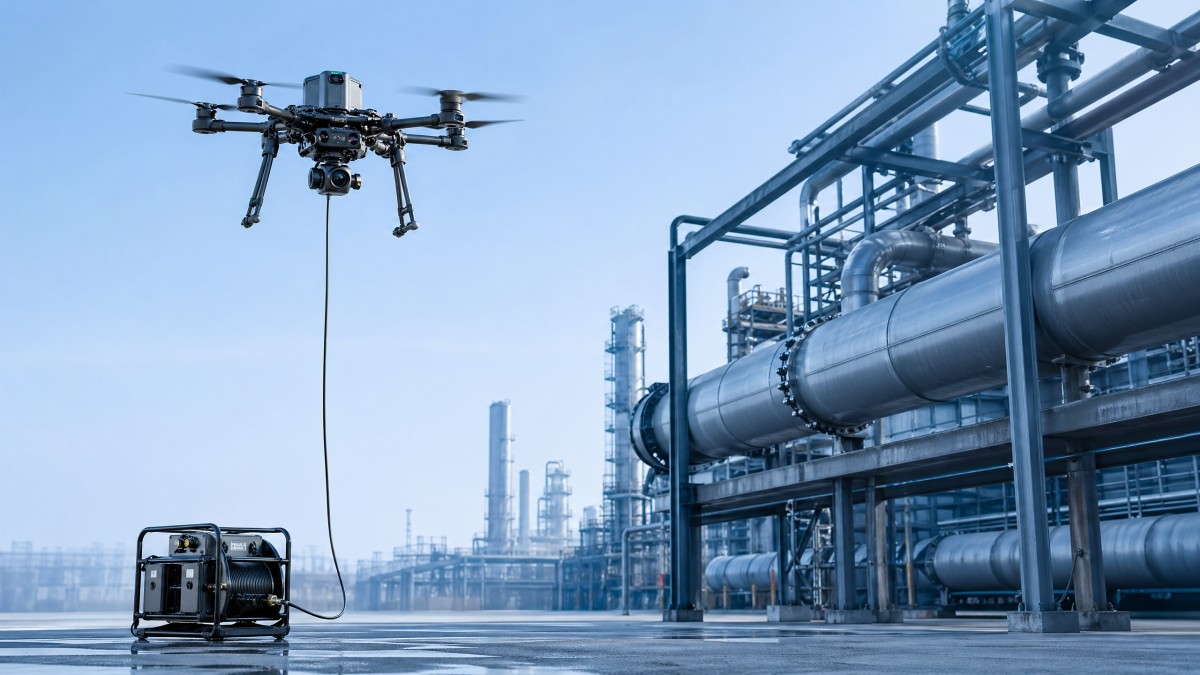
The main advantage of a tethered UAV system is continuous power delivery from the ground, which removes the largest constraint of a conventional drone: onboard battery depletion. However, replacing battery limits with a tether does not remove limits altogether. It simply shifts the limiting factors from energy storage to energy transmission and system stability.
In real deployments, tethered UAV endurance depends on whether the entire system can maintain stable operation over time. That includes the airborne platform, tether management unit, ground power source, converters, motors, cooling systems, data link, and safety controls. Any one of these can become the practical ceiling on mission duration.
For example, a system may be marketed for persistent aerial surveillance, but if its tether heats excessively at full load, if wind introduces unstable cable oscillation, or if the drone must reduce payload to maintain station keeping, the actual operational window becomes more limited than the brochure suggests.
What actually limits tethered UAV endurance in the field
1. Power transmission loss
Electricity sent through a long tether does not arrive without losses. Resistance in the cable converts part of the energy into heat. As tether length increases, voltage drop and thermal buildup become more important. This is why many higher-performance systems use high-voltage transmission with onboard step-down conversion rather than sending low-voltage power directly up the line.
For buyers, this matters because rated endurance at 30 meters may not translate cleanly to 80 or 100 meters. The drone may still fly, but with less power margin for payloads, wind compensation, or maneuvering. In other words, continuous flight is possible only within a defined operating envelope.
2. Tether weight and mechanical drag
The tether is not just a power cable. It is also a constant structural burden. As altitude increases, the drone must lift more cable weight. In windy conditions, the tether also creates drag and lateral load, which force the UAV to spend more energy stabilizing itself.
This means a tethered drone at low hover in calm weather can appear extremely efficient, while the same system at greater height or in crosswind may approach its thrust margin quickly. For pipeline inspection, border overwatch, and event security, this difference is critical because the mission altitude often defines line-of-sight value.
3. Wind loading and station-keeping demand
A tethered UAV is mechanically linked to the ground, so wind affects both the aircraft and the cable. Gusts increase rotor workload, induce tether swing, and can create unstable flight behavior if the flight controller and winch system are not tuned correctly.
In many use cases, the practical endurance limit is not lack of incoming electrical power but long-term exposure to variable wind. A system may remain technically airborne, yet no longer deliver stable imaging, communications relay quality, or sensor accuracy at the required threshold.
4. Thermal management
Continuous operation generates continuous heat. Motors, ESCs, onboard power converters, tether interfaces, and ground power electronics all require thermal control. In battery drones, thermal stress is usually tied to shorter sortie cycles. In tethered drones, the issue becomes persistent heat accumulation over hours.
If cooling is insufficient, components may derate automatically, trigger alarms, or suffer accelerated wear. That is one reason serious engineering teams ask not only for flight time claims, but also for thermal test data under full payload and ambient temperature extremes.
5. Payload power demand
Many tethered UAV missions involve EO/IR payloads, communications modules, lighting systems, LiDAR, or specialty sensors. These devices consume power and add mass. As payload demand rises, the available margin for sustained hover and wind compensation shrinks.
That is why “continuous flight” claims must always be tied to a specific payload configuration. A drone holding a lightweight daylight camera at 50 meters is not equivalent to one carrying a heavier stabilized gimbal, spotlight, or multi-sensor inspection package.
6. Ground power reliability
The airborne platform may be tethered, but it is only as stable as the ground-side infrastructure. Generator quality, grid stability, inverter performance, mobile power station capacity, and tether reel reliability all affect actual uptime. A persistent aerial system deployed in remote infrastructure inspection is vulnerable to failure if the supporting ground station is under-specified.
How to evaluate flight-time claims when comparing tethered drone systems
For procurement teams and technical evaluators, endurance claims should be treated like any other performance metric: valid only when tied to test conditions. A useful supplier conversation should move beyond “how long can it fly?” and toward a structured operating matrix.
Ask suppliers to define:
- Hover altitude at rated endurance
- Payload weight and power consumption during the test
- Wind speed range for stable continuous operation
- Tether length, diameter, and total mass
- Input voltage architecture and transmission loss profile
- Ambient temperature range and thermal derating behavior
- Ground power source assumptions
- Emergency descent or backup battery capability
If a tethered drone system factory cannot provide this level of clarity, buyers should treat broad endurance promises cautiously. For enterprise users, the most reliable vendors are usually those willing to show engineering constraints clearly rather than hide behind simplified marketing language.
What matters more than “unlimited flight” for real operations
In many commercial and industrial scenarios, absolute endurance is not the key decision variable. What matters more is whether the drone can perform the mission consistently, safely, and with predictable operating cost.
For example, in pipeline inspection, utility monitoring, perimeter security, and temporary communications relay, operators usually care more about these questions:
- Can the drone maintain stable sensor performance at the required altitude?
- Can it hold position safely in expected wind conditions?
- How much payload can it support without reducing safety margin?
- What is the maintenance interval for the tether, reel, and power electronics?
- What happens during grid interruption or generator fluctuation?
- How fast can the system be deployed, recovered, and relocated?
These factors often determine ROI more directly than raw airborne duration. A system that can operate reliably for 8 to 12 hours under realistic field conditions may create more value than one advertised for indefinite hover but limited by setup complexity, poor wind tolerance, or high maintenance burden.
Where tethered UAVs still make strong business sense
Despite the limits, tethered UAV systems remain highly valuable where persistent aerial presence matters more than mobility. They are often a strong fit for fixed-area observation, temporary site security, emergency scene illumination, communications extension, and infrastructure monitoring over a defined footprint.
They are especially compelling when compared with repeatedly landing and swapping batteries, which increases labor demand and interrupts data continuity. For organizations that need stable overwatch rather than long-distance route coverage, tethered platforms can reduce operational friction substantially.
However, for missions requiring wide-area movement, complex route navigation, or frequent repositioning, a conventional UAV or hybrid VTOL drone may be a better choice. This is why procurement should begin with mission profile definition, not platform hype.
How buyers should make better procurement decisions
If you are evaluating a tethered UAV for enterprise deployment, start with the operational envelope rather than the headline claim. Build your assessment around five practical filters:
- Mission geometry: required altitude, area coverage, and hover duration
- Environmental conditions: wind, temperature, dust, moisture, and electromagnetic interference
- Payload reality: actual sensor mass, power draw, and data-link needs
- System resilience: backup descent logic, tether failure response, and ground power redundancy
- Lifecycle economics: maintenance burden, consumables, repairability, and operator training
This framework helps technical teams separate genuine engineering capability from oversimplified marketing. It also aligns purchasing decisions with real deployment outcomes, which is especially important for organizations with safety, compliance, or uptime obligations.
Conclusion
Tethered UAV flight time is much longer than battery-powered flight, but it is not limitless in any serious engineering sense. The real ceiling comes from tether physics, transmission efficiency, wind loading, thermal control, payload demand, and ground-system reliability. For users comparing a VTOL drone for inspection or engaging a tethered drone system factory, the smartest approach is to evaluate endurance within a full operating context.
The best procurement decisions come from asking precise questions: at what height, with what payload, in what wind, at what temperature, and with what safety margin? Once those variables are made explicit, the value of a tethered UAV becomes much clearer—and far more useful than the vague promise of “unlimited flight time.”p>
Search News
Hot Articles
- Carbon Fiber StructuresHow to Specify Aerospace Carbon Fiber Assemblies for Lightweight, Load-Bearing PartsJul 11, 2026
- Machine VisionXiaomi, Alibaba DAMO Academy Drive Open-Source Robotics Model Ecosystem, Lowering Algorithm Development Barriers for Overseas SMEs Adopting Chinese Robotics SolutionsMar 30, 2026
- Cobots & ArmsShanxi 'AI+' Conference Showcases Embodied Intelligence with Multinational Buyer Engagement: Key Industry ImplicationsMar 30, 2026
Popular Tags
Recommended News
 Jul 11, 2026How to Specify Aerospace Carbon Fiber Assemblies for Lightweight, Load-Bearing PartsAerospace carbon fiber assemblies: learn how to specify laminate design, load data, joining methods, and inspection controls for lighter, reliable load-bearing aerospace parts.Elena Rostova (UAV Systems Researcher)
 Mar 30, 2026Xiaomi, Alibaba DAMO Academy Drive Open-Source Robotics Model Ecosystem, Lowering Algorithm Development Barriers for Overseas SMEs Adopting Chinese Robotics SolutionsXiaomi & Alibaba DAMO Academy's open-source robotics models lower algorithm barriers for global SMEs. Boost efficiency in manufacturing, logistics & smart retail with ROS 2 compatible solutions.TSV Data Lab
 Mar 30, 2026Shanxi 'AI+' Conference Showcases Embodied Intelligence with Multinational Buyer Engagement: Key Industry ImplicationsShanxi 'AI+' Conference highlights embodied intelligence with Tesla, Ubtech & Jiantao showcasing multimodal robotics. 40+ global buyers validated tech on-site, creating new B2B channels for industrial automation & AI solutions.Chen Wei (Automation Lead Engineer)
 Mar 30, 2026Zhongguancun Unveils 6G Integrated Sensing-Computing-Intelligence Platform to Empower Embodied Robots for Global Industrial ApplicationsZhongguancun's new 6G platform revolutionizes industrial robotics with <10ms latency, empowering global automotive, logistics & port automation. Discover how this tech boosts China's smart manufacturing exports.TSV Data Lab
 Mar 30, 2026Mech-Mind Tianjin Embodied Intelligence R&D and Production Base Goes Live, Cutting Delivery Time by 20%–30% for Global Customized AMR+Vision SolutionsMech-Mind's Tianjin AMR+Vision production base cuts delivery time by 20%-30% for欧美 & Latin American markets. Discover how this PLd-certified facility accelerates customized robotics solutions for smart manufacturing and logistics.Chen Wei (Automation Lead Engineer)
 Mar 30, 2026Boao Forum Reveals 'Co-evolution of Big and Small Brains' Trend in Humanoid Robots, China's Embodied Intelligence Accelerates Adaptation to Overseas Manufacturing Service ScenariosDiscover how China's humanoid robots, featuring 'Co-evolution of Big and Small Brains,' are revolutionizing global manufacturing. Learn about Embodied Tian Gong 3.0's ISO compliance and overseas deployment at Boao Forum 2026.Chen Wei (Automation Lead Engineer)
 Mar 30, 2026China Railway Industrial Secures Patent for Embodied Robotics in Material Handling, Boosting High-Precision Delivery Capabilities for Overseas Infrastructure and Manufacturing ProjectsChina Railway Industrial's new patent for embodied robotics in material handling boosts high-precision delivery for global infrastructure & manufacturing. Discover how this innovation enhances logistics accuracy in automotive, rail transit & EPC projects.Chen Wei (Automation Lead Engineer)
 Oct 26, 2026AMAXiMAL Releases Open-Source TopMod 3D v3 With Claude AIExplore AMAXiMAL’s free, open-source TopMod 3D v3 with Claude AI assistance, topology-based modeling and plywood fabrication tools that connect complex designs to physical builds.Dr. Marcus Vance
 Oct 26, 2026Choosing a SCADA System Integrator Company: PLC Compatibility and Long-Term SupportChoose a scada system integrator company with proven PLC compatibility and reliable long-term support. Discover what to test, compare, and require before investing.Victor Lin (Chief Software Architect)
 Oct 25, 2026Hesai Leads Global ADAS Main Lidar Shipments in Yole’s 2026 ReportHesai led global ADAS main lidar shipments with a 43% share in 2025, according to Yole’s 2026 report. Explore what this ranking reveals about its automotive market position.TSV Data Lab
 Oct 25, 2026Choosing an Aerospace Materials Manufacturer: Quality and Traceability ChecksChoosing an aerospace materials manufacturer? Learn how to verify certifications, test reports, and lot traceability to qualify suppliers confidently and reduce costly sourcing risks.Dr. Marcus Vance
 Oct 24, 2026Guotai Haitong: Global Entry-Level 3D Printer Shipments Rose 39% in Q1 2026Entry-level 3D printer shipments rose 39% in Q1 2026, Guotai Haitong reports. Explore how AI, multicolor printing and print farms are shaping market growth.Dr. Marcus Vance
 Oct 24, 2026Choosing an Industrial Vision Inspection Supplier: Acceptance Tests That MatterChoose an industrial vision inspection supplier with confidence. Discover acceptance tests for defect detection, false rejects, production speed, and reliable part rejection before you buy.TSV Data Lab
 Oct 23, 2026US Navy Raises Gecko Robotics Contract Ceiling to $300M for Robotic Fleet MaintenanceUS Navy raises Gecko Robotics’ contract ceiling to $300M for Pacific Fleet robotic inspections. Explore potential opportunities for maintenance suppliers and key procurement considerations.Chen Wei (Automation Lead Engineer)
 Oct 23, 2026Choosing Industrial Sensing Systems for Global Plants: Protocol CompatibilityCompare industrial sensing systems international buyers can trust. Explore protocol compatibility, reduce integration risks, and select proven configurations for reliable global plant deployments.TSV Data Lab
 Oct 22, 2026KUKA Showcases Physical AI and iiQKA.AI Vision at NVIDIA GTC BerlinExplore KUKA’s Physical AI showcase at NVIDIA GTC Berlin and discover how iiQKA.AI Vision aims to simplify robotic vision integration and improve 2D and 3D scene recognition.TSV Data Lab
 Oct 22, 2026Robotic Machining of Advanced Composites: What Tolerances Are Achievable?Explore advanced materials machining robotics: discover what drives achievable composite tolerances and how to validate accuracy before investing in your next machining system.Dr. Marcus Vance
 Oct 21, 2026China’s Industrial Robot Exports Near RMB 10 Billion in First Nine Months of 2026China’s industrial robot exports neared RMB 10 billion in January–September 2026, with value rising faster than volume. Explore the data and what it could mean for suppliers.Chen Wei (Automation Lead Engineer)
 Oct 21, 2026Low-Latency Industrial Data Processing: Pricing and Key Cost DriversExplore industrial data latency price drivers, from edge hardware to integration and support. Learn how to compare quotes, verify performance, and avoid unnecessary costs.TSV Data Lab
 Oct 20, 2026KUKA Launches iiQKA.AI Vision to Simplify Industrial Image ProcessingKUKA iiQKA.AI Vision simplifies industrial image processing with controller-based 2D and 3D vision. Explore drag-and-drop setup for vision-guided automation.TSV Data Lab
 Oct 20, 2026Smart Industrial Edge Devices: Key Criteria for Legacy PLC IntegrationChoose smart industrial edge devices for legacy PLC integration. Discover key criteria for compatibility, data quality, security, and reliable collection without disrupting control.TSV Data Lab
 Oct 19, 2026Choosing a Radar Sensor by Application: Range, Resolution, and Field of ViewSimplify radar sensor application based product selection. Compare range, resolution, and field of view to avoid blind spots and choose with confidence. Explore the guide.TSV Data Lab
 Oct 18, 2026Comparing Material Options for Procurement: Specs, Costs, and Supply RisksExplore procurement oriented technical content on material options, specs, costs, and supply risks. Compare alternatives to cut hidden expenses and make confident sourcing decisions.Dr. Marcus Vance
 Oct 17, 20265-Axis CNC Positioning Accuracy: How to Interpret ISO 230-2 Test ResultsAssess 5 axis CNC machining positioning accuracy with ISO 230-2. Learn to interpret repeatability, reversal error, and test conditions to compare suppliers and make confident acceptance decisions.Dr. Marcus Vance























