Why a good trampoline park design is more than layout
Publication Date
author
For commercial evaluators, a strong trampoline park design is not just about arranging attractions—it is about engineering safety, throughput, lifecycle cost, and brand durability into one measurable system. In a market crowded with visual concepts and sales claims, the real differentiator lies in structural logic, user flow, compliance planning, and operational efficiency. Understanding why trampoline park design is more than layout is essential to making lower-risk, higher-value investment decisions.
The market signal is changing: trampoline park design is becoming an operational asset, not a décor decision
One of the clearest shifts in the indoor active entertainment market is that investors no longer evaluate trampoline venues mainly by appearance, novelty, or attraction count. The conversation has moved toward performance: How many guests can move safely through the space per hour? How fast can staff supervise critical zones? How easily can operators maintain equipment, rotate programs, and refresh revenue-generating areas without major reconstruction? This change means trampoline park design is now assessed as a business system rather than a visual concept.
For commercial evaluators, this matters because the same floor area can produce very different outcomes depending on design logic. Two parks with similar square footage may have sharply different incident exposure, staffing burden, queue patterns, energy costs, and repeat-visit potential. In other words, layout still matters, but only as one layer within a broader design framework that also includes structural engineering, circulation planning, zoning strategy, acoustic control, maintenance access, and compliance readiness.
This is also consistent with a wider cross-industry trend visible in advanced manufacturing and infrastructure evaluation: decision-makers are moving away from marketing adjectives and toward measurable operational truth. A trampoline park may belong to leisure real estate, but the evaluation logic increasingly resembles industrial thinking. Parameters, tolerances, load paths, visibility lines, serviceability, and failure points all have economic consequences.
Why the design conversation is shifting now
Several converging forces are reshaping how trampoline park design is judged. First, family entertainment customers expect more than open jumping areas. They look for multi-age usability, social media appeal, comfort, and perceived safety. Second, operators face tighter economics: rent, labor, insurance, and maintenance pressure make inefficient facilities harder to justify. Third, regulators, landlords, and insurers increasingly scrutinize risk controls, material quality, emergency egress, and supervision strategy. Finally, competition from hybrid venues means parks must support flexible programming such as fitness classes, birthday events, school groups, and corporate bookings.
These pressures push the industry beyond simple attraction placement. A viable trampoline park design now has to integrate business resilience. It must support high traffic days without unsafe congestion, low traffic periods without dead zones, and future upgrades without full shutdowns. For evaluators reviewing a proposal, the key question is no longer “Does the park look exciting?” but “Can this design sustain revenue and control risk over time?”
A modern trampoline park design must solve five performance layers
When decision-makers assess proposals, it helps to separate trampoline park design into five layers. This prevents overreliance on renderings and makes comparisons more objective.
1. Safety engineering
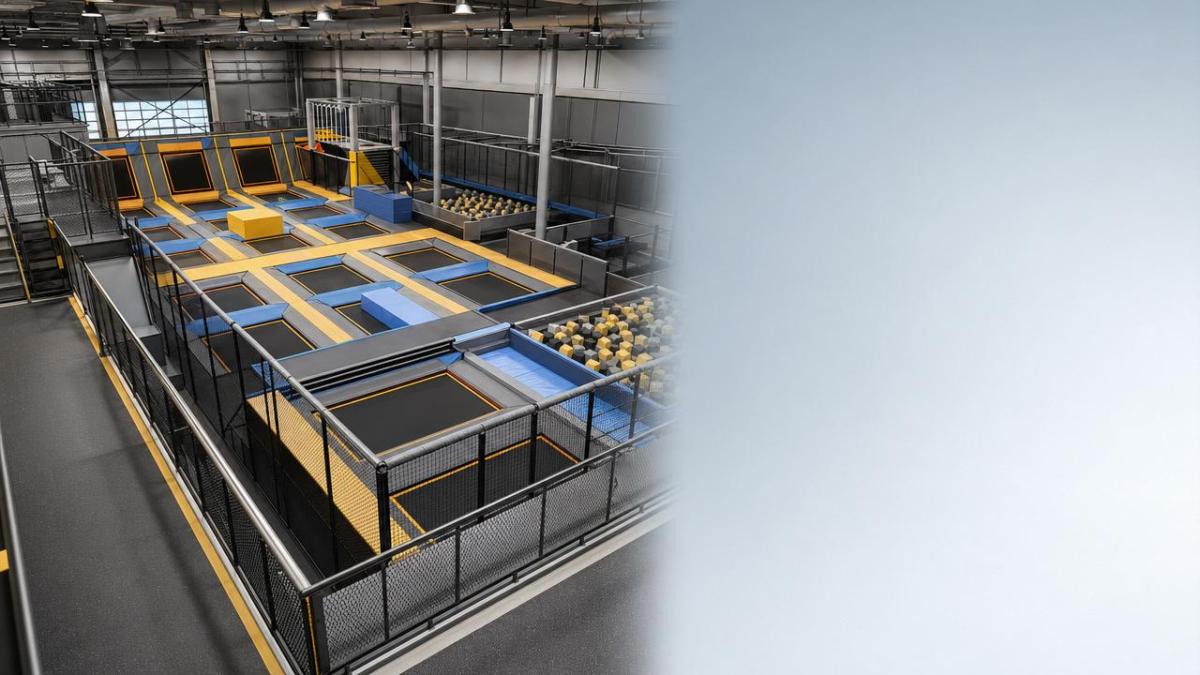
The first layer is structural and behavioral safety. This includes frame integrity, padding strategy, impact isolation, fall risk transitions, queue spillover, and the relationship between high-energy attractions and passive circulation areas. Good design anticipates how people really behave, not how they behave in ideal operating diagrams. It reduces collision vectors, separates novice and advanced users, and makes emergency access practical.
2. Throughput and circulation
A strong trampoline park design manages movement. Guests must enter, store belongings, attend briefings, access attractions, rest, buy food, and exit without friction. Congestion near socks counters, waiver check-in, foam pits, or party rooms is not a minor inconvenience; it directly affects dwell time quality, staff stress, and social perception. Throughput planning is therefore a revenue issue as much as a comfort issue.
3. Observation and staffing efficiency
Blind corners, overlapping activity lines, and obstructed sightlines increase supervision cost. Evaluators should examine whether one trained staff member can meaningfully monitor a zone, whether intervention routes are short, and whether support spaces are positioned logically. Design that ignores sightline efficiency often creates hidden operating expenses long after opening day.
4. Lifecycle maintenance and durability
Many proposals understate wear realities. High-touch surfaces, spring systems, pads, nets, flooring transitions, HVAC loads, and cleaning requirements all influence total cost of ownership. A good trampoline park design allows inspection access, part replacement, cleaning circulation, and phased maintenance. If maintenance requires constant disruption, the operator loses both time and revenue.
5. Brand adaptability
Entertainment concepts age quickly. Design should therefore support reprogramming. Can a court become a fitness zone during weekdays? Can a party area host corporate team events? Can underperforming attractions be swapped with limited structural rework? In current market conditions, adaptability is a major valuation factor.
What is driving smarter trampoline park design decisions
The move toward higher-spec trampoline park design is not just aesthetic maturity; it is driven by economics and governance. Landlords increasingly want confidence that tenants can operate reliably and maintain traffic quality. Investors prefer concepts that demonstrate controlled risk and scalable unit economics. Operators need spaces that can absorb seasonal peaks without service breakdown. Meanwhile, users compare venues instantly through online reviews, where safety perception, cleanliness, and comfort often matter as much as attraction variety.
This creates a new evaluation standard: design must prove operational intelligence. In practical terms, that means proposals should be reviewed with the same discipline used in technical procurement. Drawings should be tested against real scenarios such as emergency evacuation, school group arrival, birthday turnover, equipment downtime, and weekend peak circulation. The more a trampoline park design can withstand scenario-based review, the more robust the business case becomes.
Who is most affected by these design shifts
The impact of better or weaker trampoline park design is not limited to owners. Multiple stakeholders experience the effects differently, which is why evaluators should review design through a multi-party lens.
What evaluators should examine beyond the layout drawing
A render or plan view can hide critical weaknesses. To assess trampoline park design rigorously, commercial evaluators should look at the following signals.
- Whether user flows are modeled for peak demand, not average demand.
- Whether age groups and activity intensities are separated with operational logic.
- Whether sightlines support realistic staffing ratios.
- Whether maintenance access is embedded instead of treated as an afterthought.
- Whether food, party, waiting, and rest areas complement rather than disrupt core activity zones.
- Whether future attraction replacement can occur without major structural interruption.
- Whether the design aligns with local code, fire planning, and insurer expectations early in the process.
These criteria help evaluators move from subjective preference to decision-grade analysis. That is especially important when suppliers present similar attraction packages but very different planning quality.
The next phase of trampoline park design will be more data-led
Looking ahead, the strongest trampoline park design projects are likely to use more measurable planning inputs. Operators will increasingly map incident zones, queue dwell patterns, maintenance intervals, cleaning routes, and underused areas. This trend mirrors broader business digitization: design choices will be validated by operating data, not only by concept boards. As a result, future venues may be planned with stronger links between spatial design and KPIs such as guest throughput, staffing efficiency, average spend, and repeat visitation.
For evaluators, this means procurement and approval standards should also mature. Instead of accepting broad claims about “best-in-class experience,” reviewers can request zone logic, supervision assumptions, maintenance plans, and scenario testing. A trampoline park design that can explain how it performs under stress is usually more credible than one that simply looks impressive in presentation format.
How to make lower-risk decisions now
In today’s market, a prudent decision process should compare trampoline park design options through a structured lens: safety architecture, throughput capability, staffing logic, maintenance burden, adaptability, and compliance readiness. This does not require overcomplication. It requires asking better questions earlier. What happens on the busiest hour of the week? Where do queues accumulate? Which zones are difficult to supervise? Which components wear fastest? How expensive is a concept refresh after three years?
For businesses evaluating proposals, the most valuable next step is to treat trampoline park design like a long-life operating platform rather than a one-time fit-out. If a design improves flow, lowers staff friction, supports safer behavior, and allows future reconfiguration, it is not merely well planned—it is commercially stronger. And if an enterprise wants to judge how these trends affect its own project, it should begin by verifying three issues: whether the design can perform under operational pressure, whether it can remain compliant and maintainable over time, and whether it can adapt as customer demand evolves.
Search News
Hot Articles
- Carbon Fiber StructuresHow to Specify Aerospace Carbon Fiber Assemblies for Lightweight, Load-Bearing PartsJul 11, 2026
- Machine VisionXiaomi, Alibaba DAMO Academy Drive Open-Source Robotics Model Ecosystem, Lowering Algorithm Development Barriers for Overseas SMEs Adopting Chinese Robotics SolutionsMar 30, 2026
- Cobots & ArmsShanxi 'AI+' Conference Showcases Embodied Intelligence with Multinational Buyer Engagement: Key Industry ImplicationsMar 30, 2026
Popular Tags
Recommended News
 Jul 11, 2026How to Specify Aerospace Carbon Fiber Assemblies for Lightweight, Load-Bearing PartsAerospace carbon fiber assemblies: learn how to specify laminate design, load data, joining methods, and inspection controls for lighter, reliable load-bearing aerospace parts.Elena Rostova (UAV Systems Researcher)
 Mar 30, 2026Xiaomi, Alibaba DAMO Academy Drive Open-Source Robotics Model Ecosystem, Lowering Algorithm Development Barriers for Overseas SMEs Adopting Chinese Robotics SolutionsXiaomi & Alibaba DAMO Academy's open-source robotics models lower algorithm barriers for global SMEs. Boost efficiency in manufacturing, logistics & smart retail with ROS 2 compatible solutions.TSV Data Lab
 Mar 30, 2026Shanxi 'AI+' Conference Showcases Embodied Intelligence with Multinational Buyer Engagement: Key Industry ImplicationsShanxi 'AI+' Conference highlights embodied intelligence with Tesla, Ubtech & Jiantao showcasing multimodal robotics. 40+ global buyers validated tech on-site, creating new B2B channels for industrial automation & AI solutions.Chen Wei (Automation Lead Engineer)
 Mar 30, 2026Zhongguancun Unveils 6G Integrated Sensing-Computing-Intelligence Platform to Empower Embodied Robots for Global Industrial ApplicationsZhongguancun's new 6G platform revolutionizes industrial robotics with <10ms latency, empowering global automotive, logistics & port automation. Discover how this tech boosts China's smart manufacturing exports.TSV Data Lab
 Mar 30, 2026Mech-Mind Tianjin Embodied Intelligence R&D and Production Base Goes Live, Cutting Delivery Time by 20%–30% for Global Customized AMR+Vision SolutionsMech-Mind's Tianjin AMR+Vision production base cuts delivery time by 20%-30% for欧美 & Latin American markets. Discover how this PLd-certified facility accelerates customized robotics solutions for smart manufacturing and logistics.Chen Wei (Automation Lead Engineer)
 Mar 30, 2026Boao Forum Reveals 'Co-evolution of Big and Small Brains' Trend in Humanoid Robots, China's Embodied Intelligence Accelerates Adaptation to Overseas Manufacturing Service ScenariosDiscover how China's humanoid robots, featuring 'Co-evolution of Big and Small Brains,' are revolutionizing global manufacturing. Learn about Embodied Tian Gong 3.0's ISO compliance and overseas deployment at Boao Forum 2026.Chen Wei (Automation Lead Engineer)
 Mar 30, 2026China Railway Industrial Secures Patent for Embodied Robotics in Material Handling, Boosting High-Precision Delivery Capabilities for Overseas Infrastructure and Manufacturing ProjectsChina Railway Industrial's new patent for embodied robotics in material handling boosts high-precision delivery for global infrastructure & manufacturing. Discover how this innovation enhances logistics accuracy in automotive, rail transit & EPC projects.Chen Wei (Automation Lead Engineer)
 Sep 28, 2026Spindle Runout Measurement in Germany: DIN Standards, Methods, and Acceptance LimitsSpindle runout measurement Germany: explore DIN standards, proven methods, acceptance limits, and audit-ready practices for reliable machining quality.Dr. Marcus Vance
 Sep 27, 2026How to Select Wall-Mount Edge Devices for Space-Constrained Factory NetworksWall mount edge devices for space-constrained factories: evaluate workload, thermal design, power resilience, cable access, and network reliability for smarter deployments.TSV Data Lab
 Sep 26, 2026Machining Tolerance Analysis: How to Set Limits That Meet Function and Cost TargetsMachining tolerance analysis: learn how to set functional limits, control tolerance stacks, reduce inspection risk, and balance precision with production cost.Dr. Marcus Vance
 Sep 25, 2026How to Evaluate an Industrial Infrastructure Data Platform for Multi-Site OperationsIndustrial infrastructure data platform evaluation guide for multi-site operations: compare data quality, edge resilience, interoperability, governance, and scalable proof-of-value criteria.Victor Lin (Chief Software Architect)
 Sep 24, 2026How to Select Machine Vision Optics for Accurate Inspection at Different Working DistancesMachine vision optics selection guide for accurate inspection at every working distance. Compare FOV, pixel scale, DOF, distortion, lighting, and telecentric options.TSV Data Lab
 Sep 23, 2026How to Evaluate a Machine Vision System Integrator for High-Speed Inspection LinesChoose a machine vision system integrator with proven expertise in high-speed inspection, reliable reject timing, robust optics, and measurable acceptance criteria.TSV Data Lab
 Sep 28, 2026When is a SCADA API the right choice for connecting plant systems?SCADA API guide: learn when governed plant data integration improves traceability, security, and scalability—without compromising real-time control.Victor Lin (Chief Software Architect)
 Sep 27, 2026How SCADA data integration improves traceability across production linesSCADA data integration connects production-line data to improve traceability, accelerate quality investigations, and strengthen safety decisions.Victor Lin (Chief Software Architect)
 Sep 26, 2026What to define before starting SCADA integration planningSCADA integration planning starts with clear scope, control boundaries, data models, cybersecurity, and testing. Discover the definitions that reduce risk and costly rework.Victor Lin (Chief Software Architect)
 Sep 25, 2026How a smart factory with Industrial IoT reduces production blind spotsDiscover how a smart factory with Industrial IoT turns real-time machine, quality, and workflow data into actionable insights that reduce production blind spots and delivery risks.Victor Lin (Chief Software Architect)
 Sep 24, 2026When does Industrial IoT make smart manufacturing easier to scale?Smart manufacturing Industrial IoT scales when trusted data, interoperable systems, and secure workflows turn connected assets into measurable gains.TSV Data Lab
 Sep 23, 2026What drives ultra-precision machining cost at 1-micron tolerance?Ultra precision machining cost per part at 1 micron tolerance depends on process, material, metrology, and yield. Learn how to compare quotes confidently.Dr. Marcus Vance
 Sep 22, 2026Drone Engine-T550CC Applications: Build the UAV Power System Around the MissionAn application guide for Drone Engine-T550CC integration, covering payload planning, airframe matching, cooling, fuel, vibration, test procedures, documentation, and service preparation.Elena Rostova (UAV Systems Researcher)
 Sep 22, 2026How to Evaluate Industrial Edge Computing Vendors for Factory DeploymentIndustrial edge computing vendor evaluation guide for factories: compare latency, protocol fit, reliability, security, and lifecycle support before deployment.TSV Data Lab
 Sep 21, 2026Drone Payload Integration: Matching Power, Data, and Center of Gravity for Reliable FlightsDrone payload integration made practical: balance power, data, center of gravity, and endurance to build safer, more reliable mission-ready flights.Elena Rostova (UAV Systems Researcher)
 Sep 20, 2026Autonomous Navigation Pricing: Cost Drivers and Budget Benchmarks for AMR ProjectsAutonomous navigation price explained: compare AMR cost drivers, software, sensors, integration, safety, and lifecycle budgets to build a scalable project plan.Chen Wei (Automation Lead Engineer)
 Sep 19, 2026How to Scope Automation Integration Services for Multi-System Factory ProjectsAutomation integration services: learn how to scope multi-system factory projects with clear workflows, interface contracts, safety boundaries, and acceptance criteria.Victor Lin (Chief Software Architect)