Why Some Trampoline Parks for Sale Stay on the Market
Publication Date
author
A trampoline park for sale can look attractive on paper, yet many listings remain unsold for months because buyers see deeper operational and financial risks behind the headline numbers. For business evaluators, understanding why some assets stall on the market is essential to separating inflated seller expectations from properties with real acquisition potential.
Why a checklist-based review works better than a quick valuation
When reviewing a trampoline park for sale, the biggest mistake is treating it like a simple real estate or retail transaction. In reality, the asset combines entertainment operations, safety compliance, staffing risk, lease dependency, equipment maintenance, local competition, and brand positioning. A listing may stay on the market not because the sector lacks interest, but because informed buyers identify too many unresolved questions during diligence.
For business evaluators, a checklist approach improves speed and accuracy. It helps prioritize what to verify first, what numbers deserve skepticism, and which issues are capable of destroying deal value after acquisition. This is especially important in an environment where seller memorandums often emphasize attendance growth, birthday party bookings, or social media popularity while downplaying repair cycles, insurance pressure, or lease rollover risk.
A practical review should answer three questions early: Is the asking price anchored in reality? Are operational problems fixable? And is the market rejection a warning sign or simply a negotiation gap?
First-pass screening: the reasons a trampoline park for sale gets ignored
Before diving into detailed diligence, evaluators should screen for the most common reasons a trampoline park for sale remains unsold. If two or three of these appear together, prolonged market time is usually rational rather than accidental.
- Unrealistic seller pricing: Owners may value the business based on peak-year revenue, emotional attachment, or build-out cost instead of normalized EBITDA and current market conditions.
- Weak cash flow quality: Revenue may look acceptable, but profits are diluted by labor inefficiency, promotional discounting, excessive repairs, or rising insurance costs.
- Lease concerns: High occupancy cost, short remaining term, poor renewal protections, or landlord restrictions can make a buyer hesitate immediately.
- Deferred maintenance: Trampoline beds, padding, foam pits, climbing elements, HVAC systems, and flooring may require near-term capital expenditure not reflected in the listing.
- Safety and claims history: Prior incidents, unresolved compliance issues, or difficult insurance renewals sharply reduce buyer confidence.
- Overdependence on one demand source: If performance relies heavily on birthday parties, weekend traffic, or school breaks, seasonality risk may be too high.
- Local market saturation: Competing family entertainment centers, indoor playgrounds, climbing gyms, and multi-attraction venues may cap upside.
If a listing has been active for a long time, evaluators should assume the market has already tested these issues. That does not eliminate opportunity, but it means the buyer must identify exactly what others disliked and whether those concerns can be priced correctly.
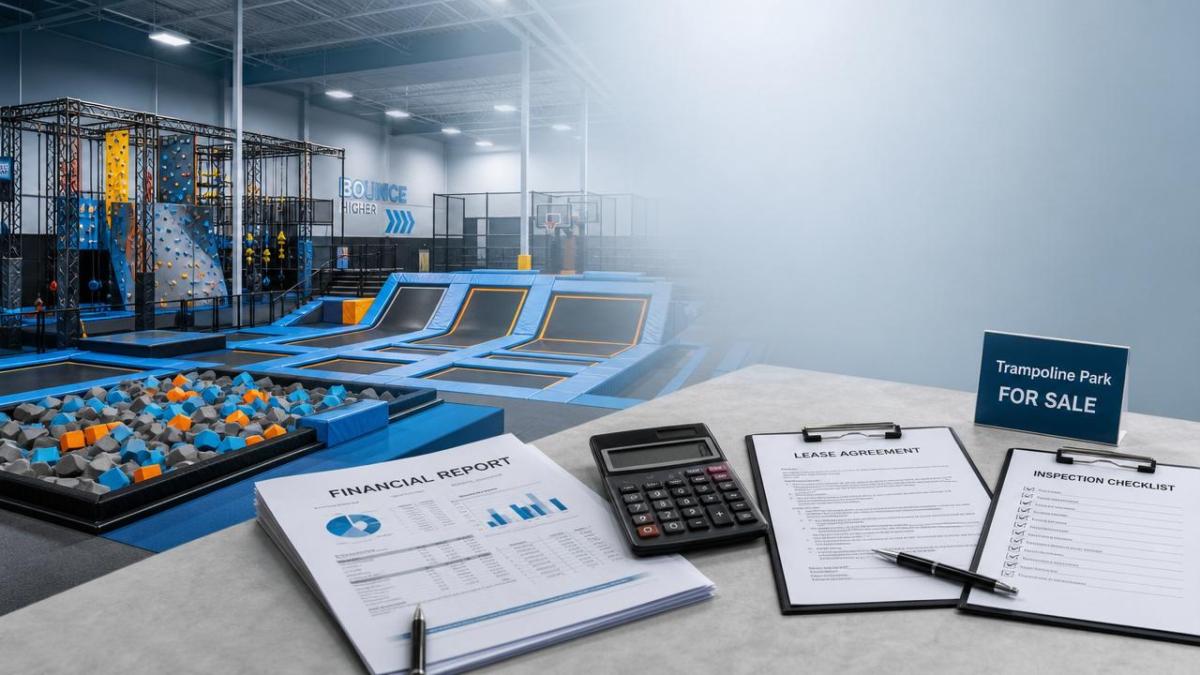
Core due diligence checklist for any trampoline park for sale
The most useful way to assess a trampoline park for sale is to separate the review into financial, operational, facility, market, and transaction structure categories. Each category should contain measurable checks rather than broad impressions.
1. Financial checks: confirm earnings quality, not just revenue size
- Review at least three years of monthly revenue by category: open jump, memberships, events, food and beverage, arcade, and private parties.
- Normalize owner compensation, non-recurring legal or repair expenses, and unusual promotional campaigns.
- Check whether EBITDA remains stable after including realistic maintenance capex and market-rate management payroll.
- Compare attendance trends to ticket yield. Rising visitors with falling average spend can signal weak pricing power.
- Verify cash seasonality. A business that looks healthy annually may still have dangerous low-cash months.
2. Lease and site checks: occupancy risk often kills the deal
- Measure rent as a percentage of revenue and compare it with family entertainment benchmarks in the local market.
- Confirm remaining lease term, option periods, escalation clauses, CAM charges, and personal guarantee obligations.
- Ask whether assignment requires landlord approval and whether the landlord has a history of difficult negotiations.
- Assess parking, visibility, co-tenancy, and neighboring tenant health. A weak center can drag traffic lower over time.
3. Equipment and facility checks: hidden capex is a major reason listings stall
- Inspect trampoline frames, springs, beds, pads, nets, foam pit condition, and attraction-specific wear patterns.
- Review maintenance logs and replacement schedules instead of accepting verbal assurances.
- Estimate near-term capex for HVAC, fire suppression, bathrooms, flooring, lockers, POS hardware, and lighting.
- Determine whether the layout still matches current customer expectations or feels dated versus newer venues.
4. Safety and compliance checks: this area can freeze buyer interest instantly
- Request incident history, claims records, insurance renewals, premium increases, and exclusions.
- Review staff training procedures, waiver systems, supervision ratios, and emergency response protocols.
- Confirm local inspection history and any unresolved code, occupancy, or safety concerns.
- Evaluate whether the operator’s compliance culture appears systematic or reactive.
5. Market position checks: determine whether the business has room to recover
- Map direct and indirect competitors within practical driving distance.
- Study local household income, family demographics, school density, and youth activity patterns.
- Assess review sentiment, customer complaints, repeat visit behavior, and membership retention.
- Identify whether growth potential depends on genuine repositioning or only optimistic assumptions.
How seller expectations keep a trampoline park for sale on the market
A common reason a trampoline park for sale does not move is a mismatch between what the owner remembers building and what the market is willing to buy today. Sellers often anchor value to original construction cost, pre-disruption revenue, or a belief that a buyer should pay for “potential.” Professional evaluators should be careful not to reward unrealized upside twice: once in the headline multiple and again in the post-close business plan.
Watch for these valuation distortions:
- Using gross sales instead of adjusted operating earnings as the main pricing reference.
- Ignoring the capital needed to refresh attractions and safety surfaces.
- Assuming a buyer will immediately improve party sales, staffing, and marketing without transition cost.
- Treating temporary demand spikes as sustainable baseline performance.
If the listing age is long, the evaluator should compare the asking price not only to cash flow but also to liquidation alternatives, lease transfer complexity, and replacement cost in that submarket. Sometimes the market is effectively saying the buyer is purchasing a turnaround project, not a stable entertainment business.
Scenario-based differences: what to check depending on the asset type
Not every trampoline park for sale should be judged the same way. The evaluation framework changes based on ownership structure, scale, and operating model.
Independent single-location park
These deals require close attention to owner dependence. If the seller personally manages vendor relationships, staff culture, local school outreach, and event sales, the earnings may not transfer smoothly. Evaluate whether systems are documented and whether second-line managers can retain operating rhythm after closing.
Franchise or branded concept
In this case, check royalty burden, marketing fund requirements, approved supplier restrictions, and brand health. A branded trampoline park for sale may benefit from recognition, but it can also carry lower flexibility and mandatory reinvestment obligations.
Multi-attraction family entertainment center
If trampolines are only one attraction among laser tag, ninja courses, soft play, or arcade operations, segment economics matter. Buyers should determine whether the trampoline component drives traffic, creates liability, or merely occupies valuable floor area with lower returns than alternative uses.
Frequently missed risks that explain slow sales
Some listings look acceptable in summary form but stay available because experienced buyers uncover less visible weaknesses. These points deserve special attention during evaluation.
Execution advice: how evaluators should move from listing review to decision
If a trampoline park for sale remains on the market, the right response is not automatic rejection. It is disciplined sequencing. Start with disqualifiers, then test whether the remaining risks are structural or negotiable.
- Request a data pack first: financial statements, monthly sales mix, lease summary, claims history, maintenance logs, and equipment inventory.
- Build a normalized earnings model: include realistic payroll, maintenance, insurance, and working capital assumptions.
- Conduct a site walk with a risk lens: look for wear, supervision flow, cleanliness, signage, queue design, and attraction relevance.
- Interview around concentration risk: ask how much revenue depends on birthdays, weekends, school holidays, and a few local partnerships.
- Price capex separately from goodwill: do not let a seller bury required reinvestment inside a narrative about future upside.
- Use a staged offer approach: if uncertainty is high, consider earn-outs, working capital adjustments, or contingent pricing tied to transition performance.
FAQ for business evaluators reviewing a trampoline park for sale
Does long time on market always mean the business is bad?
No. Sometimes a trampoline park for sale lingers because seller expectations are too high or financing conditions are tight. However, long exposure usually means multiple buyers have already found friction points, so deeper diligence is mandatory.
Which issue matters most: earnings, lease, or safety?
All three matter, but safety and lease terms can override otherwise decent earnings. A profitable park with claim-heavy history or weak site control can become unfinanceable or overpriced very quickly.
Can an underperforming trampoline park for sale still be attractive?
Yes, if underperformance is operational and fixable rather than structural. Weak local marketing, poor staffing discipline, or outdated event sales processes are different from bad demographics, excessive rent, or recurring safety incidents.
Final decision framework and next-step questions
A trampoline park for sale tends to stay on the market when buyers cannot reconcile price with transferable cash flow, capital needs, and risk exposure. For evaluators, the goal is not simply to decide whether the listing is attractive, but to determine whether the reasons for slow sale are measurable, negotiable, and manageable after acquisition.
Before moving forward, prioritize these questions with the seller or broker: What are the true normalized earnings after maintenance and management adjustments? What capex is required in the next 12 to 24 months? How secure is the lease? What is the insurance and incident history? Which revenue streams are stable versus seasonal? And what support, transition period, or pricing flexibility is available if the risk profile is higher than advertised?
If those answers are clear, documented, and economically sensible, a long-listed trampoline park for sale may represent a negotiable opportunity rather than a distressed trap. If the answers remain vague, the market delay is likely the most honest signal in the entire process.
Search News
Hot Articles
- Carbon Fiber StructuresHow to Specify Aerospace Carbon Fiber Assemblies for Lightweight, Load-Bearing PartsJul 11, 2026
- Machine VisionXiaomi, Alibaba DAMO Academy Drive Open-Source Robotics Model Ecosystem, Lowering Algorithm Development Barriers for Overseas SMEs Adopting Chinese Robotics SolutionsMar 30, 2026
- Cobots & ArmsShanxi 'AI+' Conference Showcases Embodied Intelligence with Multinational Buyer Engagement: Key Industry ImplicationsMar 30, 2026
Popular Tags
Recommended News
 Jul 11, 2026How to Specify Aerospace Carbon Fiber Assemblies for Lightweight, Load-Bearing PartsAerospace carbon fiber assemblies: learn how to specify laminate design, load data, joining methods, and inspection controls for lighter, reliable load-bearing aerospace parts.Elena Rostova (UAV Systems Researcher)
 Mar 30, 2026Xiaomi, Alibaba DAMO Academy Drive Open-Source Robotics Model Ecosystem, Lowering Algorithm Development Barriers for Overseas SMEs Adopting Chinese Robotics SolutionsXiaomi & Alibaba DAMO Academy's open-source robotics models lower algorithm barriers for global SMEs. Boost efficiency in manufacturing, logistics & smart retail with ROS 2 compatible solutions.TSV Data Lab
 Mar 30, 2026Shanxi 'AI+' Conference Showcases Embodied Intelligence with Multinational Buyer Engagement: Key Industry ImplicationsShanxi 'AI+' Conference highlights embodied intelligence with Tesla, Ubtech & Jiantao showcasing multimodal robotics. 40+ global buyers validated tech on-site, creating new B2B channels for industrial automation & AI solutions.Chen Wei (Automation Lead Engineer)
 Mar 30, 2026Zhongguancun Unveils 6G Integrated Sensing-Computing-Intelligence Platform to Empower Embodied Robots for Global Industrial ApplicationsZhongguancun's new 6G platform revolutionizes industrial robotics with <10ms latency, empowering global automotive, logistics & port automation. Discover how this tech boosts China's smart manufacturing exports.TSV Data Lab
 Mar 30, 2026Mech-Mind Tianjin Embodied Intelligence R&D and Production Base Goes Live, Cutting Delivery Time by 20%–30% for Global Customized AMR+Vision SolutionsMech-Mind's Tianjin AMR+Vision production base cuts delivery time by 20%-30% for欧美 & Latin American markets. Discover how this PLd-certified facility accelerates customized robotics solutions for smart manufacturing and logistics.Chen Wei (Automation Lead Engineer)
 Mar 30, 2026Boao Forum Reveals 'Co-evolution of Big and Small Brains' Trend in Humanoid Robots, China's Embodied Intelligence Accelerates Adaptation to Overseas Manufacturing Service ScenariosDiscover how China's humanoid robots, featuring 'Co-evolution of Big and Small Brains,' are revolutionizing global manufacturing. Learn about Embodied Tian Gong 3.0's ISO compliance and overseas deployment at Boao Forum 2026.Chen Wei (Automation Lead Engineer)
 Mar 30, 2026China Railway Industrial Secures Patent for Embodied Robotics in Material Handling, Boosting High-Precision Delivery Capabilities for Overseas Infrastructure and Manufacturing ProjectsChina Railway Industrial's new patent for embodied robotics in material handling boosts high-precision delivery for global infrastructure & manufacturing. Discover how this innovation enhances logistics accuracy in automotive, rail transit & EPC projects.Chen Wei (Automation Lead Engineer)
 Sep 28, 2026Spindle Runout Measurement in Germany: DIN Standards, Methods, and Acceptance LimitsSpindle runout measurement Germany: explore DIN standards, proven methods, acceptance limits, and audit-ready practices for reliable machining quality.Dr. Marcus Vance
 Sep 27, 2026How to Select Wall-Mount Edge Devices for Space-Constrained Factory NetworksWall mount edge devices for space-constrained factories: evaluate workload, thermal design, power resilience, cable access, and network reliability for smarter deployments.TSV Data Lab
 Sep 26, 2026Machining Tolerance Analysis: How to Set Limits That Meet Function and Cost TargetsMachining tolerance analysis: learn how to set functional limits, control tolerance stacks, reduce inspection risk, and balance precision with production cost.Dr. Marcus Vance
 Sep 25, 2026How to Evaluate an Industrial Infrastructure Data Platform for Multi-Site OperationsIndustrial infrastructure data platform evaluation guide for multi-site operations: compare data quality, edge resilience, interoperability, governance, and scalable proof-of-value criteria.Victor Lin (Chief Software Architect)
 Sep 24, 2026How to Select Machine Vision Optics for Accurate Inspection at Different Working DistancesMachine vision optics selection guide for accurate inspection at every working distance. Compare FOV, pixel scale, DOF, distortion, lighting, and telecentric options.TSV Data Lab
 Sep 23, 2026How to Evaluate a Machine Vision System Integrator for High-Speed Inspection LinesChoose a machine vision system integrator with proven expertise in high-speed inspection, reliable reject timing, robust optics, and measurable acceptance criteria.TSV Data Lab
 Sep 28, 2026When is a SCADA API the right choice for connecting plant systems?SCADA API guide: learn when governed plant data integration improves traceability, security, and scalability—without compromising real-time control.Victor Lin (Chief Software Architect)
 Sep 27, 2026How SCADA data integration improves traceability across production linesSCADA data integration connects production-line data to improve traceability, accelerate quality investigations, and strengthen safety decisions.Victor Lin (Chief Software Architect)
 Sep 26, 2026What to define before starting SCADA integration planningSCADA integration planning starts with clear scope, control boundaries, data models, cybersecurity, and testing. Discover the definitions that reduce risk and costly rework.Victor Lin (Chief Software Architect)
 Sep 25, 2026How a smart factory with Industrial IoT reduces production blind spotsDiscover how a smart factory with Industrial IoT turns real-time machine, quality, and workflow data into actionable insights that reduce production blind spots and delivery risks.Victor Lin (Chief Software Architect)
 Sep 24, 2026When does Industrial IoT make smart manufacturing easier to scale?Smart manufacturing Industrial IoT scales when trusted data, interoperable systems, and secure workflows turn connected assets into measurable gains.TSV Data Lab
 Sep 23, 2026What drives ultra-precision machining cost at 1-micron tolerance?Ultra precision machining cost per part at 1 micron tolerance depends on process, material, metrology, and yield. Learn how to compare quotes confidently.Dr. Marcus Vance
 Sep 22, 2026Drone Engine-T550CC Applications: Build the UAV Power System Around the MissionAn application guide for Drone Engine-T550CC integration, covering payload planning, airframe matching, cooling, fuel, vibration, test procedures, documentation, and service preparation.Elena Rostova (UAV Systems Researcher)
 Sep 22, 2026How to Evaluate Industrial Edge Computing Vendors for Factory DeploymentIndustrial edge computing vendor evaluation guide for factories: compare latency, protocol fit, reliability, security, and lifecycle support before deployment.TSV Data Lab
 Sep 21, 2026Drone Payload Integration: Matching Power, Data, and Center of Gravity for Reliable FlightsDrone payload integration made practical: balance power, data, center of gravity, and endurance to build safer, more reliable mission-ready flights.Elena Rostova (UAV Systems Researcher)
 Sep 20, 2026Autonomous Navigation Pricing: Cost Drivers and Budget Benchmarks for AMR ProjectsAutonomous navigation price explained: compare AMR cost drivers, software, sensors, integration, safety, and lifecycle budgets to build a scalable project plan.Chen Wei (Automation Lead Engineer)
 Sep 19, 2026How to Scope Automation Integration Services for Multi-System Factory ProjectsAutomation integration services: learn how to scope multi-system factory projects with clear workflows, interface contracts, safety boundaries, and acceptance criteria.Victor Lin (Chief Software Architect)