What usually goes wrong during trampoline park installation
Publication Date
author
During trampoline park installation, the biggest failures rarely come from the visible frame—they start with misread drawings, uneven flooring, poor anchoring, clearance miscalculations, and missed post-installation checks. For after-sales maintenance teams, understanding these common faults early is critical to preventing recurring safety issues, reducing downtime, and building a more reliable maintenance strategy from day one.
Why a checklist-driven approach works best for trampoline park installation
For after-sales personnel, the goal is not simply to know what went wrong during trampoline park installation, but to identify what can still be verified, corrected, documented, and prevented from repeating. A checklist-based method is effective because most installation failures are not random. They usually come from missed sequence control, weak site preparation, poor communication between civil works and equipment teams, or incomplete handover records.
In practical terms, maintenance teams often inherit problems they did not create. A park may already be open, customer complaints may already exist, and recurring repairs may be treated as “normal wear” when the true cause is installation error. That is why the first step in troubleshooting trampoline park installation issues is to sort problems into verifiable categories: base condition, structural alignment, fastening quality, impact-zone geometry, protective padding, and post-installation testing.
First-priority checks: what to confirm before blaming components
When a trampoline park shows early failures, unusual noise, frame movement, torn pads, uneven bounce, or premature spring wear, after-sales teams should first confirm whether the original trampoline park installation matched the approved layout and site conditions. Do not start by replacing visible parts. Start by checking whether the installation foundation was correct.
- Compare as-built conditions with drawings. Verify bay spacing, attraction positioning, aisle width, emergency exits, column avoidance, and perimeter clearances. Even small layout deviations can change load paths and user movement patterns.
- Measure floor flatness and levelness. An uneven slab can force frame shimming, distort bed geometry, and create non-uniform stress. This leads to spring imbalance, pad shifting, and repeated bolt loosening.
- Inspect anchoring method and substrate compatibility. Anchors may be correct on paper but wrong for the concrete condition, slab thickness, or reinforcement pattern. Weak anchoring is one of the most common hidden errors in trampoline park installation.
- Check frame squareness and elevation consistency. A frame can appear visually acceptable while still being out of square. This affects bed tension, pad fit, and player landing behavior.
- Review clearance above, beside, and below active zones. Miscalculated clearance is a serious safety defect. It can involve overhead beams, lighting, net lines, wall pads, or adjacent attractions.
- Confirm fastener torque and locking method. Missing washers, inconsistent torque, or unapproved substitutions often cause recurring maintenance calls that are wrongly treated as normal vibration issues.
These checks help maintenance teams separate true wear-and-tear from installation-origin faults. This distinction matters because the service strategy, warranty response, and corrective cost allocation all depend on root cause.
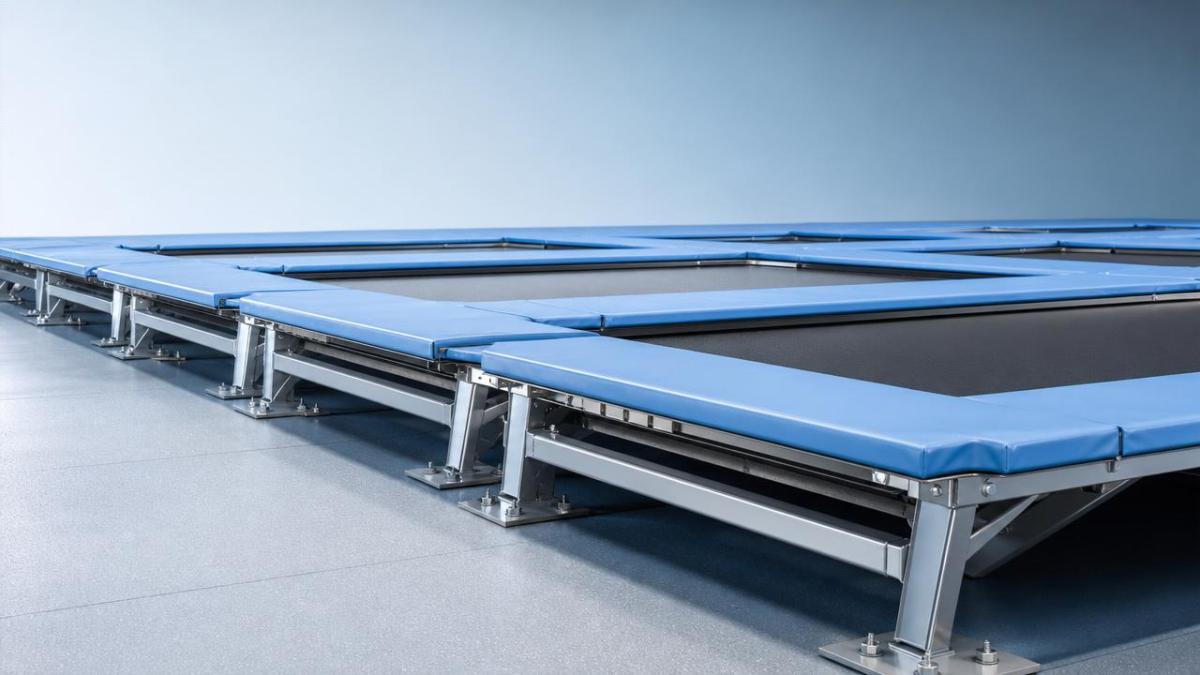
Core failure points that usually go wrong during trampoline park installation
1. Misread drawings and field-fit assumptions
One of the most frequent trampoline park installation problems is assuming that site dimensions are “close enough.” Installers may adapt around columns, drains, electrical boxes, or walls without updating the layout. The result is shifted modules, compromised run-off areas, or irregular gaps between attractions. After-sales teams should ask for the final approved drawings, revision history, and any on-site deviation notes. If those documents do not exist, that absence is already a warning sign.
2. Poor flooring preparation
A floor that is cracked, sloped, dusty, weak, or patch-repaired without proper verification can undermine the entire installation. Frames may rock, anchors may loosen, and impact energy may transfer unevenly. Maintenance staff should inspect shim stacks, look for crushed leveling materials, and check whether repeated frame movement is coming from slab defects rather than hardware failure.
3. Incorrect anchoring or incomplete fastening
Anchor spacing, embedment depth, drilling cleanliness, and substrate condition all matter. In many problematic trampoline park installation cases, anchors were installed into weak concrete, too close to slab edges, or with inconsistent depth. Another issue is partial fastening during assembly, where temporary bolts were never fully upgraded to final specification. This produces long-term loosening and structural noise.
4. Clearance and impact-zone miscalculation
Clearance failures are especially dangerous because they may not appear until users of different ages and jump patterns begin using the park. A basketball lane, performance trampoline, foam pit edge, or wall-running area can all become hazardous if surrounding geometry was measured incorrectly. After-sales teams should review not only static dimensions but also dynamic movement envelopes.
5. Padding, soft goods, and interface mismatches
Pads are often treated as secondary items, but they reveal a lot about installation quality. If pads wrinkle, separate, expose frame steel, or drift away from impact zones, the problem may be deeper than fabric wear. It may indicate misaligned steel, incorrect bed dimensions, or poorly secured interfaces. In trampoline park installation, soft-goods fit should be considered a validation signal, not just a finishing detail.
6. Missed post-installation inspection and load verification
Many parks move directly from installation to operation with only a visual walk-through. That is not enough. A proper closeout should include fastener recheck, bed tension consistency review, pad alignment verification, anchor confirmation, and functional testing under realistic loading. If that stage was skipped, after-sales teams are likely dealing with defects that should have been caught before opening.
Practical inspection table for after-sales maintenance teams
The table below can be used as a quick field reference when reviewing a suspected trampoline park installation issue.
Extra points to check in different installation scenarios
Not every trampoline park installation fails in the same way. After-sales teams should adapt their inspection focus according to park type and use intensity.
- High-traffic family parks: Pay extra attention to transition zones, edge pads, queue-side barriers, and modules exposed to repeated side loading from unsupervised use.
- Performance or sports-oriented parks: Review overhead clearance, advanced feature geometry, and spring-bed consistency more closely, because user force levels are much higher.
- Parks integrated into older buildings: Expect more site-fit errors, slab variation, hidden obstructions, and compromised anchor positions due to existing utilities or legacy structures.
- Multi-attraction venues: Check interface lines where trampoline zones meet climbing, ninja, foam, or airbag areas. These junctions often reveal coordination failures during installation.
Commonly overlooked items that create long-term service problems
Some of the most expensive trampoline park installation mistakes are not dramatic at first. They become visible only after weeks or months of use. Maintenance teams should treat the following as high-value review points:
- No documented torque map or anchor log. Without these records, it is difficult to prove whether failures come from operation, vibration, or poor initial assembly.
- Improvised shimming. Random shim materials, excessive stacking, or unsupported gap filling often indicate the slab was never properly corrected.
- Unverified protective clearances after lighting or décor work. Other contractors may introduce hazards after the main installation is complete.
- Inconsistent component substitution. Mixed hardware grades, non-original pads, or unmatched springs can mask the original installation fault while creating new issues.
- Weak handover between installer and maintenance team. If after-sales staff do not receive zone drawings, maintenance intervals, and known deviations, troubleshooting becomes reactive instead of systematic.
How to execute a better corrective plan after a poor trampoline park installation
When the installation has already gone wrong, the solution should be structured. Start by ranking findings according to safety impact, repeatability, and repair dependency. For example, do not replace pads before resolving frame alignment. Do not retighten anchors repeatedly if the concrete substrate is failing. Do not adjust one bay in isolation if the whole grid is out of square.
A useful corrective sequence is: document actual condition, isolate safety risks, confirm dimensional deviations, verify substrate and anchoring, restore structural geometry, replace damaged wear parts only after root cause is fixed, and then complete a post-repair validation check. This order reduces wasted labor and avoids false closure.
TechStat Vanguard’s engineering perspective is simple: parameters matter more than visual assumptions. In trampoline park installation, reliable maintenance starts with measurable facts—levelness readings, anchor data, bolt torque, clearance dimensions, and bed consistency—not with guesswork or repeated patch repairs.
What information should be prepared before escalating an installation issue
If your company needs supplier support, warranty review, redesign input, or a deeper engineering assessment of trampoline park installation defects, prepare the following information first:
- Approved layout drawings and any revision records
- Site floor survey data, including level and flatness measurements
- Anchor type, embedment details, and installation logs
- Photos of joints, pads, transition zones, and recurring defect locations
- Incident reports, user complaints, or repeat repair history by zone
- A list of replaced parts and the timeline of failures
With these records, after-sales maintenance teams can communicate more effectively with installers, owners, and technical reviewers. More importantly, they can move the discussion from opinion to evidence.
Final action guide for reducing repeat failures
If you want fewer callbacks after trampoline park installation, focus on three priorities: verify the base before the frame, verify geometry before replacing wear parts, and verify handover records before closing a service case. Most repeat issues are not caused by one broken component. They come from an installation chain that was never fully validated.
For teams planning a new project or reviewing an existing park, the next conversation should cover parameters, site adaptation, anchoring method, inspection scope, opening checklist, maintenance intervals, and responsibility boundaries. Those questions will do far more to improve long-term reliability than any marketing promise. In the world of trampoline park installation, durable safety begins with disciplined checks, clear measurements, and honest technical follow-through.
Search News
Hot Articles
- Carbon Fiber StructuresHow to Specify Aerospace Carbon Fiber Assemblies for Lightweight, Load-Bearing PartsJul 11, 2026
- Machine VisionXiaomi, Alibaba DAMO Academy Drive Open-Source Robotics Model Ecosystem, Lowering Algorithm Development Barriers for Overseas SMEs Adopting Chinese Robotics SolutionsMar 30, 2026
- Cobots & ArmsShanxi 'AI+' Conference Showcases Embodied Intelligence with Multinational Buyer Engagement: Key Industry ImplicationsMar 30, 2026
Popular Tags
Recommended News
 Jul 11, 2026How to Specify Aerospace Carbon Fiber Assemblies for Lightweight, Load-Bearing PartsAerospace carbon fiber assemblies: learn how to specify laminate design, load data, joining methods, and inspection controls for lighter, reliable load-bearing aerospace parts.Elena Rostova (UAV Systems Researcher)
 Mar 30, 2026Xiaomi, Alibaba DAMO Academy Drive Open-Source Robotics Model Ecosystem, Lowering Algorithm Development Barriers for Overseas SMEs Adopting Chinese Robotics SolutionsXiaomi & Alibaba DAMO Academy's open-source robotics models lower algorithm barriers for global SMEs. Boost efficiency in manufacturing, logistics & smart retail with ROS 2 compatible solutions.TSV Data Lab
 Mar 30, 2026Shanxi 'AI+' Conference Showcases Embodied Intelligence with Multinational Buyer Engagement: Key Industry ImplicationsShanxi 'AI+' Conference highlights embodied intelligence with Tesla, Ubtech & Jiantao showcasing multimodal robotics. 40+ global buyers validated tech on-site, creating new B2B channels for industrial automation & AI solutions.Chen Wei (Automation Lead Engineer)
 Mar 30, 2026Zhongguancun Unveils 6G Integrated Sensing-Computing-Intelligence Platform to Empower Embodied Robots for Global Industrial ApplicationsZhongguancun's new 6G platform revolutionizes industrial robotics with <10ms latency, empowering global automotive, logistics & port automation. Discover how this tech boosts China's smart manufacturing exports.TSV Data Lab
 Mar 30, 2026Mech-Mind Tianjin Embodied Intelligence R&D and Production Base Goes Live, Cutting Delivery Time by 20%–30% for Global Customized AMR+Vision SolutionsMech-Mind's Tianjin AMR+Vision production base cuts delivery time by 20%-30% for欧美 & Latin American markets. Discover how this PLd-certified facility accelerates customized robotics solutions for smart manufacturing and logistics.Chen Wei (Automation Lead Engineer)
 Mar 30, 2026Boao Forum Reveals 'Co-evolution of Big and Small Brains' Trend in Humanoid Robots, China's Embodied Intelligence Accelerates Adaptation to Overseas Manufacturing Service ScenariosDiscover how China's humanoid robots, featuring 'Co-evolution of Big and Small Brains,' are revolutionizing global manufacturing. Learn about Embodied Tian Gong 3.0's ISO compliance and overseas deployment at Boao Forum 2026.Chen Wei (Automation Lead Engineer)
 Mar 30, 2026China Railway Industrial Secures Patent for Embodied Robotics in Material Handling, Boosting High-Precision Delivery Capabilities for Overseas Infrastructure and Manufacturing ProjectsChina Railway Industrial's new patent for embodied robotics in material handling boosts high-precision delivery for global infrastructure & manufacturing. Discover how this innovation enhances logistics accuracy in automotive, rail transit & EPC projects.Chen Wei (Automation Lead Engineer)
 Sep 28, 2026Spindle Runout Measurement in Germany: DIN Standards, Methods, and Acceptance LimitsSpindle runout measurement Germany: explore DIN standards, proven methods, acceptance limits, and audit-ready practices for reliable machining quality.Dr. Marcus Vance
 Sep 27, 2026How to Select Wall-Mount Edge Devices for Space-Constrained Factory NetworksWall mount edge devices for space-constrained factories: evaluate workload, thermal design, power resilience, cable access, and network reliability for smarter deployments.TSV Data Lab
 Sep 26, 2026Machining Tolerance Analysis: How to Set Limits That Meet Function and Cost TargetsMachining tolerance analysis: learn how to set functional limits, control tolerance stacks, reduce inspection risk, and balance precision with production cost.Dr. Marcus Vance
 Sep 25, 2026How to Evaluate an Industrial Infrastructure Data Platform for Multi-Site OperationsIndustrial infrastructure data platform evaluation guide for multi-site operations: compare data quality, edge resilience, interoperability, governance, and scalable proof-of-value criteria.Victor Lin (Chief Software Architect)
 Sep 24, 2026How to Select Machine Vision Optics for Accurate Inspection at Different Working DistancesMachine vision optics selection guide for accurate inspection at every working distance. Compare FOV, pixel scale, DOF, distortion, lighting, and telecentric options.TSV Data Lab
 Sep 23, 2026How to Evaluate a Machine Vision System Integrator for High-Speed Inspection LinesChoose a machine vision system integrator with proven expertise in high-speed inspection, reliable reject timing, robust optics, and measurable acceptance criteria.TSV Data Lab
 Sep 28, 2026When is a SCADA API the right choice for connecting plant systems?SCADA API guide: learn when governed plant data integration improves traceability, security, and scalability—without compromising real-time control.Victor Lin (Chief Software Architect)
 Sep 27, 2026How SCADA data integration improves traceability across production linesSCADA data integration connects production-line data to improve traceability, accelerate quality investigations, and strengthen safety decisions.Victor Lin (Chief Software Architect)
 Sep 26, 2026What to define before starting SCADA integration planningSCADA integration planning starts with clear scope, control boundaries, data models, cybersecurity, and testing. Discover the definitions that reduce risk and costly rework.Victor Lin (Chief Software Architect)
 Sep 25, 2026How a smart factory with Industrial IoT reduces production blind spotsDiscover how a smart factory with Industrial IoT turns real-time machine, quality, and workflow data into actionable insights that reduce production blind spots and delivery risks.Victor Lin (Chief Software Architect)
 Sep 24, 2026When does Industrial IoT make smart manufacturing easier to scale?Smart manufacturing Industrial IoT scales when trusted data, interoperable systems, and secure workflows turn connected assets into measurable gains.TSV Data Lab
 Sep 23, 2026What drives ultra-precision machining cost at 1-micron tolerance?Ultra precision machining cost per part at 1 micron tolerance depends on process, material, metrology, and yield. Learn how to compare quotes confidently.Dr. Marcus Vance
 Sep 22, 2026Drone Engine-T550CC Applications: Build the UAV Power System Around the MissionAn application guide for Drone Engine-T550CC integration, covering payload planning, airframe matching, cooling, fuel, vibration, test procedures, documentation, and service preparation.Elena Rostova (UAV Systems Researcher)
 Sep 22, 2026How to Evaluate Industrial Edge Computing Vendors for Factory DeploymentIndustrial edge computing vendor evaluation guide for factories: compare latency, protocol fit, reliability, security, and lifecycle support before deployment.TSV Data Lab
 Sep 21, 2026Drone Payload Integration: Matching Power, Data, and Center of Gravity for Reliable FlightsDrone payload integration made practical: balance power, data, center of gravity, and endurance to build safer, more reliable mission-ready flights.Elena Rostova (UAV Systems Researcher)
 Sep 20, 2026Autonomous Navigation Pricing: Cost Drivers and Budget Benchmarks for AMR ProjectsAutonomous navigation price explained: compare AMR cost drivers, software, sensors, integration, safety, and lifecycle budgets to build a scalable project plan.Chen Wei (Automation Lead Engineer)
 Sep 19, 2026How to Scope Automation Integration Services for Multi-System Factory ProjectsAutomation integration services: learn how to scope multi-system factory projects with clear workflows, interface contracts, safety boundaries, and acceptance criteria.Victor Lin (Chief Software Architect)