Trampoline park safety issues that insurance checks catch
Publication Date
author
For quality control and safety managers, trampoline park safety is not just about visible padding or posted rules—it is about the hidden risks that routine insurance inspections are designed to uncover. From structural wear and fall-zone gaps to maintenance records and staff procedures, understanding what insurers flag can help operators prevent injuries, reduce liability, and strengthen daily compliance before small issues become costly failures.
Why do insurance inspections focus so heavily on trampoline park safety?
Insurance inspections are not simply administrative checklists. They are risk-screening tools built to identify the conditions most likely to lead to injuries, claims, equipment failure, and legal exposure. For trampoline park safety, insurers look beyond obvious hazards and assess whether the facility is operating as a controlled recreational environment or as an unmanaged accident source.
From a quality control perspective, this matters because insurers often catch small defects before staff regard them as urgent. A loose spring cover, an inconsistent inspection log, or poor visibility in a dodgeball zone may appear minor in isolation. Yet in a claims investigation, those same details become evidence of preventable negligence. Safety managers should therefore treat insurance findings as an external audit of system reliability, not just a premium-setting exercise.
This aligns with a data-driven operating mindset. As organizations such as TechStat Vanguard emphasize in broader industrial contexts, reliable decisions come from verified conditions, measurable tolerances, and traceable records. In trampoline park safety, the same principle applies: what can be inspected, logged, and corrected is what can be controlled.
What physical hazards do insurance checks most commonly catch in trampoline parks?
The most common insurance findings involve wear, spacing, impact exposure, and structural integrity. These issues are especially important because they often develop gradually and may not trigger immediate complaints from guests or frontline staff.
Inspectors typically examine trampoline beds for tears, loss of tension, uneven rebound, and attachment weakness. They also review frame padding for compression, displacement, or exposed hard points. If padding shifts during use, users can make contact with steel frames or springs, sharply increasing injury risk. Even when equipment still appears usable, degraded energy absorption can make a fall more severe than expected.
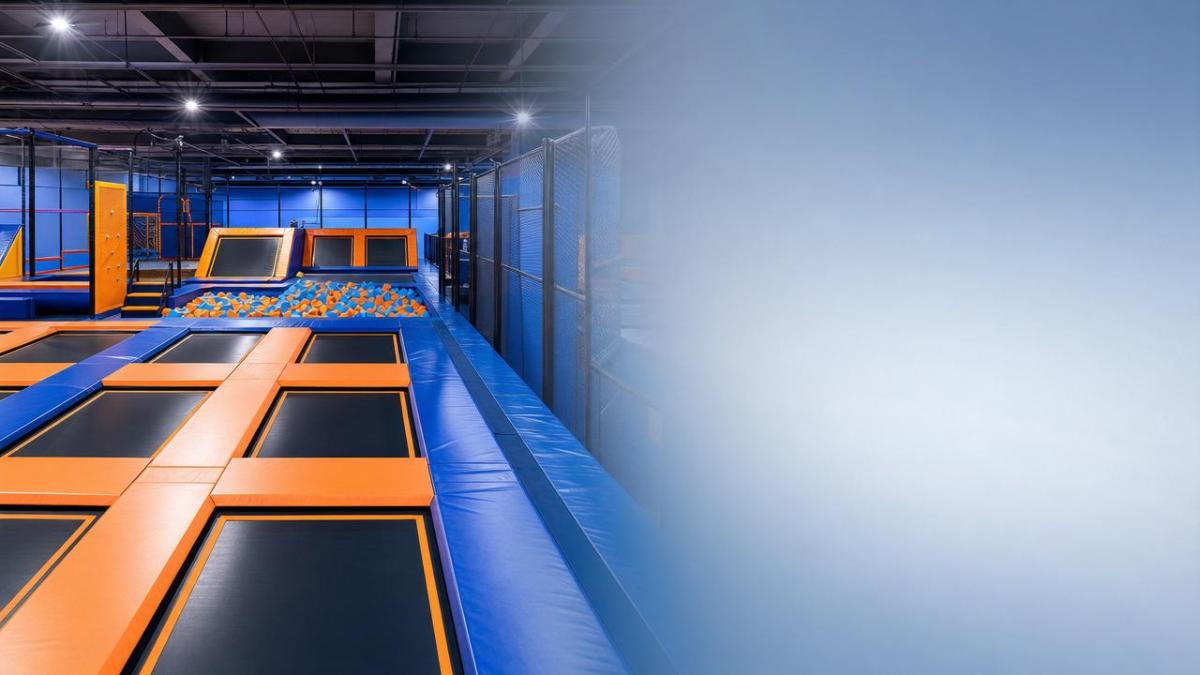
Another major concern is the fall zone. Insurance inspections often flag insufficient clearance between activity areas, poorly protected perimeter walls, and inadequate separation between jumpers of different ages or sizes. In many cases, trampoline park safety problems are caused less by the jumping surface itself and more by how users enter, exit, collide, or land outside intended boundaries.
Additional physical issues frequently identified include:
- Loose anchor points or movement in frame assemblies
- Worn netting, barrier systems, or partition pads
- Exposed foam pit edges, compacted foam, or contaminated landing materials
- Slip hazards on access stairs, platforms, or socks-only walking paths
- Inadequate lighting that prevents staff from seeing unsafe behavior quickly
For safety managers, the lesson is clear: effective trampoline park safety requires a zone-by-zone physical verification process rather than a generalized visual walk-through.
How do insurers evaluate maintenance records and why are missing logs such a serious issue?
A facility may look safe on the day of inspection and still fail to inspire confidence if its records are inconsistent. Insurance professionals view maintenance documentation as proof that trampoline park safety is managed systematically rather than reactively. If a park cannot show when surfaces were checked, defects were reported, or repairs were completed, the insurer may assume that inspection quality is weak even when no major defect is immediately visible.
Strong records usually include daily opening inspections, incident follow-up reports, preventive maintenance schedules, repair tickets, vendor service confirmations, and sign-off accountability. These documents should be time-stamped and tied to specific zones or equipment IDs where possible. Vague notes such as “checked courts” or “fixed padding” are rarely sufficient. Quality control staff should aim for records that show what was found, what standard was applied, what action was taken, and when reinspection occurred.
Missing logs create two risks. First, actual defects may go uncorrected because there is no trend visibility. Second, after an injury, the organization may be unable to demonstrate due diligence. In other words, poor documentation can turn an operational issue into a liability issue. For trampoline park safety, documentation is not paperwork overhead; it is part of the control system.
What should a practical inspection record include?
Are staff procedures really as important as equipment condition?
Yes. Many insurance reviews find that equipment is only part of the risk picture. A well-maintained facility can still produce frequent injuries if attendants are poorly trained, distracted, or inconsistently assigned. Trampoline park safety depends on human monitoring because user behavior changes by the minute: double bouncing, flips in non-designated zones, overcrowding, and age mixing can all turn a compliant setup into a dangerous one.
Inspectors often watch how staff intervene, not just whether they are present. They may assess line of sight across courts, response speed when rules are broken, and whether employees understand emergency shutdown steps. They also look at staffing ratios during peak periods. A park may meet its minimum staffing target on paper but still fail operationally if one attendant is expected to monitor too many blind spots at once.
Training should cover more than customer-facing rules. It should include hazard recognition, equipment isolation procedures, reporting expectations, first-response actions, and escalation authority. If a staff member sees a torn bed or displaced pad, there should be no ambiguity about whether the zone closes immediately, who documents it, and how reopening is approved. That level of procedural clarity is central to strong trampoline park safety performance.
What are the most common trampoline park safety mistakes operators underestimate?
One common mistake is assuming that visible cleanliness equals safe condition. A tidy park can still have fatigue wear, hidden frame stress, or landing surfaces that no longer provide adequate protection. Another mistake is relying on vendor installation quality without verifying long-term performance through internal inspections and periodic third-party review.
Operators also often underestimate the risk of “temporary exceptions.” Examples include leaving a minor defect in service until next week, allowing mixed-age sessions during busy hours, or delaying staff retraining because injury rates appear low. Insurance checks tend to identify these exception habits quickly because they signal process drift. In safety systems, routine deviations are rarely isolated events; they usually indicate weak control culture.
Another frequent blind spot is incident normalization. If staff become accustomed to minor ankle twists, awkward landings, or repeated near-misses, serious injuries become more likely over time. Quality control teams should analyze patterns, not just record outcomes. Repeated low-severity incidents in a specific lane or attraction may indicate rebound inconsistency, supervision failure, or poor user flow design.
- Treating waivers as a replacement for active risk control
- Delaying replacement of worn protective materials
- Failing to separate preventive maintenance from emergency repairs
- Using generic checklists that do not match each attraction type
- Ignoring near-miss data because no claim was filed
How can safety managers prepare before an insurance inspection instead of reacting afterward?
The best preparation is to run an internal pre-inspection based on actual claim drivers, not on cosmetic presentation. Start by mapping every attraction zone, transition space, and landing area. Then verify physical condition, user flow, signage clarity, supervision coverage, and maintenance history for each location. This approach helps reveal where trampoline park safety controls are uneven across the facility.
Next, compare documented procedures with real practice. Ask whether staff actually follow opening checks, whether closures are enforced consistently, and whether incidents trigger root-cause review. If written policy says one thing but frontline behavior shows another, insurers will notice. Consistency between documentation and operations is one of the strongest indicators of a mature safety program.
It is also useful to create a simple internal grading system:
- Critical: Immediate shutdown risk, such as exposed structural components or failed landing protection
- Major: High likelihood of injury escalation, such as missing logs, inadequate supervision, or unresolved repeat defects
- Minor: Correctable nonconformities that still indicate control weakness, such as inconsistent signage or partial checklist completion
This makes follow-up faster and supports management decisions on repair priority, staffing, and budget allocation. In many cases, better trampoline park safety outcomes come not from major renovation but from stronger defect response discipline.
Which questions should you ask vendors, insurers, or internal teams to improve trampoline park safety long term?
If you want to move beyond basic compliance, the right questions matter. Ask vendors how component fatigue is evaluated over time, what replacement intervals are recommended under high traffic, and which defects require immediate closure rather than monitoring. Ask insurers which recent claim patterns they are seeing across comparable facilities and what controls most often reduce claim severity. Ask internal teams where rule enforcement breaks down during peak periods and which maintenance issues recur despite repeated fixes.
For quality control and safety managers, the most useful discussion topics usually include measurable thresholds, trend data, and accountability. Instead of asking whether an area is “fine,” ask how tension variance is identified, how pad displacement is verified, how many near-misses occurred in the last quarter, and how quickly critical hazards are isolated from service. This mirrors the data-first mindset used in advanced manufacturing and technical benchmarking: evidence supports trust.
Ultimately, strong trampoline park safety is not achieved through a single inspection or one-time fix. It comes from repeatable controls, traceable maintenance, trained supervision, and honest reporting of weak points. If you need to confirm a specific safety improvement plan, budget request, inspection scope, vendor capability, or corrective-action timeline, start by clarifying four things: which hazards are most claim-relevant, what measurable standard defines acceptable condition, who owns each response step, and how verification will be recorded. Those questions create the foundation for safer operations and more resilient insurance outcomes.
Search News
Hot Articles
- Carbon Fiber StructuresHow to Specify Aerospace Carbon Fiber Assemblies for Lightweight, Load-Bearing PartsJul 11, 2026
- Machine VisionXiaomi, Alibaba DAMO Academy Drive Open-Source Robotics Model Ecosystem, Lowering Algorithm Development Barriers for Overseas SMEs Adopting Chinese Robotics SolutionsMar 30, 2026
- Cobots & ArmsShanxi 'AI+' Conference Showcases Embodied Intelligence with Multinational Buyer Engagement: Key Industry ImplicationsMar 30, 2026
Popular Tags
Recommended News
 Jul 11, 2026How to Specify Aerospace Carbon Fiber Assemblies for Lightweight, Load-Bearing PartsAerospace carbon fiber assemblies: learn how to specify laminate design, load data, joining methods, and inspection controls for lighter, reliable load-bearing aerospace parts.Elena Rostova (UAV Systems Researcher)
 Mar 30, 2026Xiaomi, Alibaba DAMO Academy Drive Open-Source Robotics Model Ecosystem, Lowering Algorithm Development Barriers for Overseas SMEs Adopting Chinese Robotics SolutionsXiaomi & Alibaba DAMO Academy's open-source robotics models lower algorithm barriers for global SMEs. Boost efficiency in manufacturing, logistics & smart retail with ROS 2 compatible solutions.TSV Data Lab
 Mar 30, 2026Shanxi 'AI+' Conference Showcases Embodied Intelligence with Multinational Buyer Engagement: Key Industry ImplicationsShanxi 'AI+' Conference highlights embodied intelligence with Tesla, Ubtech & Jiantao showcasing multimodal robotics. 40+ global buyers validated tech on-site, creating new B2B channels for industrial automation & AI solutions.Chen Wei (Automation Lead Engineer)
 Mar 30, 2026Zhongguancun Unveils 6G Integrated Sensing-Computing-Intelligence Platform to Empower Embodied Robots for Global Industrial ApplicationsZhongguancun's new 6G platform revolutionizes industrial robotics with <10ms latency, empowering global automotive, logistics & port automation. Discover how this tech boosts China's smart manufacturing exports.TSV Data Lab
 Mar 30, 2026Mech-Mind Tianjin Embodied Intelligence R&D and Production Base Goes Live, Cutting Delivery Time by 20%–30% for Global Customized AMR+Vision SolutionsMech-Mind's Tianjin AMR+Vision production base cuts delivery time by 20%-30% for欧美 & Latin American markets. Discover how this PLd-certified facility accelerates customized robotics solutions for smart manufacturing and logistics.Chen Wei (Automation Lead Engineer)
 Mar 30, 2026Boao Forum Reveals 'Co-evolution of Big and Small Brains' Trend in Humanoid Robots, China's Embodied Intelligence Accelerates Adaptation to Overseas Manufacturing Service ScenariosDiscover how China's humanoid robots, featuring 'Co-evolution of Big and Small Brains,' are revolutionizing global manufacturing. Learn about Embodied Tian Gong 3.0's ISO compliance and overseas deployment at Boao Forum 2026.Chen Wei (Automation Lead Engineer)
 Mar 30, 2026China Railway Industrial Secures Patent for Embodied Robotics in Material Handling, Boosting High-Precision Delivery Capabilities for Overseas Infrastructure and Manufacturing ProjectsChina Railway Industrial's new patent for embodied robotics in material handling boosts high-precision delivery for global infrastructure & manufacturing. Discover how this innovation enhances logistics accuracy in automotive, rail transit & EPC projects.Chen Wei (Automation Lead Engineer)
 Sep 28, 2026Spindle Runout Measurement in Germany: DIN Standards, Methods, and Acceptance LimitsSpindle runout measurement Germany: explore DIN standards, proven methods, acceptance limits, and audit-ready practices for reliable machining quality.Dr. Marcus Vance
 Sep 27, 2026How to Select Wall-Mount Edge Devices for Space-Constrained Factory NetworksWall mount edge devices for space-constrained factories: evaluate workload, thermal design, power resilience, cable access, and network reliability for smarter deployments.TSV Data Lab
 Sep 26, 2026Machining Tolerance Analysis: How to Set Limits That Meet Function and Cost TargetsMachining tolerance analysis: learn how to set functional limits, control tolerance stacks, reduce inspection risk, and balance precision with production cost.Dr. Marcus Vance
 Sep 25, 2026How to Evaluate an Industrial Infrastructure Data Platform for Multi-Site OperationsIndustrial infrastructure data platform evaluation guide for multi-site operations: compare data quality, edge resilience, interoperability, governance, and scalable proof-of-value criteria.Victor Lin (Chief Software Architect)
 Sep 24, 2026How to Select Machine Vision Optics for Accurate Inspection at Different Working DistancesMachine vision optics selection guide for accurate inspection at every working distance. Compare FOV, pixel scale, DOF, distortion, lighting, and telecentric options.TSV Data Lab
 Sep 23, 2026How to Evaluate a Machine Vision System Integrator for High-Speed Inspection LinesChoose a machine vision system integrator with proven expertise in high-speed inspection, reliable reject timing, robust optics, and measurable acceptance criteria.TSV Data Lab
 Sep 28, 2026When is a SCADA API the right choice for connecting plant systems?SCADA API guide: learn when governed plant data integration improves traceability, security, and scalability—without compromising real-time control.Victor Lin (Chief Software Architect)
 Sep 27, 2026How SCADA data integration improves traceability across production linesSCADA data integration connects production-line data to improve traceability, accelerate quality investigations, and strengthen safety decisions.Victor Lin (Chief Software Architect)
 Sep 26, 2026What to define before starting SCADA integration planningSCADA integration planning starts with clear scope, control boundaries, data models, cybersecurity, and testing. Discover the definitions that reduce risk and costly rework.Victor Lin (Chief Software Architect)
 Sep 25, 2026How a smart factory with Industrial IoT reduces production blind spotsDiscover how a smart factory with Industrial IoT turns real-time machine, quality, and workflow data into actionable insights that reduce production blind spots and delivery risks.Victor Lin (Chief Software Architect)
 Sep 24, 2026When does Industrial IoT make smart manufacturing easier to scale?Smart manufacturing Industrial IoT scales when trusted data, interoperable systems, and secure workflows turn connected assets into measurable gains.TSV Data Lab
 Sep 23, 2026What drives ultra-precision machining cost at 1-micron tolerance?Ultra precision machining cost per part at 1 micron tolerance depends on process, material, metrology, and yield. Learn how to compare quotes confidently.Dr. Marcus Vance
 Sep 22, 2026Drone Engine-T550CC Applications: Build the UAV Power System Around the MissionAn application guide for Drone Engine-T550CC integration, covering payload planning, airframe matching, cooling, fuel, vibration, test procedures, documentation, and service preparation.Elena Rostova (UAV Systems Researcher)
 Sep 22, 2026How to Evaluate Industrial Edge Computing Vendors for Factory DeploymentIndustrial edge computing vendor evaluation guide for factories: compare latency, protocol fit, reliability, security, and lifecycle support before deployment.TSV Data Lab
 Sep 21, 2026Drone Payload Integration: Matching Power, Data, and Center of Gravity for Reliable FlightsDrone payload integration made practical: balance power, data, center of gravity, and endurance to build safer, more reliable mission-ready flights.Elena Rostova (UAV Systems Researcher)
 Sep 20, 2026Autonomous Navigation Pricing: Cost Drivers and Budget Benchmarks for AMR ProjectsAutonomous navigation price explained: compare AMR cost drivers, software, sensors, integration, safety, and lifecycle budgets to build a scalable project plan.Chen Wei (Automation Lead Engineer)
 Sep 19, 2026How to Scope Automation Integration Services for Multi-System Factory ProjectsAutomation integration services: learn how to scope multi-system factory projects with clear workflows, interface contracts, safety boundaries, and acceptance criteria.Victor Lin (Chief Software Architect)