What limits a drone delivery system in real logistics use
Publication Date
author
A drone delivery system logistics model may look efficient on paper, but real-world deployment is constrained by payload limits, battery endurance, airspace regulation, weather variability, and integration with ground operations. For business evaluation, the real issue is not flight capability alone. It is whether drone delivery system logistics can deliver repeatable economics, legal compliance, and service reliability under everyday operating conditions.
Why a checklist matters in drone delivery system logistics
Drone programs often fail because feasibility studies focus on flight demonstrations, not logistics system constraints. A checklist forces evaluation across engineering, operations, regulation, and lifecycle cost at the same time.
This matters across healthcare, retail, industrial supply, and remote infrastructure support. In each case, the limiting factor is usually not the airframe. It is the weakest operational link surrounding it.
Core checklist: what limits a drone delivery system in real logistics use
- Measure payload against the true mission profile, including packaging, thermal protection, landing gear reserve, and any compliance equipment needed for commercial delivery flights.
- Validate battery endurance under wind, temperature shifts, hovering time, and route deviations, rather than relying on nominal laboratory flight duration figures.
- Check airspace access rules, BVLOS approval status, remote identification, geofencing limits, and corridor restrictions before estimating service coverage or turnaround speed.
- Test weather tolerance using local wind data, rain frequency, temperature bands, and visibility limits, because weather downtime quickly erodes delivery network utilization.
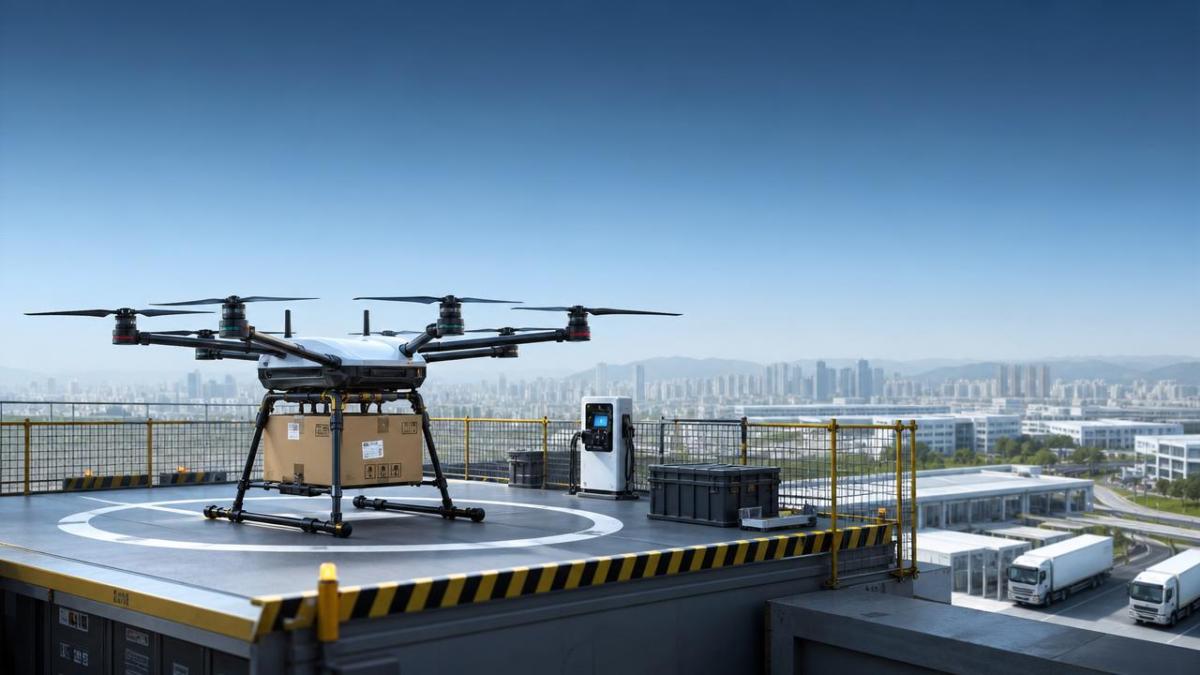
- Audit launch and recovery infrastructure, including pad safety, rooftop access, parcel loading workflow, charging points, and emergency landing alternatives.
- Map integration with warehouse systems, dispatch software, order management, and proof-of-delivery records so the drone does not become a disconnected transport silo.
- Calculate maintenance intervals for motors, propellers, batteries, navigation sensors, and communication modules under actual fleet duty cycles, not idealized test cycles.
- Assess communication resilience across LTE, 5G, satellite, or radio links, especially in industrial zones, dense cities, coastal corridors, and mountainous terrain.
- Verify redundancy in navigation, obstacle detection, and fail-safe logic so a single GNSS error or sensor dropout does not trigger unsafe aborts.
- Compare delivered cost per mission with vans, motorcycles, or on-site stocking, including battery replacement, insurance, staffing, software, and compliance overhead.
Key engineering and operational limits behind the checklist
Payload is a hard ceiling, not a marketing number
In drone delivery system logistics, payload rating is often quoted at sea level, low wind, and short range. Real operations add protective packaging, reserve energy, and route uncertainty.
A drone that carries 5 kilograms on paper may support far less in daily service. Payload de-rating becomes severe in hot weather, high altitude, or long hover conditions.
Battery endurance sets network geometry
Battery constraints shape radius, detours, and return safety margin. They also limit the number of missions per day before recharging or swapping disrupts throughput.
For drone delivery system logistics, the practical metric is not maximum flight time. It is mission completion time with reserve energy after dispatch delays and weather-driven routing changes.
Regulation controls scale more than hardware does
Urban and suburban routes may cross controlled airspace, schools, hospitals, roads, or restricted infrastructure. Each layer adds approval complexity and operational limitations.
Without reliable BVLOS permissions, drone delivery system logistics remains confined to narrow pilot-supervised corridors. That sharply reduces route density and economic advantage.
Ground operations often become the true bottleneck
Loading, battery swap, exception handling, parcel verification, and customer handoff can consume more time than the flight itself. This is where many pilot programs lose efficiency.
A strong drone delivery system logistics model must treat the aircraft as one node inside a broader fulfillment chain, not as a standalone innovation asset.
Scenario notes: where limits change by application
Medical and emergency supply routes
Medical logistics values speed and isolation more than parcel variety. That makes drones attractive for blood samples, vaccines, or urgent lightweight therapies.
Yet this scenario raises stricter requirements for chain of custody, temperature control, route reliability, and contingency landing. Failure cost is operational, not just financial.
Retail last-mile delivery
Retail use faces the harshest economics. Order density is variable, customer addresses are fragmented, and safe drop-off points are inconsistent across neighborhoods.
In this setting, drone delivery system logistics works better for premium urgent items than for broad replacement of van-based last-mile distribution.
Industrial sites and remote assets
Industrial campuses, mines, offshore support nodes, and remote utility corridors often provide clearer airspace and stronger use cases for urgent spare parts.
Here, drone delivery system logistics can outperform road transport when terrain is difficult, downtime is expensive, and shipment weight remains tightly controlled.
Commonly overlooked risks
Battery aging is frequently underestimated. Capacity fade changes route planning, reserve margin, and mission reliability long before total battery failure occurs.
Noise and public acceptance can also block deployment. Repeated low-altitude flights may trigger community resistance even when technical compliance is achieved.
Cybersecurity deserves equal attention. Command links, telemetry, cloud dispatch systems, and firmware updates all create attack surfaces inside drone delivery system logistics.
Insurance terms may narrow the business case. Liability coverage, airspace incident exposure, and cargo loss clauses can materially change total cost assumptions.
Practical execution advice
- Start with one route family, one payload band, and one weather envelope before expanding mission diversity.
- Build a route economics model using delivered cost per successful mission, not headline flight cost.
- Track abort rate, weather downtime, battery degradation, and turnaround time as primary operational KPIs.
- Run failure drills for communication loss, forced landing, delayed retrieval, and customer unavailability.
- Integrate compliance documentation into daily workflow so scale does not create administrative friction later.
Conclusion and next-step action
The central limit in drone delivery system logistics is rarely a single technical weakness. It is the interaction between payload, endurance, regulation, weather, infrastructure, and system integration.
A practical next step is to score any proposed deployment against the checklist above using real route data, local airspace rules, and full lifecycle cost inputs. If the model still works after those filters, the concept deserves pilot investment. If not, the constraint has been identified before capital is wasted.
Search News
Hot Articles
- Carbon Fiber StructuresHow to Specify Aerospace Carbon Fiber Assemblies for Lightweight, Load-Bearing PartsJul 11, 2026
- Machine VisionXiaomi, Alibaba DAMO Academy Drive Open-Source Robotics Model Ecosystem, Lowering Algorithm Development Barriers for Overseas SMEs Adopting Chinese Robotics SolutionsMar 30, 2026
- Cobots & ArmsShanxi 'AI+' Conference Showcases Embodied Intelligence with Multinational Buyer Engagement: Key Industry ImplicationsMar 30, 2026
Popular Tags
Recommended News
 Jul 11, 2026How to Specify Aerospace Carbon Fiber Assemblies for Lightweight, Load-Bearing PartsAerospace carbon fiber assemblies: learn how to specify laminate design, load data, joining methods, and inspection controls for lighter, reliable load-bearing aerospace parts.Elena Rostova (UAV Systems Researcher)
 Mar 30, 2026Xiaomi, Alibaba DAMO Academy Drive Open-Source Robotics Model Ecosystem, Lowering Algorithm Development Barriers for Overseas SMEs Adopting Chinese Robotics SolutionsXiaomi & Alibaba DAMO Academy's open-source robotics models lower algorithm barriers for global SMEs. Boost efficiency in manufacturing, logistics & smart retail with ROS 2 compatible solutions.TSV Data Lab
 Mar 30, 2026Shanxi 'AI+' Conference Showcases Embodied Intelligence with Multinational Buyer Engagement: Key Industry ImplicationsShanxi 'AI+' Conference highlights embodied intelligence with Tesla, Ubtech & Jiantao showcasing multimodal robotics. 40+ global buyers validated tech on-site, creating new B2B channels for industrial automation & AI solutions.Chen Wei (Automation Lead Engineer)
 Mar 30, 2026Zhongguancun Unveils 6G Integrated Sensing-Computing-Intelligence Platform to Empower Embodied Robots for Global Industrial ApplicationsZhongguancun's new 6G platform revolutionizes industrial robotics with <10ms latency, empowering global automotive, logistics & port automation. Discover how this tech boosts China's smart manufacturing exports.TSV Data Lab
 Mar 30, 2026Mech-Mind Tianjin Embodied Intelligence R&D and Production Base Goes Live, Cutting Delivery Time by 20%–30% for Global Customized AMR+Vision SolutionsMech-Mind's Tianjin AMR+Vision production base cuts delivery time by 20%-30% for欧美 & Latin American markets. Discover how this PLd-certified facility accelerates customized robotics solutions for smart manufacturing and logistics.Chen Wei (Automation Lead Engineer)
 Mar 30, 2026Boao Forum Reveals 'Co-evolution of Big and Small Brains' Trend in Humanoid Robots, China's Embodied Intelligence Accelerates Adaptation to Overseas Manufacturing Service ScenariosDiscover how China's humanoid robots, featuring 'Co-evolution of Big and Small Brains,' are revolutionizing global manufacturing. Learn about Embodied Tian Gong 3.0's ISO compliance and overseas deployment at Boao Forum 2026.Chen Wei (Automation Lead Engineer)
 Mar 30, 2026China Railway Industrial Secures Patent for Embodied Robotics in Material Handling, Boosting High-Precision Delivery Capabilities for Overseas Infrastructure and Manufacturing ProjectsChina Railway Industrial's new patent for embodied robotics in material handling boosts high-precision delivery for global infrastructure & manufacturing. Discover how this innovation enhances logistics accuracy in automotive, rail transit & EPC projects.Chen Wei (Automation Lead Engineer)
 Oct 03, 2026Selecting Automotive Radar Sensor Modules for ADAS Range, Resolution, and IntegrationAutomotive radar sensor module selection guide for ADAS: compare range, resolution, field of view, latency, and integration to build safer, reliable vehicle systems.TSV Data Lab
 Oct 02, 2026How to Qualify Machined Parts Suppliers for Hard Tech ProgramsHard tech supply chain machined parts demand rigorous supplier qualification. Learn how to assess capability, traceability, quality controls, and delivery resilience.Dr. Marcus Vance
 Oct 01, 2026How to Select an Outdoor Security Radar Sensor for Perimeter Detection?Outdoor security radar sensor selection guide: compare range, accuracy, false-alarm control, integration, and field testing for reliable perimeter detection.TSV Data Lab
 Sep 30, 2026How to Evaluate Solid-State LiDAR Hardware for Outdoor Autonomous VehiclesSolid state LiDAR hardware evaluation guide for outdoor autonomous vehicles—compare range, point-cloud quality, environmental resilience, integration, and safety.TSV Data Lab
 Sep 29, 2026ISO 9283 Repeatability: How to Evaluate Cobot Positioning PerformanceISO 9283 cobot repeatability explained: learn how payload, reach, approach direction, and test conditions affect positioning performance and cell capability.Chen Wei (Automation Lead Engineer)
 Oct 03, 2026Is Edge Computing Necessary for Real-Time Quality Inspection?Is industrial edge computing necessary for real-time quality inspection? Explore how latency, data volume, reliability, and control integration shape the right architecture.TSV Data Lab
 Oct 02, 2026What Documents Prove a Precision Machining Supplier Can Hold Tolerance?What documents prove a precision machining supplier can hold tolerance? Explore certificates, FAI reports, calibration, SPC, and traceability evidence to qualify suppliers with confidence.Dr. Marcus Vance
 Oct 01, 2026Can a Machining Supplier Meet Aerospace Fatigue Testing Requirements?Can a machining supplier meet aerospace fatigue testing requirements? Learn the traceability, process control, and test evidence needed for reliable aerospace parts.Dr. Marcus Vance
 Sep 30, 2026Which Industrial Robot Specifications Matter for High-Precision Assembly?Which industrial robot specifications matter most for high-precision assembly? Explore repeatability, accuracy, stiffness, vibration, calibration, and force control for reliable yields.Chen Wei (Automation Lead Engineer)
 Sep 29, 2026How Do You Verify Servo Motor Torque Under Continuous Load?How do I verify servo motor torque under continuous load? Learn RMS torque checks, torque-speed limits, thermal derating, and real-machine testing.Chen Wei (Automation Lead Engineer)
 Oct 02, 2026ZD330 Software Configuration: Verifying Cut-List Import Before PurchaseZD330 software and machine configuration: verify cut-list imports, data mapping, labels, and workflow before purchase to reduce errors and choose with confidence.Victor Lin (Chief Software Architect)
 Sep 28, 2026Spindle Runout Measurement in Germany: DIN Standards, Methods, and Acceptance LimitsSpindle runout measurement Germany: explore DIN standards, proven methods, acceptance limits, and audit-ready practices for reliable machining quality.Dr. Marcus Vance
 Sep 27, 2026How to Select Wall-Mount Edge Devices for Space-Constrained Factory NetworksWall mount edge devices for space-constrained factories: evaluate workload, thermal design, power resilience, cable access, and network reliability for smarter deployments.TSV Data Lab
 Sep 26, 2026Machining Tolerance Analysis: How to Set Limits That Meet Function and Cost TargetsMachining tolerance analysis: learn how to set functional limits, control tolerance stacks, reduce inspection risk, and balance precision with production cost.Dr. Marcus Vance
 Sep 25, 2026How to Evaluate an Industrial Infrastructure Data Platform for Multi-Site OperationsIndustrial infrastructure data platform evaluation guide for multi-site operations: compare data quality, edge resilience, interoperability, governance, and scalable proof-of-value criteria.Victor Lin (Chief Software Architect)
 Sep 24, 2026How to Select Machine Vision Optics for Accurate Inspection at Different Working DistancesMachine vision optics selection guide for accurate inspection at every working distance. Compare FOV, pixel scale, DOF, distortion, lighting, and telecentric options.TSV Data Lab
 Sep 23, 2026How to Evaluate a Machine Vision System Integrator for High-Speed Inspection LinesChoose a machine vision system integrator with proven expertise in high-speed inspection, reliable reject timing, robust optics, and measurable acceptance criteria.TSV Data Lab