US Tightens AI Chip Rules for Drone Payloads
Publication Date
author
On May 31, 2026, updated U.S. export control guidance brought a more explicit licensing threshold into focus for high-end AI chips purchased by overseas entities with Chinese ownership backgrounds. For the commercial drone and sensing supply chain, the practical significance is that exports of terminal products such as commercial payloads and LiDAR modules may now face a licensing prerequisite when their core SoC includes U.S.-licensed IP or was taped out using U.S. EDA tools. This is worth close industry attention because the change does not stop at chips themselves; it reaches into procurement, product configuration, export review, and delivery planning for AI-enabled end equipment.
What the updated guidance explicitly changes
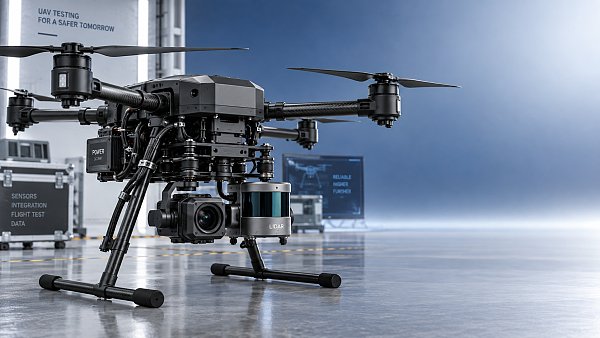
The confirmed facts are limited but commercially important. In late May, the U.S. Department of Commerce updated export control guidance with an emphasis on closing procurement gaps involving overseas entities with Chinese ownership backgrounds. The guidance makes clear that all such overseas entities seeking to purchase high-end AI chips must apply for a separate special license. The stated impact extends to terminal equipment that relies on AI edge inference, including commercial payloads such as multispectral mapping pods and LiDAR products such as solid-state Flash LiDAR modules. Where the core SoC in those products contains U.S.-licensed IP or was fabricated through a flow involving U.S. EDA tools, a licensing precondition is triggered.
Where pressure is likely to appear across the chain
Export review moves closer to the end product
From an industry perspective, exporters of drone payloads and LiDAR are likely to feel the impact because the compliance trigger is linked to the technical origin of the core SoC rather than only to the final product label. That means export review may need to examine chip design provenance, IP authorization status, and fabrication-tool exposure before shipment decisions are made. What deserves closer attention is whether existing product classification, technical declarations, and shipment documentation are detailed enough to support that review.
Procurement teams face deeper component due diligence
For procurement and sourcing functions, the main effect is not merely price or supply availability but the need for clearer visibility into upstream semiconductor attributes. If a payload or LiDAR module depends on AI edge inference, buyers may need to confirm whether the underlying SoC carries U.S.-licensed IP or was taped out with U.S. EDA tools, because those factors can become a mandatory compliance checkpoint before export. Observably, this raises the importance of supplier documentation, technical traceability, and early screening during component selection.
Manufacturing and delivery planning may need adjustment
For manufacturers and integrators, the effect is likely to appear in build planning, customer commitment, and delivery scheduling. If a licensing prerequisite applies at the SoC level, export timing for finished equipment may become more sensitive to documentation completeness and licensing review status. Analysis shows that teams handling order confirmation, project delivery, and after-sales preparation should pay closer attention to whether the product configuration itself could create an export-control bottleneck.
Service and channel partners may also need clearer file sets
Distributors, channel partners, and supply-chain service providers may not be the primary rule target, but they can still be affected in transaction execution. Where a product falls within the affected equipment categories, counterparties may ask for more complete technical files, procurement records, or compliance declarations before arranging export, transfer, or delivery. In practice, the burden may show up in document requests, contract review, and shipment readiness checks rather than only at the point of sale.
What companies should watch now
Recheck the SoC compliance profile
Companies dealing in commercial payloads or LiDAR should first review whether the core SoC in relevant products contains U.S.-licensed IP or was produced through a design flow involving U.S. EDA tools. The input information does not provide a full execution framework, so this should be treated as a current compliance review priority rather than as proof that all affected shipments will be handled the same way.
Prepare technical and trade documentation earlier
What deserves closer attention is the quality and timing of supporting files. Product specifications, chip-origin statements, supplier declarations, and other technical records may become more important in export review and customer communication. Where bid documents, delivery files, or project submissions depend on hardware origin and compliance representations, companies should be alert to possible updates in wording or evidence requirements.
Build extra time into procurement and delivery decisions
Analysis shows that firms should be cautious about treating existing procurement and shipment timelines as unchanged. If a special license becomes a precondition for certain transactions, lead times for sourcing, integration, export clearance preparation, and final delivery may require reassessment. This is especially relevant for products whose value proposition depends on onboard AI inference rather than on passive sensing alone.
Follow later wording and market execution closely
The available facts confirm the direction of the guidance, but they do not provide every operational detail. For that reason, companies should continue monitoring later official wording, practical review standards, customer-side compliance requests, and any changes in tender or procurement documents. It is more appropriate to understand the current development as a live compliance signal that requires follow-up verification in real transactions.
Why this reads as an execution signal
Observably, this development matters because it narrows the distance between semiconductor export controls and finished equipment trade. The immediate issue is not only whether high-end AI chips themselves require special licensing, but whether downstream hardware that depends on those chips can still move through normal procurement and export routines without additional review. From an industry perspective, this looks less like abstract policy messaging and more like an execution signal with direct implications for supply-chain screening. At the same time, the absence of fuller implementation detail means the market still needs to watch how the rule is interpreted in documentation practice, transaction review, and delivery management.
How the market may best read this development
The most reasonable reading at this stage is that the updated guidance has already introduced a concrete compliance threshold for a defined category of transactions, while many execution details still require observation. For companies involved in AI-enabled drone payloads and LiDAR, the key issue is not to overstate the impact, but not to treat it as a chip-only matter either. The practical takeaway is that chip-origin review, supplier documentation, export compliance checks, and delivery planning now need to be more tightly connected than before.
Basis of this article
This article is generated from the user-provided news title, event date, and event summary. For developments of this kind, relevant source types typically include official notices, releases from regulatory authorities, customs or trade-administration information, industry association updates, standards-related documents, and reporting by established trade media. A specific official source link was not provided in the input, so that point still requires verification. Follow-up attention should remain on later policy detail, practical compliance interpretation, tender-document changes, market feedback, and how companies implement the requirement in procurement, export, and delivery workflows.
Search News
Hot Articles
- Carbon Fiber StructuresHow to Specify Aerospace Carbon Fiber Assemblies for Lightweight, Load-Bearing PartsJul 11, 2026
- Machine VisionXiaomi, Alibaba DAMO Academy Drive Open-Source Robotics Model Ecosystem, Lowering Algorithm Development Barriers for Overseas SMEs Adopting Chinese Robotics SolutionsMar 30, 2026
- Cobots & ArmsShanxi 'AI+' Conference Showcases Embodied Intelligence with Multinational Buyer Engagement: Key Industry ImplicationsMar 30, 2026
Popular Tags
Recommended News
 Jul 11, 2026How to Specify Aerospace Carbon Fiber Assemblies for Lightweight, Load-Bearing PartsAerospace carbon fiber assemblies: learn how to specify laminate design, load data, joining methods, and inspection controls for lighter, reliable load-bearing aerospace parts.Elena Rostova (UAV Systems Researcher)
 Mar 30, 2026Xiaomi, Alibaba DAMO Academy Drive Open-Source Robotics Model Ecosystem, Lowering Algorithm Development Barriers for Overseas SMEs Adopting Chinese Robotics SolutionsXiaomi & Alibaba DAMO Academy's open-source robotics models lower algorithm barriers for global SMEs. Boost efficiency in manufacturing, logistics & smart retail with ROS 2 compatible solutions.TSV Data Lab
 Mar 30, 2026Shanxi 'AI+' Conference Showcases Embodied Intelligence with Multinational Buyer Engagement: Key Industry ImplicationsShanxi 'AI+' Conference highlights embodied intelligence with Tesla, Ubtech & Jiantao showcasing multimodal robotics. 40+ global buyers validated tech on-site, creating new B2B channels for industrial automation & AI solutions.Chen Wei (Automation Lead Engineer)
 Mar 30, 2026Zhongguancun Unveils 6G Integrated Sensing-Computing-Intelligence Platform to Empower Embodied Robots for Global Industrial ApplicationsZhongguancun's new 6G platform revolutionizes industrial robotics with <10ms latency, empowering global automotive, logistics & port automation. Discover how this tech boosts China's smart manufacturing exports.TSV Data Lab
 Mar 30, 2026Mech-Mind Tianjin Embodied Intelligence R&D and Production Base Goes Live, Cutting Delivery Time by 20%–30% for Global Customized AMR+Vision SolutionsMech-Mind's Tianjin AMR+Vision production base cuts delivery time by 20%-30% for欧美 & Latin American markets. Discover how this PLd-certified facility accelerates customized robotics solutions for smart manufacturing and logistics.Chen Wei (Automation Lead Engineer)
 Mar 30, 2026Boao Forum Reveals 'Co-evolution of Big and Small Brains' Trend in Humanoid Robots, China's Embodied Intelligence Accelerates Adaptation to Overseas Manufacturing Service ScenariosDiscover how China's humanoid robots, featuring 'Co-evolution of Big and Small Brains,' are revolutionizing global manufacturing. Learn about Embodied Tian Gong 3.0's ISO compliance and overseas deployment at Boao Forum 2026.Chen Wei (Automation Lead Engineer)
 Mar 30, 2026China Railway Industrial Secures Patent for Embodied Robotics in Material Handling, Boosting High-Precision Delivery Capabilities for Overseas Infrastructure and Manufacturing ProjectsChina Railway Industrial's new patent for embodied robotics in material handling boosts high-precision delivery for global infrastructure & manufacturing. Discover how this innovation enhances logistics accuracy in automotive, rail transit & EPC projects.Chen Wei (Automation Lead Engineer)
 Sep 23, 2026How to Evaluate a Machine Vision System Integrator for High-Speed Inspection LinesChoose a machine vision system integrator with proven expertise in high-speed inspection, reliable reject timing, robust optics, and measurable acceptance criteria.TSV Data Lab
 Sep 23, 2026What drives ultra-precision machining cost at 1-micron tolerance?Ultra precision machining cost per part at 1 micron tolerance depends on process, material, metrology, and yield. Learn how to compare quotes confidently.Dr. Marcus Vance
 Sep 22, 2026Drone Engine-T550CC Applications: Build the UAV Power System Around the MissionAn application guide for Drone Engine-T550CC integration, covering payload planning, airframe matching, cooling, fuel, vibration, test procedures, documentation, and service preparation.Elena Rostova (UAV Systems Researcher)
 Sep 22, 2026How to Evaluate Industrial Edge Computing Vendors for Factory DeploymentIndustrial edge computing vendor evaluation guide for factories: compare latency, protocol fit, reliability, security, and lifecycle support before deployment.TSV Data Lab
 Sep 21, 2026Drone Payload Integration: Matching Power, Data, and Center of Gravity for Reliable FlightsDrone payload integration made practical: balance power, data, center of gravity, and endurance to build safer, more reliable mission-ready flights.Elena Rostova (UAV Systems Researcher)
 Sep 20, 2026Autonomous Navigation Pricing: Cost Drivers and Budget Benchmarks for AMR ProjectsAutonomous navigation price explained: compare AMR cost drivers, software, sensors, integration, safety, and lifecycle budgets to build a scalable project plan.Chen Wei (Automation Lead Engineer)
 Sep 19, 2026How to Scope Automation Integration Services for Multi-System Factory ProjectsAutomation integration services: learn how to scope multi-system factory projects with clear workflows, interface contracts, safety boundaries, and acceptance criteria.Victor Lin (Chief Software Architect)
 Sep 18, 2026Selecting UAV Aerospace Structural Parts for Strength, Weight, and Fatigue LifeUAV aerospace structural parts guide: compare strength, weight, stiffness, fatigue life, joints, and traceability to select reliable flight-ready components.Elena Rostova (UAV Systems Researcher)
 Sep 17, 2026Selecting Commercial Drone Payloads for European Inspection ProjectsCommercial drone payloads Europe: learn how to select RGB, thermal and LiDAR systems for compliant, reliable inspection data and better project outcomes.Elena Rostova (UAV Systems Researcher)
 Sep 16, 2026Machining Tolerance Validation: How to Verify Critical Dimensions Before Production ReleaseMachining tolerance analysis validation: verify critical dimensions, measurement systems, process capability, and tolerance stacks before production release.Dr. Marcus Vance
 Sep 15, 2026AGV Tape Guidance vs Laser Navigation: Which Fits Your Warehouse Layout?AGV tape guidance comparison: discover how tape and laser navigation fit changing warehouse layouts, docking needs, floor conditions, maintenance, and route flexibility.Chen Wei (Automation Lead Engineer)
 Sep 14, 2026How Point Cloud Analytics Improves Asset Inspection Workflows Across GCC ProjectsPoint cloud analytics GCC helps project leaders improve asset inspections with accurate change detection, safer workflows, and faster maintenance decisions.TSV Data Lab
 Sep 13, 2026How Aerospace Manufacturers Can Build a Digital Thread From Design to Certified ProductionDigital manufacturing for aerospace: learn how to build a traceable digital thread from design through certified production, supplier control, and audit-ready compliance.Victor Lin (Chief Software Architect)
 Sep 12, 2026How to Select a Thermal Sensor for Mapping Drones in Surveying ProjectsMapping drone thermal sensor selection made simple: compare GSD, radiometric data, NETD, calibration, and workflow fit for accurate, survey-ready thermal maps.Elena Rostova (UAV Systems Researcher)
 Sep 11, 2026Integrating Photogrammetry Workflows into Digital Twin Projects Without Data BottlenecksPhotogrammetry workflow integration for digital twins: learn how to streamline capture, validation, versioning, and delivery to prevent data bottlenecks.Victor Lin (Chief Software Architect)
 Sep 10, 2026Hard-Tech Supply Chain Procurement: Qualifying Suppliers to Cut Lead-Time RiskHard-tech supply chain procurement guide: qualify suppliers with proven process, traceability, capacity, and change control to reduce lead-time risk.Chen Wei (Automation Lead Engineer)
 Sep 09, 2026Industrial Application Notes: Cost Factors That Shape Automation Project BudgetsIndustrial application notes cost factors explained: uncover the engineering, safety, integration, and commissioning variables that shape accurate automation budgets.Victor Lin (Chief Software Architect)