
How to compare trampoline park suppliers beyond price
Publication Date
author
Choosing a trampoline park supplier on price alone can expose buyers to hidden risks in safety, durability, compliance, and lifecycle cost. For procurement teams, the real comparison starts with engineering data, test standards, material traceability, installation capability, and after-sales support. This guide shows how to evaluate each trampoline park supplier with a sharper, evidence-based lens that supports safer investments and stronger long-term returns.
Why procurement teams need a checklist instead of a price sheet
A trampoline park is not a simple commodity purchase. It is a safety-critical, high-traffic commercial environment where steel structures, springs, pads, nets, foam systems, anchor points, and user flow design all affect risk, uptime, and profitability. That is why comparing one trampoline park supplier against another purely by quoted price often creates a false sense of savings.
For buyers, the better method is to compare evidence. Ask what data supports product life, what standards the supplier builds to, how installation quality is controlled, and how quickly parts can be replaced after opening. A lower upfront quote may hide thinner tubing, lower spring-cycle performance, weaker stitching, slower service response, or limited compliance documentation. These gaps usually become visible only after heavy use, claims, downtime, or regulatory review.
A structured checklist helps procurement teams evaluate total value, reduce approval risk, and align operations, finance, and safety managers around measurable criteria.
Start with the five questions every trampoline park supplier should answer clearly
- What safety and performance standards does the equipment meet, and can the supplier provide current test reports?
- What materials are used in frames, springs, pads, nets, and jumping mats, and is material traceability available?
- What is the expected service life of high-wear components under commercial traffic conditions?
- Who handles layout engineering, installation supervision, acceptance testing, and staff training?
- What are the real after-sales commitments for spare parts, maintenance guidance, and defect response time?
If a trampoline park supplier cannot answer these questions with documentation rather than sales language, procurement should slow down before moving into final comparison.
Use this core comparison checklist to evaluate suppliers beyond price
1. Verify safety compliance and test documentation
Safety should be the first screening gate. Ask each trampoline park supplier for documentation tied to recognized standards relevant to commercial amusement equipment, fire behavior of soft materials, structural integrity, and padding performance. Do not accept vague statements such as “complies with international quality requirements.” Ask for the actual scope of testing, report dates, issuing laboratories, and product models covered.
Important checks include impact attenuation, frame stability, enclosure strength, foam or pad flame behavior where applicable, and test coverage for the exact components quoted. A supplier may have reports for one standard model but offer a custom layout with different dimensions and load paths. Buyers should confirm whether the quoted system is truly covered.
2. Compare engineering materials, not just appearance
Many offers look similar in renderings, but material specifications differ sharply. Ask for steel grade, tube wall thickness, anti-corrosion treatment, spring wire diameter, mat weave details, pad foam density, PVC cover thickness, and net tensile properties. These items directly affect fatigue life, user feel, and maintenance frequency.
A reliable trampoline park supplier should be ready to share bill-of-material details or at least a controlled technical summary. Buyers should also check whether critical parts come from stable upstream sources. Material consistency matters more in commercial parks than in home-use equipment because cycle counts are far higher.
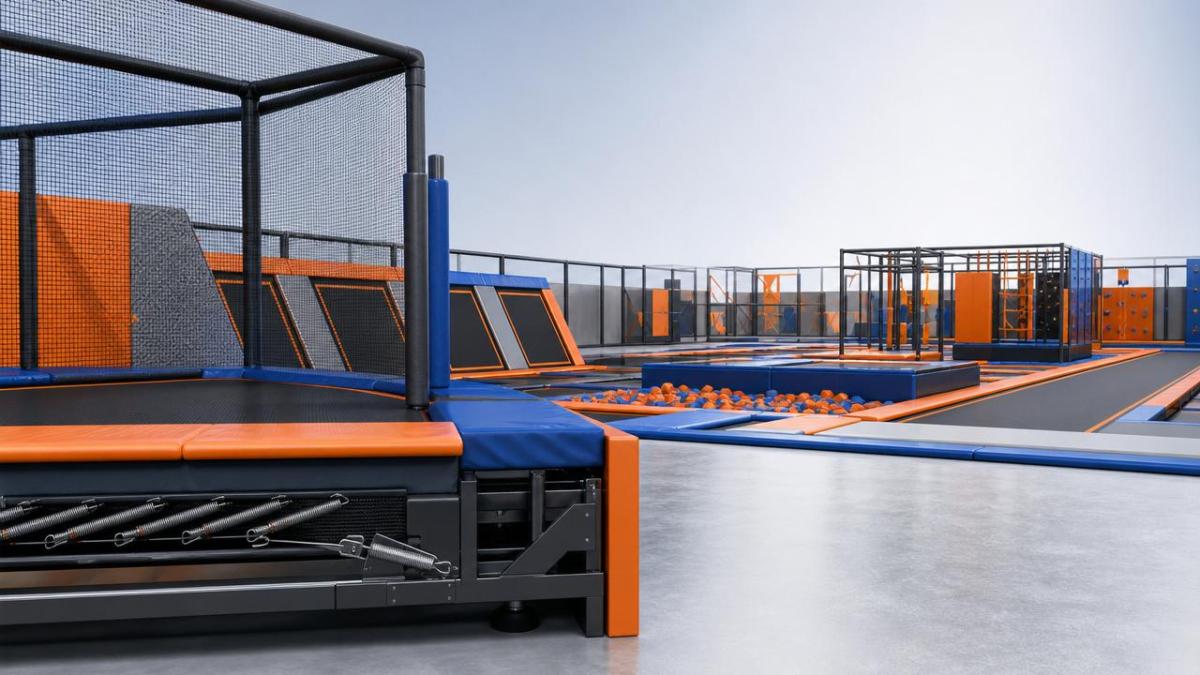
3. Assess durability using lifecycle cost logic
Procurement teams should model replacement intervals for springs, mats, pads, foam blocks, and netting. A cheaper trampoline park supplier may reduce initial capital cost but create higher annual operating expense through more frequent parts replacement and labor disruption. Ask for commercial-use lifespan assumptions, maintenance intervals, and historical replacement data from similar projects.
This is where lifecycle cost becomes more meaningful than quote comparison. Estimate total cost across three to five years, including spare parts, downtime, technician visits, freight, and warranty exclusions. The supplier with the lowest purchase price is often not the lowest-cost partner over the operating life of the park.
4. Review design capability and site-fit accuracy
A strong trampoline park supplier does more than sell modules. It should evaluate ceiling height, column positions, emergency exits, HVAC interference, viewing zones, circulation, age segmentation, and operational throughput. Poor layout design can reduce capacity, increase blind spots, or create safety conflicts between user groups.
Request detailed layout drawings, load assumptions, zone separation logic, and installation tolerances. If your project includes ninja courses, climbing elements, airbags, or toddler areas, confirm how those interfaces are engineered and whether mixed-use traffic has been considered.
5. Inspect manufacturing controls and traceability
When comparing a trampoline park supplier, manufacturing discipline is a major trust indicator. Ask about welding procedures, incoming inspection, dimensional checks, coating inspection, batch records, and final assembly verification. Even if buyers cannot audit every process, they should ask for photos, process charts, or factory quality documents.
Traceability matters especially for critical parts. If a spring batch fails early or a mat seam opens, can the supplier identify the batch and isolate affected inventory? Suppliers with stronger quality systems typically manage claims faster and reduce repeat defects.
6. Compare installation and commissioning capability
Installation quality can erase the advantage of excellent equipment if executed poorly. Clarify whether the trampoline park supplier provides on-site supervisors, full installation teams, remote guidance, or partner contractors. Ask for installation manuals, checklists, fastening torque guidance, site acceptance criteria, and training for park operators.
A supplier with proven commissioning experience usually reduces reopening delays and handover disputes. Procurement should also define who is responsible for site readiness, lifting equipment, local labor coordination, and final sign-off.
7. Measure after-sales support in practical terms
After-sales support should be measured by response speed, spare-parts availability, and clarity of warranty terms. Ask every trampoline park supplier for a written service matrix: response times, troubleshooting channels, recommended spare stock, warranty coverage by component, and exclusions caused by wear, misuse, or cleaning methods.
Good support is especially important for international buyers. Time zone coverage, export packaging, replacement lead time, and documentation in the operator’s language can strongly affect ongoing operations.
A practical supplier scorecard procurement teams can use
To make evaluation consistent, assign weighted scores rather than relying on subjective impressions. A sample framework is below.
Different project scenarios require different supplier priorities
Not every buyer should evaluate a trampoline park supplier in exactly the same way. The checklist should shift based on project type.
- New flagship park: prioritize layout engineering, brand presentation, throughput design, and long-term spare-parts planning.
- Budget-controlled regional site: focus on essential compliance, modularity, maintenance cost, and replacement simplicity rather than non-core visual upgrades.
- Mall or mixed-use family entertainment center: pay extra attention to ceiling constraints, evacuation routes, noise management, and integration with neighboring attractions.
- International rollout: emphasize export packing, documentation quality, remote support capacity, and ability to standardize components across multiple locations.
Common blind spots buyers miss when comparing a trampoline park supplier
Several issues are frequently overlooked during sourcing. First, buyers may compare drawings that look equivalent without checking whether structural sections, foam density, or stitch quality are actually comparable. Second, sample photos can hide differences between prototype quality and mass-production consistency. Third, freight, import duty, site preparation, and installation consumables may be excluded from low quotes.
Another common blind spot is warranty misunderstanding. Some trampoline park supplier agreements cover only manufacturing defects, not high-wear items under normal commercial traffic. That distinction can materially change total ownership cost. Also, ask whether replacement parts will remain backward compatible if the supplier updates product versions.
How to run the evaluation process step by step
A disciplined process improves outcomes and shortens internal approval cycles. Procurement teams can use the following sequence:
- Define site conditions, target age groups, expected traffic, and attraction mix.
- Issue a technical requirement sheet to each trampoline park supplier instead of requesting price only.
- Collect compliance reports, material data, project references, and preliminary layouts.
- Score suppliers using a weighted matrix before commercial negotiation.
- Clarify warranty, installation scope, acceptance criteria, and spare-parts commitments in writing.
- Run a final total-cost comparison, including maintenance and replacement assumptions.
FAQ: fast answers procurement teams often need
Is the cheapest trampoline park supplier always the highest risk?
Not always, but a low quote should trigger deeper verification. If pricing is significantly below market range, ask what has been reduced: materials, coverage, installation, testing, warranty, or service.
What documents should a serious trampoline park supplier provide early?
At minimum, request technical specifications, applicable test reports, project references, layout drawings, warranty terms, spare-parts list, and installation scope.
How many suppliers should buyers compare?
Three is usually enough for meaningful benchmarking, provided the technical brief is consistent and the comparison criteria are documented.
Final procurement guidance before you request a quote
The best way to compare a trampoline park supplier beyond price is to convert the buying decision into a documented engineering and operations review. Prioritize safety evidence, material quality, service life, layout accuracy, installation control, and support responsiveness. When these factors are measured clearly, price becomes one decision variable rather than the only one.
Before moving forward, prepare your site dimensions, target user profile, expected daily traffic, budget range, desired opening date, and attraction list. Then ask each trampoline park supplier to respond against the same checklist. That simple step will reveal who can truly support a durable, compliant, and commercially viable park investment.
Search News
Hot Articles
- Carbon Fiber StructuresHow to Specify Aerospace Carbon Fiber Assemblies for Lightweight, Load-Bearing PartsJul 11, 2026
- Machine VisionXiaomi, Alibaba DAMO Academy Drive Open-Source Robotics Model Ecosystem, Lowering Algorithm Development Barriers for Overseas SMEs Adopting Chinese Robotics SolutionsMar 30, 2026
- Cobots & ArmsShanxi 'AI+' Conference Showcases Embodied Intelligence with Multinational Buyer Engagement: Key Industry ImplicationsMar 30, 2026
Popular Tags
Recommended News
 Jul 11, 2026How to Specify Aerospace Carbon Fiber Assemblies for Lightweight, Load-Bearing PartsAerospace carbon fiber assemblies: learn how to specify laminate design, load data, joining methods, and inspection controls for lighter, reliable load-bearing aerospace parts.Elena Rostova (UAV Systems Researcher)
 Mar 30, 2026Xiaomi, Alibaba DAMO Academy Drive Open-Source Robotics Model Ecosystem, Lowering Algorithm Development Barriers for Overseas SMEs Adopting Chinese Robotics SolutionsXiaomi & Alibaba DAMO Academy's open-source robotics models lower algorithm barriers for global SMEs. Boost efficiency in manufacturing, logistics & smart retail with ROS 2 compatible solutions.TSV Data Lab
 Mar 30, 2026Shanxi 'AI+' Conference Showcases Embodied Intelligence with Multinational Buyer Engagement: Key Industry ImplicationsShanxi 'AI+' Conference highlights embodied intelligence with Tesla, Ubtech & Jiantao showcasing multimodal robotics. 40+ global buyers validated tech on-site, creating new B2B channels for industrial automation & AI solutions.Chen Wei (Automation Lead Engineer)
 Mar 30, 2026Zhongguancun Unveils 6G Integrated Sensing-Computing-Intelligence Platform to Empower Embodied Robots for Global Industrial ApplicationsZhongguancun's new 6G platform revolutionizes industrial robotics with <10ms latency, empowering global automotive, logistics & port automation. Discover how this tech boosts China's smart manufacturing exports.TSV Data Lab
 Mar 30, 2026Mech-Mind Tianjin Embodied Intelligence R&D and Production Base Goes Live, Cutting Delivery Time by 20%–30% for Global Customized AMR+Vision SolutionsMech-Mind's Tianjin AMR+Vision production base cuts delivery time by 20%-30% for欧美 & Latin American markets. Discover how this PLd-certified facility accelerates customized robotics solutions for smart manufacturing and logistics.Chen Wei (Automation Lead Engineer)
 Mar 30, 2026Boao Forum Reveals 'Co-evolution of Big and Small Brains' Trend in Humanoid Robots, China's Embodied Intelligence Accelerates Adaptation to Overseas Manufacturing Service ScenariosDiscover how China's humanoid robots, featuring 'Co-evolution of Big and Small Brains,' are revolutionizing global manufacturing. Learn about Embodied Tian Gong 3.0's ISO compliance and overseas deployment at Boao Forum 2026.Chen Wei (Automation Lead Engineer)
 Mar 30, 2026China Railway Industrial Secures Patent for Embodied Robotics in Material Handling, Boosting High-Precision Delivery Capabilities for Overseas Infrastructure and Manufacturing ProjectsChina Railway Industrial's new patent for embodied robotics in material handling boosts high-precision delivery for global infrastructure & manufacturing. Discover how this innovation enhances logistics accuracy in automotive, rail transit & EPC projects.Chen Wei (Automation Lead Engineer)
 Sep 28, 2026Spindle Runout Measurement in Germany: DIN Standards, Methods, and Acceptance LimitsSpindle runout measurement Germany: explore DIN standards, proven methods, acceptance limits, and audit-ready practices for reliable machining quality.Dr. Marcus Vance
 Sep 27, 2026How to Select Wall-Mount Edge Devices for Space-Constrained Factory NetworksWall mount edge devices for space-constrained factories: evaluate workload, thermal design, power resilience, cable access, and network reliability for smarter deployments.TSV Data Lab
 Sep 26, 2026Machining Tolerance Analysis: How to Set Limits That Meet Function and Cost TargetsMachining tolerance analysis: learn how to set functional limits, control tolerance stacks, reduce inspection risk, and balance precision with production cost.Dr. Marcus Vance
 Sep 25, 2026How to Evaluate an Industrial Infrastructure Data Platform for Multi-Site OperationsIndustrial infrastructure data platform evaluation guide for multi-site operations: compare data quality, edge resilience, interoperability, governance, and scalable proof-of-value criteria.Victor Lin (Chief Software Architect)
 Sep 24, 2026How to Select Machine Vision Optics for Accurate Inspection at Different Working DistancesMachine vision optics selection guide for accurate inspection at every working distance. Compare FOV, pixel scale, DOF, distortion, lighting, and telecentric options.TSV Data Lab
 Sep 23, 2026How to Evaluate a Machine Vision System Integrator for High-Speed Inspection LinesChoose a machine vision system integrator with proven expertise in high-speed inspection, reliable reject timing, robust optics, and measurable acceptance criteria.TSV Data Lab
 Sep 28, 2026When is a SCADA API the right choice for connecting plant systems?SCADA API guide: learn when governed plant data integration improves traceability, security, and scalability—without compromising real-time control.Victor Lin (Chief Software Architect)
 Sep 27, 2026How SCADA data integration improves traceability across production linesSCADA data integration connects production-line data to improve traceability, accelerate quality investigations, and strengthen safety decisions.Victor Lin (Chief Software Architect)
 Sep 26, 2026What to define before starting SCADA integration planningSCADA integration planning starts with clear scope, control boundaries, data models, cybersecurity, and testing. Discover the definitions that reduce risk and costly rework.Victor Lin (Chief Software Architect)
 Sep 25, 2026How a smart factory with Industrial IoT reduces production blind spotsDiscover how a smart factory with Industrial IoT turns real-time machine, quality, and workflow data into actionable insights that reduce production blind spots and delivery risks.Victor Lin (Chief Software Architect)
 Sep 24, 2026When does Industrial IoT make smart manufacturing easier to scale?Smart manufacturing Industrial IoT scales when trusted data, interoperable systems, and secure workflows turn connected assets into measurable gains.TSV Data Lab
 Sep 23, 2026What drives ultra-precision machining cost at 1-micron tolerance?Ultra precision machining cost per part at 1 micron tolerance depends on process, material, metrology, and yield. Learn how to compare quotes confidently.Dr. Marcus Vance
 Sep 22, 2026Drone Engine-T550CC Applications: Build the UAV Power System Around the MissionAn application guide for Drone Engine-T550CC integration, covering payload planning, airframe matching, cooling, fuel, vibration, test procedures, documentation, and service preparation.Elena Rostova (UAV Systems Researcher)
 Sep 22, 2026How to Evaluate Industrial Edge Computing Vendors for Factory DeploymentIndustrial edge computing vendor evaluation guide for factories: compare latency, protocol fit, reliability, security, and lifecycle support before deployment.TSV Data Lab
 Sep 21, 2026Drone Payload Integration: Matching Power, Data, and Center of Gravity for Reliable FlightsDrone payload integration made practical: balance power, data, center of gravity, and endurance to build safer, more reliable mission-ready flights.Elena Rostova (UAV Systems Researcher)
 Sep 20, 2026Autonomous Navigation Pricing: Cost Drivers and Budget Benchmarks for AMR ProjectsAutonomous navigation price explained: compare AMR cost drivers, software, sensors, integration, safety, and lifecycle budgets to build a scalable project plan.Chen Wei (Automation Lead Engineer)
 Sep 19, 2026How to Scope Automation Integration Services for Multi-System Factory ProjectsAutomation integration services: learn how to scope multi-system factory projects with clear workflows, interface contracts, safety boundaries, and acceptance criteria.Victor Lin (Chief Software Architect)























