Trampoline park maintenance issues that turn into bigger costs
Publication Date
author
Small trampoline park maintenance issues rarely stay small for long. A loose spring, uneven frame wear, delayed padding replacement, or neglected inspection log can quickly escalate into higher repair bills, safety incidents, downtime, and insurance pressure. For after-sales maintenance teams, understanding how trampoline park maintenance problems compound is the first step toward reducing total lifecycle cost and keeping equipment performance, compliance, and customer trust intact.
For most after-sales maintenance teams, the real question is not whether wear will appear, but how fast minor defects turn into major cost events. In trampoline environments, repeated dynamic loads, heavy daily usage, moisture, cleaning chemicals, and rushed repairs accelerate this process. What starts as a small service item often spreads across adjacent components, increases labor time, and creates operational risk that is far more expensive than the original fix.
This is why effective trampoline park maintenance should be treated as a cost-control discipline, not just a safety checklist. The teams that control total maintenance cost best are usually the ones that catch pattern failures early, document them consistently, and prioritize repairs based on consequence rather than convenience. That approach protects uptime, extends equipment life, and makes future budgeting far more accurate.
Why small trampoline park maintenance issues become expensive so quickly
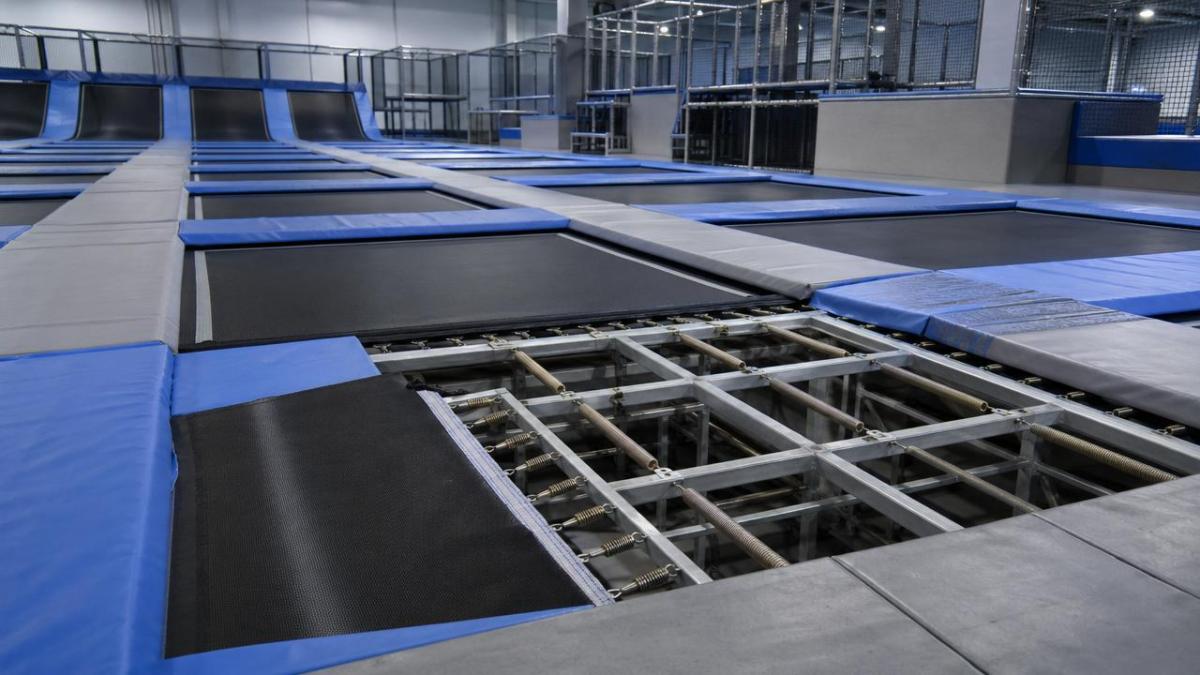
The core problem is compounding failure. A trampoline park is a connected mechanical and protective system, not a collection of isolated parts. When one component begins to fail, surrounding parts often absorb extra load, friction, or impact. A slightly overstretched spring can shift stress to the frame connection points. Worn bed material can alter bounce behavior and create uneven loading. Damaged padding can expose hard edges and turn a minor cosmetic issue into a reportable injury risk.
For maintenance personnel, this means the visible defect is often not the full defect. The first symptom may be simple, but the hidden cost sits behind it: secondary damage, emergency labor, rushed parts procurement, lost operating hours, and additional inspections. In many parks, the largest avoidable expenses come not from catastrophic failures alone, but from delayed response to minor warning signs.
There is also a timing issue. If a defect is found during planned inspection, it can usually be bundled into scheduled service. If it is found after a complaint, incident, or closure event, the same defect becomes an urgent issue. Urgent issues nearly always cost more because they disrupt staff scheduling, force temporary area shutdowns, and increase pressure to install whatever replacement part is available fastest.
The maintenance issues that most often snowball into larger repair costs
Several recurring problems in trampoline park maintenance deserve more attention because they create higher downstream cost than teams expect. Springs are the most obvious example. A spring does not need to be fully broken to cause trouble. Corrosion, overstretch, inconsistent tension, and damaged hooks can all reduce performance and transfer abnormal force to the mat and frame. Replacing one failed spring without checking neighboring springs often leads to repeat service calls because the load pattern remains unbalanced.
Trampoline beds are another major cost driver. Small tears, stitching fatigue, surface fraying, and loss of elasticity can look manageable during a quick walk-through, but these conditions usually worsen under repetitive commercial use. Once the fabric weakens beyond a certain point, damage spreads faster and often requires a full section replacement instead of a localized repair. The difference in cost is not only material. It includes longer shutdown, retensioning time, and more detailed post-repair testing.
Padding failures are frequently underestimated because they may appear non-structural. In reality, foam compression, torn vinyl covers, detached fasteners, and shifting pad alignment directly affect impact protection. Delaying replacement can trigger incidents that involve first aid response, customer complaints, insurance review, and reputational damage. In cost terms, a modest padding repair can become much more expensive once an injury claim enters the picture.
Frames and support structures also deserve close tracking. Early signs such as paint cracking, corrosion at weld points, loose bolts, or slight movement under load often indicate fatigue progression. These issues rarely fix themselves. If ignored, they can expand into alignment problems, broader structural repairs, or replacement of multiple interconnected sections. The labor intensity of structural repair is usually much higher than the cost of addressing early-stage wear.
Nets, soft barriers, deck surfaces, anchor points, and transition zones also matter. They may not be the first components people associate with bounce performance, but they are essential to controlling falls, redirection, and safe circulation. Minor tears, loosened fixings, or worn landing surfaces can increase incident probability and create avoidable call-backs for the maintenance team.
What after-sales maintenance teams should inspect before damage spreads
Strong inspection routines are the most practical defense against escalating maintenance cost. The key is to inspect for trend indicators, not just obvious breakage. Daily visual checks should focus on surface condition, pad placement, exposed hardware, unusual noise, and any area where bounce behavior feels inconsistent. These checks do not need to be complex, but they must be disciplined and documented.
Weekly and monthly inspections should go deeper. Teams should verify spring condition and count, frame fastener torque, weld integrity, fabric wear patterns, net attachment points, foam compression, and evidence of moisture ingress. It is especially useful to compare current findings with previous logs. A single worn spot matters, but a worn spot that has doubled in size since the last service matters much more. Trend visibility is what converts inspection data into cost prevention.
Maintenance teams should also pay attention to usage concentration. Not all sections of a trampoline park age at the same rate. High-traffic zones, dodgeball courts, foam pit approaches, launch lanes, and beginner areas often show different wear signatures. When inspections are too generic, these patterns get missed. When they are zone-specific, replacement planning becomes more accurate and less reactive.
Another practical step is to classify defects by consequence. Aesthetic defects, performance defects, and safety-critical defects should not sit in the same priority bucket. If every issue is treated the same, teams either overreact to low-risk wear or underreact to high-risk deterioration. A simple severity matrix helps allocate labor where it will reduce the most future cost.
How delayed maintenance increases total lifecycle cost
Delayed maintenance almost always looks cheaper in the short term because it avoids immediate parts and labor expense. But in trampoline parks, that saving is usually temporary. A deferred repair can trigger three larger costs: accelerated damage to adjacent components, unplanned downtime, and emergency response overhead. These combined costs can easily exceed the original repair several times over.
Consider a loose frame connection that is left for later service. The park may continue operating, but repeated dynamic movement can enlarge the connection wear area, loosen nearby hardware, and alter load distribution. What could have been a short intervention with basic hardware and inspection time may later require partial disassembly, structural reinforcement, more extensive verification, and a longer closure window.
Downtime cost is often underestimated by technical teams because it sits outside direct maintenance accounting. When a court or attraction closes unexpectedly, the business loses revenue, staff efficiency drops, customer satisfaction declines, and management pressure increases. If the closure happens during peak hours or a busy season, the business effect may exceed the repair invoice itself. Good trampoline park maintenance therefore protects both equipment and earning capacity.
Insurance and compliance pressure also rise when maintenance discipline weakens. Missing logs, repeated temporary fixes, and unresolved known defects make incident investigation harder and can reduce confidence from insurers, auditors, or business partners. For after-sales teams, documentation quality is part of cost control because poor records can magnify the consequences of an otherwise manageable defect.
Repair versus replacement: how to make the right call
One of the most common challenges in trampoline park maintenance is deciding whether to repair a component or replace it outright. The cheapest option at the moment is not always the most economical over the service life. Teams should evaluate at least five factors: current defect severity, expected remaining life, impact on adjacent components, labor intensity, and risk of repeat failure.
If a part shows isolated wear and the surrounding system remains stable, repair may be justified. If multiple related components are aging together, a partial repair can become false economy. For example, replacing only the most visibly worn springs in a field of similarly fatigued springs can create uneven performance and generate another service event soon after. In that case, grouped replacement often delivers better value.
Historical failure data is extremely useful here. If records show the same component or zone has required repeated intervention within short intervals, the team should reassess the strategy. The issue may be incomplete repair scope, unsuitable material selection, installation inconsistency, or usage intensity beyond the original assumption. A replacement decision should be informed by failure pattern, not just current condition.
It is also important to consider labor access. Some parts are inexpensive but time-consuming to reach, remove, and test. If repeated service on the same assembly consumes significant technician hours, replacing a larger section during planned downtime may cost less overall than multiple smaller interventions.
Documentation, logs, and traceability are not paperwork overhead
For execution-focused maintenance staff, paperwork can feel secondary to physical repair. In reality, structured records are one of the strongest tools for preventing larger future costs. Good logs help teams identify recurring defects, compare wear rates by zone, justify replacement budgets, and defend maintenance decisions after incidents or customer complaints.
A useful maintenance record should include component type, exact location, defect description, severity level, immediate action taken, parts used, technician name, inspection date, and follow-up requirement. Photos are especially valuable because they allow later comparison and reduce ambiguity between shifts or service providers. Even simple photo standards can improve consistency significantly.
Traceability also supports procurement quality control. If replacement parts from one batch, vendor, or material specification show unusually fast wear, maintenance records can reveal the pattern early. That allows the business to challenge supply quality, adjust specifications, or change sourcing before the issue spreads across the facility.
This is where a data-driven mindset matters. Maintenance is not only about fixing what is broken today. It is about creating enough reliable evidence to predict what will break next, how fast it will degrade, and which intervention gives the best cost outcome. That approach aligns strongly with the broader engineering principle that measurable parameters produce better operational decisions than assumptions.
Practical ways to reduce future maintenance cost without overmaintaining
The goal is not to replace everything early. The goal is to build a smarter service model. Start by defining clear inspection intervals based on equipment type, traffic intensity, and failure history. A low-use section may not need the same replacement cycle as a high-impact area. Condition-based planning is usually more efficient than purely calendar-based planning.
Second, standardize failure criteria. Teams should know exactly when a spring, pad, bed, net, or frame condition moves from monitor to repair to replace. Clear thresholds reduce inconsistent judgment between technicians and help avoid both unnecessary replacements and dangerous delays.
Third, stock critical spare parts that have high failure consequence or long lead times. Emergency sourcing is expensive and risky. A modest spare strategy for core items can reduce downtime dramatically and keep urgent repairs under control. The best spare list is built from actual failure records, not guesswork.
Fourth, train frontline staff to report early symptoms accurately. Attendants, supervisors, and cleaners often see equipment more frequently than maintenance specialists do. If they know how to identify shifting pads, unusual sounds, loose fittings, or visible fabric changes, issues can be escalated before they become major repairs.
Finally, review maintenance outcomes regularly. Which repairs solved the problem long term? Which ones led to repeat visits? Which zones consume the most time and parts? A quarterly review of these patterns can produce meaningful savings because it turns maintenance from reactive work into a controlled improvement process.
Conclusion: better trampoline park maintenance is really about stopping cost escalation early
The biggest maintenance costs in trampoline parks usually do not begin as big failures. They begin as small defects that were easy to dismiss, difficult to prioritize, or inconvenient to schedule. For after-sales maintenance teams, the practical lesson is clear: early detection, consistent documentation, consequence-based prioritization, and smarter repair-versus-replacement decisions are what keep total cost under control.
Effective trampoline park maintenance protects more than equipment condition. It protects uptime, compliance, safety performance, budget predictability, and customer confidence. When teams treat each small defect as a potential cost multiplier rather than an isolated nuisance, they make better technical decisions and prevent avoidable operational losses. In a high-use commercial environment, that mindset is often the difference between manageable service expense and recurring, expensive disruption.
Search News
Hot Articles
- Carbon Fiber StructuresHow to Specify Aerospace Carbon Fiber Assemblies for Lightweight, Load-Bearing PartsJul 11, 2026
- Machine VisionXiaomi, Alibaba DAMO Academy Drive Open-Source Robotics Model Ecosystem, Lowering Algorithm Development Barriers for Overseas SMEs Adopting Chinese Robotics SolutionsMar 30, 2026
- Cobots & ArmsShanxi 'AI+' Conference Showcases Embodied Intelligence with Multinational Buyer Engagement: Key Industry ImplicationsMar 30, 2026
Popular Tags
Recommended News
 Jul 11, 2026How to Specify Aerospace Carbon Fiber Assemblies for Lightweight, Load-Bearing PartsAerospace carbon fiber assemblies: learn how to specify laminate design, load data, joining methods, and inspection controls for lighter, reliable load-bearing aerospace parts.Elena Rostova (UAV Systems Researcher)
 Mar 30, 2026Xiaomi, Alibaba DAMO Academy Drive Open-Source Robotics Model Ecosystem, Lowering Algorithm Development Barriers for Overseas SMEs Adopting Chinese Robotics SolutionsXiaomi & Alibaba DAMO Academy's open-source robotics models lower algorithm barriers for global SMEs. Boost efficiency in manufacturing, logistics & smart retail with ROS 2 compatible solutions.TSV Data Lab
 Mar 30, 2026Shanxi 'AI+' Conference Showcases Embodied Intelligence with Multinational Buyer Engagement: Key Industry ImplicationsShanxi 'AI+' Conference highlights embodied intelligence with Tesla, Ubtech & Jiantao showcasing multimodal robotics. 40+ global buyers validated tech on-site, creating new B2B channels for industrial automation & AI solutions.Chen Wei (Automation Lead Engineer)
 Mar 30, 2026Zhongguancun Unveils 6G Integrated Sensing-Computing-Intelligence Platform to Empower Embodied Robots for Global Industrial ApplicationsZhongguancun's new 6G platform revolutionizes industrial robotics with <10ms latency, empowering global automotive, logistics & port automation. Discover how this tech boosts China's smart manufacturing exports.TSV Data Lab
 Mar 30, 2026Mech-Mind Tianjin Embodied Intelligence R&D and Production Base Goes Live, Cutting Delivery Time by 20%–30% for Global Customized AMR+Vision SolutionsMech-Mind's Tianjin AMR+Vision production base cuts delivery time by 20%-30% for欧美 & Latin American markets. Discover how this PLd-certified facility accelerates customized robotics solutions for smart manufacturing and logistics.Chen Wei (Automation Lead Engineer)
 Mar 30, 2026Boao Forum Reveals 'Co-evolution of Big and Small Brains' Trend in Humanoid Robots, China's Embodied Intelligence Accelerates Adaptation to Overseas Manufacturing Service ScenariosDiscover how China's humanoid robots, featuring 'Co-evolution of Big and Small Brains,' are revolutionizing global manufacturing. Learn about Embodied Tian Gong 3.0's ISO compliance and overseas deployment at Boao Forum 2026.Chen Wei (Automation Lead Engineer)
 Mar 30, 2026China Railway Industrial Secures Patent for Embodied Robotics in Material Handling, Boosting High-Precision Delivery Capabilities for Overseas Infrastructure and Manufacturing ProjectsChina Railway Industrial's new patent for embodied robotics in material handling boosts high-precision delivery for global infrastructure & manufacturing. Discover how this innovation enhances logistics accuracy in automotive, rail transit & EPC projects.Chen Wei (Automation Lead Engineer)
 Sep 28, 2026Spindle Runout Measurement in Germany: DIN Standards, Methods, and Acceptance LimitsSpindle runout measurement Germany: explore DIN standards, proven methods, acceptance limits, and audit-ready practices for reliable machining quality.Dr. Marcus Vance
 Sep 27, 2026How to Select Wall-Mount Edge Devices for Space-Constrained Factory NetworksWall mount edge devices for space-constrained factories: evaluate workload, thermal design, power resilience, cable access, and network reliability for smarter deployments.TSV Data Lab
 Sep 26, 2026Machining Tolerance Analysis: How to Set Limits That Meet Function and Cost TargetsMachining tolerance analysis: learn how to set functional limits, control tolerance stacks, reduce inspection risk, and balance precision with production cost.Dr. Marcus Vance
 Sep 25, 2026How to Evaluate an Industrial Infrastructure Data Platform for Multi-Site OperationsIndustrial infrastructure data platform evaluation guide for multi-site operations: compare data quality, edge resilience, interoperability, governance, and scalable proof-of-value criteria.Victor Lin (Chief Software Architect)
 Sep 24, 2026How to Select Machine Vision Optics for Accurate Inspection at Different Working DistancesMachine vision optics selection guide for accurate inspection at every working distance. Compare FOV, pixel scale, DOF, distortion, lighting, and telecentric options.TSV Data Lab
 Sep 23, 2026How to Evaluate a Machine Vision System Integrator for High-Speed Inspection LinesChoose a machine vision system integrator with proven expertise in high-speed inspection, reliable reject timing, robust optics, and measurable acceptance criteria.TSV Data Lab
 Sep 28, 2026When is a SCADA API the right choice for connecting plant systems?SCADA API guide: learn when governed plant data integration improves traceability, security, and scalability—without compromising real-time control.Victor Lin (Chief Software Architect)
 Sep 27, 2026How SCADA data integration improves traceability across production linesSCADA data integration connects production-line data to improve traceability, accelerate quality investigations, and strengthen safety decisions.Victor Lin (Chief Software Architect)
 Sep 26, 2026What to define before starting SCADA integration planningSCADA integration planning starts with clear scope, control boundaries, data models, cybersecurity, and testing. Discover the definitions that reduce risk and costly rework.Victor Lin (Chief Software Architect)
 Sep 25, 2026How a smart factory with Industrial IoT reduces production blind spotsDiscover how a smart factory with Industrial IoT turns real-time machine, quality, and workflow data into actionable insights that reduce production blind spots and delivery risks.Victor Lin (Chief Software Architect)
 Sep 24, 2026When does Industrial IoT make smart manufacturing easier to scale?Smart manufacturing Industrial IoT scales when trusted data, interoperable systems, and secure workflows turn connected assets into measurable gains.TSV Data Lab
 Sep 23, 2026What drives ultra-precision machining cost at 1-micron tolerance?Ultra precision machining cost per part at 1 micron tolerance depends on process, material, metrology, and yield. Learn how to compare quotes confidently.Dr. Marcus Vance
 Sep 22, 2026Drone Engine-T550CC Applications: Build the UAV Power System Around the MissionAn application guide for Drone Engine-T550CC integration, covering payload planning, airframe matching, cooling, fuel, vibration, test procedures, documentation, and service preparation.Elena Rostova (UAV Systems Researcher)
 Sep 22, 2026How to Evaluate Industrial Edge Computing Vendors for Factory DeploymentIndustrial edge computing vendor evaluation guide for factories: compare latency, protocol fit, reliability, security, and lifecycle support before deployment.TSV Data Lab
 Sep 21, 2026Drone Payload Integration: Matching Power, Data, and Center of Gravity for Reliable FlightsDrone payload integration made practical: balance power, data, center of gravity, and endurance to build safer, more reliable mission-ready flights.Elena Rostova (UAV Systems Researcher)
 Sep 20, 2026Autonomous Navigation Pricing: Cost Drivers and Budget Benchmarks for AMR ProjectsAutonomous navigation price explained: compare AMR cost drivers, software, sensors, integration, safety, and lifecycle budgets to build a scalable project plan.Chen Wei (Automation Lead Engineer)
 Sep 19, 2026How to Scope Automation Integration Services for Multi-System Factory ProjectsAutomation integration services: learn how to scope multi-system factory projects with clear workflows, interface contracts, safety boundaries, and acceptance criteria.Victor Lin (Chief Software Architect)