Trampoline park construction delays often begin before buildout
Publication Date
author
Trampoline park construction delays often start long before crews arrive on site. For project managers and engineering leads, the real risks usually emerge in early planning, vendor validation, code review, and specification alignment. This article examines how hidden pre-build gaps can disrupt timelines, inflate costs, and weaken delivery certainty—and how a data-driven approach helps keep trampoline park construction on schedule from day one.
Why the delay pattern in trampoline park construction is changing
A few years ago, many owners treated trampoline park construction as a relatively straightforward interior fit-out: lease a large shell, design the attraction layout, bring in equipment, and move toward opening. That assumption is becoming less reliable. Today, trampoline park construction sits at the intersection of entertainment, structural engineering, fire and life safety, building code interpretation, insurance scrutiny, and increasingly demanding customer expectations around safety and throughput.
The result is a shift in where schedule risk appears. Delays are no longer caused only by slow field labor or material shortages. More often, they begin in the invisible stages: incomplete site due diligence, conflicting authority having jurisdiction requirements, weak performance specifications, missing load-path verification, late revisions to mezzanine or foam pit details, and supplier documents that do not match local approval standards. For project leaders, this means the real critical path now starts much earlier than buildout.
This shift matters because the economics of location-based entertainment are unforgiving. Lease commencement dates, soft-opening windows, seasonal revenue cycles, staffing plans, and lender milestones all depend on predictable delivery. When early assumptions are wrong, trampoline park construction timelines compress at the exact moment complexity increases.
The market signals project managers should not ignore
Several signals show why pre-build rigor is now a competitive advantage in trampoline park construction. First, adaptive reuse spaces are more common, and these sites often come with hidden structural and MEP constraints. Second, operators want denser attraction mixes, which means more point loads, more circulation planning, and more integration between equipment suppliers and base-building systems. Third, safety documentation is under closer review from insurers, landlords, and local reviewers.
At the same time, owners are under pressure to open faster and differentiate more clearly. That pushes design teams to combine sports, party zones, climbing features, food service, digital access systems, and spectator areas in one footprint. Each added function increases coordination demands before mobilization begins. In practice, trampoline park construction now behaves less like a simple themed tenant improvement and more like a multi-system engineering program.
The hidden drivers behind pre-build delay risk
The biggest driver is specification ambiguity. In many trampoline park construction projects, owners receive attractive concept packages but not engineering-grade definitions. A layout may look complete while still omitting exact anchorage assumptions, fall-zone separations, netting interfaces, floor tolerances, acoustic requirements, or maintenance clearances. Those gaps do not stay theoretical. They surface later as RFIs, redesign fees, or field conflicts.
A second driver is fragmented accountability. The equipment vendor, architect, structural engineer, MEP consultant, general contractor, and code reviewer may each be working from different assumptions. If no one owns parameter alignment early, trampoline park construction becomes vulnerable to sequence failure: permit packages move ahead before supplier submittals are mature, procurement starts before field dimensions are verified, or interior design decisions change egress logic after plan review.
A third driver is local code variability. Even when a concept has been built elsewhere, local interpretation can differ on occupancy load, fire separation, sprinkler modifications, accessibility, guardrail treatment, or special amusement classification. Reusing prior drawings without a fresh jurisdictional strategy is one of the fastest ways to create avoidable delay.
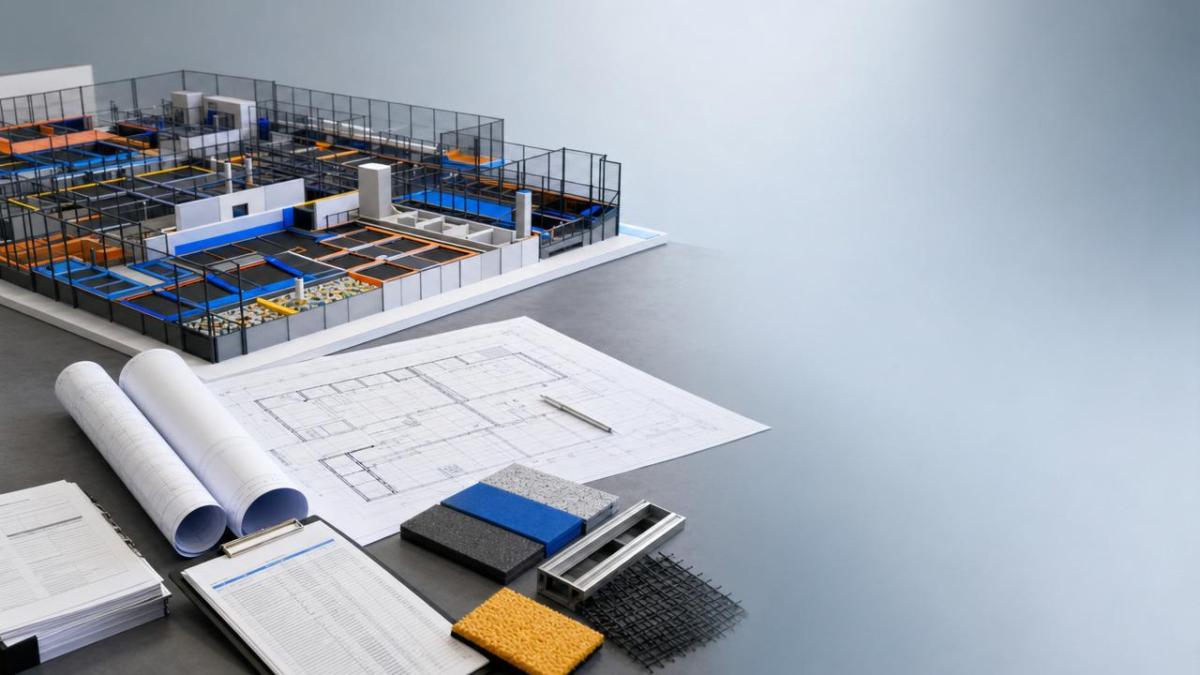
Where trampoline park construction typically slips before site work starts
For engineering-minded teams, it helps to map delay origins by phase. Most schedule loss comes from decision latency rather than one dramatic failure. By the time construction crews arrive, the downstream effects are already locked in.
Who feels the impact most
The consequences of poor early planning in trampoline park construction are not evenly distributed. Project managers absorb the schedule pressure, but the financial and operational effects spread across the full delivery chain. Owners face rent burn before revenue. Engineers inherit compressed review windows. Contractors lose sequencing efficiency. Procurement teams are forced into substitutions or expedite costs. Operations teams receive less time for commissioning, training, and safety validation.
For multi-site operators, the impact is even larger. If one project encounters preventable pre-build delays, internal capital planning, launch staffing, and brand rollout can all shift. In this environment, the ability to predict delay risk in trampoline park construction is becoming a portfolio management capability, not just a site-level project skill.
Why data-driven planning is becoming the safer standard
The broader industry is moving away from narrative-based planning and toward parameter-based decision making. That trend aligns with the TSV view that engineering truth starts with verifiable inputs, not optimistic assumptions. In trampoline park construction, this means asking more exact questions earlier: What are the actual slab flatness tolerances? What suspended loads are permitted? What documentation does the reviewer require for impact areas, netting systems, guard conditions, and equipment anchorage? Which supplier claims are backed by stamped drawings, testing records, and consistent installation manuals?
A data-driven process does not make projects slow. It prevents late-cycle chaos. When teams establish measurable acceptance criteria up front, they reduce ambiguity at every handoff. That includes dimensional surveys before final layout release, code matrices before permit submission, interface schedules between attraction systems and building systems, and procurement trackers tied to field sequence rather than generic purchase dates.
This is also where better vendor qualification matters. In trampoline park construction, not all suppliers support engineering coordination at the same level. Some can provide clear tolerances, connection details, maintenance clearances, and approval-ready packages; others depend on broad assumptions and post-award clarification. For project leaders, that distinction often determines whether schedule certainty is real or cosmetic.
What project managers should change now
The most effective response is to treat the pre-build phase as the main risk-control phase. That requires earlier engineering involvement, tighter document validation, and more disciplined gate reviews. Instead of asking whether the concept is attractive, teams should ask whether the concept is technically executable in that exact building, under that exact jurisdiction, with those exact vendors and lead times.
For trampoline park construction, several practical shifts stand out:
- Run structural, utility, and egress due diligence before locking attraction density.
- Require vendor submittal checklists tied to permit and installation needs, not only sales presentations.
- Build a jurisdiction review matrix early, including occupancy, fire protection, accessibility, and special use interpretations.
- Model long-lead dependencies around field readiness and approval status.
- Create a single source of truth for dimensions, interfaces, revisions, and decision ownership.
Signals worth monitoring over the next project cycle
Looking ahead, teams involved in trampoline park construction should monitor five signals closely. First, whether local reviewers are increasing documentation demands for active entertainment facilities. Second, whether insurance partners are asking for more detailed safety and maintenance evidence before opening. Third, whether attraction formats continue to hybridize, creating more design interfaces. Fourth, whether landlords become less flexible on rent start and turnover conditions. Fifth, whether equipment suppliers improve or weaken their technical support quality as demand fluctuates.
These signals are useful because they help separate temporary friction from structural change. If scrutiny, complexity, and documentation demands continue rising, then trampoline park construction planning must evolve permanently toward deeper front-end validation. Firms that adapt early will protect schedules better than those still relying on compressed downstream problem solving.
A practical decision framework for stronger delivery confidence
Before the next trampoline park construction project moves into permit or procurement, leadership teams should test their readiness against a few core questions. Are all critical assumptions measurable? Are supplier documents approval-ready? Has local code interpretation been challenged early enough? Are structural and MEP constraints validated against the actual attraction mix? Is the master schedule based on dependencies or on hope?
If the answer to any of these questions is unclear, delay risk is already present. The solution is not more meetings; it is better engineering clarity. A disciplined, data-led pre-build strategy gives project managers the leverage to reduce uncertainty before it becomes cost. In a market where opening windows are tight and review standards are rising, that is increasingly the difference between a controlled launch and a reactive recovery plan.
Final takeaway for engineering and project leadership teams
The most important trend in trampoline park construction is not simply that projects are becoming more complex. It is that complexity is moving upstream. Early-stage decisions about site conditions, specifications, approvals, and vendor capability now shape the delivery outcome more than late-stage field acceleration ever can. For project managers and engineering leads, the actionable response is clear: shift attention from buildout speed alone to pre-build precision.
If your organization wants to judge how these changes affect its own pipeline, start by confirming three things: which assumptions remain unverified, which interfaces lack parameter-level clarity, and which approval steps depend on documents that do not yet exist. In today’s trampoline park construction environment, those questions are often more valuable than another optimistic schedule update.
Search News
Hot Articles
- Carbon Fiber StructuresHow to Specify Aerospace Carbon Fiber Assemblies for Lightweight, Load-Bearing PartsJul 11, 2026
- Machine VisionXiaomi, Alibaba DAMO Academy Drive Open-Source Robotics Model Ecosystem, Lowering Algorithm Development Barriers for Overseas SMEs Adopting Chinese Robotics SolutionsMar 30, 2026
- Cobots & ArmsShanxi 'AI+' Conference Showcases Embodied Intelligence with Multinational Buyer Engagement: Key Industry ImplicationsMar 30, 2026
Popular Tags
Recommended News
 Jul 11, 2026How to Specify Aerospace Carbon Fiber Assemblies for Lightweight, Load-Bearing PartsAerospace carbon fiber assemblies: learn how to specify laminate design, load data, joining methods, and inspection controls for lighter, reliable load-bearing aerospace parts.Elena Rostova (UAV Systems Researcher)
 Mar 30, 2026Xiaomi, Alibaba DAMO Academy Drive Open-Source Robotics Model Ecosystem, Lowering Algorithm Development Barriers for Overseas SMEs Adopting Chinese Robotics SolutionsXiaomi & Alibaba DAMO Academy's open-source robotics models lower algorithm barriers for global SMEs. Boost efficiency in manufacturing, logistics & smart retail with ROS 2 compatible solutions.TSV Data Lab
 Mar 30, 2026Shanxi 'AI+' Conference Showcases Embodied Intelligence with Multinational Buyer Engagement: Key Industry ImplicationsShanxi 'AI+' Conference highlights embodied intelligence with Tesla, Ubtech & Jiantao showcasing multimodal robotics. 40+ global buyers validated tech on-site, creating new B2B channels for industrial automation & AI solutions.Chen Wei (Automation Lead Engineer)
 Mar 30, 2026Zhongguancun Unveils 6G Integrated Sensing-Computing-Intelligence Platform to Empower Embodied Robots for Global Industrial ApplicationsZhongguancun's new 6G platform revolutionizes industrial robotics with <10ms latency, empowering global automotive, logistics & port automation. Discover how this tech boosts China's smart manufacturing exports.TSV Data Lab
 Mar 30, 2026Mech-Mind Tianjin Embodied Intelligence R&D and Production Base Goes Live, Cutting Delivery Time by 20%–30% for Global Customized AMR+Vision SolutionsMech-Mind's Tianjin AMR+Vision production base cuts delivery time by 20%-30% for欧美 & Latin American markets. Discover how this PLd-certified facility accelerates customized robotics solutions for smart manufacturing and logistics.Chen Wei (Automation Lead Engineer)
 Mar 30, 2026Boao Forum Reveals 'Co-evolution of Big and Small Brains' Trend in Humanoid Robots, China's Embodied Intelligence Accelerates Adaptation to Overseas Manufacturing Service ScenariosDiscover how China's humanoid robots, featuring 'Co-evolution of Big and Small Brains,' are revolutionizing global manufacturing. Learn about Embodied Tian Gong 3.0's ISO compliance and overseas deployment at Boao Forum 2026.Chen Wei (Automation Lead Engineer)
 Mar 30, 2026China Railway Industrial Secures Patent for Embodied Robotics in Material Handling, Boosting High-Precision Delivery Capabilities for Overseas Infrastructure and Manufacturing ProjectsChina Railway Industrial's new patent for embodied robotics in material handling boosts high-precision delivery for global infrastructure & manufacturing. Discover how this innovation enhances logistics accuracy in automotive, rail transit & EPC projects.Chen Wei (Automation Lead Engineer)
 Sep 28, 2026Spindle Runout Measurement in Germany: DIN Standards, Methods, and Acceptance LimitsSpindle runout measurement Germany: explore DIN standards, proven methods, acceptance limits, and audit-ready practices for reliable machining quality.Dr. Marcus Vance
 Sep 27, 2026How to Select Wall-Mount Edge Devices for Space-Constrained Factory NetworksWall mount edge devices for space-constrained factories: evaluate workload, thermal design, power resilience, cable access, and network reliability for smarter deployments.TSV Data Lab
 Sep 26, 2026Machining Tolerance Analysis: How to Set Limits That Meet Function and Cost TargetsMachining tolerance analysis: learn how to set functional limits, control tolerance stacks, reduce inspection risk, and balance precision with production cost.Dr. Marcus Vance
 Sep 25, 2026How to Evaluate an Industrial Infrastructure Data Platform for Multi-Site OperationsIndustrial infrastructure data platform evaluation guide for multi-site operations: compare data quality, edge resilience, interoperability, governance, and scalable proof-of-value criteria.Victor Lin (Chief Software Architect)
 Sep 24, 2026How to Select Machine Vision Optics for Accurate Inspection at Different Working DistancesMachine vision optics selection guide for accurate inspection at every working distance. Compare FOV, pixel scale, DOF, distortion, lighting, and telecentric options.TSV Data Lab
 Sep 23, 2026How to Evaluate a Machine Vision System Integrator for High-Speed Inspection LinesChoose a machine vision system integrator with proven expertise in high-speed inspection, reliable reject timing, robust optics, and measurable acceptance criteria.TSV Data Lab
 Sep 28, 2026When is a SCADA API the right choice for connecting plant systems?SCADA API guide: learn when governed plant data integration improves traceability, security, and scalability—without compromising real-time control.Victor Lin (Chief Software Architect)
 Sep 27, 2026How SCADA data integration improves traceability across production linesSCADA data integration connects production-line data to improve traceability, accelerate quality investigations, and strengthen safety decisions.Victor Lin (Chief Software Architect)
 Sep 26, 2026What to define before starting SCADA integration planningSCADA integration planning starts with clear scope, control boundaries, data models, cybersecurity, and testing. Discover the definitions that reduce risk and costly rework.Victor Lin (Chief Software Architect)
 Sep 25, 2026How a smart factory with Industrial IoT reduces production blind spotsDiscover how a smart factory with Industrial IoT turns real-time machine, quality, and workflow data into actionable insights that reduce production blind spots and delivery risks.Victor Lin (Chief Software Architect)
 Sep 24, 2026When does Industrial IoT make smart manufacturing easier to scale?Smart manufacturing Industrial IoT scales when trusted data, interoperable systems, and secure workflows turn connected assets into measurable gains.TSV Data Lab
 Sep 23, 2026What drives ultra-precision machining cost at 1-micron tolerance?Ultra precision machining cost per part at 1 micron tolerance depends on process, material, metrology, and yield. Learn how to compare quotes confidently.Dr. Marcus Vance
 Sep 22, 2026Drone Engine-T550CC Applications: Build the UAV Power System Around the MissionAn application guide for Drone Engine-T550CC integration, covering payload planning, airframe matching, cooling, fuel, vibration, test procedures, documentation, and service preparation.Elena Rostova (UAV Systems Researcher)
 Sep 22, 2026How to Evaluate Industrial Edge Computing Vendors for Factory DeploymentIndustrial edge computing vendor evaluation guide for factories: compare latency, protocol fit, reliability, security, and lifecycle support before deployment.TSV Data Lab
 Sep 21, 2026Drone Payload Integration: Matching Power, Data, and Center of Gravity for Reliable FlightsDrone payload integration made practical: balance power, data, center of gravity, and endurance to build safer, more reliable mission-ready flights.Elena Rostova (UAV Systems Researcher)
 Sep 20, 2026Autonomous Navigation Pricing: Cost Drivers and Budget Benchmarks for AMR ProjectsAutonomous navigation price explained: compare AMR cost drivers, software, sensors, integration, safety, and lifecycle budgets to build a scalable project plan.Chen Wei (Automation Lead Engineer)
 Sep 19, 2026How to Scope Automation Integration Services for Multi-System Factory ProjectsAutomation integration services: learn how to scope multi-system factory projects with clear workflows, interface contracts, safety boundaries, and acceptance criteria.Victor Lin (Chief Software Architect)