Do Trampoline Park Accessories Increase Spend per Visit?
Publication Date
author
For business evaluators, the question is not whether trampoline park accessories look appealing, but whether they measurably raise revenue per guest. From grip socks and party add-ons to arcade tie-ins and branded merchandise, the real value lies in margin, attachment rate, and repeat-spend behavior. This article examines how trampoline park accessories can influence spend per visit through data-driven commercial analysis rather than surface-level marketing claims.
Why a checklist is the right way to evaluate trampoline park accessories
When evaluating trampoline park accessories, broad statements such as “accessories increase guest engagement” are not useful enough for commercial decision-making. Business evaluators need a checklist because spend per visit is shaped by multiple variables at once: ticket pricing, dwell time, family composition, party sales, staff selling behavior, inventory turnover, and the practical fit between add-on items and the guest journey.
A structured review helps separate high-margin accessories from low-impact stock, and it also prevents a common mistake: assuming every extra product increases revenue equally. In reality, some trampoline park accessories function as mandatory operational items, some as emotional impulse purchases, and others as strategic revenue bridges that move guests into birthday packages, food and beverage, or repeat visits.
For a buyer, investor, operator, or procurement reviewer, the right question is not simply “Should we sell more accessories?” It is “Which accessories create measurable uplift in average revenue per guest without adding disproportionate labor, spoilage, or complexity?”
First-check criteria before approving any trampoline park accessories program
Before comparing product categories, confirm the baseline commercial conditions. These checks determine whether trampoline park accessories will genuinely increase spend per visit or merely reshuffle existing guest spending.
- Confirm current average spend per visit by segment: walk-in guests, parties, group bookings, members, and holiday traffic. Accessory performance differs sharply by visit type.
- Measure existing attachment rate: what share of guests already purchase socks, lockers, beverages, arcade credits, or merchandise?
- Review gross margin by category, not just selling price. A low-priced accessory with high margin and high conversion can outperform a premium item with weak turnover.
- Check operational friction: does the item require fitting, restocking, staff explanation, extra cleaning, or refund handling?
- Verify whether the accessory supports safety, convenience, identity, or celebration. These four motives are usually the strongest drivers of add-on spend.
- Assess point-of-sale placement and digital integration. Even well-chosen trampoline park accessories underperform if they are not offered at booking, check-in, and exit.
This initial screen matters because a park may already have high revenue capture from core admissions. In that case, accessories should be judged by incremental spend and retention value, not by unit sales alone.
Core checklist: which accessory categories usually raise spend per visit
1. Grip socks: the baseline revenue anchor
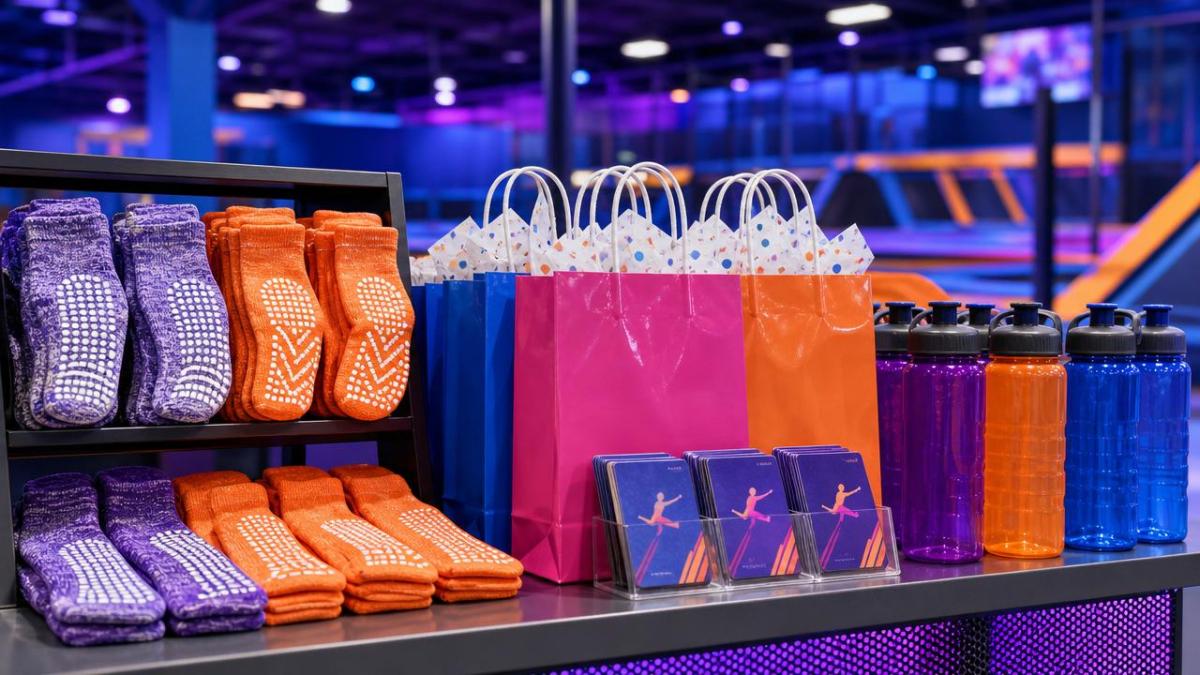
Grip socks are often the most reliable of all trampoline park accessories because they are tied to safety policy and guest compliance. For evaluators, the key issue is not whether socks sell, but how effectively the park uses them. The strongest model is one where socks combine mandatory demand, clear branding, controlled inventory, and occasional premium variants for children, toddlers, or themed events.
Check whether socks are one-time only, reusable, bundled into party packages, or discounted for members. A well-run sock program can increase spend per visit directly while also reinforcing brand recall after the guest leaves.
2. Party add-ons: the highest-value accessory layer
Birthday and group bookings often generate the biggest accessory-driven uplift. Typical examples include themed tableware, private room upgrades, party host enhancements, souvenir cups, gift bags, mascot appearances, or premium dessert options. These are not minor extras; they are margin multipliers attached to high-intent buyers.
For business evaluators, this category should be reviewed by package penetration, average upsell value, and conversion at inquiry stage. If party sales staff are trained to present add-ons as experience enhancers rather than cost adders, spend per visit usually rises significantly for the entire booking group.
3. Arcade, redemption, and digital play tie-ins
Where the venue includes arcade games or adjacent attractions, bundled credits can meaningfully increase per-capita spend. The commercial logic is straightforward: trampoline time creates physical excitement, while arcade play extends dwell time and opens a second spending cycle. Bundles such as jump session plus game credit, or birthday package plus redemption card, often outperform separate offers.
However, evaluators should test whether arcade tie-ins create net new spending or cannibalize food, retail, or premium attraction sales. The answer depends on guest flow design and age profile.
4. Branded merchandise and memory products
T-shirts, water bottles, plush items, photos, medals, and event-specific keepsakes can work well, but only when the park has strong traffic, repeat family visits, or a visible local brand. Unlike grip socks, these trampoline park accessories are discretionary, so conversion depends on emotional timing. Exit zones, birthday pickup moments, and achievement-based events usually produce the best results.
The critical check is SKU discipline. Too many merchandise choices can weaken sell-through and create dead stock. Fewer items with stronger branding usually perform better than broad novelty assortments.
5. Convenience accessories that reduce friction
Lockers, phone pouches, refill bottles, towels, or parent-comfort items may look secondary, but they can increase spend per visit by solving real pain points. These accessories are especially effective in larger parks, longer-stay venues, or family destinations where convenience directly affects the guest’s willingness to spend more time on site.
Commercial scoring table for trampoline park accessories
Use the following decision grid to compare accessory categories on practical business terms rather than assumptions.
What to check by venue type and customer mix
Not all trampoline park accessories perform the same way across formats. Evaluators should adjust expectations based on site economics and audience behavior.
Small urban parks
Focus on high-turn, low-complexity items such as socks, lockers, simple party upgrades, and limited branded goods. Space constraints make large retail displays less efficient, so conversion depends on checkout integration and staff prompts.
Destination family entertainment centers
These venues can support broader accessory layering: jump packages, arcade bundles, meal upgrades, event souvenirs, and premium family bundles. Here, spend per visit often rises through package architecture more than through stand-alone item sales.
Membership-driven parks
For recurring guests, the strongest trampoline park accessories are those with repeat replenishment or exclusive value, such as member-only sock designs, seasonal merchandise, discounted party extras, or prepaid digital credits. The goal is not a one-time high ticket, but a durable ancillary revenue stream.
Common blind spots that distort accessory ROI
Many operators overstate the impact of trampoline park accessories because they do not separate gross sales from net contribution. Watch for these common errors.
- Counting mandatory socks as pure upsell without considering whether admission pricing could have absorbed the same value.
- Overbuying branded merchandise that looks attractive in concept but has slow turnover and markdown risk.
- Failing to track package breakage, meaning included add-ons are used unevenly and profitability is misunderstood.
- Ignoring labor costs from retail handling, replenishment, or dispute management.
- Assuming all guests respond equally to offers, when parents, teens, party hosts, and members each spend differently.
Another overlooked factor is timing. The same accessory can perform very differently at online booking, front desk check-in, café dwell time, or exit. Accessory economics are strongly tied to when the offer appears.
Execution checklist: how to raise spend per visit without creating retail clutter
- Start with three to five accessory lines only, led by proven high-conversion products.
- Bundle trampoline park accessories into booking flows instead of relying only on counter sales.
- Set weekly tracking for attachment rate, gross margin, and units per guest segment.
- Train staff to use short, consistent scripts linked to convenience or celebration value.
- Test premium versions only after the base line shows stable turnover.
- Review dead stock monthly and remove weak SKUs quickly.
This step-by-step method is usually more effective than launching a broad retail wall. In entertainment venues, accessory success comes from relevance and timing, not assortment size.
FAQ for business evaluators reviewing trampoline park accessories
Do trampoline park accessories always increase spend per visit?
No. They increase spend per visit when they fit guest intent, are priced clearly, have healthy margin, and are integrated into the sales path. Poorly chosen accessories can add complexity without lifting net revenue.
Which accessory type usually delivers the fastest return?
Grip socks usually provide the fastest and most stable return, while party add-ons often provide the highest value per transaction. The best answer depends on visitor mix and party penetration.
How should accessory success be measured?
Track attachment rate, average revenue per guest, gross margin by item, inventory turnover, and repeat purchase behavior. If possible, compare periods with and without bundled offers to isolate uplift.
Final decision guide and next-step questions
So, do trampoline park accessories increase spend per visit? In most cases, yes—but only when they are selected and managed as a commercial system rather than as decorative retail extras. The highest-performing accessory programs usually combine one mandatory or high-frequency item, one event-driven upsell layer, and one experience-extension offer such as arcade credits or merchandise tied to memory.
If your team needs to validate a program, prioritize these questions: Which guest segment is the target? What is the expected attachment rate? What margin remains after labor and shrinkage? Which accessories belong in online booking, front desk, or party sales? How quickly can weak SKUs be replaced? These are the practical checkpoints that turn trampoline park accessories from a side offering into a measurable revenue tool.
For further evaluation, it is advisable to gather current spend-per-visit data, party conversion figures, inventory terms, replenishment cycle details, POS integration requirements, and packaging options. With those inputs, a buyer or operator can judge whether a specific accessory mix will improve revenue, fit the venue model, and support scalable commercial performance.
Search News
Hot Articles
- Carbon Fiber StructuresHow to Specify Aerospace Carbon Fiber Assemblies for Lightweight, Load-Bearing PartsJul 11, 2026
- Machine VisionXiaomi, Alibaba DAMO Academy Drive Open-Source Robotics Model Ecosystem, Lowering Algorithm Development Barriers for Overseas SMEs Adopting Chinese Robotics SolutionsMar 30, 2026
- Cobots & ArmsShanxi 'AI+' Conference Showcases Embodied Intelligence with Multinational Buyer Engagement: Key Industry ImplicationsMar 30, 2026
Popular Tags
Recommended News
 Jul 11, 2026How to Specify Aerospace Carbon Fiber Assemblies for Lightweight, Load-Bearing PartsAerospace carbon fiber assemblies: learn how to specify laminate design, load data, joining methods, and inspection controls for lighter, reliable load-bearing aerospace parts.Elena Rostova (UAV Systems Researcher)
 Mar 30, 2026Xiaomi, Alibaba DAMO Academy Drive Open-Source Robotics Model Ecosystem, Lowering Algorithm Development Barriers for Overseas SMEs Adopting Chinese Robotics SolutionsXiaomi & Alibaba DAMO Academy's open-source robotics models lower algorithm barriers for global SMEs. Boost efficiency in manufacturing, logistics & smart retail with ROS 2 compatible solutions.TSV Data Lab
 Mar 30, 2026Shanxi 'AI+' Conference Showcases Embodied Intelligence with Multinational Buyer Engagement: Key Industry ImplicationsShanxi 'AI+' Conference highlights embodied intelligence with Tesla, Ubtech & Jiantao showcasing multimodal robotics. 40+ global buyers validated tech on-site, creating new B2B channels for industrial automation & AI solutions.Chen Wei (Automation Lead Engineer)
 Mar 30, 2026Zhongguancun Unveils 6G Integrated Sensing-Computing-Intelligence Platform to Empower Embodied Robots for Global Industrial ApplicationsZhongguancun's new 6G platform revolutionizes industrial robotics with <10ms latency, empowering global automotive, logistics & port automation. Discover how this tech boosts China's smart manufacturing exports.TSV Data Lab
 Mar 30, 2026Mech-Mind Tianjin Embodied Intelligence R&D and Production Base Goes Live, Cutting Delivery Time by 20%–30% for Global Customized AMR+Vision SolutionsMech-Mind's Tianjin AMR+Vision production base cuts delivery time by 20%-30% for欧美 & Latin American markets. Discover how this PLd-certified facility accelerates customized robotics solutions for smart manufacturing and logistics.Chen Wei (Automation Lead Engineer)
 Mar 30, 2026Boao Forum Reveals 'Co-evolution of Big and Small Brains' Trend in Humanoid Robots, China's Embodied Intelligence Accelerates Adaptation to Overseas Manufacturing Service ScenariosDiscover how China's humanoid robots, featuring 'Co-evolution of Big and Small Brains,' are revolutionizing global manufacturing. Learn about Embodied Tian Gong 3.0's ISO compliance and overseas deployment at Boao Forum 2026.Chen Wei (Automation Lead Engineer)
 Mar 30, 2026China Railway Industrial Secures Patent for Embodied Robotics in Material Handling, Boosting High-Precision Delivery Capabilities for Overseas Infrastructure and Manufacturing ProjectsChina Railway Industrial's new patent for embodied robotics in material handling boosts high-precision delivery for global infrastructure & manufacturing. Discover how this innovation enhances logistics accuracy in automotive, rail transit & EPC projects.Chen Wei (Automation Lead Engineer)
 Sep 28, 2026Spindle Runout Measurement in Germany: DIN Standards, Methods, and Acceptance LimitsSpindle runout measurement Germany: explore DIN standards, proven methods, acceptance limits, and audit-ready practices for reliable machining quality.Dr. Marcus Vance
 Sep 27, 2026How to Select Wall-Mount Edge Devices for Space-Constrained Factory NetworksWall mount edge devices for space-constrained factories: evaluate workload, thermal design, power resilience, cable access, and network reliability for smarter deployments.TSV Data Lab
 Sep 26, 2026Machining Tolerance Analysis: How to Set Limits That Meet Function and Cost TargetsMachining tolerance analysis: learn how to set functional limits, control tolerance stacks, reduce inspection risk, and balance precision with production cost.Dr. Marcus Vance
 Sep 25, 2026How to Evaluate an Industrial Infrastructure Data Platform for Multi-Site OperationsIndustrial infrastructure data platform evaluation guide for multi-site operations: compare data quality, edge resilience, interoperability, governance, and scalable proof-of-value criteria.Victor Lin (Chief Software Architect)
 Sep 24, 2026How to Select Machine Vision Optics for Accurate Inspection at Different Working DistancesMachine vision optics selection guide for accurate inspection at every working distance. Compare FOV, pixel scale, DOF, distortion, lighting, and telecentric options.TSV Data Lab
 Sep 23, 2026How to Evaluate a Machine Vision System Integrator for High-Speed Inspection LinesChoose a machine vision system integrator with proven expertise in high-speed inspection, reliable reject timing, robust optics, and measurable acceptance criteria.TSV Data Lab
 Sep 28, 2026When is a SCADA API the right choice for connecting plant systems?SCADA API guide: learn when governed plant data integration improves traceability, security, and scalability—without compromising real-time control.Victor Lin (Chief Software Architect)
 Sep 27, 2026How SCADA data integration improves traceability across production linesSCADA data integration connects production-line data to improve traceability, accelerate quality investigations, and strengthen safety decisions.Victor Lin (Chief Software Architect)
 Sep 26, 2026What to define before starting SCADA integration planningSCADA integration planning starts with clear scope, control boundaries, data models, cybersecurity, and testing. Discover the definitions that reduce risk and costly rework.Victor Lin (Chief Software Architect)
 Sep 25, 2026How a smart factory with Industrial IoT reduces production blind spotsDiscover how a smart factory with Industrial IoT turns real-time machine, quality, and workflow data into actionable insights that reduce production blind spots and delivery risks.Victor Lin (Chief Software Architect)
 Sep 24, 2026When does Industrial IoT make smart manufacturing easier to scale?Smart manufacturing Industrial IoT scales when trusted data, interoperable systems, and secure workflows turn connected assets into measurable gains.TSV Data Lab
 Sep 23, 2026What drives ultra-precision machining cost at 1-micron tolerance?Ultra precision machining cost per part at 1 micron tolerance depends on process, material, metrology, and yield. Learn how to compare quotes confidently.Dr. Marcus Vance
 Sep 22, 2026Drone Engine-T550CC Applications: Build the UAV Power System Around the MissionAn application guide for Drone Engine-T550CC integration, covering payload planning, airframe matching, cooling, fuel, vibration, test procedures, documentation, and service preparation.Elena Rostova (UAV Systems Researcher)
 Sep 22, 2026How to Evaluate Industrial Edge Computing Vendors for Factory DeploymentIndustrial edge computing vendor evaluation guide for factories: compare latency, protocol fit, reliability, security, and lifecycle support before deployment.TSV Data Lab
 Sep 21, 2026Drone Payload Integration: Matching Power, Data, and Center of Gravity for Reliable FlightsDrone payload integration made practical: balance power, data, center of gravity, and endurance to build safer, more reliable mission-ready flights.Elena Rostova (UAV Systems Researcher)
 Sep 20, 2026Autonomous Navigation Pricing: Cost Drivers and Budget Benchmarks for AMR ProjectsAutonomous navigation price explained: compare AMR cost drivers, software, sensors, integration, safety, and lifecycle budgets to build a scalable project plan.Chen Wei (Automation Lead Engineer)
 Sep 19, 2026How to Scope Automation Integration Services for Multi-System Factory ProjectsAutomation integration services: learn how to scope multi-system factory projects with clear workflows, interface contracts, safety boundaries, and acceptance criteria.Victor Lin (Chief Software Architect)