Trampoline Park Accessories That Improve Safety and Throughput
Publication Date
author
For quality control and safety managers, selecting the right trampoline park accessories is not just about adding features—it directly affects incident prevention, inspection efficiency, and guest flow. From impact-absorbing pads to queue-control systems and modular barriers, the right accessories can strengthen compliance, reduce downtime, and improve throughput. This guide examines the most practical options through a safety-first, performance-driven lens.
What Safety and QC Managers Actually Need From Trampoline Park Accessories
When buyers search for trampoline park accessories, they are rarely looking for decorative add-ons. In practice, the core intent is more operational: which accessories measurably reduce injury risk, simplify inspections, support compliance, and keep participant flow moving during peak hours.
For safety managers, the first question is not “What accessories are available?” but “Which accessories close the biggest risk gaps?” For quality control personnel, the focus is often broader: durability, installation quality, maintenance cycles, material consistency, and whether an accessory improves or complicates routine inspection.
That changes how accessories should be evaluated. The best options are not the most visually impressive. They are the ones that improve protective coverage, reduce exposed failure points, create clearer traffic patterns, and maintain performance under heavy daily use.
In other words, the right accessory package should do three things at once: lower the probability of incidents, shorten the time required for checks and maintenance, and increase usable capacity by reducing congestion and stoppages.
Start With Risk Control, Not Feature Expansion
Before comparing product categories, it helps to divide accessories into three decision groups: safety-critical, throughput-supporting, and convenience-enhancing. Safety-critical items deserve the highest budget priority because they directly affect injury prevention and compliance exposure. Throughput-supporting items come next because they influence line speed, staff efficiency, and user distribution. Convenience items should only be considered after the first two groups are covered.
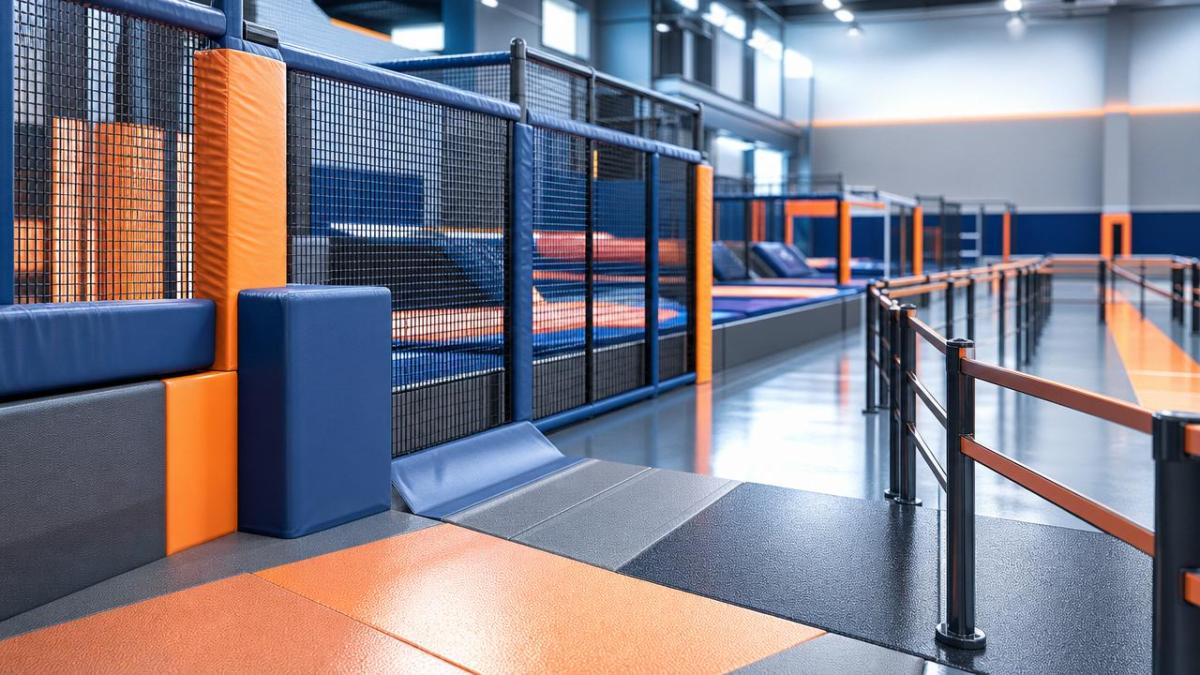
For most trampoline parks, safety-critical accessories include frame pads, spring pads, end-deck padding, wall padding, column wraps, netting, soft barriers, anti-slip entry surfaces, and zone separation systems. These components protect guests from impact with hard structures, exposed springs, sharp edges, or unintended movement between activity areas.
Throughput-supporting accessories often include queue-control barriers, lane markers, signage systems, cubby or shoe-storage layouts, staff-position platforms, modular fencing, and access-control gates. These do not always look like “safety products,” but they have direct safety implications because poor flow management increases collisions, confusion, and crowding.
Convenience-enhancing accessories may include visual theming pieces, casual seating, basic décor elements, or non-essential soft goods. These can support the guest experience, but they should not distract from the higher-value decisions that influence operational resilience.
The Highest-Impact Safety Accessories to Prioritize First
If the goal is to prevent incidents, some accessories consistently deliver more value than others. The first category is impact attenuation. High-quality pads on springs, frames, decks, and adjacent structures are fundamental because these are the surfaces participants hit when jumps go off line, landings fail, or traffic becomes unpredictable.
Not all padding performs equally well. Safety managers should look beyond nominal thickness and ask about foam density, compression recovery, cover material tear resistance, seam strength, moisture resistance, UV stability, and fastening design. A pad that shifts out of place, absorbs sweat or cleaning fluid, or splits along the seams creates hidden risk even if it looked adequate at installation.
Wall pads and column wraps deserve similar attention, especially around dodgeball courts, performance lanes, foam pit approaches, and spectator-transition zones. In many parks, side-impact events are less anticipated than falls, but they can be just as serious when rigid structural elements are nearby.
Protective netting and containment barriers also matter where users could enter adjacent zones, approach elevated features incorrectly, or come too close to staff-only spaces. The main QC concern here is not only tensile performance but also anchoring quality, connection wear, and the likelihood of sagging over time.
Finally, anti-slip mats and transition surfaces around entries, stairs, ramps, and sock-change areas are often undervalued. Yet many preventable incidents happen outside the main jumping bed, where participants are moving quickly, carrying belongings, or not fully attentive.
Accessories That Improve Throughput Without Compromising Safety
Throughput in a trampoline park is not just a sales metric. It is also a safety variable. When users wait too long, cut across zones, or enter play areas without clear guidance, the result is often disorder, and disorder increases exposure. The right trampoline park accessories help convert a chaotic floor into a controlled, predictable environment.
Queue-control systems are one of the simplest examples. Stanchions, modular rails, and floor-guidance markers can reduce crowd bunching near high-demand attractions such as air bags, basketball lanes, climbing features, and ninja-style challenge zones. When lines are clearly defined, staff intervention decreases and entry becomes more orderly.
Zone dividers and low-height modular barriers also support throughput by preventing participants from crossing into active lanes from the side. This is especially useful in mixed-age parks where younger guests, spectators, and active jumpers share adjacent circulation space.
Signage is another high-leverage accessory category. Clear instructional signs, capacity limit boards, one-way movement arrows, and height or age restriction markers reduce verbal repetition by staff and speed up compliance at the point of entry. Good signage does not replace supervision, but it reduces ambiguity and improves consistency.
Storage and transition accessories can also increase usable throughput. Shoe racks, locker layouts, sock-check stations, and bag-drop organization reduce congestion at entrances and keep pathways clear. That means fewer start-stop disruptions and a lower chance of slips or trip hazards during busy periods.
How to Evaluate Accessory Quality Beyond Marketing Claims
Because many suppliers use similar language, safety and procurement teams need a more disciplined evaluation method. The first step is to ask for data that reflects real operating conditions rather than generic claims. “Durable,” “premium,” and “commercial grade” are not enough.
For padding systems, request specifications for foam type, density, impact performance, cover substrate, coating type, stitch construction, and fastening method. Ask whether samples have been tested for repeated compression, tear propagation, cleaning-chemical resistance, and edge separation after heavy use.
For barriers and modular fencing, confirm structural material, weld integrity where relevant, connection hardware grade, anchoring method, and how easily components can be removed or reinstalled during maintenance. Poorly designed barriers can become loose, create snag points, or interfere with evacuation routes.
For netting, check mesh size, abrasion resistance, fastening redundancy, and whether replacement sections are available individually. Parks that need to replace entire assemblies because one panel fails often face higher downtime and maintenance costs than expected.
It is also important to assess inspection visibility. Some accessories appear robust when new but hide wear in the areas that matter most. Accessories with inaccessible anchors, concealed fasteners, or enclosed moisture-prone sections may increase long-term QC burden even if purchase price is attractive.
Key Questions to Ask Suppliers Before Approval
A practical supplier review process should focus on risk, serviceability, and consistency. Start with product traceability. Can the supplier identify material batches, manufacturing dates, replacement-part compatibility, and revision history? That matters when failures occur or when parks expand and need matching components later.
Next, ask how the accessory was designed for maintenance. Can pads be removed for inspection without damaging covers? Are replacement skins, foam inserts, connectors, or net panels available separately? How long is the lead time for consumable or high-wear parts? Accessories with poor parts support often create avoidable downtime.
Another critical question is installation tolerance. Even good accessories can fail if field installation is inconsistent. Ask whether the supplier provides layout drawings, fastening specifications, torque guidance if applicable, and post-install inspection checklists. Safety performance depends on the installed condition, not just factory condition.
For parks operating at high traffic levels, ask about lifecycle expectations under heavy commercial use rather than nominal product lifespan. A pad expected to last three years in low-volume conditions may require replacement far sooner in a high-turnover venue with aggressive daily cleaning and frequent repositioning.
Finally, ask for evidence from comparable installations. References are useful, but better still are documented use cases involving similar attendance volume, age profile, and attraction mix. Accessories behave differently in a toddler-focused venue than in a high-energy freestyle or dodgeball-heavy environment.
Matching Accessories to Specific Risk Zones Inside the Park
Not every area needs the same accessory strategy. A more effective approach is zone-based prioritization. Entry and check-in zones benefit from anti-slip flooring, queue barriers, sock-check stations, and wayfinding signage. The objective there is smooth intake, clean transitions, and minimal obstruction.
Main jumping courts need robust frame and spring protection, visible lane definition where appropriate, and clear access boundaries to control the timing of entry. Around these zones, the biggest risk usually comes from missteps, side collisions, or users entering active space too abruptly.
Performance features such as airbags, wall-run areas, launch lanes, and foam pit approaches require stronger visual controls and more disciplined participant routing. Here, barriers and instructional signage are especially important because users often focus on the feature rather than surrounding hazards.
Children’s zones require a different balance. Soft containment, lower-profile barriers, padded transitions, and strong sightline preservation are typically more important than rigid separation. Accessories should reduce wandering into advanced zones while still allowing guardians and staff to monitor easily.
Back-of-house and maintenance-adjacent areas should not be overlooked. Staff-only gates, tool-control storage, cable covers, and service barriers help prevent unauthorized access and reduce operational interruptions. These accessories may not affect guest perception directly, but they support safer daily operation.
Common Purchasing Mistakes That Create Long-Term Safety Problems
One of the most common mistakes is buying accessories as isolated items instead of as part of an operating system. A pad may meet expectations individually, but if it interferes with cleaning access, loosens adjacent components, or creates visual blind spots, it may reduce overall safety performance.
Another mistake is overvaluing appearance at handover and undervaluing retention of performance over time. Bright finishes and thick-looking materials can create a false sense of quality. What matters more is how the accessory performs after months of foot traffic, impact cycles, sanitation exposure, and temperature changes.
Safety teams also run into trouble when accessories are added reactively without updating inspection protocols. If new barriers, mats, or net systems are installed, checklists should change too. Every accessory introduces new attachment points, wear surfaces, and housekeeping requirements.
A further issue is underestimating replacement logistics. If damaged parts cannot be swapped quickly, operators may be tempted to continue using compromised accessories longer than they should. Standardized modular components generally make QC control easier than highly customized one-off elements.
Building an Accessory Strategy Around Compliance, Uptime, and ROI
For decision-makers, the real value of trampoline park accessories is not that they “add equipment.” It is that they can reduce incident probability, improve staff efficiency, and preserve operating uptime. A useful purchasing framework therefore combines three filters: compliance relevance, maintenance burden, and throughput effect.
Compliance relevance asks whether the accessory addresses a known hazard, supports safer separation, improves visibility, or strengthens control of user behavior. Maintenance burden asks how often the item needs inspection, cleaning, adjustment, or replacement, and whether those tasks are practical for the existing team.
Throughput effect looks at whether the accessory reduces congestion, speeds transitions, supports better supervision, or prevents temporary closures caused by avoidable damage and disorder. Accessories that score well across all three categories should typically move to the top of the approval list.
For many parks, the strongest returns come not from adding more attractions, but from improving the supporting layer around them. Better pads, clearer barriers, stronger signage, and smarter queue design often deliver a quieter but more meaningful benefit: fewer disruptions, fewer close calls, and more stable daily output.
Conclusion: Choose Accessories That Make the Park Safer to Operate, Not Just Better to Look At
For quality control and safety managers, the smartest way to evaluate trampoline park accessories is to treat them as risk-control and flow-management tools. The best choices are the ones that hold up under repeated use, are easy to inspect, support clear participant movement, and reduce the need for constant staff correction.
If budget prioritization is required, start with impact protection, containment, anti-slip transitions, and clear zone control. Then invest in queue management, signage, and modular layouts that improve throughput without adding confusion. Accessories should earn their place by reducing hazards, simplifying maintenance, and helping the park run more predictably.
In a high-volume trampoline environment, safer operation and better throughput are not competing goals. With the right accessory strategy, they reinforce each other.
Search News
Hot Articles
- Carbon Fiber StructuresHow to Specify Aerospace Carbon Fiber Assemblies for Lightweight, Load-Bearing PartsJul 11, 2026
- Machine VisionXiaomi, Alibaba DAMO Academy Drive Open-Source Robotics Model Ecosystem, Lowering Algorithm Development Barriers for Overseas SMEs Adopting Chinese Robotics SolutionsMar 30, 2026
- Cobots & ArmsShanxi 'AI+' Conference Showcases Embodied Intelligence with Multinational Buyer Engagement: Key Industry ImplicationsMar 30, 2026
Popular Tags
Recommended News
 Jul 11, 2026How to Specify Aerospace Carbon Fiber Assemblies for Lightweight, Load-Bearing PartsAerospace carbon fiber assemblies: learn how to specify laminate design, load data, joining methods, and inspection controls for lighter, reliable load-bearing aerospace parts.Elena Rostova (UAV Systems Researcher)
 Mar 30, 2026Xiaomi, Alibaba DAMO Academy Drive Open-Source Robotics Model Ecosystem, Lowering Algorithm Development Barriers for Overseas SMEs Adopting Chinese Robotics SolutionsXiaomi & Alibaba DAMO Academy's open-source robotics models lower algorithm barriers for global SMEs. Boost efficiency in manufacturing, logistics & smart retail with ROS 2 compatible solutions.TSV Data Lab
 Mar 30, 2026Shanxi 'AI+' Conference Showcases Embodied Intelligence with Multinational Buyer Engagement: Key Industry ImplicationsShanxi 'AI+' Conference highlights embodied intelligence with Tesla, Ubtech & Jiantao showcasing multimodal robotics. 40+ global buyers validated tech on-site, creating new B2B channels for industrial automation & AI solutions.Chen Wei (Automation Lead Engineer)
 Mar 30, 2026Zhongguancun Unveils 6G Integrated Sensing-Computing-Intelligence Platform to Empower Embodied Robots for Global Industrial ApplicationsZhongguancun's new 6G platform revolutionizes industrial robotics with <10ms latency, empowering global automotive, logistics & port automation. Discover how this tech boosts China's smart manufacturing exports.TSV Data Lab
 Mar 30, 2026Mech-Mind Tianjin Embodied Intelligence R&D and Production Base Goes Live, Cutting Delivery Time by 20%–30% for Global Customized AMR+Vision SolutionsMech-Mind's Tianjin AMR+Vision production base cuts delivery time by 20%-30% for欧美 & Latin American markets. Discover how this PLd-certified facility accelerates customized robotics solutions for smart manufacturing and logistics.Chen Wei (Automation Lead Engineer)
 Mar 30, 2026Boao Forum Reveals 'Co-evolution of Big and Small Brains' Trend in Humanoid Robots, China's Embodied Intelligence Accelerates Adaptation to Overseas Manufacturing Service ScenariosDiscover how China's humanoid robots, featuring 'Co-evolution of Big and Small Brains,' are revolutionizing global manufacturing. Learn about Embodied Tian Gong 3.0's ISO compliance and overseas deployment at Boao Forum 2026.Chen Wei (Automation Lead Engineer)
 Mar 30, 2026China Railway Industrial Secures Patent for Embodied Robotics in Material Handling, Boosting High-Precision Delivery Capabilities for Overseas Infrastructure and Manufacturing ProjectsChina Railway Industrial's new patent for embodied robotics in material handling boosts high-precision delivery for global infrastructure & manufacturing. Discover how this innovation enhances logistics accuracy in automotive, rail transit & EPC projects.Chen Wei (Automation Lead Engineer)
 Sep 28, 2026Spindle Runout Measurement in Germany: DIN Standards, Methods, and Acceptance LimitsSpindle runout measurement Germany: explore DIN standards, proven methods, acceptance limits, and audit-ready practices for reliable machining quality.Dr. Marcus Vance
 Sep 27, 2026How to Select Wall-Mount Edge Devices for Space-Constrained Factory NetworksWall mount edge devices for space-constrained factories: evaluate workload, thermal design, power resilience, cable access, and network reliability for smarter deployments.TSV Data Lab
 Sep 26, 2026Machining Tolerance Analysis: How to Set Limits That Meet Function and Cost TargetsMachining tolerance analysis: learn how to set functional limits, control tolerance stacks, reduce inspection risk, and balance precision with production cost.Dr. Marcus Vance
 Sep 25, 2026How to Evaluate an Industrial Infrastructure Data Platform for Multi-Site OperationsIndustrial infrastructure data platform evaluation guide for multi-site operations: compare data quality, edge resilience, interoperability, governance, and scalable proof-of-value criteria.Victor Lin (Chief Software Architect)
 Sep 24, 2026How to Select Machine Vision Optics for Accurate Inspection at Different Working DistancesMachine vision optics selection guide for accurate inspection at every working distance. Compare FOV, pixel scale, DOF, distortion, lighting, and telecentric options.TSV Data Lab
 Sep 23, 2026How to Evaluate a Machine Vision System Integrator for High-Speed Inspection LinesChoose a machine vision system integrator with proven expertise in high-speed inspection, reliable reject timing, robust optics, and measurable acceptance criteria.TSV Data Lab
 Sep 28, 2026When is a SCADA API the right choice for connecting plant systems?SCADA API guide: learn when governed plant data integration improves traceability, security, and scalability—without compromising real-time control.Victor Lin (Chief Software Architect)
 Sep 27, 2026How SCADA data integration improves traceability across production linesSCADA data integration connects production-line data to improve traceability, accelerate quality investigations, and strengthen safety decisions.Victor Lin (Chief Software Architect)
 Sep 26, 2026What to define before starting SCADA integration planningSCADA integration planning starts with clear scope, control boundaries, data models, cybersecurity, and testing. Discover the definitions that reduce risk and costly rework.Victor Lin (Chief Software Architect)
 Sep 25, 2026How a smart factory with Industrial IoT reduces production blind spotsDiscover how a smart factory with Industrial IoT turns real-time machine, quality, and workflow data into actionable insights that reduce production blind spots and delivery risks.Victor Lin (Chief Software Architect)
 Sep 24, 2026When does Industrial IoT make smart manufacturing easier to scale?Smart manufacturing Industrial IoT scales when trusted data, interoperable systems, and secure workflows turn connected assets into measurable gains.TSV Data Lab
 Sep 23, 2026What drives ultra-precision machining cost at 1-micron tolerance?Ultra precision machining cost per part at 1 micron tolerance depends on process, material, metrology, and yield. Learn how to compare quotes confidently.Dr. Marcus Vance
 Sep 22, 2026Drone Engine-T550CC Applications: Build the UAV Power System Around the MissionAn application guide for Drone Engine-T550CC integration, covering payload planning, airframe matching, cooling, fuel, vibration, test procedures, documentation, and service preparation.Elena Rostova (UAV Systems Researcher)
 Sep 22, 2026How to Evaluate Industrial Edge Computing Vendors for Factory DeploymentIndustrial edge computing vendor evaluation guide for factories: compare latency, protocol fit, reliability, security, and lifecycle support before deployment.TSV Data Lab
 Sep 21, 2026Drone Payload Integration: Matching Power, Data, and Center of Gravity for Reliable FlightsDrone payload integration made practical: balance power, data, center of gravity, and endurance to build safer, more reliable mission-ready flights.Elena Rostova (UAV Systems Researcher)
 Sep 20, 2026Autonomous Navigation Pricing: Cost Drivers and Budget Benchmarks for AMR ProjectsAutonomous navigation price explained: compare AMR cost drivers, software, sensors, integration, safety, and lifecycle budgets to build a scalable project plan.Chen Wei (Automation Lead Engineer)
 Sep 19, 2026How to Scope Automation Integration Services for Multi-System Factory ProjectsAutomation integration services: learn how to scope multi-system factory projects with clear workflows, interface contracts, safety boundaries, and acceptance criteria.Victor Lin (Chief Software Architect)