Commercial Drones Sourcing Guide: How to Vet Suppliers, Specs, and Compliance
Publication Date
author
Commercial Drones Sourcing Guide: How to Vet Suppliers, Specs, and Compliance
Commercial drones sourcing is no longer a simple price comparison exercise.
It now sits at the intersection of airworthiness, supplier credibility, payload fit, and regulatory exposure.
That shift matters because many vendors still sell with polished claims and vague parameter sheets.
In real procurement work, vague claims create expensive downstream problems.
A drone that looks competitive on paper may fail during integration, field testing, or compliance review.
That is why commercial drones sourcing needs a structured evaluation framework from the start.
The practical goal is clear: reduce supplier qualification risk while protecting mission performance and program timelines.
The sections below break down how to assess suppliers, verify specifications, and confirm compliance before issuing volume orders.
Start Commercial Drones Sourcing With the Mission Profile
The first mistake in commercial drones sourcing is comparing suppliers before defining the actual mission.
A mapping platform, an agricultural sprayer, and an inspection UAV do not share the same technical priorities.
From recent market changes, the stronger signal is application specialization.
This means sourcing teams should write the mission profile before contacting vendors.
A solid mission profile usually includes:
- Operational range, endurance, and cruise speed
- Payload type, payload mass, and interface requirements
- Environmental conditions such as wind, dust, rain, and temperature
- Required data outputs, accuracy thresholds, and software compatibility
- Regional compliance constraints and pilot operation model
This step sounds basic, but it is where sourcing quality is decided.
Without this baseline, every later comparison in commercial drones sourcing becomes inconsistent.
How to Vet Suppliers Beyond the Sales Deck
Supplier screening should begin with manufacturing evidence, not brochure language.
In commercial drones sourcing, the strongest suppliers can explain process control in measurable terms.
Ask how they manage component traceability, firmware version control, battery sourcing, and final flight testing.
If those answers stay high level, that is already useful information.
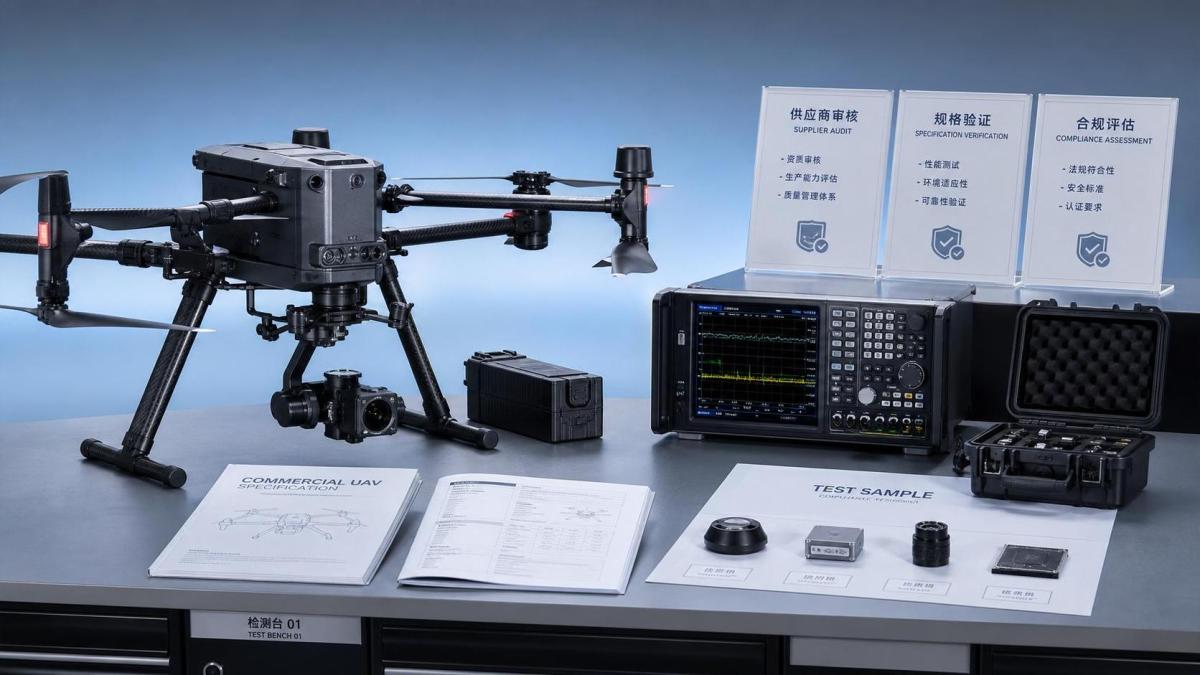
A serious supplier review should cover five areas:
- Factory capability, including assembly discipline and QA checkpoints
- Key subsystem sourcing for motors, ESCs, GNSS, batteries, and flight controllers
- Engineering support for payload integration and field troubleshooting
- Service infrastructure, spare parts policy, and repair turnaround time
- Document quality, including test reports, manuals, and compliance records
In practice, site audits or remote video audits remain valuable.
They reveal whether the supplier actually builds repeatable systems or only assembles small pilot batches.
For larger programs, request batch consistency evidence from previous commercial deliveries.
That evidence is often more useful than a polished customer list in commercial drones sourcing.
Verify Drone Specs the Way Engineers Do
Spec sheets are necessary, but they are rarely enough.
Commercial drones sourcing often fails when buyers compare headline numbers without checking test conditions.
Endurance is a good example.
Was the stated flight time measured at sea level, no wind, half payload, and ideal battery temperature?
If yes, that figure may have limited procurement value.
The most important parameters to validate include:
- Maximum takeoff weight versus useful payload
- Endurance under real payload and realistic wind conditions
- GNSS performance, hover accuracy, and positioning resilience
- Data link range and interference tolerance
- Ingress protection, thermal limits, and battery cycle life
- Payload power budget and mechanical mounting standards
A good sourcing checklist asks for raw test context, not just final values.
Ask for altitude, temperature, wind speed, payload setup, battery condition, and firmware version.
This also helps normalize comparisons across vendors.
The more technical the application, the more this discipline matters in commercial drones sourcing.
Payload Integration Is Usually the Hidden Risk
Many drone programs do not fail because the airframe is weak.
They fail because the payload, software, and power architecture were not evaluated together.
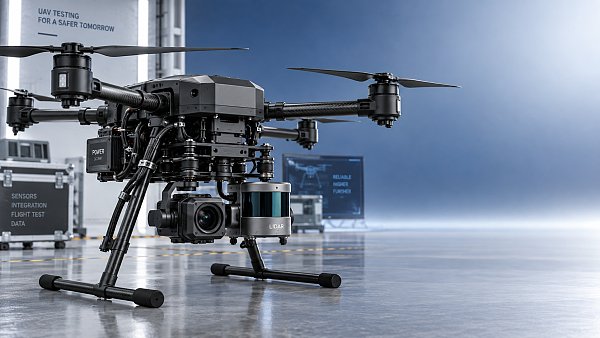
This is especially common in commercial drones sourcing for mapping, security, and industrial inspection.
A drone may physically carry a camera or LiDAR unit, yet still perform poorly in real operation.
Check the integration stack from four angles:
- Mechanical fit, vibration isolation, and center of gravity impact
- Electrical load, voltage stability, and connector reliability
- Data interface compatibility with onboard systems and ground software
- Trigger synchronization, timestamp quality, and calibration workflow
Suppliers should be able to share prior integration cases with measurable results.
That includes vibration data, sample datasets, or field records from similar payload classes.
In commercial drones sourcing, integration maturity is often the difference between a fast rollout and months of rework.
Compliance Should Be Checked Before Negotiation Deepens
Compliance is not a paperwork task for the end of the purchase cycle.
In commercial drones sourcing, late compliance discovery can invalidate the entire supplier shortlist.
Requirements vary by country, use case, transmission band, and payload category.
That also means one approved platform in one market may still be unsuitable elsewhere.
Common compliance checkpoints include:
- Remote identification or equivalent local UAV registration rules
- Radio frequency approvals and communication band legality
- Battery transport certifications and dangerous goods handling
- Operational limits tied to BVLOS, altitude, or urban airspace
- Data security, imaging restrictions, and export control exposure
More importantly, ask who owns the compliance burden.
Some suppliers provide only product declarations, while others support local certification and filing.
That support level should be scored explicitly in any commercial drones sourcing matrix.
Build a Practical Commercial Drones Sourcing Scorecard
Once the technical and regulatory filters are clear, scoring becomes more defensible.
A structured scorecard keeps emotional bias and price pressure from distorting the decision.
It also makes internal review easier when engineering, operations, and procurement priorities differ.
The exact weighting should reflect the application.
For example, public safety programs may weigh compliance and uptime more heavily.
Survey programs may prioritize payload data quality and positioning precision.
The key is to make commercial drones sourcing measurable before negotiations become price-driven.
Final Checks Before Awarding the Order
Before final award, run a short but disciplined validation stage.
This stage should confirm that the selected supplier can deliver repeatably, not just impress during demos.
Useful final checks include:
- Pilot order with acceptance criteria tied to measurable performance
- Spare parts list with pricing, stocking policy, and critical component lead times
- Firmware update policy and cybersecurity responsibility boundaries
- Field support escalation path and named technical contacts
- Contract language covering nonconformance handling and warranty triggers
This final layer protects the program after the PO is issued.
It also turns commercial drones sourcing from a transactional purchase into a controlled supply decision.
In a crowded UAV market, that discipline is what separates fast deployment from expensive procurement regret.
The best sourcing outcomes usually come from simple habits.
Define the mission clearly, verify specs under real conditions, audit supplier depth, and check compliance early. That is the real foundation of dependable commercial drones sourcing.
Search News
Hot Articles
- Carbon Fiber StructuresHow to Specify Aerospace Carbon Fiber Assemblies for Lightweight, Load-Bearing PartsJul 11, 2026
- Machine VisionXiaomi, Alibaba DAMO Academy Drive Open-Source Robotics Model Ecosystem, Lowering Algorithm Development Barriers for Overseas SMEs Adopting Chinese Robotics SolutionsMar 30, 2026
- Cobots & ArmsShanxi 'AI+' Conference Showcases Embodied Intelligence with Multinational Buyer Engagement: Key Industry ImplicationsMar 30, 2026
Popular Tags
Recommended News
 Jul 11, 2026How to Specify Aerospace Carbon Fiber Assemblies for Lightweight, Load-Bearing PartsAerospace carbon fiber assemblies: learn how to specify laminate design, load data, joining methods, and inspection controls for lighter, reliable load-bearing aerospace parts.Elena Rostova (UAV Systems Researcher)
 Mar 30, 2026Xiaomi, Alibaba DAMO Academy Drive Open-Source Robotics Model Ecosystem, Lowering Algorithm Development Barriers for Overseas SMEs Adopting Chinese Robotics SolutionsXiaomi & Alibaba DAMO Academy's open-source robotics models lower algorithm barriers for global SMEs. Boost efficiency in manufacturing, logistics & smart retail with ROS 2 compatible solutions.TSV Data Lab
 Mar 30, 2026Shanxi 'AI+' Conference Showcases Embodied Intelligence with Multinational Buyer Engagement: Key Industry ImplicationsShanxi 'AI+' Conference highlights embodied intelligence with Tesla, Ubtech & Jiantao showcasing multimodal robotics. 40+ global buyers validated tech on-site, creating new B2B channels for industrial automation & AI solutions.Chen Wei (Automation Lead Engineer)
 Mar 30, 2026Zhongguancun Unveils 6G Integrated Sensing-Computing-Intelligence Platform to Empower Embodied Robots for Global Industrial ApplicationsZhongguancun's new 6G platform revolutionizes industrial robotics with <10ms latency, empowering global automotive, logistics & port automation. Discover how this tech boosts China's smart manufacturing exports.TSV Data Lab
 Mar 30, 2026Mech-Mind Tianjin Embodied Intelligence R&D and Production Base Goes Live, Cutting Delivery Time by 20%–30% for Global Customized AMR+Vision SolutionsMech-Mind's Tianjin AMR+Vision production base cuts delivery time by 20%-30% for欧美 & Latin American markets. Discover how this PLd-certified facility accelerates customized robotics solutions for smart manufacturing and logistics.Chen Wei (Automation Lead Engineer)
 Mar 30, 2026Boao Forum Reveals 'Co-evolution of Big and Small Brains' Trend in Humanoid Robots, China's Embodied Intelligence Accelerates Adaptation to Overseas Manufacturing Service ScenariosDiscover how China's humanoid robots, featuring 'Co-evolution of Big and Small Brains,' are revolutionizing global manufacturing. Learn about Embodied Tian Gong 3.0's ISO compliance and overseas deployment at Boao Forum 2026.Chen Wei (Automation Lead Engineer)
 Mar 30, 2026China Railway Industrial Secures Patent for Embodied Robotics in Material Handling, Boosting High-Precision Delivery Capabilities for Overseas Infrastructure and Manufacturing ProjectsChina Railway Industrial's new patent for embodied robotics in material handling boosts high-precision delivery for global infrastructure & manufacturing. Discover how this innovation enhances logistics accuracy in automotive, rail transit & EPC projects.Chen Wei (Automation Lead Engineer)
 Sep 25, 2026How to Evaluate an Industrial Infrastructure Data Platform for Multi-Site OperationsIndustrial infrastructure data platform evaluation guide for multi-site operations: compare data quality, edge resilience, interoperability, governance, and scalable proof-of-value criteria.Victor Lin (Chief Software Architect)
 Sep 24, 2026How to Select Machine Vision Optics for Accurate Inspection at Different Working DistancesMachine vision optics selection guide for accurate inspection at every working distance. Compare FOV, pixel scale, DOF, distortion, lighting, and telecentric options.TSV Data Lab
 Sep 23, 2026How to Evaluate a Machine Vision System Integrator for High-Speed Inspection LinesChoose a machine vision system integrator with proven expertise in high-speed inspection, reliable reject timing, robust optics, and measurable acceptance criteria.TSV Data Lab
 Sep 25, 2026How a smart factory with Industrial IoT reduces production blind spotsDiscover how a smart factory with Industrial IoT turns real-time machine, quality, and workflow data into actionable insights that reduce production blind spots and delivery risks.Victor Lin (Chief Software Architect)
 Sep 24, 2026When does Industrial IoT make smart manufacturing easier to scale?Smart manufacturing Industrial IoT scales when trusted data, interoperable systems, and secure workflows turn connected assets into measurable gains.TSV Data Lab
 Sep 23, 2026What drives ultra-precision machining cost at 1-micron tolerance?Ultra precision machining cost per part at 1 micron tolerance depends on process, material, metrology, and yield. Learn how to compare quotes confidently.Dr. Marcus Vance
 Sep 22, 2026Drone Engine-T550CC Applications: Build the UAV Power System Around the MissionAn application guide for Drone Engine-T550CC integration, covering payload planning, airframe matching, cooling, fuel, vibration, test procedures, documentation, and service preparation.Elena Rostova (UAV Systems Researcher)
 Sep 22, 2026How to Evaluate Industrial Edge Computing Vendors for Factory DeploymentIndustrial edge computing vendor evaluation guide for factories: compare latency, protocol fit, reliability, security, and lifecycle support before deployment.TSV Data Lab
 Sep 21, 2026Drone Payload Integration: Matching Power, Data, and Center of Gravity for Reliable FlightsDrone payload integration made practical: balance power, data, center of gravity, and endurance to build safer, more reliable mission-ready flights.Elena Rostova (UAV Systems Researcher)
 Sep 20, 2026Autonomous Navigation Pricing: Cost Drivers and Budget Benchmarks for AMR ProjectsAutonomous navigation price explained: compare AMR cost drivers, software, sensors, integration, safety, and lifecycle budgets to build a scalable project plan.Chen Wei (Automation Lead Engineer)
 Sep 19, 2026How to Scope Automation Integration Services for Multi-System Factory ProjectsAutomation integration services: learn how to scope multi-system factory projects with clear workflows, interface contracts, safety boundaries, and acceptance criteria.Victor Lin (Chief Software Architect)
 Sep 18, 2026Selecting UAV Aerospace Structural Parts for Strength, Weight, and Fatigue LifeUAV aerospace structural parts guide: compare strength, weight, stiffness, fatigue life, joints, and traceability to select reliable flight-ready components.Elena Rostova (UAV Systems Researcher)
 Sep 17, 2026Selecting Commercial Drone Payloads for European Inspection ProjectsCommercial drone payloads Europe: learn how to select RGB, thermal and LiDAR systems for compliant, reliable inspection data and better project outcomes.Elena Rostova (UAV Systems Researcher)
 Sep 16, 2026Machining Tolerance Validation: How to Verify Critical Dimensions Before Production ReleaseMachining tolerance analysis validation: verify critical dimensions, measurement systems, process capability, and tolerance stacks before production release.Dr. Marcus Vance
 Sep 15, 2026AGV Tape Guidance vs Laser Navigation: Which Fits Your Warehouse Layout?AGV tape guidance comparison: discover how tape and laser navigation fit changing warehouse layouts, docking needs, floor conditions, maintenance, and route flexibility.Chen Wei (Automation Lead Engineer)
 Sep 14, 2026How Point Cloud Analytics Improves Asset Inspection Workflows Across GCC ProjectsPoint cloud analytics GCC helps project leaders improve asset inspections with accurate change detection, safer workflows, and faster maintenance decisions.TSV Data Lab
 Sep 13, 2026How Aerospace Manufacturers Can Build a Digital Thread From Design to Certified ProductionDigital manufacturing for aerospace: learn how to build a traceable digital thread from design through certified production, supplier control, and audit-ready compliance.Victor Lin (Chief Software Architect)