Servo Motor CNC Router Cost: Which Specs Raise Price and Where to Save?
Publication Date
author
Why does servo motor CNC router cost vary so much between similar-looking machines?
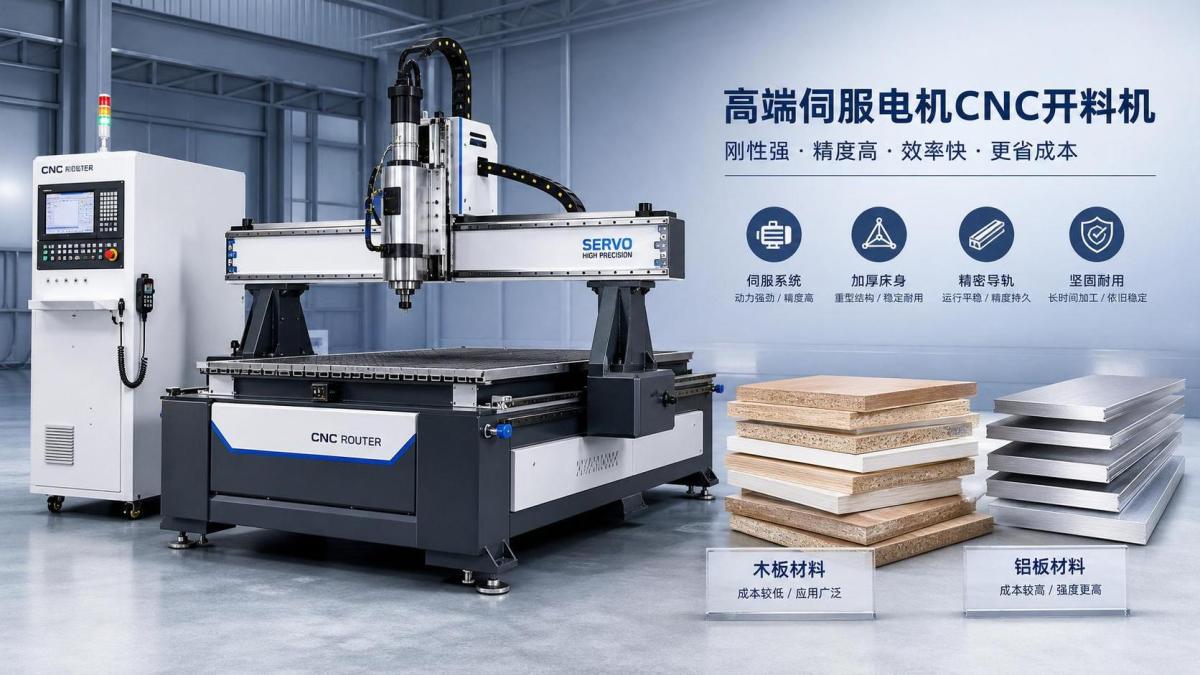
At first glance, many routers appear comparable. The frame size matches, the spindle rating looks familiar, and both suppliers promise precision.
The real difference in servo motor CNC router cost usually sits deeper. It comes from motion stability, structural rigidity, controller quality, and service risk over time.
That matters because a lower quote can hide weaker acceleration control, poorer interpolation, or inconsistent cutting repeatability under load.
In practical buying reviews, the machine is not only a capital item. It is also a throughput tool, a maintenance burden, and a quality-control variable.
This is where TSV’s engineering-first view is useful. The right comparison starts with measurable parameters, not promotional wording.
For servo-driven routers, that means asking how the machine behaves in continuous production, not how it performs in a short showroom demo.
A machine that holds path accuracy at high feed rates often costs more for valid reasons. A machine with decorative options often costs more for weak reasons.
So the useful question is not simply, “What is the price?” It is, “Which specifications actually change output, scrap rate, and downtime?”
Which specifications raise servo motor CNC router cost for good reasons?
Several upgrades push servo motor CNC router cost upward because they improve measurable production performance.
The first is the servo package itself. Not all servo systems deliver the same torque curve, encoder resolution, overload capacity, or tuning stability.
Higher-grade servo motors and drives usually improve contour accuracy, acceleration response, and recovery from load variation during dense toolpaths.
The second cost driver is frame construction. A heavier, stress-relieved bed and stronger gantry reduce vibration and help preserve dimensional consistency.
That becomes more important when cutting aluminum, composites, hardwood panels, or thicker sheet materials at aggressive cycle times.
The third is spindle quality. A reliable spindle with proper bearings, cooling design, and stable power delivery costs more, but it usually protects uptime.
Controller capability also matters. Better controllers handle smoother interpolation, smarter motion planning, and cleaner integration with nesting or production software.
Linear guides, ball screws, rack quality, lubrication systems, and electrical cabinet standards also affect total equipment value.
When comparing offers, a short judgment table helps separate real value from cosmetic inflation.
Where do buyers often overpay on a servo motor CNC router?
Not every upgrade improves return. Some additions increase servo motor CNC router cost without changing throughput or part quality in a meaningful way.
One common example is oversized spindle power. If the application is mostly wood, plastics, foam, or light composite trimming, extra spindle capacity may sit unused.
Another is chasing extreme speed specifications. A higher rapid traverse figure looks impressive, but cutting quality depends more on stable loaded motion than empty travel speed.
Some optional automation packages also deserve scrutiny. Tool changers, loading systems, and vacuum zoning can be excellent, but only if utilization justifies them.
A machine can also be dressed with touchscreen interfaces, enclosure styling, or expanded software features that add comfort yet contribute little to core output.
The better approach is to match the router to the material mix, shift pattern, geometry complexity, and acceptable tolerance band.
TSV often frames this as a filtering exercise. Strip away claims that are not backed by production data, maintenance records, or application-specific samples.
If a supplier cannot connect an upgrade to cycle time, scrap reduction, or lower intervention frequency, the premium may not be justified.
Typical areas where cost inflation appears
- Spindle power far above real material demand
- Headline speed upgrades without loaded-cut data
- Premium software modules with low daily use
- Cosmetic enclosure changes presented as performance improvements
- Imported subcomponents without clear service advantage
How should servo motor CNC router cost be judged beyond the purchase quote?
The quoted machine price is only one layer. The more reliable view is total operating cost across output, maintenance, downtime, and qualification effort.
A lower initial quote can become expensive when spare parts are slow, servo tuning support is weak, or controller faults require repeated remote troubleshooting.
Electric power use, spindle service intervals, vacuum system demands, and operator learning time also affect the business case.
For tighter production environments, documentation quality matters more than many expect. Clear wiring diagrams, parameter backups, and maintenance schedules reduce recovery time.
This is especially relevant in global supply chains where qualification cycles are expensive. In TSV’s framework, traceability and measurable service response are part of cost.
Instead of focusing on one price line, compare the offers through a broader decision lens.
What is the smartest place to save without hurting performance?
The best savings usually come from narrowing specification drift, not from cutting essential motion components.
In many projects, the safe place to save is table size. Oversized working areas raise frame cost, floor-space burden, and vacuum demand.
Savings can also come from choosing the right spindle range rather than the largest available option. Match power to actual material removal load.
Another realistic saving area is automation timing. It may be wiser to buy a router prepared for future upgrades than to install everything on day one.
Software licenses should follow workflow reality. If nesting complexity is moderate, an advanced package may not return its premium immediately.
However, it is usually unwise to save on servo drive quality, machine rigidity, electrical protection, or after-sales technical support.
Those areas influence the long tail of servo motor CNC router cost. They decide whether the machine remains productive after the first months.
A practical savings checklist
- Reduce unused work envelope before reducing core drive quality
- Specify spindle power from actual cut data, not future guesswork
- Delay optional automation until utilization is proven
- Request performance samples instead of feature-heavy brochures
- Confirm spare part lead time before signing off
Which questions should be answered before approving a supplier?
A strong decision usually depends on a short list of hard questions. These questions reveal whether the servo motor CNC router cost is defensible.
Ask for repeatability data under production feed rates, not only no-load positioning numbers. Ask for component lists down to servo, controller, rail, and spindle origin.
Request maintenance intervals, spare part stocking policy, and expected service response time for your region.
It is also worth checking whether the supplier can show application samples close to your material set and thickness range.
Where qualification standards are strict, ask for documentation discipline. Drawings, calibration records, alarm history methods, and parameter backups should be available.
That discipline aligns with the broader TSV principle: parameters do not lie, and tolerances determine whether a machine deserves trust.
Before closing a comparison, build a simple approval sheet based on performance evidence, service evidence, and cost evidence together.
Final takeaway: how do you control servo motor CNC router cost without losing confidence?
The cleanest way to control servo motor CNC router cost is to pay for stable motion, structural integrity, and support quality, then trim non-essential extras.
That keeps the comparison grounded in engineering truth rather than noise. It also makes supplier discussions faster and easier to defend internally.
A useful next step is to write a requirement sheet with five lines: material range, tolerance target, daily output, software compatibility, and acceptable downtime window.
Then compare each quote against those lines, not against marketing language. The result is a more accurate reading of servo motor CNC router cost and a safer procurement decision.
Search News
Hot Articles
- Carbon Fiber StructuresHow to Specify Aerospace Carbon Fiber Assemblies for Lightweight, Load-Bearing PartsJul 11, 2026
- Machine VisionXiaomi, Alibaba DAMO Academy Drive Open-Source Robotics Model Ecosystem, Lowering Algorithm Development Barriers for Overseas SMEs Adopting Chinese Robotics SolutionsMar 30, 2026
- Cobots & ArmsShanxi 'AI+' Conference Showcases Embodied Intelligence with Multinational Buyer Engagement: Key Industry ImplicationsMar 30, 2026
Popular Tags
Recommended News
 Jul 11, 2026How to Specify Aerospace Carbon Fiber Assemblies for Lightweight, Load-Bearing PartsAerospace carbon fiber assemblies: learn how to specify laminate design, load data, joining methods, and inspection controls for lighter, reliable load-bearing aerospace parts.Elena Rostova (UAV Systems Researcher)
 Mar 30, 2026Xiaomi, Alibaba DAMO Academy Drive Open-Source Robotics Model Ecosystem, Lowering Algorithm Development Barriers for Overseas SMEs Adopting Chinese Robotics SolutionsXiaomi & Alibaba DAMO Academy's open-source robotics models lower algorithm barriers for global SMEs. Boost efficiency in manufacturing, logistics & smart retail with ROS 2 compatible solutions.TSV Data Lab
 Mar 30, 2026Shanxi 'AI+' Conference Showcases Embodied Intelligence with Multinational Buyer Engagement: Key Industry ImplicationsShanxi 'AI+' Conference highlights embodied intelligence with Tesla, Ubtech & Jiantao showcasing multimodal robotics. 40+ global buyers validated tech on-site, creating new B2B channels for industrial automation & AI solutions.Chen Wei (Automation Lead Engineer)
 Mar 30, 2026Zhongguancun Unveils 6G Integrated Sensing-Computing-Intelligence Platform to Empower Embodied Robots for Global Industrial ApplicationsZhongguancun's new 6G platform revolutionizes industrial robotics with <10ms latency, empowering global automotive, logistics & port automation. Discover how this tech boosts China's smart manufacturing exports.TSV Data Lab
 Mar 30, 2026Mech-Mind Tianjin Embodied Intelligence R&D and Production Base Goes Live, Cutting Delivery Time by 20%–30% for Global Customized AMR+Vision SolutionsMech-Mind's Tianjin AMR+Vision production base cuts delivery time by 20%-30% for欧美 & Latin American markets. Discover how this PLd-certified facility accelerates customized robotics solutions for smart manufacturing and logistics.Chen Wei (Automation Lead Engineer)
 Mar 30, 2026Boao Forum Reveals 'Co-evolution of Big and Small Brains' Trend in Humanoid Robots, China's Embodied Intelligence Accelerates Adaptation to Overseas Manufacturing Service ScenariosDiscover how China's humanoid robots, featuring 'Co-evolution of Big and Small Brains,' are revolutionizing global manufacturing. Learn about Embodied Tian Gong 3.0's ISO compliance and overseas deployment at Boao Forum 2026.Chen Wei (Automation Lead Engineer)
 Mar 30, 2026China Railway Industrial Secures Patent for Embodied Robotics in Material Handling, Boosting High-Precision Delivery Capabilities for Overseas Infrastructure and Manufacturing ProjectsChina Railway Industrial's new patent for embodied robotics in material handling boosts high-precision delivery for global infrastructure & manufacturing. Discover how this innovation enhances logistics accuracy in automotive, rail transit & EPC projects.Chen Wei (Automation Lead Engineer)
 Sep 25, 2026How to Evaluate an Industrial Infrastructure Data Platform for Multi-Site OperationsIndustrial infrastructure data platform evaluation guide for multi-site operations: compare data quality, edge resilience, interoperability, governance, and scalable proof-of-value criteria.Victor Lin (Chief Software Architect)
 Sep 24, 2026How to Select Machine Vision Optics for Accurate Inspection at Different Working DistancesMachine vision optics selection guide for accurate inspection at every working distance. Compare FOV, pixel scale, DOF, distortion, lighting, and telecentric options.TSV Data Lab
 Sep 23, 2026How to Evaluate a Machine Vision System Integrator for High-Speed Inspection LinesChoose a machine vision system integrator with proven expertise in high-speed inspection, reliable reject timing, robust optics, and measurable acceptance criteria.TSV Data Lab
 Sep 25, 2026How a smart factory with Industrial IoT reduces production blind spotsDiscover how a smart factory with Industrial IoT turns real-time machine, quality, and workflow data into actionable insights that reduce production blind spots and delivery risks.Victor Lin (Chief Software Architect)
 Sep 24, 2026When does Industrial IoT make smart manufacturing easier to scale?Smart manufacturing Industrial IoT scales when trusted data, interoperable systems, and secure workflows turn connected assets into measurable gains.TSV Data Lab
 Sep 23, 2026What drives ultra-precision machining cost at 1-micron tolerance?Ultra precision machining cost per part at 1 micron tolerance depends on process, material, metrology, and yield. Learn how to compare quotes confidently.Dr. Marcus Vance
 Sep 22, 2026Drone Engine-T550CC Applications: Build the UAV Power System Around the MissionAn application guide for Drone Engine-T550CC integration, covering payload planning, airframe matching, cooling, fuel, vibration, test procedures, documentation, and service preparation.Elena Rostova (UAV Systems Researcher)
 Sep 22, 2026How to Evaluate Industrial Edge Computing Vendors for Factory DeploymentIndustrial edge computing vendor evaluation guide for factories: compare latency, protocol fit, reliability, security, and lifecycle support before deployment.TSV Data Lab
 Sep 21, 2026Drone Payload Integration: Matching Power, Data, and Center of Gravity for Reliable FlightsDrone payload integration made practical: balance power, data, center of gravity, and endurance to build safer, more reliable mission-ready flights.Elena Rostova (UAV Systems Researcher)
 Sep 20, 2026Autonomous Navigation Pricing: Cost Drivers and Budget Benchmarks for AMR ProjectsAutonomous navigation price explained: compare AMR cost drivers, software, sensors, integration, safety, and lifecycle budgets to build a scalable project plan.Chen Wei (Automation Lead Engineer)
 Sep 19, 2026How to Scope Automation Integration Services for Multi-System Factory ProjectsAutomation integration services: learn how to scope multi-system factory projects with clear workflows, interface contracts, safety boundaries, and acceptance criteria.Victor Lin (Chief Software Architect)
 Sep 18, 2026Selecting UAV Aerospace Structural Parts for Strength, Weight, and Fatigue LifeUAV aerospace structural parts guide: compare strength, weight, stiffness, fatigue life, joints, and traceability to select reliable flight-ready components.Elena Rostova (UAV Systems Researcher)
 Sep 17, 2026Selecting Commercial Drone Payloads for European Inspection ProjectsCommercial drone payloads Europe: learn how to select RGB, thermal and LiDAR systems for compliant, reliable inspection data and better project outcomes.Elena Rostova (UAV Systems Researcher)
 Sep 16, 2026Machining Tolerance Validation: How to Verify Critical Dimensions Before Production ReleaseMachining tolerance analysis validation: verify critical dimensions, measurement systems, process capability, and tolerance stacks before production release.Dr. Marcus Vance
 Sep 15, 2026AGV Tape Guidance vs Laser Navigation: Which Fits Your Warehouse Layout?AGV tape guidance comparison: discover how tape and laser navigation fit changing warehouse layouts, docking needs, floor conditions, maintenance, and route flexibility.Chen Wei (Automation Lead Engineer)
 Sep 14, 2026How Point Cloud Analytics Improves Asset Inspection Workflows Across GCC ProjectsPoint cloud analytics GCC helps project leaders improve asset inspections with accurate change detection, safer workflows, and faster maintenance decisions.TSV Data Lab
 Sep 13, 2026How Aerospace Manufacturers Can Build a Digital Thread From Design to Certified ProductionDigital manufacturing for aerospace: learn how to build a traceable digital thread from design through certified production, supplier control, and audit-ready compliance.Victor Lin (Chief Software Architect)