Can a trampoline park business stay profitable year-round?
Publication Date
author
Can a trampoline park business stay profitable year-round? For business evaluators, the answer depends less on seasonal hype and more on measurable drivers such as utilization rates, pricing strategy, operating costs, customer retention, and revenue diversification. This introduction examines how a trampoline park business can balance risk and cash flow across peak and off-peak periods, providing a practical lens for assessing long-term commercial viability.
For decision-makers working in a data-led B2B environment, the key issue is not whether demand exists, but whether the trampoline park business can maintain stable throughput, defend margins, and convert foot traffic into recurring revenue over 12 months. A rigorous evaluation should look beyond school holidays and weekend spikes, and instead focus on utilization benchmarks, cost structure, local catchment dynamics, safety governance, and secondary revenue streams.
This matters especially for business evaluators who prefer engineering-style clarity over marketing claims. In practical terms, a year-round profitable operation is usually built on 4 measurable pillars: occupancy discipline, diversified monetization, controlled fixed costs, and repeatable customer acquisition. When these variables are tracked monthly rather than emotionally, the profitability profile becomes easier to forecast and compare.
What determines year-round profitability in a trampoline park business
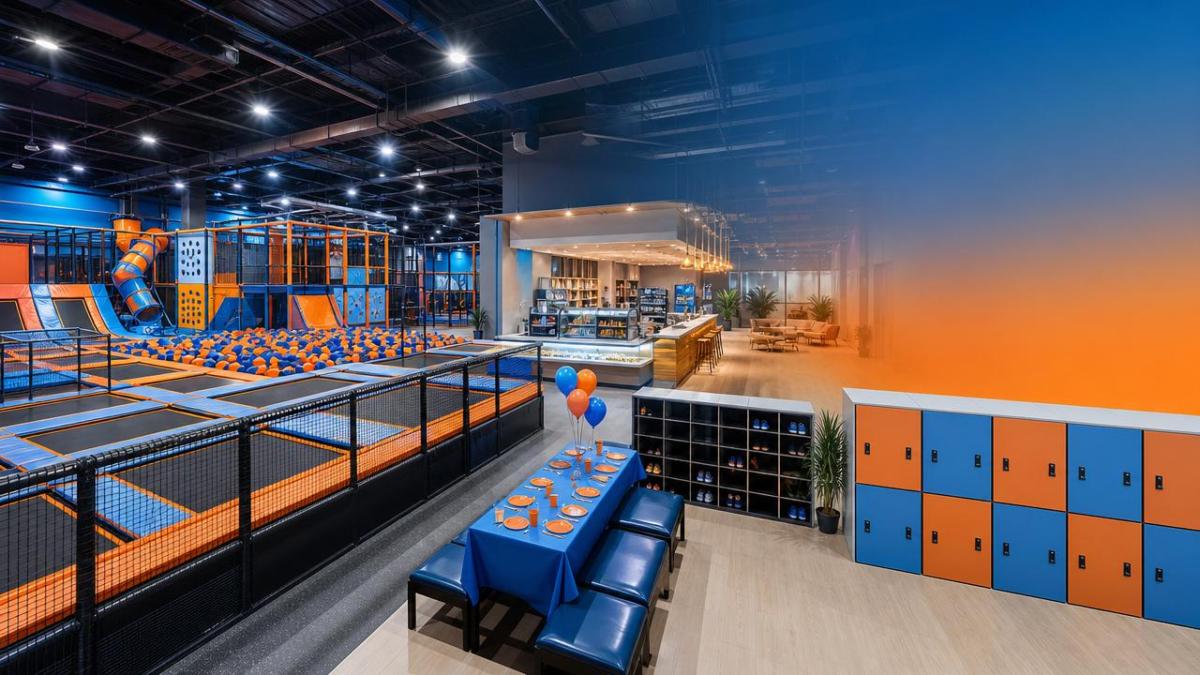
A trampoline park business is typically exposed to demand volatility. Peak periods often include weekends, public holidays, and school breaks, while weekday mornings and certain off-season months may operate at 20% to 40% lower traffic. The core question is whether the business model can recover fixed costs during slower periods without relying on unsustainable discounting.
From an evaluation standpoint, profitability should be assessed through contribution margin per visitor, average revenue per party booking, labor cost ratio, and the percentage of non-jump revenue. A healthy site does not depend on one customer type. It blends open jump sessions, birthday events, school programs, fitness classes, team-building packages, and food-and-beverage sales into a more resilient revenue mix.
Key operating metrics evaluators should review
For most sites, 5 to 7 metrics provide a reliable first-pass commercial screen. These include average daily attendance, utilization by time block, labor as a percentage of revenue, insurance and maintenance burden, repeat visit rate, and average spend per guest. A site may show strong top-line revenue but still underperform if staffing and promotional costs erode margin.
- Target utilization during prime hours: often 60% to 80%
- Off-peak utilization threshold worth monitoring: below 25% may signal underused capacity
- Labor cost ratio: commonly reviewed in the 18% to 30% range depending on format
- Non-ticket revenue contribution: many evaluators look for 15% to 35%
- Repeat customer share: a stronger model often exceeds 30% of monthly visits
Why seasonality alone is a weak predictor
Seasonality affects traffic, but it does not automatically determine annual profit. Indoor leisure businesses can offset weather and calendar swings through pricing controls, programmed events, and institutional contracts. For example, weekday school partnerships or youth club bookings can fill low-demand slots that casual consumers rarely use. That type of demand smoothing has a larger impact on annual cash flow than a single holiday surge.
The table below gives business evaluators a practical framework for judging whether a trampoline park business is built for year-round resilience or just short-term volume.
The main takeaway is simple: a profitable trampoline park business rarely depends on volume alone. The more balanced the revenue stack and the more disciplined the cost model, the better the odds of maintaining margin in both peak and off-peak months.
Revenue diversification is the main defense against off-season weakness
If evaluators want one variable that most influences year-round outcomes, it is revenue diversification. A trampoline park business with only general admission income can struggle when traffic dips 15% to 25%. By contrast, a site with 5 or 6 recurring revenue channels can absorb slower weeks with less pricing pressure and lower cash-flow volatility.
High-value revenue streams beyond open jump
The strongest operators package capacity into use cases. Birthday parties usually carry higher average ticket values than standard sessions. Corporate events improve weekday monetization. Memberships support recurring billing. School and club programs create repeat bookings across term calendars. F&B, socks, arcade units, and premium attractions can lift spend per visit without requiring major floor expansion.
- Birthday and private events: often the highest margin booking type
- Membership plans: improve visibility on monthly revenue
- School visits and youth groups: useful for filling weekday slots between 10:00 and 15:00
- Fitness and toddler sessions: attract distinct demographic segments
- Corporate team-building: supports premium pricing on low-traffic days
Membership economics and retention value
A membership program only works when usage controls and cancellation policies are designed carefully. For example, a monthly plan should be tested against visit frequency, blackout rules, and booking priority. If average member usage exceeds pricing assumptions by 20% or more, the program can dilute margin. If structured well, however, recurring members raise customer lifetime value and stabilize demand during weaker months.
The table below shows how different revenue channels contribute differently to margin stability, booking predictability, and off-peak utilization.
For evaluators, the preferred model is not necessarily the one with the most channels, but the one with the best balance. If one stream exceeds 70% of total revenue, volatility risk increases. A broader mix usually improves forecasting accuracy and valuation confidence.
Cost structure, safety discipline, and utilization planning decide the margin outcome
A trampoline park business can appear successful from the front desk while losing efficiency in the back office. Rent, payroll, utilities, insurance, repairs, and safety compliance create a fixed-cost base that does not disappear when attendance softens. This is why annual profitability should be modeled at monthly intervals rather than as a single yearly average.
Fixed and variable costs that deserve close review
Business evaluators should separate costs into at least 3 categories: occupancy and lease obligations, staffing and training, and maintenance plus risk management. A site with high rent but weak secondary spend may need consistently high attendance just to break even. Likewise, a park that cuts maintenance to preserve short-term cash may increase downtime or liability exposure later.
- Lease and occupancy costs should be tested against monthly breakeven traffic.
- Staffing should be scheduled by demand blocks, not static rosters.
- Maintenance should follow a planned calendar, often weekly, monthly, and quarterly checks.
- Insurance and compliance documentation should be reviewed as recurring operating requirements, not exceptional costs.
Capacity planning is a financial control tool
Utilization planning is not just an operations issue. It is a margin lever. If a venue knows its practical operating capacity by hour, it can adjust staffing, launch targeted promotions for quiet windows, and limit deep discounting during high-demand sessions. Even a 10% improvement in off-peak occupancy can materially improve annual EBITDA in businesses with heavy fixed overhead.
Another critical factor is safety discipline. Unlike simple retail formats, a trampoline park business carries operational risk that can directly affect claims, closures, and brand trust. Strong inspection logs, staff training refresh cycles every 30 to 90 days, and rapid incident response processes support both operational continuity and commercial credibility.
How business evaluators should assess commercial viability before investment or partnership
Before endorsing a site, financing expansion, or approving a partnership, evaluators should apply a structured review model. The objective is to test whether current earnings are repeatable, whether demand is diversified, and whether capital requirements are manageable over the next 12 to 24 months.
A practical 6-point evaluation checklist
- Review 12 months of attendance by daypart, not just monthly totals.
- Measure revenue by channel, including parties, groups, memberships, and ancillary spend.
- Test breakeven occupancy under normal and weak-season assumptions.
- Inspect maintenance routines, incident procedures, and staff certification records.
- Analyze local competition within a 15 to 30 minute drive-time catchment.
- Examine rebooking, churn, and customer database quality for retention strength.
Common mistakes in evaluating a trampoline park business
One common mistake is overvaluing gross revenue during holiday peaks while ignoring weak weekday productivity. Another is assuming that high attendance always means strong profitability. In reality, low ticket yields, heavy discounting, and inefficient labor deployment can reduce profit even at respectable traffic levels. A third mistake is underestimating the effect of refresh capital, since wear-intensive attractions may require periodic reinvestment every few years.
Evaluators should also avoid relying solely on local popularity or social media engagement. A site may be visible online yet still lack retention mechanics, pricing discipline, or group sales structure. Commercial durability is better measured by repeat behavior, advance bookings, and net cash generation than by short-term buzz.
Where data-driven operators gain an advantage
Operators that think like performance-driven businesses usually outperform those that market only to casual visitors. The advantage comes from tracking conversion by channel, scheduling labor against forecast demand, and testing offers in defined 2-week to 4-week windows. This mirrors a more disciplined industrial mindset: parameters first, assumptions second. For business evaluators, that operating discipline is often a stronger signal than headline revenue alone.
A trampoline park business can stay profitable year-round, but only when the model is engineered for recurring use, flexible monetization, and controlled risk. The strongest operations combine balanced revenue channels, measurable utilization targets, disciplined maintenance, and retention systems that reduce dependence on seasonal spikes. For business evaluators, that makes the opportunity easier to forecast, compare, and scale with confidence.
If you need a more structured commercial assessment framework for indoor leisure or attraction-based ventures, TechStat Vanguard can help you evaluate operational variables with a clearer, data-first lens. Contact us to discuss a tailored review model, obtain a custom benchmarking framework, or learn more solutions for evidence-based business evaluation.
Search News
Hot Articles
- Carbon Fiber StructuresHow to Specify Aerospace Carbon Fiber Assemblies for Lightweight, Load-Bearing PartsJul 11, 2026
- Machine VisionXiaomi, Alibaba DAMO Academy Drive Open-Source Robotics Model Ecosystem, Lowering Algorithm Development Barriers for Overseas SMEs Adopting Chinese Robotics SolutionsMar 30, 2026
- Cobots & ArmsShanxi 'AI+' Conference Showcases Embodied Intelligence with Multinational Buyer Engagement: Key Industry ImplicationsMar 30, 2026
Popular Tags
Recommended News
 Jul 11, 2026How to Specify Aerospace Carbon Fiber Assemblies for Lightweight, Load-Bearing PartsAerospace carbon fiber assemblies: learn how to specify laminate design, load data, joining methods, and inspection controls for lighter, reliable load-bearing aerospace parts.Elena Rostova (UAV Systems Researcher)
 Mar 30, 2026Xiaomi, Alibaba DAMO Academy Drive Open-Source Robotics Model Ecosystem, Lowering Algorithm Development Barriers for Overseas SMEs Adopting Chinese Robotics SolutionsXiaomi & Alibaba DAMO Academy's open-source robotics models lower algorithm barriers for global SMEs. Boost efficiency in manufacturing, logistics & smart retail with ROS 2 compatible solutions.TSV Data Lab
 Mar 30, 2026Shanxi 'AI+' Conference Showcases Embodied Intelligence with Multinational Buyer Engagement: Key Industry ImplicationsShanxi 'AI+' Conference highlights embodied intelligence with Tesla, Ubtech & Jiantao showcasing multimodal robotics. 40+ global buyers validated tech on-site, creating new B2B channels for industrial automation & AI solutions.Chen Wei (Automation Lead Engineer)
 Mar 30, 2026Zhongguancun Unveils 6G Integrated Sensing-Computing-Intelligence Platform to Empower Embodied Robots for Global Industrial ApplicationsZhongguancun's new 6G platform revolutionizes industrial robotics with <10ms latency, empowering global automotive, logistics & port automation. Discover how this tech boosts China's smart manufacturing exports.TSV Data Lab
 Mar 30, 2026Mech-Mind Tianjin Embodied Intelligence R&D and Production Base Goes Live, Cutting Delivery Time by 20%–30% for Global Customized AMR+Vision SolutionsMech-Mind's Tianjin AMR+Vision production base cuts delivery time by 20%-30% for欧美 & Latin American markets. Discover how this PLd-certified facility accelerates customized robotics solutions for smart manufacturing and logistics.Chen Wei (Automation Lead Engineer)
 Mar 30, 2026Boao Forum Reveals 'Co-evolution of Big and Small Brains' Trend in Humanoid Robots, China's Embodied Intelligence Accelerates Adaptation to Overseas Manufacturing Service ScenariosDiscover how China's humanoid robots, featuring 'Co-evolution of Big and Small Brains,' are revolutionizing global manufacturing. Learn about Embodied Tian Gong 3.0's ISO compliance and overseas deployment at Boao Forum 2026.Chen Wei (Automation Lead Engineer)
 Mar 30, 2026China Railway Industrial Secures Patent for Embodied Robotics in Material Handling, Boosting High-Precision Delivery Capabilities for Overseas Infrastructure and Manufacturing ProjectsChina Railway Industrial's new patent for embodied robotics in material handling boosts high-precision delivery for global infrastructure & manufacturing. Discover how this innovation enhances logistics accuracy in automotive, rail transit & EPC projects.Chen Wei (Automation Lead Engineer)
 Sep 28, 2026Spindle Runout Measurement in Germany: DIN Standards, Methods, and Acceptance LimitsSpindle runout measurement Germany: explore DIN standards, proven methods, acceptance limits, and audit-ready practices for reliable machining quality.Dr. Marcus Vance
 Sep 27, 2026How to Select Wall-Mount Edge Devices for Space-Constrained Factory NetworksWall mount edge devices for space-constrained factories: evaluate workload, thermal design, power resilience, cable access, and network reliability for smarter deployments.TSV Data Lab
 Sep 26, 2026Machining Tolerance Analysis: How to Set Limits That Meet Function and Cost TargetsMachining tolerance analysis: learn how to set functional limits, control tolerance stacks, reduce inspection risk, and balance precision with production cost.Dr. Marcus Vance
 Sep 25, 2026How to Evaluate an Industrial Infrastructure Data Platform for Multi-Site OperationsIndustrial infrastructure data platform evaluation guide for multi-site operations: compare data quality, edge resilience, interoperability, governance, and scalable proof-of-value criteria.Victor Lin (Chief Software Architect)
 Sep 24, 2026How to Select Machine Vision Optics for Accurate Inspection at Different Working DistancesMachine vision optics selection guide for accurate inspection at every working distance. Compare FOV, pixel scale, DOF, distortion, lighting, and telecentric options.TSV Data Lab
 Sep 23, 2026How to Evaluate a Machine Vision System Integrator for High-Speed Inspection LinesChoose a machine vision system integrator with proven expertise in high-speed inspection, reliable reject timing, robust optics, and measurable acceptance criteria.TSV Data Lab
 Sep 28, 2026When is a SCADA API the right choice for connecting plant systems?SCADA API guide: learn when governed plant data integration improves traceability, security, and scalability—without compromising real-time control.Victor Lin (Chief Software Architect)
 Sep 27, 2026How SCADA data integration improves traceability across production linesSCADA data integration connects production-line data to improve traceability, accelerate quality investigations, and strengthen safety decisions.Victor Lin (Chief Software Architect)
 Sep 26, 2026What to define before starting SCADA integration planningSCADA integration planning starts with clear scope, control boundaries, data models, cybersecurity, and testing. Discover the definitions that reduce risk and costly rework.Victor Lin (Chief Software Architect)
 Sep 25, 2026How a smart factory with Industrial IoT reduces production blind spotsDiscover how a smart factory with Industrial IoT turns real-time machine, quality, and workflow data into actionable insights that reduce production blind spots and delivery risks.Victor Lin (Chief Software Architect)
 Sep 24, 2026When does Industrial IoT make smart manufacturing easier to scale?Smart manufacturing Industrial IoT scales when trusted data, interoperable systems, and secure workflows turn connected assets into measurable gains.TSV Data Lab
 Sep 23, 2026What drives ultra-precision machining cost at 1-micron tolerance?Ultra precision machining cost per part at 1 micron tolerance depends on process, material, metrology, and yield. Learn how to compare quotes confidently.Dr. Marcus Vance
 Sep 22, 2026Drone Engine-T550CC Applications: Build the UAV Power System Around the MissionAn application guide for Drone Engine-T550CC integration, covering payload planning, airframe matching, cooling, fuel, vibration, test procedures, documentation, and service preparation.Elena Rostova (UAV Systems Researcher)
 Sep 22, 2026How to Evaluate Industrial Edge Computing Vendors for Factory DeploymentIndustrial edge computing vendor evaluation guide for factories: compare latency, protocol fit, reliability, security, and lifecycle support before deployment.TSV Data Lab
 Sep 21, 2026Drone Payload Integration: Matching Power, Data, and Center of Gravity for Reliable FlightsDrone payload integration made practical: balance power, data, center of gravity, and endurance to build safer, more reliable mission-ready flights.Elena Rostova (UAV Systems Researcher)
 Sep 20, 2026Autonomous Navigation Pricing: Cost Drivers and Budget Benchmarks for AMR ProjectsAutonomous navigation price explained: compare AMR cost drivers, software, sensors, integration, safety, and lifecycle budgets to build a scalable project plan.Chen Wei (Automation Lead Engineer)
 Sep 19, 2026How to Scope Automation Integration Services for Multi-System Factory ProjectsAutomation integration services: learn how to scope multi-system factory projects with clear workflows, interface contracts, safety boundaries, and acceptance criteria.Victor Lin (Chief Software Architect)