Agricultural Drone for Crop Spraying and Drift Control Limits
Publication Date
author
Choosing the right agricultural drone for crop spraying is no longer just about coverage speed—it is about drift control, application accuracy, and field-safe performance. As regulations tighten and growers demand measurable results, understanding spray stability, droplet behavior, and operational limits becomes essential before making any buying decision.
For growers, farm managers, and procurement teams evaluating an agricultural drone for crop spraying, the real question is not simply how many hectares can be treated per hour. The better question is how consistently the aircraft can place droplets on target while limiting off-target movement under real field conditions such as variable wind, uneven canopy height, and changing tank load.
This matters because drift is not a minor technical detail. A 2 m/s to 4 m/s crosswind, an overly fine droplet spectrum, or poor nozzle selection can reduce deposition efficiency, increase chemical waste, and create compliance risks near roads, waterways, or neighboring crops. In practical terms, an agricultural drone for crop spraying should be judged as a precision application system, not only as a flying platform.
From the TechStat Vanguard perspective, buyers should filter out generic claims and focus on measurable engineering criteria: flow rate stability, flight speed control, spray swath consistency, pump response time, altitude hold accuracy, and drift mitigation features that remain effective across different field scenarios. Those parameters determine whether a drone performs safely in a 20-hectare orchard, a rice field with standing water, or a vegetable block near a buffer zone.
What Drift Control Really Means in Agricultural Drone Spraying
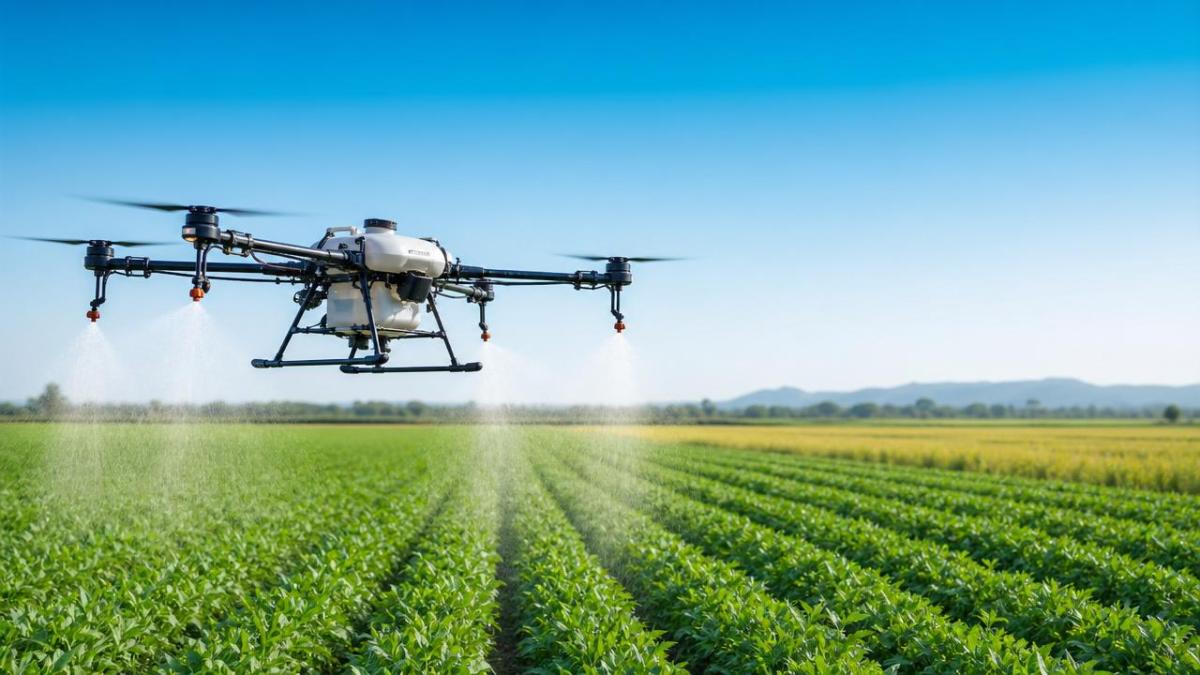
When buyers search for an agricultural drone for crop spraying, drift control is often described too broadly. In operational terms, drift control is the ability to keep droplets within the intended treatment zone during release, transport, and canopy interception. It depends on 4 interacting factors: droplet size, rotor downwash, flight height, and wind conditions.
A drone may look powerful on paper, but if it flies too high above the canopy or uses a nozzle configuration that generates excessive fine droplets below 150 microns, the risk of drift increases sharply. On the other hand, flying too low can create canopy disturbance, uneven deposition, and safety concerns over irregular terrain. In most field operations, maintaining a spraying height of roughly 1.5 m to 3 m above the crop canopy is a common working range, though the exact value depends on crop type and rotor configuration.
Key Variables That Affect Off-Target Movement
Drift control is rarely the result of one premium component. It is the result of system balance. A well-configured agricultural drone for crop spraying typically combines stable GNSS positioning, responsive terrain following, adjustable flow control, and a nozzle setup matched to spray volume and formulation. If one element is weak, the entire application profile becomes less predictable.
- Wind speed: many operators treat 3 m/s as a caution point and 5 m/s as a strong limit for routine spraying.
- Droplet size: medium to coarse droplets usually drift less than very fine droplets, but may alter coverage on dense leaf surfaces.
- Flight speed: common working speeds of 4 m/s to 7 m/s can affect deposition pattern and swath overlap.
- Nozzle and pump matching: poor matching creates unstable flow, especially during acceleration or turning.
- Canopy structure: tall orchards and dense row crops require different airflow and penetration strategies than broadacre crops.
Why Rotor Downwash Is Both an Advantage and a Risk
Rotor downwash can improve canopy penetration by pushing droplets downward, which is one reason drones are attractive for targeted applications. However, the same airflow can also create turbulence at field edges or around irregular plant structures. Buyers should therefore ask not only about payload size, but about how the aircraft maintains stable spray behavior at different tank fill levels, especially between 100% full load and the final 20% of a spraying mission.
The table below shows how typical operational variables influence drift risk and application quality when selecting an agricultural drone for crop spraying.
The practical takeaway is clear: drift control is not a marketing add-on. It is the outcome of controlled airflow, spray physics, and software logic working together. If a supplier cannot explain how the aircraft manages those variables, the buyer is being asked to accept uncertainty where precision should exist.
How to Evaluate an Agricultural Drone for Crop Spraying Before Purchase
A well-informed purchase process should compare more than tank capacity or battery endurance. For end users and procurement decision-makers, the most reliable evaluation framework includes at least 6 checkpoints: payload-to-swath balance, application rate flexibility, spray system stability, field mapping integration, safety redundancy, and after-sales support response time.
1. Payload Size Must Match Field Reality
Larger payloads can improve productivity, but only if the farm layout supports efficient turns, battery swaps, and refill logistics. In small or fragmented plots, a 30 L to 40 L system may not always outperform a lighter platform if setup time, access paths, and terrain interruptions reduce hourly productivity. Buyers should estimate full-cycle performance, not just nominal tank volume.
2. Application Rate Flexibility Matters More Than Peak Capacity
Different crops require different spray volumes. Broadacre cereals may run at lower volumes, while orchard and specialty crop applications often demand more precise targeting and canopy penetration. A practical agricultural drone for crop spraying should support adjustable output across multiple rates, such as 10 L/ha to 40 L/ha or more, without large swings in droplet quality or line pressure.
3. Look for Stable Control Under Dynamic Conditions
Spraying is not a laboratory test. Tank weight drops minute by minute, battery voltage changes during flight, and terrain can shift across a single mission. Reliable buyers ask whether the aircraft maintains target flow rate during acceleration, deceleration, and headland turns. Even a 5% to 10% application error over repeated passes can translate into under-treatment, rework, or wasted product.
Recommended Buyer Questions
- What is the practical spray height range above canopy in routine field use?
- How does the system compensate for speed changes during turns and slope transitions?
- Which nozzle types are supported, and how quickly can they be changed between crops?
- What wind threshold triggers operator warning or automatic mission pause?
- How long does a typical battery cycle last under spraying load: 8 minutes, 12 minutes, or more?
- What is the response time for local service, spare parts, and pump replacement?
The following comparison matrix helps buyers separate headline specifications from real operational value.
A strong buying decision usually comes from testing the drone as a complete spraying workflow. If demo conditions ignore refill time, route planning, weather response, or maintenance access, the buyer may overestimate daily field output by 15% to 30%.
Operational Limits, Compliance, and Field Safety
Every agricultural drone for crop spraying operates within limits, and those limits are critical to safe deployment. The most important restrictions are usually environmental, operational, and procedural rather than purely mechanical. Wind, temperature, humidity, buffer requirements, and pilot discipline all influence whether a spraying mission should proceed.
Environmental Limits Buyers Should Respect
Many field teams use a simple go/no-go rule set before takeoff. If gusts are unstable, if temperature inversion conditions are suspected, or if adjacent areas include sensitive crops, schools, or open water, spraying may need to be delayed. In some practical farm programs, early morning and late afternoon offer better drift conditions than midday, but only if humidity, dew, and visibility remain acceptable.
- Wind: routine caution often starts above 3 m/s; higher gusts require stricter judgment.
- Temperature: hotter conditions can increase evaporation and reduce droplet mass.
- Humidity: very low humidity may accelerate droplet shrinkage before canopy contact.
- Buffer zones: treatment near roads, residences, or waterways should follow local restrictions.
Pilot Workflow and Safety Redundancy
Even advanced automation does not remove the need for a disciplined workflow. A safe operation typically includes 5 core steps: site check, weather verification, route planning, system calibration, and post-flight rinse plus inspection. Skipping one step can compromise both spray quality and equipment life.
Buyers should also look for redundancy features such as low-battery return logic, obstacle sensing, geofencing, and fail-safe landing protocols. These do not eliminate risk, but they reduce the chance that a controllable error escalates into equipment damage or chemical exposure.
Common Buying Mistakes
One common mistake is assuming that higher payload automatically means better economics. Another is selecting a system based on flight time in empty-load conditions rather than loaded spraying duty. A third is underestimating support needs during a 2-week to 6-week peak application season, when spare pumps, batteries, and charging logistics directly affect uptime.
Best-Fit Scenarios, Maintenance, and Long-Term Value
An agricultural drone for crop spraying delivers the best value when its design matches the crop system and the operator’s management model. Broadacre farms often prioritize area coverage and route efficiency. Orchards may prioritize canopy penetration and maneuverability. Vegetable and specialty crop growers often place greater weight on application precision near sensitive boundaries.
Where Drones Usually Add the Most Value
Drones often show strong operational value in 3 situations: fields with wet or fragile ground where wheeled access is limited, plots with irregular geometry that reduce ground sprayer efficiency, and high-value crops where precision placement matters more than maximum daily area. In these cases, reduced crop trampling and faster re-entry planning can justify the investment beyond simple labor comparison.
Maintenance Discipline Protects Performance
Routine maintenance is not optional. Nozzles, filters, hoses, pumps, and battery connectors should be checked after each working session, while deeper inspections may be scheduled every 25 to 50 flight hours depending on use intensity and chemical exposure. Poor cleaning discipline can change flow behavior long before a failure becomes visible in flight logs.
For buyers comparing suppliers, service structure often determines long-term ownership value. Ask whether training includes calibration, seasonal storage, and troubleshooting for inconsistent spray pattern. A strong supplier should be able to support not just delivery, but stable use over 1 season, 3 seasons, and beyond.
What Informed Buyers Should Prioritize
If the goal is reliable field performance, prioritize a balanced specification over headline numbers. The best agricultural drone for crop spraying is usually the one that combines repeatable deposition, manageable maintenance, practical refill logistics, and clear operating limits. In procurement terms, a stable 8 out of 10 across all major categories is often more valuable than a system that excels in 2 categories and underperforms in 3 others.
Quick Decision Checklist
- Match payload and swath to actual field size and crop structure.
- Verify drift control under 3 m/s to 5 m/s working conditions, not just calm-air demos.
- Confirm adjustable application rates and nozzle compatibility.
- Review total work cycle, including refill and battery change time.
- Check service lead time for wear parts during peak spray periods.
- Request operational guidance for buffers, weather limits, and daily maintenance.
For decision-makers who want measurable value rather than broad sales claims, the right agricultural drone for crop spraying should be assessed through drift control capability, application stability, field safety logic, and support readiness. Those are the factors that convert a drone from a promising tool into a dependable part of farm operations.
TechStat Vanguard advocates a parameter-first approach: compare the thresholds that matter, test under realistic conditions, and choose systems that disclose operating limits clearly. If you are evaluating options for a new purchase or an upgrade, now is the time to consult product details, request a field-relevant configuration review, and get a tailored spraying solution aligned with your crop, terrain, and compliance needs.
Search News
Hot Articles
- Carbon Fiber StructuresHow to Specify Aerospace Carbon Fiber Assemblies for Lightweight, Load-Bearing PartsJul 11, 2026
- Machine VisionXiaomi, Alibaba DAMO Academy Drive Open-Source Robotics Model Ecosystem, Lowering Algorithm Development Barriers for Overseas SMEs Adopting Chinese Robotics SolutionsMar 30, 2026
- Cobots & ArmsShanxi 'AI+' Conference Showcases Embodied Intelligence with Multinational Buyer Engagement: Key Industry ImplicationsMar 30, 2026
Popular Tags
Recommended News
 Jul 11, 2026How to Specify Aerospace Carbon Fiber Assemblies for Lightweight, Load-Bearing PartsAerospace carbon fiber assemblies: learn how to specify laminate design, load data, joining methods, and inspection controls for lighter, reliable load-bearing aerospace parts.Elena Rostova (UAV Systems Researcher)
 Mar 30, 2026Xiaomi, Alibaba DAMO Academy Drive Open-Source Robotics Model Ecosystem, Lowering Algorithm Development Barriers for Overseas SMEs Adopting Chinese Robotics SolutionsXiaomi & Alibaba DAMO Academy's open-source robotics models lower algorithm barriers for global SMEs. Boost efficiency in manufacturing, logistics & smart retail with ROS 2 compatible solutions.TSV Data Lab
 Mar 30, 2026Shanxi 'AI+' Conference Showcases Embodied Intelligence with Multinational Buyer Engagement: Key Industry ImplicationsShanxi 'AI+' Conference highlights embodied intelligence with Tesla, Ubtech & Jiantao showcasing multimodal robotics. 40+ global buyers validated tech on-site, creating new B2B channels for industrial automation & AI solutions.Chen Wei (Automation Lead Engineer)
 Mar 30, 2026Zhongguancun Unveils 6G Integrated Sensing-Computing-Intelligence Platform to Empower Embodied Robots for Global Industrial ApplicationsZhongguancun's new 6G platform revolutionizes industrial robotics with <10ms latency, empowering global automotive, logistics & port automation. Discover how this tech boosts China's smart manufacturing exports.TSV Data Lab
 Mar 30, 2026Mech-Mind Tianjin Embodied Intelligence R&D and Production Base Goes Live, Cutting Delivery Time by 20%–30% for Global Customized AMR+Vision SolutionsMech-Mind's Tianjin AMR+Vision production base cuts delivery time by 20%-30% for欧美 & Latin American markets. Discover how this PLd-certified facility accelerates customized robotics solutions for smart manufacturing and logistics.Chen Wei (Automation Lead Engineer)
 Mar 30, 2026Boao Forum Reveals 'Co-evolution of Big and Small Brains' Trend in Humanoid Robots, China's Embodied Intelligence Accelerates Adaptation to Overseas Manufacturing Service ScenariosDiscover how China's humanoid robots, featuring 'Co-evolution of Big and Small Brains,' are revolutionizing global manufacturing. Learn about Embodied Tian Gong 3.0's ISO compliance and overseas deployment at Boao Forum 2026.Chen Wei (Automation Lead Engineer)
 Mar 30, 2026China Railway Industrial Secures Patent for Embodied Robotics in Material Handling, Boosting High-Precision Delivery Capabilities for Overseas Infrastructure and Manufacturing ProjectsChina Railway Industrial's new patent for embodied robotics in material handling boosts high-precision delivery for global infrastructure & manufacturing. Discover how this innovation enhances logistics accuracy in automotive, rail transit & EPC projects.Chen Wei (Automation Lead Engineer)
 Sep 29, 2026ISO 9283 Repeatability: How to Evaluate Cobot Positioning PerformanceISO 9283 cobot repeatability explained: learn how payload, reach, approach direction, and test conditions affect positioning performance and cell capability.Chen Wei (Automation Lead Engineer)
 Sep 28, 2026Spindle Runout Measurement in Germany: DIN Standards, Methods, and Acceptance LimitsSpindle runout measurement Germany: explore DIN standards, proven methods, acceptance limits, and audit-ready practices for reliable machining quality.Dr. Marcus Vance
 Sep 27, 2026How to Select Wall-Mount Edge Devices for Space-Constrained Factory NetworksWall mount edge devices for space-constrained factories: evaluate workload, thermal design, power resilience, cable access, and network reliability for smarter deployments.TSV Data Lab
 Sep 26, 2026Machining Tolerance Analysis: How to Set Limits That Meet Function and Cost TargetsMachining tolerance analysis: learn how to set functional limits, control tolerance stacks, reduce inspection risk, and balance precision with production cost.Dr. Marcus Vance
 Sep 25, 2026How to Evaluate an Industrial Infrastructure Data Platform for Multi-Site OperationsIndustrial infrastructure data platform evaluation guide for multi-site operations: compare data quality, edge resilience, interoperability, governance, and scalable proof-of-value criteria.Victor Lin (Chief Software Architect)
 Sep 24, 2026How to Select Machine Vision Optics for Accurate Inspection at Different Working DistancesMachine vision optics selection guide for accurate inspection at every working distance. Compare FOV, pixel scale, DOF, distortion, lighting, and telecentric options.TSV Data Lab
 Sep 23, 2026How to Evaluate a Machine Vision System Integrator for High-Speed Inspection LinesChoose a machine vision system integrator with proven expertise in high-speed inspection, reliable reject timing, robust optics, and measurable acceptance criteria.TSV Data Lab
 Sep 28, 2026When is a SCADA API the right choice for connecting plant systems?SCADA API guide: learn when governed plant data integration improves traceability, security, and scalability—without compromising real-time control.Victor Lin (Chief Software Architect)
 Sep 27, 2026How SCADA data integration improves traceability across production linesSCADA data integration connects production-line data to improve traceability, accelerate quality investigations, and strengthen safety decisions.Victor Lin (Chief Software Architect)
 Sep 26, 2026What to define before starting SCADA integration planningSCADA integration planning starts with clear scope, control boundaries, data models, cybersecurity, and testing. Discover the definitions that reduce risk and costly rework.Victor Lin (Chief Software Architect)
 Sep 25, 2026How a smart factory with Industrial IoT reduces production blind spotsDiscover how a smart factory with Industrial IoT turns real-time machine, quality, and workflow data into actionable insights that reduce production blind spots and delivery risks.Victor Lin (Chief Software Architect)
 Sep 24, 2026When does Industrial IoT make smart manufacturing easier to scale?Smart manufacturing Industrial IoT scales when trusted data, interoperable systems, and secure workflows turn connected assets into measurable gains.TSV Data Lab
 Sep 23, 2026What drives ultra-precision machining cost at 1-micron tolerance?Ultra precision machining cost per part at 1 micron tolerance depends on process, material, metrology, and yield. Learn how to compare quotes confidently.Dr. Marcus Vance
 Sep 22, 2026Drone Engine-T550CC Applications: Build the UAV Power System Around the MissionAn application guide for Drone Engine-T550CC integration, covering payload planning, airframe matching, cooling, fuel, vibration, test procedures, documentation, and service preparation.Elena Rostova (UAV Systems Researcher)
 Sep 22, 2026How to Evaluate Industrial Edge Computing Vendors for Factory DeploymentIndustrial edge computing vendor evaluation guide for factories: compare latency, protocol fit, reliability, security, and lifecycle support before deployment.TSV Data Lab
 Sep 21, 2026Drone Payload Integration: Matching Power, Data, and Center of Gravity for Reliable FlightsDrone payload integration made practical: balance power, data, center of gravity, and endurance to build safer, more reliable mission-ready flights.Elena Rostova (UAV Systems Researcher)
 Sep 20, 2026Autonomous Navigation Pricing: Cost Drivers and Budget Benchmarks for AMR ProjectsAutonomous navigation price explained: compare AMR cost drivers, software, sensors, integration, safety, and lifecycle budgets to build a scalable project plan.Chen Wei (Automation Lead Engineer)