
What buyers miss in carbon fiber drone frame wholesale
Publication Date
author
In carbon fiber drone frame wholesale, the biggest buying mistake is treating frames as commodity parts. Price matters, but for commercial UAV programs, the hidden variables are laminate quality, dimensional consistency, joint design, vibration behavior, and batch-to-batch repeatability. Those factors directly affect flight stability, payload performance, maintenance frequency, and supplier risk. For teams sourcing platforms for inspection, mapping, thermal imaging, or VTOL integration, the right question is not “Who offers the cheapest frame?” but “Which frame can hold mechanical performance across production batches and field cycles?”
Many buyers discover too late that two carbon fiber frames with similar dimensions and similar marketing claims can behave very differently in service. One may maintain stiffness under payload load and vibration, while another develops fastener loosening, arm flex, resonance issues, or fatigue cracks after repeated flights. In wholesale purchasing, those differences scale into operational downtime, warranty friction, and requalification costs. That is why technical due diligence matters far more than brochure language.
Why carbon fiber drone frame wholesale decisions often go wrong
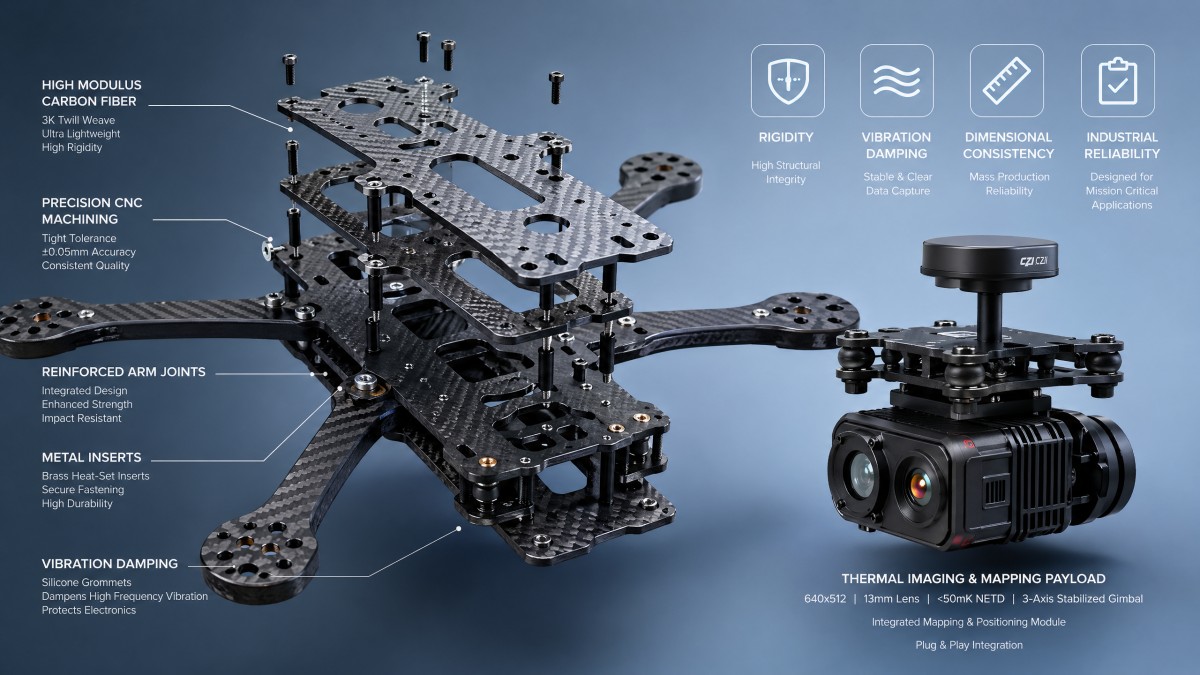
The most common sourcing failure is overreliance on visible specs: wheelbase, nominal weight, and unit price. These are easy to compare, but they do not reveal whether the frame is structurally stable across real mission conditions. Buyers often miss that a carbon fiber drone frame is not a single-variable product. Its performance depends on fiber grade, resin system, ply orientation, curing control, machining quality, insert design, and assembly tolerances.
In wholesale deals, this creates a false sense of comparability. A supplier may present “3K carbon fiber,” “lightweight design,” or “high strength” as proof of quality, but those claims say little about torsional rigidity, edge delamination resistance, or fatigue life at motor mount zones. For procurement teams, this means a lower initial price can mask much higher lifecycle cost if the frame requires more balancing work, fails under payload stress, or produces inconsistent flight behavior across fleets.
This matters even more when the end application includes sensitive payloads or demanding mission profiles. A frame used in a vtol drone for pipeline inspection, for example, must maintain geometry and stiffness during mode transitions, cruise vibration, and repeated landing cycles. Likewise, if the aircraft carries thermal payloads and the team is already running a drone thermal camera resolution comparison, then airframe vibration and mounting stability become central to image usability. Sensor quality alone cannot compensate for a mechanically unstable platform.
What buyers should evaluate beyond price and basic weight
If the goal is to reduce sourcing risk, there are several engineering checkpoints that deserve priority.
1. Stiffness-to-weight consistency
A light frame is not automatically a better frame. If weight reduction comes at the cost of lower stiffness, the aircraft may suffer from oscillation, poorer control tuning margins, and payload instability. Ask for stiffness data, not just mass data. If no quantified bending or torsional performance is available, treat that as a warning sign.
2. Fatigue behavior at stress concentration points
Wholesale buyers often inspect plate quality but ignore interfaces: motor mounts, arm roots, landing gear joints, fold mechanisms, and payload bracket zones. These are common failure origins. A frame that survives static load can still fail early under cyclic stress. Ask what fatigue testing has been done and whether the supplier tracks crack initiation in repeated mission simulation.
3. Batch-to-batch dimensional repeatability
For engineering teams and operators, frame consistency matters more than one good sample. Misaligned drill holes, varying plate thickness, or inconsistent bonding can change assembly fit and flight tuning from one unit to the next. In fleet procurement, poor repeatability increases labor time, spare parts mismatch, and quality control burden.
4. Fastener and insert reliability
Many field issues come from connection details, not from the carbon plate itself. Metal inserts, threaded joints, countersunk areas, and bonded interfaces need scrutiny. Poorly designed or poorly installed inserts can loosen under motor vibration and thermal cycling. Ask whether the supplier validates pull-out strength and thread retention after repeated assembly cycles.
5. Vibration transmission characteristics
Drone frame performance is not only about strength. It is also about how vibration moves through the structure. That affects IMU stability, camera clarity, and control system behavior. If a supplier cannot discuss vibration control, damping strategy, or resonance zones, they may not understand the practical demands of mission-grade UAV integration.
Which engineering data actually helps a buyer make a better decision
Buyers do not need more adjectives. They need a short list of measurable evidence that improves comparison quality.
The most useful technical data includes:
- Plate thickness tolerance and finished assembly dimensional tolerance
- Frame weight tolerance across production batches, not just a nominal value
- Bending and torsional rigidity test results under defined load conditions
- Fatigue cycle test data at key load-bearing joints
- Flatness and hole-position accuracy for assembly-critical components
- Resin system and curing process control information
- Insert retention, fastener torque retention, and joint durability results
- Failure mode records from field or accelerated testing
For procurement managers and enterprise decision-makers, this data serves two purposes. First, it supports supplier comparison on objective grounds. Second, it reduces downstream engineering uncertainty. If the supplier cannot provide these metrics, your internal team will absorb the missing validation burden through longer testing, slower onboarding, and higher qualification cost.
One practical rule is this: if a supplier talks mainly about “aerospace-grade carbon” but cannot document tolerance control or fatigue verification, their commercial message is stronger than their engineering transparency.
How frame quality affects mission outcomes in real UAV operations
The value of a better frame becomes clearer when linked to actual use cases.
In pipeline inspection missions, especially with VTOL platforms, structural stiffness influences transition stability, navigation confidence, and payload alignment. Small frame deflections can alter sensor pointing accuracy or require more aggressive tuning. Over time, repeated takeoff and landing loads can also expose weak joint areas. That is why buyers evaluating a vtol drone for pipeline inspection should treat airframe structure as a mission-critical subsystem, not a passive shell.
For thermal inspection and imaging workflows, frame behavior affects data quality indirectly but significantly. Teams may spend time on a drone thermal camera resolution comparison to optimize sensor choice, but if the frame introduces high-frequency vibration or mount instability, image sharpness, calibration consistency, and thermal interpretation can all degrade. In such cases, the frame becomes a hidden bottleneck in the sensing stack.
For agricultural, mapping, and industrial inspection fleets, the issue is often repeatability at scale. A single unstable frame can be managed. A batch of inconsistent frames creates process disruption: extra tuning, non-uniform spare strategy, more maintenance checks, and lower confidence in mission planning. This is why wholesale sourcing must evaluate manufacturing control, not just prototype performance.
Questions procurement teams should ask before placing a wholesale order
A strong sourcing process depends on asking the right questions early. Buyers should request clear answers to the following:
- What are the actual tolerances for plate thickness, hole position, and assembled geometry?
- How much unit-to-unit weight variation exists across a standard production batch?
- What fatigue or cyclic load tests have been performed on the frame and its joints?
- Which areas historically show the highest failure rates, and how were they improved?
- What quality controls are used for cutting, drilling, curing, bonding, and final inspection?
- Can the supplier provide data from vibration, load, or flight validation tests?
- How are inserts, threaded connections, and bonded assemblies verified?
- What change-control process exists if materials or process parameters shift?
These questions do more than screen technical quality. They also reveal supplier maturity. A capable manufacturer will answer with process clarity, test logic, and traceable evidence. A weak supplier will return to vague terms like “premium,” “high precision,” or “widely trusted.”
What enterprise buyers should optimize for: total risk, not just unit cost
For business decision-makers, the right frame is the one that lowers total system uncertainty. A cheaper frame may look attractive in a spreadsheet, but if it increases qualification cycles, payload troubleshooting, field failures, or support overhead, the real cost rises quickly.
When evaluating carbon fiber drone frame wholesale, the strongest commercial outcome usually comes from balancing four factors:
- Mechanical performance under real mission load
- Consistency across batches and over time
- Supplier transparency and responsiveness
- Lifecycle cost across operations, maintenance, and integration
This is especially important in advanced manufacturing and hard-tech procurement environments where UAV platforms are part of broader operational systems. A frame decision can affect flight controller tuning, sensor output quality, service intervals, and project timelines. In that context, technical ambiguity is a procurement risk, not a minor inconvenience.
Conclusion
What buyers miss in carbon fiber drone frame wholesale is rarely the visible spec. It is the invisible engineering reality behind stiffness, fatigue resistance, vibration behavior, and production consistency. Those factors determine whether a frame performs reliably in inspection, mapping, thermal, or VTOL applications.
The best buying approach is to move beyond generic claims and request measurable data that reflects real structural behavior. For operators, that means fewer field issues and better payload performance. For procurement teams, it means lower supplier risk. For enterprise leaders, it means better return on UAV investment and faster deployment confidence. In wholesale sourcing, the strongest frame offer is not the one with the loudest marketing. It is the one with the clearest engineering evidence.
Search News
Hot Articles
- Carbon Fiber StructuresHow to Specify Aerospace Carbon Fiber Assemblies for Lightweight, Load-Bearing PartsJul 11, 2026
- Machine VisionXiaomi, Alibaba DAMO Academy Drive Open-Source Robotics Model Ecosystem, Lowering Algorithm Development Barriers for Overseas SMEs Adopting Chinese Robotics SolutionsMar 30, 2026
- Cobots & ArmsShanxi 'AI+' Conference Showcases Embodied Intelligence with Multinational Buyer Engagement: Key Industry ImplicationsMar 30, 2026
Popular Tags
Recommended News
 Jul 11, 2026How to Specify Aerospace Carbon Fiber Assemblies for Lightweight, Load-Bearing PartsAerospace carbon fiber assemblies: learn how to specify laminate design, load data, joining methods, and inspection controls for lighter, reliable load-bearing aerospace parts.Elena Rostova (UAV Systems Researcher)
 Mar 30, 2026Xiaomi, Alibaba DAMO Academy Drive Open-Source Robotics Model Ecosystem, Lowering Algorithm Development Barriers for Overseas SMEs Adopting Chinese Robotics SolutionsXiaomi & Alibaba DAMO Academy's open-source robotics models lower algorithm barriers for global SMEs. Boost efficiency in manufacturing, logistics & smart retail with ROS 2 compatible solutions.TSV Data Lab
 Mar 30, 2026Shanxi 'AI+' Conference Showcases Embodied Intelligence with Multinational Buyer Engagement: Key Industry ImplicationsShanxi 'AI+' Conference highlights embodied intelligence with Tesla, Ubtech & Jiantao showcasing multimodal robotics. 40+ global buyers validated tech on-site, creating new B2B channels for industrial automation & AI solutions.Chen Wei (Automation Lead Engineer)
 Mar 30, 2026Zhongguancun Unveils 6G Integrated Sensing-Computing-Intelligence Platform to Empower Embodied Robots for Global Industrial ApplicationsZhongguancun's new 6G platform revolutionizes industrial robotics with <10ms latency, empowering global automotive, logistics & port automation. Discover how this tech boosts China's smart manufacturing exports.TSV Data Lab
 Mar 30, 2026Mech-Mind Tianjin Embodied Intelligence R&D and Production Base Goes Live, Cutting Delivery Time by 20%–30% for Global Customized AMR+Vision SolutionsMech-Mind's Tianjin AMR+Vision production base cuts delivery time by 20%-30% for欧美 & Latin American markets. Discover how this PLd-certified facility accelerates customized robotics solutions for smart manufacturing and logistics.Chen Wei (Automation Lead Engineer)
 Mar 30, 2026Boao Forum Reveals 'Co-evolution of Big and Small Brains' Trend in Humanoid Robots, China's Embodied Intelligence Accelerates Adaptation to Overseas Manufacturing Service ScenariosDiscover how China's humanoid robots, featuring 'Co-evolution of Big and Small Brains,' are revolutionizing global manufacturing. Learn about Embodied Tian Gong 3.0's ISO compliance and overseas deployment at Boao Forum 2026.Chen Wei (Automation Lead Engineer)
 Mar 30, 2026China Railway Industrial Secures Patent for Embodied Robotics in Material Handling, Boosting High-Precision Delivery Capabilities for Overseas Infrastructure and Manufacturing ProjectsChina Railway Industrial's new patent for embodied robotics in material handling boosts high-precision delivery for global infrastructure & manufacturing. Discover how this innovation enhances logistics accuracy in automotive, rail transit & EPC projects.Chen Wei (Automation Lead Engineer)
 Oct 26, 2026AMAXiMAL Releases Open-Source TopMod 3D v3 With Claude AIExplore AMAXiMAL’s free, open-source TopMod 3D v3 with Claude AI assistance, topology-based modeling and plywood fabrication tools that connect complex designs to physical builds.Dr. Marcus Vance
 Oct 26, 2026Choosing a SCADA System Integrator Company: PLC Compatibility and Long-Term SupportChoose a scada system integrator company with proven PLC compatibility and reliable long-term support. Discover what to test, compare, and require before investing.Victor Lin (Chief Software Architect)
 Oct 25, 2026Hesai Leads Global ADAS Main Lidar Shipments in Yole’s 2026 ReportHesai led global ADAS main lidar shipments with a 43% share in 2025, according to Yole’s 2026 report. Explore what this ranking reveals about its automotive market position.TSV Data Lab
 Oct 25, 2026Choosing an Aerospace Materials Manufacturer: Quality and Traceability ChecksChoosing an aerospace materials manufacturer? Learn how to verify certifications, test reports, and lot traceability to qualify suppliers confidently and reduce costly sourcing risks.Dr. Marcus Vance
 Oct 24, 2026Guotai Haitong: Global Entry-Level 3D Printer Shipments Rose 39% in Q1 2026Entry-level 3D printer shipments rose 39% in Q1 2026, Guotai Haitong reports. Explore how AI, multicolor printing and print farms are shaping market growth.Dr. Marcus Vance
 Oct 24, 2026Choosing an Industrial Vision Inspection Supplier: Acceptance Tests That MatterChoose an industrial vision inspection supplier with confidence. Discover acceptance tests for defect detection, false rejects, production speed, and reliable part rejection before you buy.TSV Data Lab
 Oct 23, 2026US Navy Raises Gecko Robotics Contract Ceiling to $300M for Robotic Fleet MaintenanceUS Navy raises Gecko Robotics’ contract ceiling to $300M for Pacific Fleet robotic inspections. Explore potential opportunities for maintenance suppliers and key procurement considerations.Chen Wei (Automation Lead Engineer)
 Oct 23, 2026Choosing Industrial Sensing Systems for Global Plants: Protocol CompatibilityCompare industrial sensing systems international buyers can trust. Explore protocol compatibility, reduce integration risks, and select proven configurations for reliable global plant deployments.TSV Data Lab
 Oct 22, 2026KUKA Showcases Physical AI and iiQKA.AI Vision at NVIDIA GTC BerlinExplore KUKA’s Physical AI showcase at NVIDIA GTC Berlin and discover how iiQKA.AI Vision aims to simplify robotic vision integration and improve 2D and 3D scene recognition.TSV Data Lab
 Oct 22, 2026Robotic Machining of Advanced Composites: What Tolerances Are Achievable?Explore advanced materials machining robotics: discover what drives achievable composite tolerances and how to validate accuracy before investing in your next machining system.Dr. Marcus Vance
 Oct 21, 2026China’s Industrial Robot Exports Near RMB 10 Billion in First Nine Months of 2026China’s industrial robot exports neared RMB 10 billion in January–September 2026, with value rising faster than volume. Explore the data and what it could mean for suppliers.Chen Wei (Automation Lead Engineer)
 Oct 21, 2026Low-Latency Industrial Data Processing: Pricing and Key Cost DriversExplore industrial data latency price drivers, from edge hardware to integration and support. Learn how to compare quotes, verify performance, and avoid unnecessary costs.TSV Data Lab
 Oct 20, 2026KUKA Launches iiQKA.AI Vision to Simplify Industrial Image ProcessingKUKA iiQKA.AI Vision simplifies industrial image processing with controller-based 2D and 3D vision. Explore drag-and-drop setup for vision-guided automation.TSV Data Lab
 Oct 20, 2026Smart Industrial Edge Devices: Key Criteria for Legacy PLC IntegrationChoose smart industrial edge devices for legacy PLC integration. Discover key criteria for compatibility, data quality, security, and reliable collection without disrupting control.TSV Data Lab
 Oct 19, 2026Choosing a Radar Sensor by Application: Range, Resolution, and Field of ViewSimplify radar sensor application based product selection. Compare range, resolution, and field of view to avoid blind spots and choose with confidence. Explore the guide.TSV Data Lab
 Oct 18, 2026Comparing Material Options for Procurement: Specs, Costs, and Supply RisksExplore procurement oriented technical content on material options, specs, costs, and supply risks. Compare alternatives to cut hidden expenses and make confident sourcing decisions.Dr. Marcus Vance
 Oct 17, 20265-Axis CNC Positioning Accuracy: How to Interpret ISO 230-2 Test ResultsAssess 5 axis CNC machining positioning accuracy with ISO 230-2. Learn to interpret repeatability, reversal error, and test conditions to compare suppliers and make confident acceptance decisions.Dr. Marcus Vance























