
Carbon fiber drone frame wholesale: how to judge quality
Publication Date
author
In carbon fiber drone frame wholesale, flashy claims mean little without measurable proof. For buyers comparing UAV structures for vtol drone for pipeline inspection or reviewing drone thermal camera resolution comparison and tethered uav continuous flight time requirements, quality must be judged by fiber grade, layup consistency, resin control, machining tolerance, and fatigue performance. This guide explains how to separate real engineering value from marketing noise.
For procurement teams, operators, R&D engineers, and business decision-makers, the challenge is not finding a supplier that says “high strength” or “lightweight.” The challenge is verifying whether a frame can keep dimensional stability under vibration, absorb repeated landing loads, and maintain strength after hundreds of flight hours in heat, moisture, dust, or chemical exposure.
In practical UAV programs, frame quality directly affects payload ratio, motor efficiency, thermal behavior, maintenance frequency, and fleet reliability. A carbon fiber drone frame that is 5% lighter but inconsistent in layup can create far higher downstream cost than a slightly heavier frame that holds tolerance within ±0.15 mm and remains structurally stable over 300 to 500 operating cycles.
Why frame quality matters in wholesale UAV sourcing
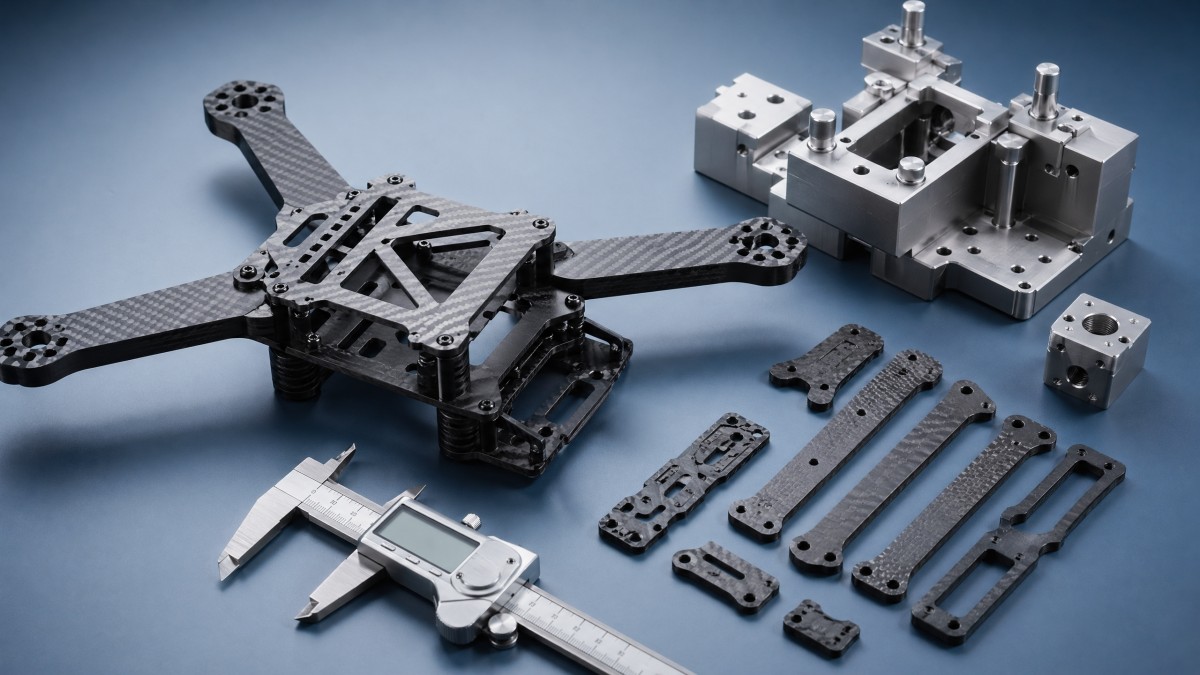
In wholesale sourcing, the buying decision is rarely about one frame. It is about production repeatability across 50, 200, or 1,000 units. A prototype may look excellent, but if the supplier cannot maintain fiber orientation, bonding consistency, and machining precision from batch to batch, the delivered fleet will show uneven arm stiffness, misaligned mounting holes, and unstable center-of-gravity behavior.
For industrial UAV missions such as mapping, corridor inspection, agriculture, or tethered monitoring, the frame is a structural system, not a cosmetic shell. Even a 0.3 mm mismatch in motor mount flatness can affect vibration transmission to the flight controller. Over time, that can reduce image sharpness, increase IMU noise, and shorten maintenance intervals from every 150 hours to every 80 to 100 hours.
This becomes more critical in VTOL drone for pipeline inspection, where the airframe must survive transition loads, long-span cruising vibration, and field transport shocks. A poor frame may pass a simple bench test but fail after repeated takeoff-and-landing cycles. In tethered UAV operations, continuous flight time demands stable heat behavior around power routing points and cable interface zones, making resin quality and laminate design especially important.
TechStat Vanguard’s engineering-first view is simple: quality is visible in measurable thresholds. Buyers should look for fiber specification, ply schedule, resin system, cure process, post-machining tolerance, and fatigue test method. If a supplier cannot explain these six points clearly, the wholesale risk is already elevated.
The hidden cost of low-grade frames
The unit price difference between low-end and better-controlled carbon fiber drone frame wholesale orders may be only 8% to 18%. However, the total ownership impact can be much larger when field failure causes grounding, rework, delayed payload integration, or warranty replacement. This is especially true when a frame supports thermal imaging, LiDAR, or stabilized optics that cost several times more than the structure itself.
- Higher vibration can reduce sensor output quality and increase image blur.
- Inconsistent hole position can extend assembly time by 15 to 30 minutes per unit.
- Poor resin control can lead to hidden delamination after temperature cycling.
- Weak inserts or bonded joints can fail under repeated landing loads.
Core technical indicators buyers should verify
When judging carbon fiber drone frame quality, start with the technical indicators that directly affect structural reliability. Fiber grade is the first checkpoint. Not every “carbon fiber” plate or tube offers the same stiffness and strength. Standard modulus fiber may be suitable for cost-sensitive frames, while higher modulus options can improve rigidity in long arms or large VTOL beams, but may require stricter processing control to avoid brittleness in certain load paths.
The second checkpoint is layup design. A frame made from 100% 0° layers may look strong in one direction but perform poorly in torsion. Industrial drone structures usually need a balanced laminate with 0°, 90°, and ±45° layers. This improves torsional stiffness, distributes landing loads, and reduces crack propagation around fastener holes. Buyers do not always need the exact proprietary stack, but they should ask whether the design is symmetric and whether local reinforcement exists at arm roots, landing gear points, and payload interfaces.
The third checkpoint is resin content and curing discipline. Excess resin adds weight without adding proportional strength. A poorly controlled cure can create voids, dry spots, or local warpage. In practical sourcing, ask the supplier what cure route they use, whether they track batch records, and what typical flatness or thickness tolerance they can hold. For machined plates, a thickness deviation around ±0.10 mm to ±0.20 mm is usually easier to integrate than loosely controlled panels with visible variation.
The fourth checkpoint is post-processing precision. Carbon fiber parts may look clean in photos, but edge breakout, burrs, poor countersink quality, or inaccurate hole spacing often appear only during assembly. On a wholesale order, even a 1 mm offset in one drilling pattern can turn into large-scale rework. Request dimensional inspection points for critical interfaces such as motor mounts, stack mounting holes, payload rails, and tube bonding sockets.
A practical quality review checklist
Before issuing a purchase order, use a checklist that converts quality claims into verifiable engineering facts. The table below can help teams compare multiple suppliers using the same structure.
The key takeaway is that buyers should ask for measurable ranges, not adjectives. Even if a supplier does not disclose every material source detail, they should still be able to state tolerance capability, inspection method, and fatigue validation logic in a clear and technically consistent way.
Four warning signs during supplier review
- The sample looks polished, but no dimensional report is available.
- The supplier cannot explain laminate orientation or reinforcement zones.
- Weight is advertised aggressively, but no stiffness or fatigue data is discussed.
- All applications are described with one universal frame design, despite different load cases.
Manufacturing quality: where good frames are really made or lost
A carbon fiber drone frame wholesale program depends as much on process control as on material choice. Two suppliers may both use similar carbon cloth or prepreg, but their final frame quality can differ sharply due to cutting accuracy, stacking discipline, pressure consistency, cure temperature control, and machining quality after curing. In industrial sourcing, this is often the difference between repeatable production and unstable batches.
Buyers should pay close attention to how parts are made. Hand layup may be acceptable for low-volume prototypes, but for repeated wholesale orders, process discipline matters more than brochure language. Ask how ply orientation is verified, how resin distribution is controlled, and whether the supplier uses jigs or fixtures to maintain alignment during bonding and assembly. If arm sockets or plate stacks are bonded, alignment error should be tightly managed to prevent thrust vector deviation.
Machining is another major filter. Carbon fiber edges are vulnerable to splintering if tools are worn or feed rates are poorly controlled. That can create micro-damage around holes and corners, especially where stress concentration is already high. Rounded internal corners, clean countersinks, and sealed edge treatment often indicate a more mature production process than rough, exposed edges with visible fiber tear-out.
For enterprise buyers, consistency across batches matters more than a single perfect sample. Ask for first article inspection on batch start, in-process checks, and final inspection logic. Even a simple three-stage control plan can significantly reduce defect escape in orders above 100 units.
Typical production checkpoints worth reviewing
The following comparison shows how manufacturing checkpoints translate into sourcing confidence.
For buyers managing drone frame procurement across multiple programs, these checkpoints also improve communication with design and operations teams. They allow more accurate approval gates, faster supplier qualification, and lower trial-and-error cost during scale-up.
What to request before mass order approval
- A dimensional report on critical holes, arm interfaces, and payload mounting surfaces.
- A weight record for at least 5 to 10 sample parts from the same batch.
- A basic description of cure and machining controls.
- Photos of edge finish, bonded joints, and reinforcement zones.
- If possible, a simple vibration or repeated load validation summary.
How to evaluate frames by application scenario and mission profile
A common mistake in carbon fiber drone frame wholesale is evaluating every frame with the same checklist regardless of mission type. In reality, a mapping quadcopter, a tethered security UAV, and a VTOL inspection platform face very different structural priorities. Quality should always be judged against the real duty cycle, payload type, flight duration, and transport conditions.
For a VTOL drone for pipeline inspection, wing-fuselage joints, transition load paths, and landing impact zones deserve extra attention. Long-range missions can expose the frame to hours of vibration, repeated temperature change, and field assembly stress. Here, torsional rigidity and fatigue resistance often matter more than achieving the absolute lowest frame mass.
For thermal imaging platforms, operators often compare payload behavior together with drone thermal camera resolution comparison results. High-resolution thermal or EO payloads amplify the effect of airframe vibration. A frame that appears acceptable with a basic camera may underperform with finer imaging systems. In such cases, mounting stiffness, resonance control, and motor arm symmetry become key buying criteria.
For tethered UAV systems, continuous flight introduces another layer of quality assessment. Tethered uav continuous flight time depends not only on power system design, but also on the frame’s ability to manage cable routing stress, motor heat, and localized loads over long dwell periods. Brackets, anchor points, and heat-sensitive bonded zones should be reviewed more strictly than on short-endurance battery-only aircraft.
Application-driven selection priorities
The table below links common UAV mission profiles to the frame characteristics buyers should prioritize during supplier screening.
This application-based approach helps procurement teams avoid overbuying in low-risk scenarios and underbuying in mission-critical ones. It also creates a cleaner conversation between operations, engineering, and supplier quality teams because each frame requirement is tied to an actual operating condition.
Three scenario questions to ask internally
- Will the drone face repeated transition, landing, or transport shock over 200 or more cycles?
- Is the payload sensitive enough that small vibration differences will affect usable data quality?
- Does the mission expose the frame to heat, chemicals, humidity, or continuous static load for more than 2 to 4 hours per session?
Procurement process, supplier qualification, and common buying mistakes
A strong carbon fiber drone frame wholesale decision is built on a disciplined sourcing process. Price, lead time, and sample appearance matter, but they should not be the only filters. For enterprise procurement, the better path is a staged review that starts with specification alignment, moves to sample validation, and ends with batch control requirements. This reduces the risk of discovering hidden defects after integration work has already started.
A practical process often has 5 steps: define the mission load case, identify critical dimensions, review sample documentation, run pilot assembly, and approve batch controls. Even for orders under 100 units, this structure saves time because it reveals whether the supplier can communicate in engineering terms. In many cases, communication quality predicts production quality better than sales language does.
Another frequent mistake is approving a supplier based only on visual finish. A glossy plate surface says little about internal void content, stack consistency, or local reinforcement quality. Similarly, a very low weight figure is not automatically a strength advantage. If weight reduction removes too much material around fasteners, cutouts, or payload interfaces, the real operating margin may shrink below acceptable levels.
Lead time should also be reviewed carefully. A custom frame project may require 2 to 4 weeks for sample revision and 3 to 6 weeks for stable batch production, depending on tooling, machining complexity, and inspection level. Buyers who compress the schedule too aggressively often end up accepting incomplete validation, which increases the probability of rework later.
Suggested supplier qualification flow
- Step 1: Define target payload, maximum takeoff weight, and expected flight cycle count.
- Step 2: Mark 6 to 10 critical dimensions that must be inspected on every first batch.
- Step 3: Request sample weight, flatness, and hole position records before assembly.
- Step 4: Run a pilot build and track assembly time, fit consistency, and vibration behavior.
- Step 5: Approve a batch control plan covering inspection frequency, packaging, and traceability.
FAQ: common questions from wholesale buyers
How many samples should be checked before a wholesale order?
For standard designs, 3 to 5 samples can reveal obvious fit and finish issues. For custom or higher-risk frames, checking 5 to 10 parts from one batch gives a better view of repeatability, especially for weight spread and hole alignment.
What tolerance level is usually worth requesting?
It depends on the interface, but critical mounting patterns and plate thickness often benefit from control around ±0.10 mm to ±0.20 mm. Large tube cut lengths or non-critical covers can allow wider tolerance if they do not affect alignment or vibration.
Should buyers always choose the lightest frame?
No. The best frame is the one that balances weight, stiffness, fatigue life, and assembly stability. A frame that is 80 to 150 grams heavier may be the better business choice if it improves durability, reduces rework, and protects expensive sensors.
What documents are most useful if a supplier cannot share full material details?
Ask for dimensional inspection reports, batch weight consistency, process overview, and any available fatigue or repeated load validation notes. Those records are often enough to screen serious suppliers from purely marketing-driven ones.
For organizations that need reliable UAV structures, the most effective buying strategy is to convert every quality claim into a checkable parameter: fiber type, laminate logic, resin control, machining tolerance, and fatigue evidence. That approach supports better sourcing decisions for R&D teams, operators, procurement managers, and executives who need lower qualification risk and more predictable fleet performance.
If your team is comparing suppliers, defining technical acceptance criteria, or planning a carbon fiber drone frame wholesale program for industrial UAV deployment, now is the time to move from marketing language to engineering data. Contact us to discuss your specification priorities, request a tailored evaluation framework, or explore more hard-tech sourcing solutions built around measurable performance.
Search News
Hot Articles
- Carbon Fiber StructuresHow to Specify Aerospace Carbon Fiber Assemblies for Lightweight, Load-Bearing PartsJul 11, 2026
- Machine VisionXiaomi, Alibaba DAMO Academy Drive Open-Source Robotics Model Ecosystem, Lowering Algorithm Development Barriers for Overseas SMEs Adopting Chinese Robotics SolutionsMar 30, 2026
- Cobots & ArmsShanxi 'AI+' Conference Showcases Embodied Intelligence with Multinational Buyer Engagement: Key Industry ImplicationsMar 30, 2026
Popular Tags
Recommended News
 Jul 11, 2026How to Specify Aerospace Carbon Fiber Assemblies for Lightweight, Load-Bearing PartsAerospace carbon fiber assemblies: learn how to specify laminate design, load data, joining methods, and inspection controls for lighter, reliable load-bearing aerospace parts.Elena Rostova (UAV Systems Researcher)
 Mar 30, 2026Xiaomi, Alibaba DAMO Academy Drive Open-Source Robotics Model Ecosystem, Lowering Algorithm Development Barriers for Overseas SMEs Adopting Chinese Robotics SolutionsXiaomi & Alibaba DAMO Academy's open-source robotics models lower algorithm barriers for global SMEs. Boost efficiency in manufacturing, logistics & smart retail with ROS 2 compatible solutions.TSV Data Lab
 Mar 30, 2026Shanxi 'AI+' Conference Showcases Embodied Intelligence with Multinational Buyer Engagement: Key Industry ImplicationsShanxi 'AI+' Conference highlights embodied intelligence with Tesla, Ubtech & Jiantao showcasing multimodal robotics. 40+ global buyers validated tech on-site, creating new B2B channels for industrial automation & AI solutions.Chen Wei (Automation Lead Engineer)
 Mar 30, 2026Zhongguancun Unveils 6G Integrated Sensing-Computing-Intelligence Platform to Empower Embodied Robots for Global Industrial ApplicationsZhongguancun's new 6G platform revolutionizes industrial robotics with <10ms latency, empowering global automotive, logistics & port automation. Discover how this tech boosts China's smart manufacturing exports.TSV Data Lab
 Mar 30, 2026Mech-Mind Tianjin Embodied Intelligence R&D and Production Base Goes Live, Cutting Delivery Time by 20%–30% for Global Customized AMR+Vision SolutionsMech-Mind's Tianjin AMR+Vision production base cuts delivery time by 20%-30% for欧美 & Latin American markets. Discover how this PLd-certified facility accelerates customized robotics solutions for smart manufacturing and logistics.Chen Wei (Automation Lead Engineer)
 Mar 30, 2026Boao Forum Reveals 'Co-evolution of Big and Small Brains' Trend in Humanoid Robots, China's Embodied Intelligence Accelerates Adaptation to Overseas Manufacturing Service ScenariosDiscover how China's humanoid robots, featuring 'Co-evolution of Big and Small Brains,' are revolutionizing global manufacturing. Learn about Embodied Tian Gong 3.0's ISO compliance and overseas deployment at Boao Forum 2026.Chen Wei (Automation Lead Engineer)
 Mar 30, 2026China Railway Industrial Secures Patent for Embodied Robotics in Material Handling, Boosting High-Precision Delivery Capabilities for Overseas Infrastructure and Manufacturing ProjectsChina Railway Industrial's new patent for embodied robotics in material handling boosts high-precision delivery for global infrastructure & manufacturing. Discover how this innovation enhances logistics accuracy in automotive, rail transit & EPC projects.Chen Wei (Automation Lead Engineer)
 Oct 26, 2026AMAXiMAL Releases Open-Source TopMod 3D v3 With Claude AIExplore AMAXiMAL’s free, open-source TopMod 3D v3 with Claude AI assistance, topology-based modeling and plywood fabrication tools that connect complex designs to physical builds.Dr. Marcus Vance
 Oct 26, 2026Choosing a SCADA System Integrator Company: PLC Compatibility and Long-Term SupportChoose a scada system integrator company with proven PLC compatibility and reliable long-term support. Discover what to test, compare, and require before investing.Victor Lin (Chief Software Architect)
 Oct 25, 2026Hesai Leads Global ADAS Main Lidar Shipments in Yole’s 2026 ReportHesai led global ADAS main lidar shipments with a 43% share in 2025, according to Yole’s 2026 report. Explore what this ranking reveals about its automotive market position.TSV Data Lab
 Oct 25, 2026Choosing an Aerospace Materials Manufacturer: Quality and Traceability ChecksChoosing an aerospace materials manufacturer? Learn how to verify certifications, test reports, and lot traceability to qualify suppliers confidently and reduce costly sourcing risks.Dr. Marcus Vance
 Oct 24, 2026Guotai Haitong: Global Entry-Level 3D Printer Shipments Rose 39% in Q1 2026Entry-level 3D printer shipments rose 39% in Q1 2026, Guotai Haitong reports. Explore how AI, multicolor printing and print farms are shaping market growth.Dr. Marcus Vance
 Oct 24, 2026Choosing an Industrial Vision Inspection Supplier: Acceptance Tests That MatterChoose an industrial vision inspection supplier with confidence. Discover acceptance tests for defect detection, false rejects, production speed, and reliable part rejection before you buy.TSV Data Lab
 Oct 23, 2026US Navy Raises Gecko Robotics Contract Ceiling to $300M for Robotic Fleet MaintenanceUS Navy raises Gecko Robotics’ contract ceiling to $300M for Pacific Fleet robotic inspections. Explore potential opportunities for maintenance suppliers and key procurement considerations.Chen Wei (Automation Lead Engineer)
 Oct 23, 2026Choosing Industrial Sensing Systems for Global Plants: Protocol CompatibilityCompare industrial sensing systems international buyers can trust. Explore protocol compatibility, reduce integration risks, and select proven configurations for reliable global plant deployments.TSV Data Lab
 Oct 22, 2026KUKA Showcases Physical AI and iiQKA.AI Vision at NVIDIA GTC BerlinExplore KUKA’s Physical AI showcase at NVIDIA GTC Berlin and discover how iiQKA.AI Vision aims to simplify robotic vision integration and improve 2D and 3D scene recognition.TSV Data Lab
 Oct 22, 2026Robotic Machining of Advanced Composites: What Tolerances Are Achievable?Explore advanced materials machining robotics: discover what drives achievable composite tolerances and how to validate accuracy before investing in your next machining system.Dr. Marcus Vance
 Oct 21, 2026China’s Industrial Robot Exports Near RMB 10 Billion in First Nine Months of 2026China’s industrial robot exports neared RMB 10 billion in January–September 2026, with value rising faster than volume. Explore the data and what it could mean for suppliers.Chen Wei (Automation Lead Engineer)
 Oct 21, 2026Low-Latency Industrial Data Processing: Pricing and Key Cost DriversExplore industrial data latency price drivers, from edge hardware to integration and support. Learn how to compare quotes, verify performance, and avoid unnecessary costs.TSV Data Lab
 Oct 20, 2026KUKA Launches iiQKA.AI Vision to Simplify Industrial Image ProcessingKUKA iiQKA.AI Vision simplifies industrial image processing with controller-based 2D and 3D vision. Explore drag-and-drop setup for vision-guided automation.TSV Data Lab
 Oct 20, 2026Smart Industrial Edge Devices: Key Criteria for Legacy PLC IntegrationChoose smart industrial edge devices for legacy PLC integration. Discover key criteria for compatibility, data quality, security, and reliable collection without disrupting control.TSV Data Lab
 Oct 19, 2026Choosing a Radar Sensor by Application: Range, Resolution, and Field of ViewSimplify radar sensor application based product selection. Compare range, resolution, and field of view to avoid blind spots and choose with confidence. Explore the guide.TSV Data Lab
 Oct 18, 2026Comparing Material Options for Procurement: Specs, Costs, and Supply RisksExplore procurement oriented technical content on material options, specs, costs, and supply risks. Compare alternatives to cut hidden expenses and make confident sourcing decisions.Dr. Marcus Vance
 Oct 17, 20265-Axis CNC Positioning Accuracy: How to Interpret ISO 230-2 Test ResultsAssess 5 axis CNC machining positioning accuracy with ISO 230-2. Learn to interpret repeatability, reversal error, and test conditions to compare suppliers and make confident acceptance decisions.Dr. Marcus Vance























