What Causes UAV GPS RTK Accuracy to Drift from Millimeter Claims?
Publication Date
author
Many UAV vendors advertise uav gps rtk accuracy millimeter performance, yet real-world drift often appears once payload changes, electromagnetic noise, and flight dynamics enter the equation. For engineers, operators, buyers, and decision-makers, understanding how drone electromagnetic interference test results, carbon fiber frame vibration dampening, flight controller latency benchmark data, and uav center of gravity calculation affect positioning stability is essential before trusting precision claims.
Why does UAV GPS RTK accuracy drift even when brochures promise millimeter-level results?
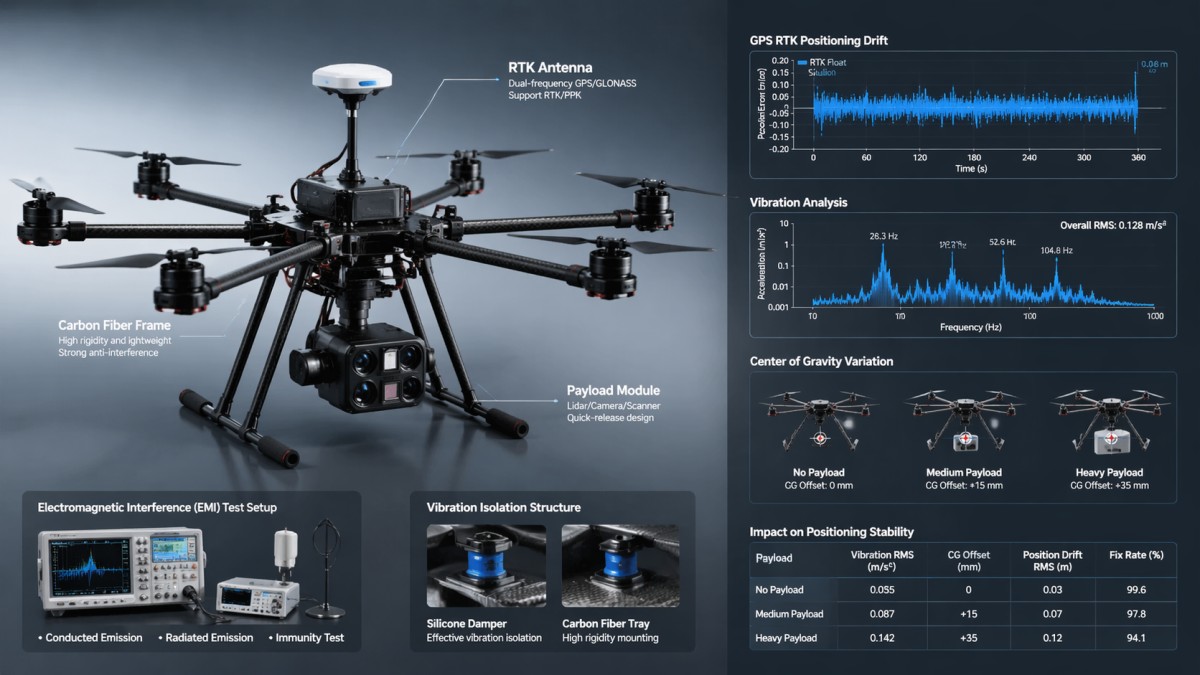
The first issue is semantic, not technical. In UAV positioning, a millimeter claim often refers to idealized RTK solution conditions: fixed ambiguity, strong satellite geometry, controlled baseline length, stable antenna phase center behavior, and limited motion disturbance. Once a drone enters actual field work, the stack becomes dynamic. Antenna tilt changes, propulsion vibration rises, and interference from cameras, radios, power lines, or onboard computing can move performance away from laboratory expectations.
For information researchers and procurement teams, the key distinction is between point accuracy, repeatability, and mission accuracy. A vendor may cite static rover precision in a low-wind environment, while the user actually needs stable geotagging accuracy during a 20–40 minute mapping flight. That gap explains why uav gps rtk accuracy may look excellent on a datasheet but drift by centimeters during turns, speed changes, or payload swaps.
Engineers should also separate vertical and horizontal behavior. Under favorable conditions, horizontal errors may remain controlled while altitude error grows faster due to geometry, vibration, and barometric fusion behavior. In practice, many operational complaints are not caused by RTK alone. They result from a chain effect involving flight controller latency benchmark data, antenna mounting, center of gravity shifts, and poor electromagnetic design in the airframe.
At TSV, the working principle is straightforward: parameters must be traced back to test conditions. If a claim does not specify baseline length, update rate, satellite constellation usage, wind band, payload mass, and fix retention time, it should not be used as a procurement-level reference. A meaningful review must examine at least 3 layers: navigation source quality, platform dynamics, and mission workflow.
- Static precision: often measured on the ground with limited motion and predictable antenna orientation.
- Dynamic flight precision: influenced by acceleration, yaw rate, vibration spectrum, and link latency.
- Mission output precision: determined by sensor trigger timing, geotag synchronization, and post-processing workflow.
Which technical variables most often push uav gps rtk accuracy away from ideal claims?
Electromagnetic interference is one of the most underestimated causes. A drone electromagnetic interference test may reveal that GNSS reception degrades when high-current ESCs, video transmitters, radar payloads, or edge processors operate simultaneously. The issue is not always complete signal loss. More often, it appears as degraded carrier-phase stability, slower fixed-solution recovery, or intermittent jumps during aggressive maneuvers. In field missions near substations, telecom towers, or metallic roofs, the effect can intensify.
Mechanical behavior is equally important. Carbon fiber frame vibration dampening is frequently marketed as a structural advantage, but carbon fiber alone does not guarantee a quiet GNSS environment. The stiffness-to-weight benefit may help flight efficiency, yet the actual outcome depends on arm resonance, motor balancing, propeller quality, mounting isolation, and how the GNSS antenna mast couples with frame harmonics. A platform flying at 5–12 m/s can experience recurring vibration bands that degrade antenna stability even when the frame material is premium.
Another common source is flight controller timing. If flight controller latency benchmark data show delays in sensor fusion, event stamping, or camera trigger registration, the resulting coordinate record may not match the drone’s true position at the capture instant. This matters in corridor mapping, inspection, and precision agriculture where speed changes are frequent. Even when the RTK engine remains fixed, the mission output can drift because the timestamp pipeline is not deterministic enough.
The fourth variable is mass distribution. A flawed uav center of gravity calculation changes control effort, increases motor compensation, and amplifies transient oscillation after turns or payload release. That creates a secondary effect: greater antenna motion and noisier IMU behavior. In aircraft carrying 1 payload versus 2 payload configurations, small CG shifts may not look severe during hover, but they often become obvious during climb, braking, or crosswind correction.
The table below summarizes the technical variables that most often explain why millimeter marketing language becomes centimeter-level field drift.
For procurement use, this table should be read as a filter, not a checklist to complete once. If a supplier can only provide headline RTK numbers without the three supporting layers of EMI, dynamic vibration, and timing verification, the accuracy claim is incomplete. A robust sourcing process typically compares at least 3 flight profiles, 2 payload states, and 1 interference-stressed condition.
How should operators and buyers evaluate real-world positioning stability before purchase?
A practical evaluation starts with test design. Do not accept a single hover result as proof of mission accuracy. Instead, ask for a structured validation sequence covering hover, straight-line cruise, repeated turns, and one payload-change scenario. For many enterprise UAVs, a useful pre-purchase program can be completed in 1–2 days if the vendor already has logs and can support site verification. The goal is to determine whether uav gps rtk accuracy remains consistent across realistic mission states.
Operators should pay close attention to fix retention rather than fix acquisition alone. A platform that reaches RTK fixed quickly but drops the solution during acceleration or radio activity may still produce unreliable deliverables. For mapping or inspection users, the critical questions are simple: How often does the fix state degrade? How long does recovery take? Does the camera trigger remain synchronized during this period? These questions matter more than promotional millimeter language.
Procurement teams also need to connect technical risk with cost risk. A lower-cost drone may appear attractive if the GNSS specification is similar on paper. However, if poor center of gravity management or weak EMI isolation causes repeated reflight, the total project cost increases through labor, delay, and data rejection. In many B2B environments, the hidden cost of a failed mission is larger than the savings from the lower purchase price.
Decision-makers should require a test package with logs, conditions, and limits. This is where TSV’s data-first approach becomes useful. Instead of asking whether a UAV is “high precision,” ask whether its accuracy envelope is documented across 4 dimensions: environment, payload, motion, and timing. That framing converts marketing into engineering evidence.
A procurement checklist that reveals hidden drift risk
The following checklist helps teams compare competing platforms under the same decision logic. It is especially relevant for buyers managing supplier qualification cycles of 2–4 weeks.
- Confirm whether the published accuracy refers to static, dynamic, or mission-output performance.
- Ask for drone electromagnetic interference test records with payloads powered on and radios active.
- Review carbon fiber frame vibration dampening strategy, including antenna mount isolation and propeller balancing controls.
- Check flight controller latency benchmark data, especially trigger-to-log timing and sensor fusion update rates.
- Verify uav center of gravity calculation for each payload mass band and battery configuration.
- Request sample flight logs from at least 3 mission states: hover, cruise, and turning.
The next table can be used during vendor review meetings to rank practical deployment risk instead of relying only on brochure claims.
A useful pattern appears here. The most reliable suppliers do not avoid complexity; they document it. They can explain how accuracy changes from one mission state to another, what thresholds trigger re-calibration, and when a payload combination moves outside the validated operating envelope.
What mistakes cause teams to overtrust millimeter claims in mapping, inspection, and industrial UAV work?
The most common mistake is treating RTK as a standalone module. In reality, RTK is one subsystem inside a flight and sensing chain. A UAV used for corridor mapping, plant inspection, or precision spraying experiences changing speeds, vibration loads, and radio conditions across the mission. If users ignore that systems view, they may misdiagnose drift as a GNSS problem when the real cause is camera timing, antenna mounting, or control instability after payload changes.
A second mistake is assuming carbon fiber automatically solves stability problems. Carbon fiber frame vibration dampening can improve structural efficiency, but a poorly tuned airframe can still transmit troublesome frequencies into the GNSS and IMU stack. Material choice matters less than integrated design. Buyers should ask how the frame, mast, motors, props, and payload brackets behave together across a usable RPM range rather than focusing on the material label alone.
A third mistake is overlooking center of gravity changes during field operations. A drone may fly well with a standard camera, then drift more once a heavier multispectral sensor, LiDAR pod, or extra battery arrangement is installed. That is why uav center of gravity calculation should be part of acceptance, not just initial assembly. In many enterprise fleets, payload changes happen weekly or even daily, so configuration drift becomes operational drift.
A fourth mistake is using incomplete acceptance criteria. Teams may verify flight time and image quality but fail to define fix retention thresholds, latency limits, or log completeness. A better acceptance plan includes 5 checkpoints: RTK fix persistence, event timing consistency, vibration behavior, EMI tolerance, and payload-specific balance validation. Without these, the same aircraft may pass a demo yet underperform during routine deployment.
FAQ for researchers, operators, and procurement teams
Does millimeter-level uav gps rtk accuracy mean my survey output will also be millimeter-level?
Not necessarily. The published number may refer to a favorable GNSS solution state, not the final deliverable. Survey output depends on aircraft motion, trigger timing, calibration, overlap strategy, ground control policy, and processing workflow. In many UAV operations, mission-output accuracy is better understood as a system result rather than a single receiver specification.
How important is a drone electromagnetic interference test during selection?
It is critical when the aircraft carries high-power radios, computing modules, or industrial payloads. EMI tests help reveal whether the RTK solution remains stable when the drone is in its true operating state. For enterprise buyers, asking for EMI behavior under at least 2–3 powered payload scenarios is often more informative than asking for a single nominal accuracy number.
Can flight controller latency benchmark data really affect geospatial accuracy?
Yes. If trigger events, image capture, and position logs are not aligned correctly, the aircraft can tag data with a position that no longer matches the actual exposure instant. This becomes more visible at higher speeds, during turns, or in missions with frequent accelerations. Timing errors can create spatial error even when the RTK engine itself remains fixed.
When should buyers reject a millimeter claim?
Reject or at least heavily qualify the claim when the vendor cannot state test conditions, payload setup, baseline range, motion state, and fix retention behavior. A procurement-grade claim should tell you where the number came from, under what conditions it stays valid, and when it begins to drift. Without that context, the figure is not decision-ready.
Why work with TSV when evaluating UAV positioning accuracy, supplier claims, and deployment risk?
TSV is built for teams that need engineering truth rather than promotional shorthand. In UAV and aerospace metrics, the real challenge is not finding more claims. It is filtering noise and identifying which parameters truly govern field performance. That is why our analysis framework emphasizes traceable conditions, benchmark logic, and cross-functional interpretation for engineers, operators, sourcing managers, and executives.
When reviewing a UAV platform, we focus on the variables that alter deployment outcomes: payload extremes, flight controller stability in complex electromagnetic environments, structural behavior of carbon fiber components, and the link between timing architecture and mission deliverables. This approach helps reduce R&D trial-and-error costs and shortens supplier qualification cycles by shifting evaluation from slogans to measurable thresholds.
If your team is comparing RTK-enabled drones, planning a procurement program, or trying to understand why actual missions do not match advertised precision, you can engage TSV around concrete topics instead of generic consulting. Typical discussions include parameter confirmation, product selection logic, expected delivery cycle for validated configurations, payload-specific center-of-gravity assessment, EMI-related risk review, and specification-sheet support for supplier comparison.
For decision-makers, this means a clearer path from technical uncertainty to actionable sourcing. For operators, it means fewer surprises in the field. For engineering teams, it means a more defensible validation framework. If you need a data-driven review of uav gps rtk accuracy claims, benchmark interpretation, or a structured evaluation matrix before quotation and pilot deployment, contact TSV with your mission profile, payload range, target environment, and required tolerance window.
- Request support for parameter confirmation: RTK conditions, latency path, EMI exposure, and payload-specific balance limits.
- Ask for selection guidance: compare candidate UAV architectures by mission type, risk tolerance, and integration complexity.
- Discuss delivery and validation planning: define test stages, acceptance checkpoints, and documentation needed for procurement approval.
- Initiate quotation and technical review: align performance expectations before pilot orders, sample verification, or supplier shortlisting.
Search News
Hot Articles
- Carbon Fiber StructuresHow to Specify Aerospace Carbon Fiber Assemblies for Lightweight, Load-Bearing PartsJul 11, 2026
- Machine VisionXiaomi, Alibaba DAMO Academy Drive Open-Source Robotics Model Ecosystem, Lowering Algorithm Development Barriers for Overseas SMEs Adopting Chinese Robotics SolutionsMar 30, 2026
- Cobots & ArmsShanxi 'AI+' Conference Showcases Embodied Intelligence with Multinational Buyer Engagement: Key Industry ImplicationsMar 30, 2026
Popular Tags
Recommended News
 Jul 11, 2026How to Specify Aerospace Carbon Fiber Assemblies for Lightweight, Load-Bearing PartsAerospace carbon fiber assemblies: learn how to specify laminate design, load data, joining methods, and inspection controls for lighter, reliable load-bearing aerospace parts.Elena Rostova (UAV Systems Researcher)
 Mar 30, 2026Xiaomi, Alibaba DAMO Academy Drive Open-Source Robotics Model Ecosystem, Lowering Algorithm Development Barriers for Overseas SMEs Adopting Chinese Robotics SolutionsXiaomi & Alibaba DAMO Academy's open-source robotics models lower algorithm barriers for global SMEs. Boost efficiency in manufacturing, logistics & smart retail with ROS 2 compatible solutions.TSV Data Lab
 Mar 30, 2026Shanxi 'AI+' Conference Showcases Embodied Intelligence with Multinational Buyer Engagement: Key Industry ImplicationsShanxi 'AI+' Conference highlights embodied intelligence with Tesla, Ubtech & Jiantao showcasing multimodal robotics. 40+ global buyers validated tech on-site, creating new B2B channels for industrial automation & AI solutions.Chen Wei (Automation Lead Engineer)
 Mar 30, 2026Zhongguancun Unveils 6G Integrated Sensing-Computing-Intelligence Platform to Empower Embodied Robots for Global Industrial ApplicationsZhongguancun's new 6G platform revolutionizes industrial robotics with <10ms latency, empowering global automotive, logistics & port automation. Discover how this tech boosts China's smart manufacturing exports.TSV Data Lab
 Mar 30, 2026Mech-Mind Tianjin Embodied Intelligence R&D and Production Base Goes Live, Cutting Delivery Time by 20%–30% for Global Customized AMR+Vision SolutionsMech-Mind's Tianjin AMR+Vision production base cuts delivery time by 20%-30% for欧美 & Latin American markets. Discover how this PLd-certified facility accelerates customized robotics solutions for smart manufacturing and logistics.Chen Wei (Automation Lead Engineer)
 Mar 30, 2026Boao Forum Reveals 'Co-evolution of Big and Small Brains' Trend in Humanoid Robots, China's Embodied Intelligence Accelerates Adaptation to Overseas Manufacturing Service ScenariosDiscover how China's humanoid robots, featuring 'Co-evolution of Big and Small Brains,' are revolutionizing global manufacturing. Learn about Embodied Tian Gong 3.0's ISO compliance and overseas deployment at Boao Forum 2026.Chen Wei (Automation Lead Engineer)
 Mar 30, 2026China Railway Industrial Secures Patent for Embodied Robotics in Material Handling, Boosting High-Precision Delivery Capabilities for Overseas Infrastructure and Manufacturing ProjectsChina Railway Industrial's new patent for embodied robotics in material handling boosts high-precision delivery for global infrastructure & manufacturing. Discover how this innovation enhances logistics accuracy in automotive, rail transit & EPC projects.Chen Wei (Automation Lead Engineer)
 Oct 23, 2026US Navy Raises Gecko Robotics Contract Ceiling to $300M for Robotic Fleet MaintenanceUS Navy raises Gecko Robotics’ contract ceiling to $300M for Pacific Fleet robotic inspections. Explore potential opportunities for maintenance suppliers and key procurement considerations.Chen Wei (Automation Lead Engineer)
 Oct 23, 2026Choosing Industrial Sensing Systems for Global Plants: Protocol CompatibilityCompare industrial sensing systems international buyers can trust. Explore protocol compatibility, reduce integration risks, and select proven configurations for reliable global plant deployments.TSV Data Lab
 Oct 22, 2026KUKA Showcases Physical AI and iiQKA.AI Vision at NVIDIA GTC BerlinExplore KUKA’s Physical AI showcase at NVIDIA GTC Berlin and discover how iiQKA.AI Vision aims to simplify robotic vision integration and improve 2D and 3D scene recognition.TSV Data Lab
 Oct 22, 2026Robotic Machining of Advanced Composites: What Tolerances Are Achievable?Explore advanced materials machining robotics: discover what drives achievable composite tolerances and how to validate accuracy before investing in your next machining system.Dr. Marcus Vance
 Oct 21, 2026China’s Industrial Robot Exports Near RMB 10 Billion in First Nine Months of 2026China’s industrial robot exports neared RMB 10 billion in January–September 2026, with value rising faster than volume. Explore the data and what it could mean for suppliers.Chen Wei (Automation Lead Engineer)
 Oct 21, 2026Low-Latency Industrial Data Processing: Pricing and Key Cost DriversExplore industrial data latency price drivers, from edge hardware to integration and support. Learn how to compare quotes, verify performance, and avoid unnecessary costs.TSV Data Lab
 Oct 20, 2026KUKA Launches iiQKA.AI Vision to Simplify Industrial Image ProcessingKUKA iiQKA.AI Vision simplifies industrial image processing with controller-based 2D and 3D vision. Explore drag-and-drop setup for vision-guided automation.TSV Data Lab
 Oct 20, 2026Smart Industrial Edge Devices: Key Criteria for Legacy PLC IntegrationChoose smart industrial edge devices for legacy PLC integration. Discover key criteria for compatibility, data quality, security, and reliable collection without disrupting control.TSV Data Lab
 Oct 19, 2026Choosing a Radar Sensor by Application: Range, Resolution, and Field of ViewSimplify radar sensor application based product selection. Compare range, resolution, and field of view to avoid blind spots and choose with confidence. Explore the guide.TSV Data Lab
 Oct 18, 2026Comparing Material Options for Procurement: Specs, Costs, and Supply RisksExplore procurement oriented technical content on material options, specs, costs, and supply risks. Compare alternatives to cut hidden expenses and make confident sourcing decisions.Dr. Marcus Vance
 Oct 17, 20265-Axis CNC Positioning Accuracy: How to Interpret ISO 230-2 Test ResultsAssess 5 axis CNC machining positioning accuracy with ISO 230-2. Learn to interpret repeatability, reversal error, and test conditions to compare suppliers and make confident acceptance decisions.Dr. Marcus Vance
 Oct 16, 2026Choosing a Rugged Edge AI Box Supplier: Thermal Tests and Lifecycle SupportChoose a rugged edge AI box supplier with proven thermal performance and reliable lifecycle support. Discover the tests and commitments to verify before you buy.TSV Data Lab
 Oct 15, 2026R&D Cost Reduction Services: How to Evaluate Fees, Savings, and ROIEvaluate R&D cost reduction services with confidence. Compare fees, verify savings, and calculate ROI without compromising performance. Discover how to choose a provider that delivers real value.Chen Wei (Automation Lead Engineer)
 Oct 23, 2026How Do You Evaluate Solid-State LiDAR Point Cloud Density?Evaluate solid-state LiDAR point cloud density using valid returns, angular spacing, and real-world coverage. Discover how to compare sensors and choose the right fit for your application.TSV Data Lab
 Oct 22, 2026How Do You Test AMR Navigation Accuracy in a Warehouse?Test AMR navigation accuracy in warehouses with practical methods for localization, path tracking, and docking. Learn to set tolerances and compare robots before deployment.Chen Wei (Automation Lead Engineer)
 Oct 21, 2026How Should You Balance Cobot Payload Against Reach?Explore cobot payload versus reach to choose the right robot. Learn how tooling, load limits, workspace, and cycle time affect performance—and avoid costly selection mistakes.Chen Wei (Automation Lead Engineer)
 Oct 20, 2026How Do You Measure Industrial IoT Gateway Latency Under Load?Measure industrial IoT gateway latency under load with reliable timestamps, realistic traffic, and tail-latency analysis. Discover how to expose bottlenecks and choose the right gateway.TSV Data Lab