Millimeter RTK Accuracy Sounds Ideal, but Is It Repeatable?
Publication Date
author
Millimeter-level RTK positioning is possible in controlled conditions, but the practical answer is more nuanced: it is not automatically repeatable in real UAV operations. For most industrial teams, the real question is not whether a receiver can briefly achieve millimeter-class output, but whether that level of performance can be reproduced across flights, environments, payload changes, and electromagnetic stress. In practice, repeatability depends on the entire system: GNSS signal quality, correction-link stability, antenna placement, flight controller latency benchmark results, drone electromagnetic interference test performance, and even basic factors such as UAV center of gravity calculation. If you are evaluating RTK for mapping, inspection, surveying, or autonomous operations, headline accuracy claims should be treated as a starting point—not a procurement conclusion.
What users really need to know: millimeter RTK accuracy can exist, but repeatability is the real engineering metric
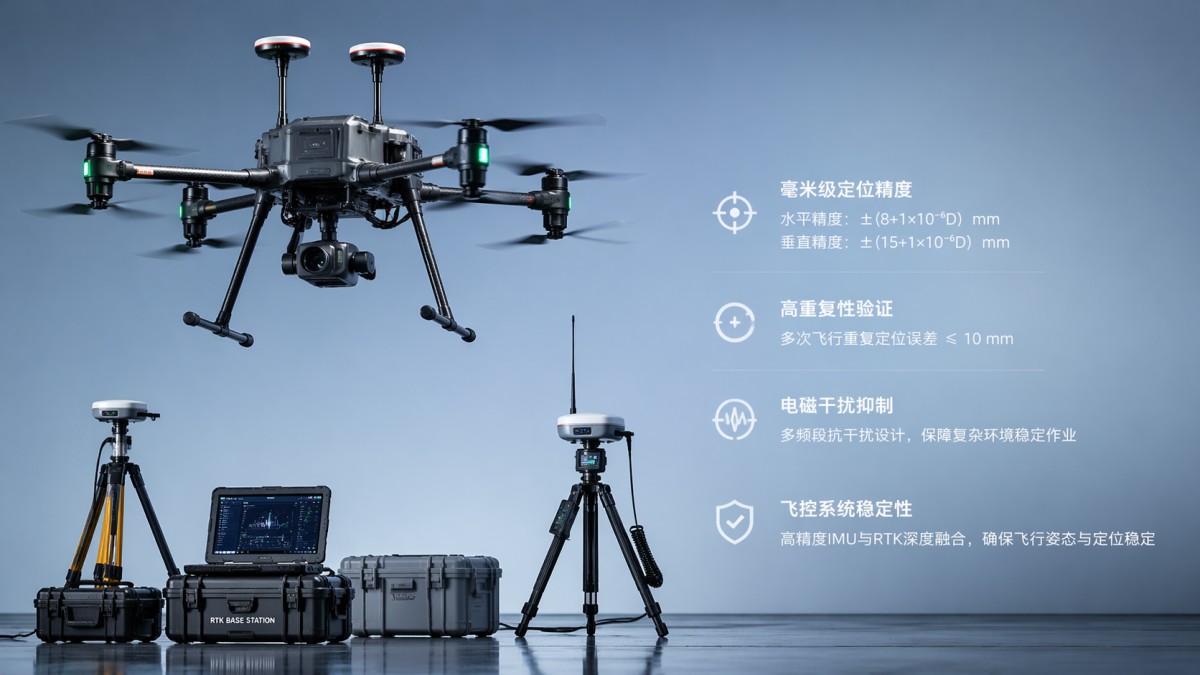
When users search for whether millimeter RTK accuracy is repeatable, they are usually trying to answer one of four practical questions:
- Can this system deliver the same positioning quality every time, not just in a demo?
- What operating conditions make RTK results degrade?
- How should buyers verify vendor claims before purchase?
- What level of accuracy is actually realistic for the intended use case?
Those are the right questions. In industrial settings, repeatability is often more valuable than peak precision. A drone that occasionally reports millimeter-grade fixes but drifts under EMI, payload variation, or correction-link instability is less useful than a platform that consistently holds a known centimeter-level envelope.
For operators and engineering teams, the difference matters because mission planning, control logic, georeferencing confidence, and rework costs all depend on consistency. For procurement leaders and enterprise decision-makers, the issue is risk: if the system performs only under ideal lab conditions, field deployment can become expensive very quickly.
Why “millimeter accuracy” in RTK marketing often gets misunderstood
Many RTK claims are technically true in a narrow sense but misleading in practical interpretation. Vendors may refer to:
- Carrier-phase measurement capability under ideal satellite geometry
- Static ground test performance rather than dynamic flight behavior
- Relative positioning precision instead of true end-to-end operational accuracy
- Short-duration best-case results rather than long-run repeatable outcomes
That distinction is critical. A GNSS RTK engine may resolve position with extremely fine mathematical precision, but the UAV system still has to maintain that quality in motion. As soon as the aircraft is flying, the positioning chain is influenced by vibration, antenna multipath, correction latency, controller timing, frame resonance, payload shadowing, and onboard electrical noise.
In other words, “can output millimeter-class coordinates” is not the same as “can repeatedly deliver millimeter-grade operational positioning in the field.”
What actually determines RTK repeatability in UAV operations
If the goal is to judge whether uav gps rtk accuracy millimeter claims are meaningful, the most useful approach is to evaluate the full stack rather than the GNSS module alone.
1. Satellite geometry and correction quality
RTK performance rises and falls with signal conditions. Poor satellite visibility, changing PDOP, intermittent correction feeds, and base-rover communication dropouts all reduce repeatability. Even if the receiver regains a fixed solution, the recovered quality may not match the pre-interruption state.
2. Flight controller latency benchmark results
Position accuracy is not only a navigation problem; it is also a timing problem. Flight controller latency benchmark data helps show how quickly the platform reacts to updated position inputs. If the controller stack introduces delay, the aircraft can overshoot, oscillate, or fail to hold the intended path tightly enough to preserve repeatable ground truth. This matters in corridor mapping, infrastructure inspection, precision spraying, and autonomous landing.
3. Drone electromagnetic interference test performance
Electromagnetic interference is one of the most underestimated causes of RTK inconsistency. Power distribution systems, ESCs, telemetry radios, video transmitters, payload electronics, and even poor grounding design can contaminate GNSS reception. A drone electromagnetic interference test should not be treated as a compliance box-tick; it is essential evidence for whether RTK stability will survive real payload and power conditions.
4. UAV center of gravity calculation
UAV center of gravity calculation affects more than flight feel. If payload changes shift the center of gravity, control effort changes too. That can alter platform vibration, attitude behavior, and trajectory tracking. For RTK-dependent applications, these effects can reduce the repeatability of image overlap, waypoint adherence, and measured position consistency.
5. Mechanical vibration and antenna installation
The quality of RTK output depends heavily on antenna environment. Poor antenna mounting, frame reflections, cable routing issues, and propeller-induced vibration can all degrade phase tracking. Two aircraft using the same RTK receiver can produce different repeatability results simply because the airframe integration quality is different.
6. Mission profile and speed
Static test data often looks better than dynamic flight performance. Hovering over a point, flying slowly over open terrain, and conducting repeat passes in crosswind are very different operating conditions. A procurement team should ask whether the claimed precision was achieved during actual mission speeds and payload configurations.
Repeatability vs. accuracy: the distinction that matters most for buyers
For most target readers, this is the key decision-making framework:
- Accuracy asks: How close was one result to the true position?
- Repeatability asks: How consistently does the system return the same result under the same conditions?
A UAV can sometimes show impressive one-off accuracy while still having weak repeatability across different days, battery states, weather windows, or payload combinations. For mapping and measurement workflows, repeatability often determines whether outputs remain comparable over time. For autonomous operations, repeatability determines control confidence and safety margin.
This is why engineering teams should request test reports that show variance across repeated missions, not just best-case screenshots or single-flight statistics.
What level of RTK performance is realistic in real deployments?
The practical answer depends on the application.
- Survey and ground control workflows: Millimeter-class results may be achievable in static or highly controlled conditions, but dynamic airborne repeatability is usually harder.
- UAV mapping: Consistent centimeter-level absolute positioning is often more realistic and more operationally meaningful than chasing millimeter claims.
- Inspection and navigation: Stable trajectory control, robust fix retention, and repeat-pass consistency often matter more than theoretical coordinate resolution.
- Autonomous docking or precision operations: System-level tuning, sensor fusion, and local references may be needed because GNSS RTK alone may not guarantee repeatable millimeter behavior.
For many enterprises, the right target is not “the smallest advertised number.” It is the narrowest performance band that can be maintained reliably in their own environment.
How engineers and procurement teams should verify RTK claims before buying
If you want to reduce supplier qualification risk, ask for evidence in a format that reflects real operations.
Request these data points
- Repeated flight-test results across multiple days and environmental conditions
- Fix rate, re-fix time, and correction-link interruption behavior
- Flight controller latency benchmark reports
- Drone electromagnetic interference test data under full payload power draw
- Antenna installation guidance and integration constraints
- Performance changes under different center-of-gravity configurations
- Dynamic path-following accuracy, not only static hover screenshots
Ask operational questions, not marketing questions
- What is the repeatability over 20 identical missions?
- How does performance change when payload weight shifts?
- What happens after temporary correction loss?
- How does EMI from mission equipment affect fix stability?
- What is the tested accuracy during flight, not just on the ground?
Run a use-case-specific acceptance test
The best validation method is to test under your own operating constraints: your mission altitude, your flight speed, your payload, your geography, and your interference environment. A good supplier should support a repeatable acceptance protocol rather than relying only on brochure specifications.
When millimeter-level RTK claims are valuable—and when they are mostly noise
Millimeter-level claims can be meaningful when they are tied to a clearly defined context: static measurements, controlled baselines, short observation windows, excellent correction quality, low vibration, and disciplined system integration.
They become less meaningful when they are presented without:
- Test conditions
- Dynamic flight data
- Repeatability statistics
- EMI robustness evidence
- Integration constraints
For hard-tech buyers, the takeaway is simple: precision without context is not engineering truth. If a vendor cannot explain how its RTK system behaves under realistic UAV operating conditions, the claim should not drive procurement decisions.
Conclusion: in UAV RTK, repeatable performance is more important than idealized precision
Millimeter RTK accuracy sounds ideal, but it is only valuable if it is repeatable in the field. In real UAV deployments, repeatability depends on far more than the receiver itself. Flight controller latency benchmark behavior, drone electromagnetic interference test results, antenna integration, correction-link quality, and UAV center of gravity calculation all influence whether positioning remains consistent across missions.
For engineers and operators, the practical goal is stable, verified performance under actual mission conditions. For procurement teams and decision-makers, the right buying question is not “Can it achieve millimeter accuracy?” but “How reliably can it hold a known performance envelope in our environment?”
That shift in perspective leads to better technical decisions, lower validation cost, and fewer surprises after deployment. In industrial UAV systems, repeatability is the metric that separates impressive specifications from dependable capability.
Search News
Hot Articles
- Carbon Fiber StructuresHow to Specify Aerospace Carbon Fiber Assemblies for Lightweight, Load-Bearing PartsJul 11, 2026
- Machine VisionXiaomi, Alibaba DAMO Academy Drive Open-Source Robotics Model Ecosystem, Lowering Algorithm Development Barriers for Overseas SMEs Adopting Chinese Robotics SolutionsMar 30, 2026
- Cobots & ArmsShanxi 'AI+' Conference Showcases Embodied Intelligence with Multinational Buyer Engagement: Key Industry ImplicationsMar 30, 2026
Popular Tags
Recommended News
 Jul 11, 2026How to Specify Aerospace Carbon Fiber Assemblies for Lightweight, Load-Bearing PartsAerospace carbon fiber assemblies: learn how to specify laminate design, load data, joining methods, and inspection controls for lighter, reliable load-bearing aerospace parts.Elena Rostova (UAV Systems Researcher)
 Mar 30, 2026Xiaomi, Alibaba DAMO Academy Drive Open-Source Robotics Model Ecosystem, Lowering Algorithm Development Barriers for Overseas SMEs Adopting Chinese Robotics SolutionsXiaomi & Alibaba DAMO Academy's open-source robotics models lower algorithm barriers for global SMEs. Boost efficiency in manufacturing, logistics & smart retail with ROS 2 compatible solutions.TSV Data Lab
 Mar 30, 2026Shanxi 'AI+' Conference Showcases Embodied Intelligence with Multinational Buyer Engagement: Key Industry ImplicationsShanxi 'AI+' Conference highlights embodied intelligence with Tesla, Ubtech & Jiantao showcasing multimodal robotics. 40+ global buyers validated tech on-site, creating new B2B channels for industrial automation & AI solutions.Chen Wei (Automation Lead Engineer)
 Mar 30, 2026Zhongguancun Unveils 6G Integrated Sensing-Computing-Intelligence Platform to Empower Embodied Robots for Global Industrial ApplicationsZhongguancun's new 6G platform revolutionizes industrial robotics with <10ms latency, empowering global automotive, logistics & port automation. Discover how this tech boosts China's smart manufacturing exports.TSV Data Lab
 Mar 30, 2026Mech-Mind Tianjin Embodied Intelligence R&D and Production Base Goes Live, Cutting Delivery Time by 20%–30% for Global Customized AMR+Vision SolutionsMech-Mind's Tianjin AMR+Vision production base cuts delivery time by 20%-30% for欧美 & Latin American markets. Discover how this PLd-certified facility accelerates customized robotics solutions for smart manufacturing and logistics.Chen Wei (Automation Lead Engineer)
 Mar 30, 2026Boao Forum Reveals 'Co-evolution of Big and Small Brains' Trend in Humanoid Robots, China's Embodied Intelligence Accelerates Adaptation to Overseas Manufacturing Service ScenariosDiscover how China's humanoid robots, featuring 'Co-evolution of Big and Small Brains,' are revolutionizing global manufacturing. Learn about Embodied Tian Gong 3.0's ISO compliance and overseas deployment at Boao Forum 2026.Chen Wei (Automation Lead Engineer)
 Mar 30, 2026China Railway Industrial Secures Patent for Embodied Robotics in Material Handling, Boosting High-Precision Delivery Capabilities for Overseas Infrastructure and Manufacturing ProjectsChina Railway Industrial's new patent for embodied robotics in material handling boosts high-precision delivery for global infrastructure & manufacturing. Discover how this innovation enhances logistics accuracy in automotive, rail transit & EPC projects.Chen Wei (Automation Lead Engineer)
 Oct 22, 2026KUKA Showcases Physical AI and iiQKA.AI Vision at NVIDIA GTC BerlinExplore KUKA’s Physical AI showcase at NVIDIA GTC Berlin and discover how iiQKA.AI Vision aims to simplify robotic vision integration and improve 2D and 3D scene recognition.TSV Data Lab
 Oct 22, 2026Robotic Machining of Advanced Composites: What Tolerances Are Achievable?Explore advanced materials machining robotics: discover what drives achievable composite tolerances and how to validate accuracy before investing in your next machining system.Dr. Marcus Vance
 Oct 21, 2026China’s Industrial Robot Exports Near RMB 10 Billion in First Nine Months of 2026China’s industrial robot exports neared RMB 10 billion in January–September 2026, with value rising faster than volume. Explore the data and what it could mean for suppliers.Chen Wei (Automation Lead Engineer)
 Oct 21, 2026Low-Latency Industrial Data Processing: Pricing and Key Cost DriversExplore industrial data latency price drivers, from edge hardware to integration and support. Learn how to compare quotes, verify performance, and avoid unnecessary costs.TSV Data Lab
 Oct 20, 2026KUKA Launches iiQKA.AI Vision to Simplify Industrial Image ProcessingKUKA iiQKA.AI Vision simplifies industrial image processing with controller-based 2D and 3D vision. Explore drag-and-drop setup for vision-guided automation.TSV Data Lab
 Oct 20, 2026Smart Industrial Edge Devices: Key Criteria for Legacy PLC IntegrationChoose smart industrial edge devices for legacy PLC integration. Discover key criteria for compatibility, data quality, security, and reliable collection without disrupting control.TSV Data Lab
 Oct 19, 2026Choosing a Radar Sensor by Application: Range, Resolution, and Field of ViewSimplify radar sensor application based product selection. Compare range, resolution, and field of view to avoid blind spots and choose with confidence. Explore the guide.TSV Data Lab
 Oct 18, 2026Comparing Material Options for Procurement: Specs, Costs, and Supply RisksExplore procurement oriented technical content on material options, specs, costs, and supply risks. Compare alternatives to cut hidden expenses and make confident sourcing decisions.Dr. Marcus Vance
 Oct 17, 20265-Axis CNC Positioning Accuracy: How to Interpret ISO 230-2 Test ResultsAssess 5 axis CNC machining positioning accuracy with ISO 230-2. Learn to interpret repeatability, reversal error, and test conditions to compare suppliers and make confident acceptance decisions.Dr. Marcus Vance
 Oct 16, 2026Choosing a Rugged Edge AI Box Supplier: Thermal Tests and Lifecycle SupportChoose a rugged edge AI box supplier with proven thermal performance and reliable lifecycle support. Discover the tests and commitments to verify before you buy.TSV Data Lab
 Oct 15, 2026R&D Cost Reduction Services: How to Evaluate Fees, Savings, and ROIEvaluate R&D cost reduction services with confidence. Compare fees, verify savings, and calculate ROI without compromising performance. Discover how to choose a provider that delivers real value.Chen Wei (Automation Lead Engineer)
 Oct 22, 2026How Do You Test AMR Navigation Accuracy in a Warehouse?Test AMR navigation accuracy in warehouses with practical methods for localization, path tracking, and docking. Learn to set tolerances and compare robots before deployment.Chen Wei (Automation Lead Engineer)
 Oct 21, 2026How Should You Balance Cobot Payload Against Reach?Explore cobot payload versus reach to choose the right robot. Learn how tooling, load limits, workspace, and cycle time affect performance—and avoid costly selection mistakes.Chen Wei (Automation Lead Engineer)
 Oct 20, 2026How Do You Measure Industrial IoT Gateway Latency Under Load?Measure industrial IoT gateway latency under load with reliable timestamps, realistic traffic, and tail-latency analysis. Discover how to expose bottlenecks and choose the right gateway.TSV Data Lab
 Oct 19, 2026How Do You Verify That Precision Machined Parts Meet Tolerances?Master precision machining tolerance verification with the right tools, datum setups, and acceptance rules. Learn how to validate parts confidently and reduce costly inspection errors.Dr. Marcus Vance
 Oct 18, 2026What Should an AS9100 Machining Supplier Checklist Include?Build an AS9100 machining supplier checklist that verifies capability, traceability, inspection, and outsourced processes. Discover what to check before approving your next aerospace supplier.Dr. Marcus Vance
 Oct 17, 2026How Should You Interpret Industrial Robot Repeatability Specs?Decode industrial robot repeatability specifications, understand ISO 9283 test conditions, and avoid costly selection mistakes. Learn how to verify performance for your process.Chen Wei (Automation Lead Engineer)