Vision Sensor Framerate vs Resolution in Fast Inspection
Publication Date
author
In fast inspection, choosing between speed and image detail is rarely simple. Understanding vision sensor framerate vs resolution is essential when production lines accelerate, defect tolerances tighten, and data-driven quality control becomes a baseline rather than an upgrade. Across packaging, electronics, automotive parts, medical consumables, and precision machining, the central question is no longer whether machine vision should be deployed, but how to balance throughput, detection reliability, and image fidelity without overbuilding the system.
The engineering reality is straightforward: higher resolution increases pixel detail, while higher framerate improves temporal sampling. Yet in fast inspection, these two strengths compete for bandwidth, exposure time, processing load, storage, and illumination budget. That is why vision sensor framerate vs resolution has become a decisive evaluation topic in modern inspection planning. A sensor that looks impressive on a datasheet can still underperform if line speed, object size, defect scale, motion blur, lens choice, and edge processing are not evaluated as one system.
Why vision sensor framerate vs resolution is becoming a sharper decision point
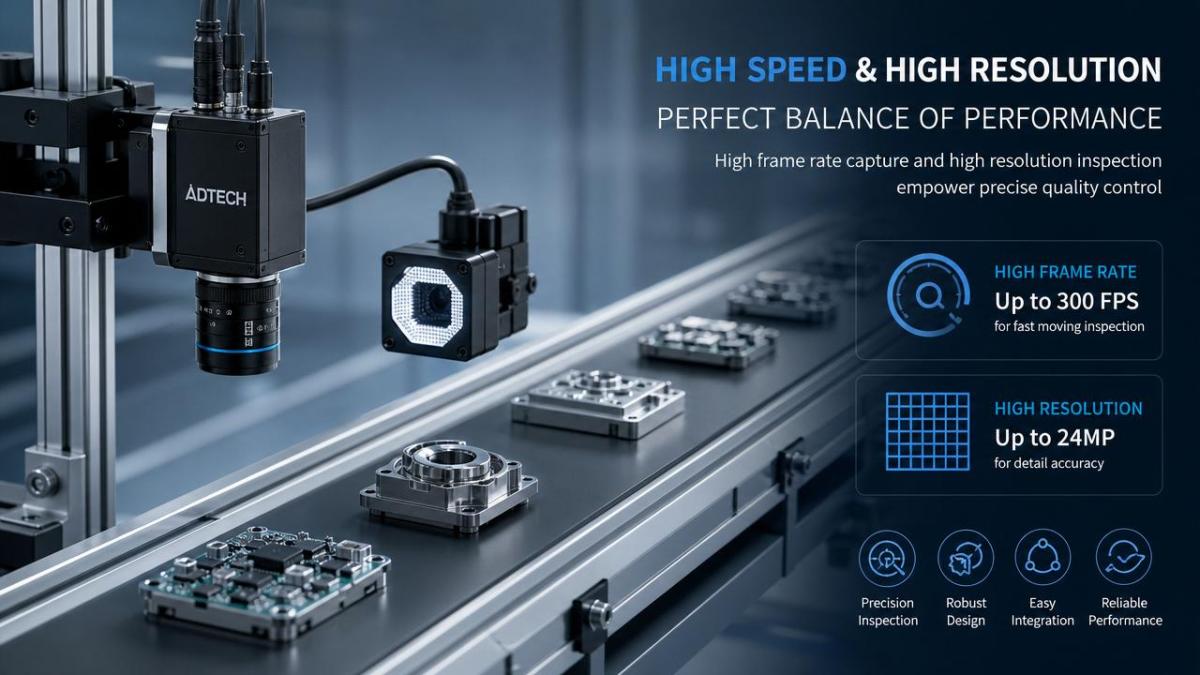
A clear trend across the broader industrial landscape is the move from sampling inspection to continuous in-line inspection. Production equipment is running faster, product variety is increasing, and acceptable escape rates are shrinking. At the same time, edge AI and industrial networking make it easier to collect more image data, which raises expectations for traceability and real-time control. As a result, vision sensor framerate vs resolution is no longer a niche camera-selection issue; it is now a system-level decision that affects overall equipment effectiveness, false reject rates, and the stability of automated responses.
Another signal is that defect types are changing. Many inspection tasks once focused on presence or absence, basic positioning, or barcode reading. Today, more lines need to detect micro-scratches, edge chipping, print defects, seal contamination, burrs, fiber exposure, and subtle shape deviations. Some of these require more pixels on target. Others require more frames per second to avoid missing transient events on high-speed conveyors, rotating parts, or intermittent motion systems. This is exactly where the trade-off in vision sensor framerate vs resolution becomes practical rather than theoretical.
The forces pushing faster inspection systems toward tougher trade-offs
Several engineering and operational factors are making vision sensor framerate vs resolution more important in daily decision-making:
These pressures explain why the best answer to vision sensor framerate vs resolution depends on application physics, not on headline specifications. More pixels are not always better, and more frames are not always useful if image exposure, lighting, or processing cannot keep pace.
What the trade-off means in real inspection conditions
In practice, vision sensor framerate vs resolution affects four linked performance areas: spatial detail, time capture, signal quality, and system latency. If resolution is too low, a defect may occupy too few pixels to be detected reliably. If framerate is too low, the part may move too far between frames, creating missed events or unstable measurements. If exposure is shortened to reach higher framerate, image brightness drops, which can increase noise unless lighting intensity is raised. If resolution is increased, data transfer and inference time rise, which can delay reject decisions.
Common engineering consequences
- High resolution with low framerate may detect tiny defects but miss fast-moving targets.
- High framerate with low resolution may keep up with speed but fail on fine surface flaws.
- Short exposure needed for motion freeze often demands stronger, more controlled illumination.
- Larger image payloads can overload industrial networks, edge processors, or storage systems.
- Lens quality and pixel size can limit usable detail even when nominal resolution is high.
This is why evaluating vision sensor framerate vs resolution should begin with pixels per defect and frames per part, not with megapixels alone. If a scratch must be represented by at least 3 to 5 pixels for stable classification, field of view and working distance matter immediately. If each part is visible for only 40 milliseconds, then framerate and trigger timing define whether the camera gets one meaningful look or several.
How different production stages feel the impact
The effect of vision sensor framerate vs resolution extends beyond the camera station itself. Upstream mechanical stability, lighting architecture, and downstream reject timing all influence the useful operating window. A conveyor with speed fluctuation may require extra temporal margin. A robotic pick-and-place cell may benefit more from lower latency than from ultra-fine image detail. A final inspection gate for safety-critical assemblies may justify higher resolution and more compute because the cost of escape is far greater than the cost of processing.
There is also a business-layer effect. Over-specifying resolution often increases sensor price, optics cost, lighting power, processing hardware, and archive storage. Over-specifying framerate can create diminishing returns if image quality collapses under short exposure or if the control system cannot react quickly enough. A disciplined vision sensor framerate vs resolution assessment reduces unnecessary capital spending while improving confidence in detection coverage.
The most important metrics to check before choosing a side
A robust decision framework for vision sensor framerate vs resolution should focus on measurable inspection requirements rather than broad assumptions. The following checkpoints are the most useful:
- Minimum defect size: Define the smallest flaw that must be detected consistently.
- Required pixels on target: Estimate how many pixels that defect should occupy for rule-based or AI-based classification.
- Field of view: Determine whether the whole part must be seen at once or whether multi-camera zoning is more efficient.
- Part velocity: Measure actual motion through the inspection zone, including acceleration and vibration.
- Exposure limit: Calculate the maximum exposure time that avoids unacceptable blur.
- Lighting budget: Confirm whether available illumination can support short exposures at needed signal-to-noise ratio.
- Processing latency: Include image transfer, inference, PLC response, and actuator delay.
- Retention needs: Check whether full-resolution images must be stored continuously or only exception frames.
When these variables are quantified, vision sensor framerate vs resolution becomes a solvable engineering balance. In many cases, a moderate-resolution sensor with optimized optics and lighting outperforms a higher-resolution sensor working near its bandwidth limits. In other cases, splitting one broad view into multiple focused views yields better inspection confidence than trying to force a single camera to do everything.
A practical decision path for fast inspection lines
A useful rule is to optimize the entire imaging chain before buying more pixels. Check optics MTF, strobe timing, sensor sensitivity, region of interest settings, binning options, and data path capacity. Many systems improve substantially when the field of view is narrowed, illumination is stabilized, and frame capture is synchronized more precisely. Those changes often deliver better results than simply escalating the vision sensor framerate vs resolution specification.
What to do next if performance is uncertain
If the right balance is still unclear, the next step should be a controlled benchmark rather than a guess. Build a short test around actual part speed, realistic defect samples, target lighting, and production-relevant acceptance criteria. Record blur level, defect recall, false positives, transfer load, and decision latency. Compare at least two operating points, such as higher framerate with lower resolution versus higher resolution with reduced framerate. This creates actionable evidence around vision sensor framerate vs resolution instead of relying on generic camera marketing.
The strongest inspection systems are not defined by the biggest numbers on paper, but by how efficiently they convert light, motion, and data into reliable quality decisions. When vision sensor framerate vs resolution is evaluated through measurable defect requirements, line dynamics, and processing constraints, fast inspection becomes more predictable, scalable, and economically sound. Start with the defect, quantify the motion, test the imaging chain, and let the data determine whether speed or detail deserves priority.
Search News
Hot Articles
- Carbon Fiber StructuresHow to Specify Aerospace Carbon Fiber Assemblies for Lightweight, Load-Bearing PartsJul 11, 2026
- Machine VisionXiaomi, Alibaba DAMO Academy Drive Open-Source Robotics Model Ecosystem, Lowering Algorithm Development Barriers for Overseas SMEs Adopting Chinese Robotics SolutionsMar 30, 2026
- Cobots & ArmsShanxi 'AI+' Conference Showcases Embodied Intelligence with Multinational Buyer Engagement: Key Industry ImplicationsMar 30, 2026
Popular Tags
Recommended News
 Jul 11, 2026How to Specify Aerospace Carbon Fiber Assemblies for Lightweight, Load-Bearing PartsAerospace carbon fiber assemblies: learn how to specify laminate design, load data, joining methods, and inspection controls for lighter, reliable load-bearing aerospace parts.Elena Rostova (UAV Systems Researcher)
 Mar 30, 2026Xiaomi, Alibaba DAMO Academy Drive Open-Source Robotics Model Ecosystem, Lowering Algorithm Development Barriers for Overseas SMEs Adopting Chinese Robotics SolutionsXiaomi & Alibaba DAMO Academy's open-source robotics models lower algorithm barriers for global SMEs. Boost efficiency in manufacturing, logistics & smart retail with ROS 2 compatible solutions.TSV Data Lab
 Mar 30, 2026Shanxi 'AI+' Conference Showcases Embodied Intelligence with Multinational Buyer Engagement: Key Industry ImplicationsShanxi 'AI+' Conference highlights embodied intelligence with Tesla, Ubtech & Jiantao showcasing multimodal robotics. 40+ global buyers validated tech on-site, creating new B2B channels for industrial automation & AI solutions.Chen Wei (Automation Lead Engineer)
 Mar 30, 2026Zhongguancun Unveils 6G Integrated Sensing-Computing-Intelligence Platform to Empower Embodied Robots for Global Industrial ApplicationsZhongguancun's new 6G platform revolutionizes industrial robotics with <10ms latency, empowering global automotive, logistics & port automation. Discover how this tech boosts China's smart manufacturing exports.TSV Data Lab
 Mar 30, 2026Mech-Mind Tianjin Embodied Intelligence R&D and Production Base Goes Live, Cutting Delivery Time by 20%–30% for Global Customized AMR+Vision SolutionsMech-Mind's Tianjin AMR+Vision production base cuts delivery time by 20%-30% for欧美 & Latin American markets. Discover how this PLd-certified facility accelerates customized robotics solutions for smart manufacturing and logistics.Chen Wei (Automation Lead Engineer)
 Mar 30, 2026Boao Forum Reveals 'Co-evolution of Big and Small Brains' Trend in Humanoid Robots, China's Embodied Intelligence Accelerates Adaptation to Overseas Manufacturing Service ScenariosDiscover how China's humanoid robots, featuring 'Co-evolution of Big and Small Brains,' are revolutionizing global manufacturing. Learn about Embodied Tian Gong 3.0's ISO compliance and overseas deployment at Boao Forum 2026.Chen Wei (Automation Lead Engineer)
 Mar 30, 2026China Railway Industrial Secures Patent for Embodied Robotics in Material Handling, Boosting High-Precision Delivery Capabilities for Overseas Infrastructure and Manufacturing ProjectsChina Railway Industrial's new patent for embodied robotics in material handling boosts high-precision delivery for global infrastructure & manufacturing. Discover how this innovation enhances logistics accuracy in automotive, rail transit & EPC projects.Chen Wei (Automation Lead Engineer)
 Sep 29, 2026ISO 9283 Repeatability: How to Evaluate Cobot Positioning PerformanceISO 9283 cobot repeatability explained: learn how payload, reach, approach direction, and test conditions affect positioning performance and cell capability.Chen Wei (Automation Lead Engineer)
 Sep 28, 2026Spindle Runout Measurement in Germany: DIN Standards, Methods, and Acceptance LimitsSpindle runout measurement Germany: explore DIN standards, proven methods, acceptance limits, and audit-ready practices for reliable machining quality.Dr. Marcus Vance
 Sep 27, 2026How to Select Wall-Mount Edge Devices for Space-Constrained Factory NetworksWall mount edge devices for space-constrained factories: evaluate workload, thermal design, power resilience, cable access, and network reliability for smarter deployments.TSV Data Lab
 Sep 26, 2026Machining Tolerance Analysis: How to Set Limits That Meet Function and Cost TargetsMachining tolerance analysis: learn how to set functional limits, control tolerance stacks, reduce inspection risk, and balance precision with production cost.Dr. Marcus Vance
 Sep 25, 2026How to Evaluate an Industrial Infrastructure Data Platform for Multi-Site OperationsIndustrial infrastructure data platform evaluation guide for multi-site operations: compare data quality, edge resilience, interoperability, governance, and scalable proof-of-value criteria.Victor Lin (Chief Software Architect)
 Sep 24, 2026How to Select Machine Vision Optics for Accurate Inspection at Different Working DistancesMachine vision optics selection guide for accurate inspection at every working distance. Compare FOV, pixel scale, DOF, distortion, lighting, and telecentric options.TSV Data Lab
 Sep 23, 2026How to Evaluate a Machine Vision System Integrator for High-Speed Inspection LinesChoose a machine vision system integrator with proven expertise in high-speed inspection, reliable reject timing, robust optics, and measurable acceptance criteria.TSV Data Lab
 Sep 28, 2026When is a SCADA API the right choice for connecting plant systems?SCADA API guide: learn when governed plant data integration improves traceability, security, and scalability—without compromising real-time control.Victor Lin (Chief Software Architect)
 Sep 27, 2026How SCADA data integration improves traceability across production linesSCADA data integration connects production-line data to improve traceability, accelerate quality investigations, and strengthen safety decisions.Victor Lin (Chief Software Architect)
 Sep 26, 2026What to define before starting SCADA integration planningSCADA integration planning starts with clear scope, control boundaries, data models, cybersecurity, and testing. Discover the definitions that reduce risk and costly rework.Victor Lin (Chief Software Architect)
 Sep 25, 2026How a smart factory with Industrial IoT reduces production blind spotsDiscover how a smart factory with Industrial IoT turns real-time machine, quality, and workflow data into actionable insights that reduce production blind spots and delivery risks.Victor Lin (Chief Software Architect)
 Sep 24, 2026When does Industrial IoT make smart manufacturing easier to scale?Smart manufacturing Industrial IoT scales when trusted data, interoperable systems, and secure workflows turn connected assets into measurable gains.TSV Data Lab
 Sep 23, 2026What drives ultra-precision machining cost at 1-micron tolerance?Ultra precision machining cost per part at 1 micron tolerance depends on process, material, metrology, and yield. Learn how to compare quotes confidently.Dr. Marcus Vance
 Sep 22, 2026Drone Engine-T550CC Applications: Build the UAV Power System Around the MissionAn application guide for Drone Engine-T550CC integration, covering payload planning, airframe matching, cooling, fuel, vibration, test procedures, documentation, and service preparation.Elena Rostova (UAV Systems Researcher)
 Sep 22, 2026How to Evaluate Industrial Edge Computing Vendors for Factory DeploymentIndustrial edge computing vendor evaluation guide for factories: compare latency, protocol fit, reliability, security, and lifecycle support before deployment.TSV Data Lab
 Sep 21, 2026Drone Payload Integration: Matching Power, Data, and Center of Gravity for Reliable FlightsDrone payload integration made practical: balance power, data, center of gravity, and endurance to build safer, more reliable mission-ready flights.Elena Rostova (UAV Systems Researcher)
 Sep 20, 2026Autonomous Navigation Pricing: Cost Drivers and Budget Benchmarks for AMR ProjectsAutonomous navigation price explained: compare AMR cost drivers, software, sensors, integration, safety, and lifecycle budgets to build a scalable project plan.Chen Wei (Automation Lead Engineer)