3D vision for robotic bin picking works best when parts are not perfect
Publication Date
author
3d vision for robotic bin picking delivers its greatest value in real production, where cast, stamped, or machined parts are rarely identical. For technical evaluators, the real question is not whether a vision system works under ideal conditions, but how reliably it handles variation, glare, overlap, and tolerance drift. This article examines why imperfect parts are the true benchmark for robust robotic picking performance.
What 3D vision for robotic bin picking really means
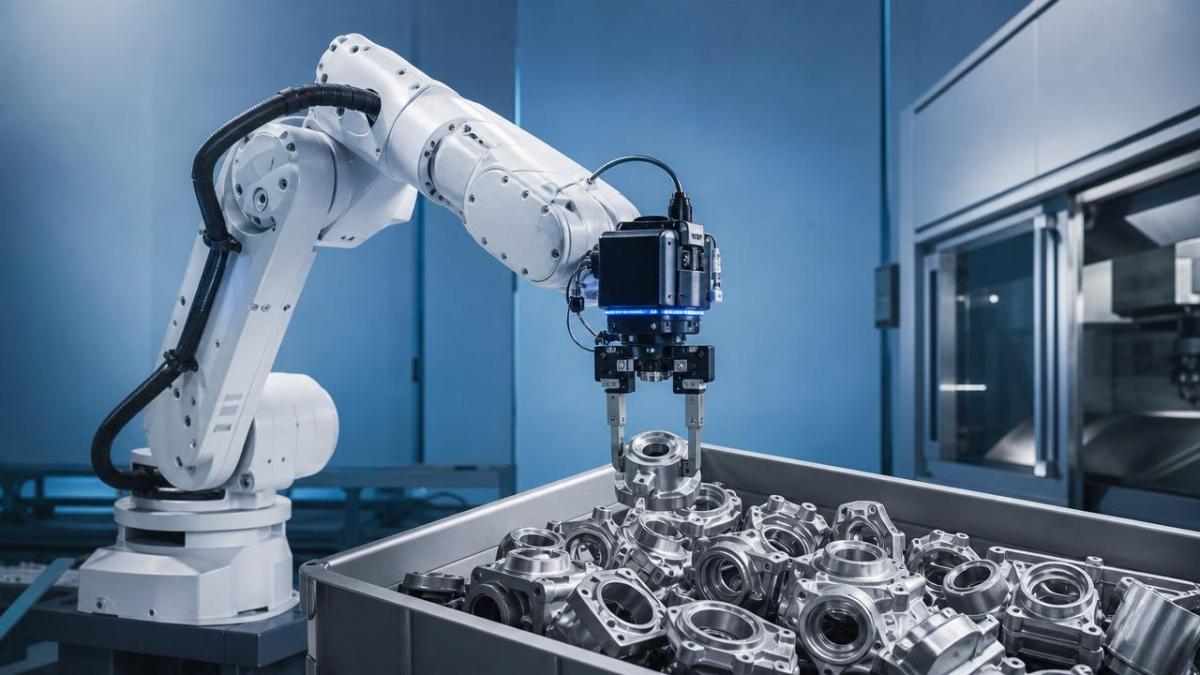
At a basic level, 3d vision for robotic bin picking combines depth sensing, object recognition, pose estimation, and robot motion planning to identify parts inside a container and guide a gripper to pick them one by one. In theory, the task sounds straightforward: scan the bin, find a part, calculate orientation, and execute a pick. In practice, this workflow becomes difficult the moment real manufacturing variables enter the scene.
Unlike neatly arranged demo parts, production components arrive with edge burrs, surface oxidation, slight dimensional drift, reflective coatings, and random stacking patterns. Some are oily. Some are dark and absorb light. Some have worn corners after transport. These details matter because the success of 3d vision for robotic bin picking depends less on laboratory precision and more on tolerance to inconsistency.
For technical assessment teams, this changes the evaluation standard. A system should not be judged only by nominal point-cloud resolution or advertised AI capabilities. It should be judged by how consistently it can localize and pick parts when geometry is imperfect, when bins are half empty, when shadows change, and when cycle time pressure is high.
Why the industry pays attention to imperfect-part performance
Manufacturing automation has moved beyond highly controlled fixtures into flexible cells that must process mixed batches, shorter runs, and higher variation. This shift is one reason 3d vision for robotic bin picking has become strategically important across automotive suppliers, aerospace machining, metal fabrication, electronics subassembly, and contract manufacturing. The more production needs flexibility, the more value vision-guided picking can create.
However, flexibility also exposes weak systems. A vision platform that performs well only with identical parts under stable lighting may deliver attractive demo results while failing in production. For organizations aligned with engineering-first evaluation principles, such as the data-driven approach promoted by TechStat Vanguard, the key issue is measurable robustness. Parameters do not lie, but test conditions often do if they are too clean.
This is why imperfect parts deserve to be the benchmark. They force the system to prove capability in the areas that actually affect uptime: segmentation accuracy in clutter, pose estimation under partial occlusion, grasp planning on non-ideal edges, and recovery behavior after failed picks. In other words, imperfection reveals whether the system is a production tool or just a polished demonstration.
The production factors that make bin picking difficult
Several technical factors explain why 3d vision for robotic bin picking works best when parts are not perfect to begin with as an evaluation condition. Each factor introduces uncertainty into the sensing and motion pipeline.
- Part-to-part variation: castings, forgings, and molded parts often have normal manufacturing spread that alters edge definition and local geometry.
- Reflective or absorptive surfaces: polished metal, black rubber, or translucent materials can reduce depth data reliability.
- Random overlap: stacked or entangled parts hide important features and complicate pose estimation.
- Orientation uncertainty: parts may settle in unstable positions that differ from the CAD model’s most common views.
- Environmental noise: changing light, vibration, dust, coolant mist, and bin wear all affect repeatability.
These are not edge cases. They are normal production conditions. A robust 3d vision for robotic bin picking system therefore needs more than image processing speed. It needs reliable 3D data acquisition, strong model matching, adaptable grasp logic, and error handling that minimizes cell stoppage.
Where imperfect-part benchmarking creates the most business value
The business case for testing with imperfect parts is strong because production economics depend on sustained throughput, not occasional peak performance. If technical evaluators rely on ideal samples during validation, they risk overestimating real-world output and underestimating support burden.
In advanced manufacturing, even a small drop in pick success rate can cascade into labor intervention, queue buildup, or unplanned downtime. For example, a cell that achieves 98% picking success in a controlled test but only 89% in production may require frequent operator rescue. That difference affects labor planning, OEE, and return on automation.
From a supply chain and engineering management perspective, realistic validation also shortens qualification cycles. Teams can compare suppliers using measurable criteria such as first-pick success, picks per hour across mixed bins, regrasp frequency, and recovery time after failed detection. This matches the broader hard-tech evaluation philosophy of focusing on verified technical evidence rather than generic performance claims.
Industry overview: how part quality affects vision-guided picking
The impact of imperfection is not equal across all industries. The table below shows how common production realities influence 3d vision for robotic bin picking performance and what evaluators should prioritize.
Typical application paths for 3D vision for robotic bin picking
Although the core technology is shared, applications differ according to part geometry, downstream process, and required autonomy level. Technical evaluators should classify use cases before comparing systems.
Single-SKU, high-volume cells
These applications often involve one part family with stable packaging and a narrow variation band. The challenge is usually speed rather than recognition breadth. Even here, imperfect samples still matter because worn bins, burrs, and finish variation can shift performance over time.
Multi-variant production
Contract manufacturers and flexible job shops increasingly need one cell to handle several similar parts. In this scenario, 3d vision for robotic bin picking must distinguish between variants, maintain grasp confidence, and avoid false positives when features partially resemble each other.
Difficult surface or geometry cases
Shiny fasteners, black molded parts, mesh-like structures, and complex castings are often the true stress tests. Here, the sensor modality, optical setup, and data filtering pipeline become as important as the robot itself.
Downstream quality-sensitive handling
When picked parts feed precision machining, welding, inspection, or aerospace assembly, the acceptable error window becomes narrower. The value of 3d vision for robotic bin picking then lies not only in finding a part, but in delivering a repeatable pose and preserving part integrity.
What technical evaluators should measure beyond a successful demo
A standard demonstration can hide production risk if it uses clean parts, shallow bins, and manual tuning. A better assessment framework uses mixed-quality samples and repeatable tests. The following criteria are especially useful.
- Detection robustness: Can the system maintain stable recognition across scratches, burrs, or lot-to-lot finish changes?
- Pose accuracy under occlusion: Does overlap degrade robot approach quality or just slow selection?
- Grasp adaptability: Can the planner switch grasp points when nominal surfaces are blocked or malformed?
- Recovery strategy: After a failed pick, how quickly does the cell rescan and continue without human intervention?
- Cycle-time stability: Is throughput consistent across full, half-full, and nearly empty bins?
- Data transparency: Are confidence scores, error logs, and performance traces available for engineering review?
These metrics align with the needs of technical evaluators who must justify decisions using evidence. They also reflect the engineering culture that values traceable performance over broad marketing language.
Practical guidance for validating real-world performance
To assess 3d vision for robotic bin picking in a way that predicts deployment success, validation should mirror production reality as closely as possible. This means building a test protocol around variation instead of excluding it.
Start with a representative part set drawn from multiple production lots. Include cosmetically imperfect but acceptable parts, because those are exactly what the system will encounter. Test across different bin fill levels and container wear states. If lighting will vary on the shop floor, reproduce that variation rather than stabilizing everything for convenience.
Next, evaluate not only average performance but tail behavior. The critical question is often what happens in the difficult 5% of cases. A cell that slows slightly but recovers autonomously may be more valuable than a faster one that stalls when the pile becomes complex. It is also important to document failure categories: missed detection, wrong pose, unstable grasp, collision risk, or downstream placement error. This level of detail helps compare root causes across vendors or internal design iterations.
Finally, connect vision results to the full automation stack. In many projects, limitations come not from the 3D sensor alone but from gripper design, robot reach, path planning, or feeder presentation. Strong 3d vision for robotic bin picking performance depends on system integration quality, not just one component specification.
Why imperfect parts are the most honest benchmark
Imperfect parts are the most honest benchmark because they expose the gap between theoretical capability and operating resilience. They test whether the vision system understands shape variation, whether the robot can approach safely in clutter, and whether the cell can sustain useful output without constant tuning. For technical evaluators, this is the difference between buying a feature set and validating a manufacturing asset.
In sectors where engineering accuracy, uptime, and supplier credibility matter, realistic validation is not a nice-to-have. It is the basis of sound decision-making. That is why 3d vision for robotic bin picking should always be assessed with the same discipline used in other hard-tech domains: define the parameters, test the edge conditions, and trust measured results over polished claims.
For teams refining automation strategy, the practical takeaway is clear: if a system can pick imperfect parts reliably, it is far more likely to succeed when production pressure rises. And if it only works when every part looks perfect, it is not yet proving the level of robustness modern manufacturing requires.
Search News
Hot Articles
- Carbon Fiber StructuresHow to Specify Aerospace Carbon Fiber Assemblies for Lightweight, Load-Bearing PartsJul 11, 2026
- Machine VisionXiaomi, Alibaba DAMO Academy Drive Open-Source Robotics Model Ecosystem, Lowering Algorithm Development Barriers for Overseas SMEs Adopting Chinese Robotics SolutionsMar 30, 2026
- Cobots & ArmsShanxi 'AI+' Conference Showcases Embodied Intelligence with Multinational Buyer Engagement: Key Industry ImplicationsMar 30, 2026
Popular Tags
Recommended News
 Jul 11, 2026How to Specify Aerospace Carbon Fiber Assemblies for Lightweight, Load-Bearing PartsAerospace carbon fiber assemblies: learn how to specify laminate design, load data, joining methods, and inspection controls for lighter, reliable load-bearing aerospace parts.Elena Rostova (UAV Systems Researcher)
 Mar 30, 2026Xiaomi, Alibaba DAMO Academy Drive Open-Source Robotics Model Ecosystem, Lowering Algorithm Development Barriers for Overseas SMEs Adopting Chinese Robotics SolutionsXiaomi & Alibaba DAMO Academy's open-source robotics models lower algorithm barriers for global SMEs. Boost efficiency in manufacturing, logistics & smart retail with ROS 2 compatible solutions.TSV Data Lab
 Mar 30, 2026Shanxi 'AI+' Conference Showcases Embodied Intelligence with Multinational Buyer Engagement: Key Industry ImplicationsShanxi 'AI+' Conference highlights embodied intelligence with Tesla, Ubtech & Jiantao showcasing multimodal robotics. 40+ global buyers validated tech on-site, creating new B2B channels for industrial automation & AI solutions.Chen Wei (Automation Lead Engineer)
 Mar 30, 2026Zhongguancun Unveils 6G Integrated Sensing-Computing-Intelligence Platform to Empower Embodied Robots for Global Industrial ApplicationsZhongguancun's new 6G platform revolutionizes industrial robotics with <10ms latency, empowering global automotive, logistics & port automation. Discover how this tech boosts China's smart manufacturing exports.TSV Data Lab
 Mar 30, 2026Mech-Mind Tianjin Embodied Intelligence R&D and Production Base Goes Live, Cutting Delivery Time by 20%–30% for Global Customized AMR+Vision SolutionsMech-Mind's Tianjin AMR+Vision production base cuts delivery time by 20%-30% for欧美 & Latin American markets. Discover how this PLd-certified facility accelerates customized robotics solutions for smart manufacturing and logistics.Chen Wei (Automation Lead Engineer)
 Mar 30, 2026Boao Forum Reveals 'Co-evolution of Big and Small Brains' Trend in Humanoid Robots, China's Embodied Intelligence Accelerates Adaptation to Overseas Manufacturing Service ScenariosDiscover how China's humanoid robots, featuring 'Co-evolution of Big and Small Brains,' are revolutionizing global manufacturing. Learn about Embodied Tian Gong 3.0's ISO compliance and overseas deployment at Boao Forum 2026.Chen Wei (Automation Lead Engineer)
 Mar 30, 2026China Railway Industrial Secures Patent for Embodied Robotics in Material Handling, Boosting High-Precision Delivery Capabilities for Overseas Infrastructure and Manufacturing ProjectsChina Railway Industrial's new patent for embodied robotics in material handling boosts high-precision delivery for global infrastructure & manufacturing. Discover how this innovation enhances logistics accuracy in automotive, rail transit & EPC projects.Chen Wei (Automation Lead Engineer)
 Sep 28, 2026Spindle Runout Measurement in Germany: DIN Standards, Methods, and Acceptance LimitsSpindle runout measurement Germany: explore DIN standards, proven methods, acceptance limits, and audit-ready practices for reliable machining quality.Dr. Marcus Vance
 Sep 27, 2026How to Select Wall-Mount Edge Devices for Space-Constrained Factory NetworksWall mount edge devices for space-constrained factories: evaluate workload, thermal design, power resilience, cable access, and network reliability for smarter deployments.TSV Data Lab
 Sep 26, 2026Machining Tolerance Analysis: How to Set Limits That Meet Function and Cost TargetsMachining tolerance analysis: learn how to set functional limits, control tolerance stacks, reduce inspection risk, and balance precision with production cost.Dr. Marcus Vance
 Sep 25, 2026How to Evaluate an Industrial Infrastructure Data Platform for Multi-Site OperationsIndustrial infrastructure data platform evaluation guide for multi-site operations: compare data quality, edge resilience, interoperability, governance, and scalable proof-of-value criteria.Victor Lin (Chief Software Architect)
 Sep 24, 2026How to Select Machine Vision Optics for Accurate Inspection at Different Working DistancesMachine vision optics selection guide for accurate inspection at every working distance. Compare FOV, pixel scale, DOF, distortion, lighting, and telecentric options.TSV Data Lab
 Sep 23, 2026How to Evaluate a Machine Vision System Integrator for High-Speed Inspection LinesChoose a machine vision system integrator with proven expertise in high-speed inspection, reliable reject timing, robust optics, and measurable acceptance criteria.TSV Data Lab
 Sep 28, 2026When is a SCADA API the right choice for connecting plant systems?SCADA API guide: learn when governed plant data integration improves traceability, security, and scalability—without compromising real-time control.Victor Lin (Chief Software Architect)
 Sep 27, 2026How SCADA data integration improves traceability across production linesSCADA data integration connects production-line data to improve traceability, accelerate quality investigations, and strengthen safety decisions.Victor Lin (Chief Software Architect)
 Sep 26, 2026What to define before starting SCADA integration planningSCADA integration planning starts with clear scope, control boundaries, data models, cybersecurity, and testing. Discover the definitions that reduce risk and costly rework.Victor Lin (Chief Software Architect)
 Sep 25, 2026How a smart factory with Industrial IoT reduces production blind spotsDiscover how a smart factory with Industrial IoT turns real-time machine, quality, and workflow data into actionable insights that reduce production blind spots and delivery risks.Victor Lin (Chief Software Architect)
 Sep 24, 2026When does Industrial IoT make smart manufacturing easier to scale?Smart manufacturing Industrial IoT scales when trusted data, interoperable systems, and secure workflows turn connected assets into measurable gains.TSV Data Lab
 Sep 23, 2026What drives ultra-precision machining cost at 1-micron tolerance?Ultra precision machining cost per part at 1 micron tolerance depends on process, material, metrology, and yield. Learn how to compare quotes confidently.Dr. Marcus Vance
 Sep 22, 2026Drone Engine-T550CC Applications: Build the UAV Power System Around the MissionAn application guide for Drone Engine-T550CC integration, covering payload planning, airframe matching, cooling, fuel, vibration, test procedures, documentation, and service preparation.Elena Rostova (UAV Systems Researcher)
 Sep 22, 2026How to Evaluate Industrial Edge Computing Vendors for Factory DeploymentIndustrial edge computing vendor evaluation guide for factories: compare latency, protocol fit, reliability, security, and lifecycle support before deployment.TSV Data Lab
 Sep 21, 2026Drone Payload Integration: Matching Power, Data, and Center of Gravity for Reliable FlightsDrone payload integration made practical: balance power, data, center of gravity, and endurance to build safer, more reliable mission-ready flights.Elena Rostova (UAV Systems Researcher)
 Sep 20, 2026Autonomous Navigation Pricing: Cost Drivers and Budget Benchmarks for AMR ProjectsAutonomous navigation price explained: compare AMR cost drivers, software, sensors, integration, safety, and lifecycle budgets to build a scalable project plan.Chen Wei (Automation Lead Engineer)
 Sep 19, 2026How to Scope Automation Integration Services for Multi-System Factory ProjectsAutomation integration services: learn how to scope multi-system factory projects with clear workflows, interface contracts, safety boundaries, and acceptance criteria.Victor Lin (Chief Software Architect)