Is Solid-State LiDAR Reliable in Dust and Rain?
Publication Date
author
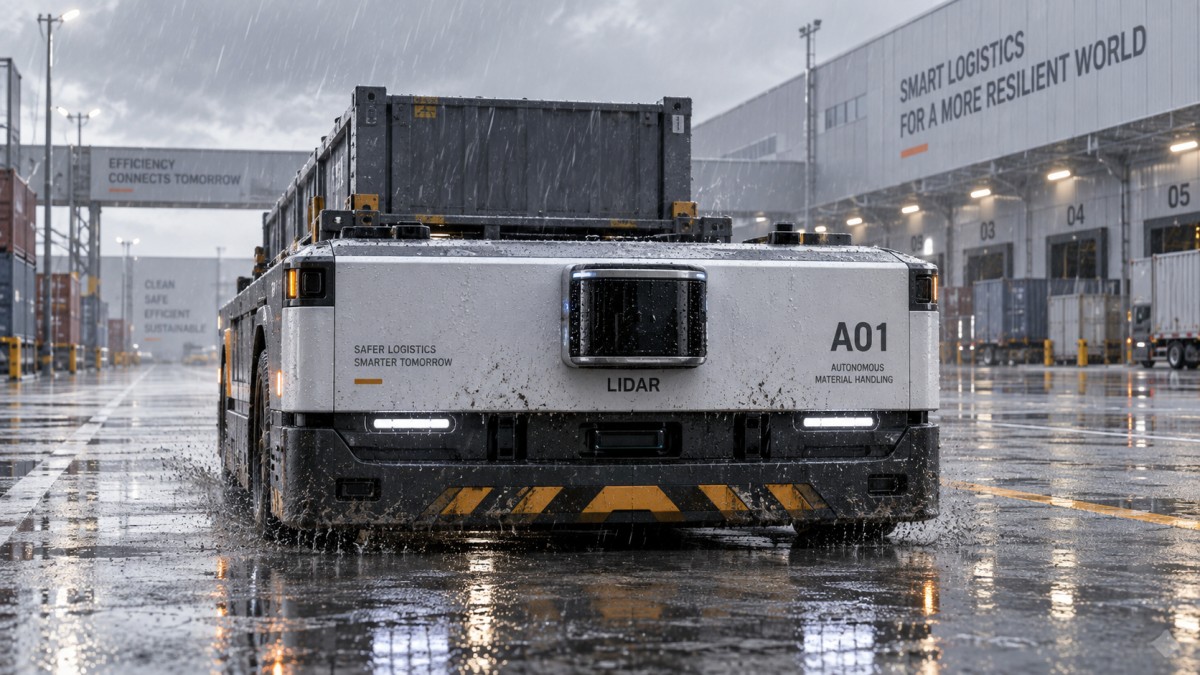
A LiDAR unit can look perfectly healthy on a bench and become uncertain the moment a delivery vehicle throws up road dust or a rain band crosses an airfield. That gap matters. For an autonomous mobile robot, an unmanned aircraft, or an outdoor industrial vehicle, sensing failure is rarely dramatic at first: the point cloud thins, range fluctuates, false returns appear near the lens, and the perception stack begins making decisions with less reliable evidence.
Is solid-state LiDAR reliable in dust and rain? Yes—under defined conditions and with an engineering approach that treats environmental resilience as a system property rather than a line item on a datasheet. A sealed housing helps, but ingress protection alone does not guarantee usable point-cloud data. Reliability in harsh weather depends on optical-window contamination, wavelength and receiver behavior, signal-processing logic, thermal control, mounting geometry, cleaning strategy, and the way downstream software reacts when visibility degrades.
The useful procurement question is therefore not, “Does this sensor work in rain?” It is: At what rain intensity, dust concentration, contamination state, vehicle speed, and minimum detection range does performance remain acceptable for the intended safety or productivity function?
What dust and rain actually do to a LiDAR measurement
Solid-state LiDAR removes the mechanical spinning assembly associated with conventional rotating sensors. Depending on the architecture, it may use MEMS beam steering, optical phased arrays, flash illumination, or another electronically controlled scanning method. Fewer moving mechanical components can improve durability and reduce certain vibration-related failure modes. Yet the light path remains exposed to the same physical realities: airborne particles scatter photons, water accumulates on optical surfaces, and the target signal can be weakened or distorted before it reaches the receiver.
Dust introduces two separate problems that are often confused. The first is airborne backscatter. Fine particles suspended between the sensor and an object can return laser energy early, creating near-field noise or reducing the energy available to reach the real target. The second is window fouling. Dust, mud, salt residue, oil mist, and dried water spots on the protective cover change transmission and scatter light directly at the sensor aperture.
Rain behaves similarly, but its effects vary more sharply with droplet size, angle, and intensity. Raindrops can produce temporary returns, attenuate the outgoing beam, and create an uneven optical layer on the cover window. Heavy rain is especially challenging because a sensor may still detect large nearby objects while losing confidence in small, low-reflectivity, or distant targets—the very objects that can matter most in a navigation or collision-avoidance workflow.
Neither condition automatically makes LiDAR unusable. The important distinction is between sensor survival and measurement integrity. A device can remain powered, sealed, and operational while its effective range, detection probability, angular precision, or false-positive rate no longer meets the application requirement.
An IP rating is necessary, but it does not answer the reliability question
Engineers commonly start with an IP rating because it is visible, standardized, and easy to compare. It is a valid screening criterion. The first digit addresses intrusion by solids, while the second concerns water exposure under specified test conditions. A high ingress-protection rating indicates that the enclosure has been tested against defined dust and water entry conditions.
What it does not prove is that the optical window stays clear, that range loss remains within a usable limit, or that a perception model can distinguish rain clutter from a genuine obstacle. An IP test is not a complete operational-weather validation program.
This is particularly relevant when a LiDAR is mounted low on a vehicle, close to wheels, conveyors, agricultural implements, or landing gear. The sensor may be sealed against water ingress but still face a continuous spray of abrasive slurry. In a quarry, warehouse yard, construction site, or crop field, the optical cover can become the dominant reliability constraint long before enclosure leakage becomes an issue.
Ask suppliers to separate these claims clearly:
- Environmental enclosure rating and test standard;
- Operating temperature range and thermal derating behavior;
- Performance under controlled rain, fog, dust, or mud-splash conditions;
- Optical-window material, coating, and replacement method;
- Detection and diagnostic mechanisms for lens obstruction;
- Degradation behavior rather than only nominal, clean-window performance.
The metrics that reveal whether a solid-state LiDAR is dependable
“Works in harsh weather” is too vague for a specification sheet. A stronger evaluation defines a baseline and then measures how far the sensor departs from it under repeatable environmental stress. For each target class relevant to the machine—pedestrian, pallet edge, cable, vehicle, wall, crop row, power line, or terrain feature—teams should examine the following metrics.
These measurements should be tied to a mission requirement. An AMR operating at walking speed in a fenced logistics yard can tolerate different uncertainty than a high-speed autonomous platform. Likewise, a UAV using LiDAR for terrain following may need stable ground returns through airborne dust, while a mining vehicle may prioritize near-field obstacle detection despite persistent mud exposure.
Why optical-window design often decides the outcome
The front window is not a passive cosmetic panel. It is part of the optical system. Its transmission characteristics, thickness, surface finish, anti-reflective coating, slope, and material resistance all influence the received signal. A well-designed window should minimize internal reflections while resisting abrasion and chemical exposure. But even a robust material will eventually lose optical quality if it is constantly hit by grit or cleaned with unsuitable tools.
Hydrophobic and oleophobic coatings can help water bead and reduce residue adhesion. They are useful, not magical. Their effectiveness changes with wear, contaminant chemistry, cleaning practices, and exposure to UV or abrasive particles. In many real deployments, the most reliable answer is not a coating alone but a contamination-management strategy: recessed mounting, a sloped optical surface, airflow routing, a washer jet, air knife, wiper, or a serviceable sacrificial cover.
Mounting angle deserves more attention than it receives. A flat, forward-facing window can retain droplets and dust. A slightly inclined placement may encourage water runoff, but it can also increase exposure to debris thrown from tires or rotors. The correct geometry comes from the actual contamination path around the host machine, not from a generic sensor bracket.
Solid-state architecture helps—but it does not eliminate weather physics
One reason solid-state LiDAR is attractive for outdoor equipment is its potential for compact packaging, lower mechanical complexity, and improved resilience to shock and vibration. In applications with frequent starts, stops, vibration, or long duty cycles, avoiding a continuously rotating assembly can simplify reliability engineering.
However, buyers should avoid treating “solid-state” as a universal weather-performance label. Different architectures have different fields of view, scan patterns, power profiles, aperture sizes, and sensitivity characteristics. A sensor optimized for short-range robotic navigation may not provide the long-range robustness needed for roadway perception. A flash LiDAR’s scene-wide illumination creates one set of design trade-offs; a beam-steering approach creates another. The right comparison is between validated performance envelopes, not category names.
Wavelength is also relevant, though it should not be reduced to a simplistic rule. Atmospheric transmission, eye-safety constraints, detector technology, laser power, target reflectivity, and receiver design interact. A wavelength choice can support a particular system design, but no wavelength makes dense dust, driving rain, or an opaque mud layer disappear.
Build for graceful degradation, not perfect visibility
In harsh outdoor environments, the best sensor strategy assumes that visibility will occasionally decline. A dependable autonomous system does not wait for LiDAR to fail completely; it monitors confidence and adjusts behavior before uncertainty becomes unsafe or operationally costly.
That may mean reducing speed when point-cloud quality falls below a threshold, increasing following distance, pausing an automated maneuver, switching to a safer route, or requesting human intervention. Multi-sensor fusion can add resilience, but it is not a substitute for validation. Cameras struggle in glare, darkness, and lens contamination; radar has different resolution limits and clutter behaviors. Combining modalities is valuable when the system understands the failure signatures of each one.
For industrial automation, a practical approach is to define three operating states: normal, degraded, and unavailable. In the normal state, LiDAR supports the full planned function. In degraded operation, the machine may continue with lower speed, restricted zones, or tighter confirmation from other sensors. In the unavailable state, the relevant autonomous action must stop or revert to a defined safe mode. These boundaries should be based on measured detection capability, not on an arbitrary signal-strength number.
A test plan that resembles the real deployment
Laboratory environmental tests are essential, but they should be followed by field trials that reflect actual contamination mechanisms. A desert UAV, a port-side AGV, and an agricultural robot may all encounter “dust and rain,” yet their exposure profiles are radically different.
A useful validation plan begins with a clean baseline: target range, point density, range precision, latency, and object-detection performance at relevant speeds and angles. Then introduce controlled stress conditions one at a time—fine dust, coarse dust, water spray, rain simulation, thermal cycling, vibration, salt residue, and partial window blockage. Finally, test combinations. Rain after dust can create an adherent film that is more problematic than either condition alone.
Document the target materials as well. Highly reflective panels can make a sensor appear more capable than it will be around dark rubber, wet asphalt, weathered timber, foliage, matte-painted machinery, or low-reflectivity garments. The most useful report states the target reflectivity, geometry, distance, motion, weather condition, and pass/fail definition.
For procurement teams, a supplier demonstration should not be treated as final evidence unless the test setup is transparent. Request raw or representative point-cloud samples where possible, understand the filtering configuration, and confirm whether the sensor was tested with a clean window, a wetted window, or realistic contaminant accumulation. A strong engineering partner will be able to discuss limitations without hiding behind broad environmental claims.
Questions to ask before selecting a sensor
Before committing to a solid-state LiDAR platform, align the technical team around a short set of uncomfortable but necessary questions:
- What is the minimum object size and reflectivity that must be detected, and at what distance?
- What weather and contamination conditions are expected during the machine’s operating hours?
- Where will the sensor sit relative to wheels, rotors, exhaust, conveyors, and washdown zones?
- Can the host system clean the window automatically, and how will cleaning effectiveness be verified?
- What diagnostic output indicates partial obstruction or declining optical performance?
- What action will the machine take when the point cloud becomes too sparse or unstable?
- How frequently can the optical cover be inspected, cleaned, or replaced without disrupting operations?
The answers often reveal that the sensor itself is only one component of the solution. Mechanical design, maintenance access, software safeguards, and application-specific test criteria determine whether a promising LiDAR specification becomes dependable field performance.
The practical verdict
Solid-state LiDAR can be reliable in dust and rain, particularly when its compact, low-moving-part design is paired with environmental sealing, intelligent thermal management, contamination control, and robust perception software. But reliability should never be inferred from an IP rating or a clean-condition range figure alone.
For engineering teams, the defensible decision is to specify measurable performance under the exact conditions that threaten the mission: wet-window operation, airborne particulates, realistic target materials, vibration, temperature variation, and partial obstruction. Parameters do not lie—but only when the test conditions behind them are made visible. In harsh environments, that level of evidence is what separates a sensor that survives the weather from one that continues to provide trustworthy data through it.
Search News
Hot Articles
- Carbon Fiber StructuresHow to Specify Aerospace Carbon Fiber Assemblies for Lightweight, Load-Bearing PartsJul 11, 2026
- Machine VisionXiaomi, Alibaba DAMO Academy Drive Open-Source Robotics Model Ecosystem, Lowering Algorithm Development Barriers for Overseas SMEs Adopting Chinese Robotics SolutionsMar 30, 2026
- Cobots & ArmsShanxi 'AI+' Conference Showcases Embodied Intelligence with Multinational Buyer Engagement: Key Industry ImplicationsMar 30, 2026
Popular Tags
Recommended News
 Jul 11, 2026How to Specify Aerospace Carbon Fiber Assemblies for Lightweight, Load-Bearing PartsAerospace carbon fiber assemblies: learn how to specify laminate design, load data, joining methods, and inspection controls for lighter, reliable load-bearing aerospace parts.Elena Rostova (UAV Systems Researcher)
 Mar 30, 2026Xiaomi, Alibaba DAMO Academy Drive Open-Source Robotics Model Ecosystem, Lowering Algorithm Development Barriers for Overseas SMEs Adopting Chinese Robotics SolutionsXiaomi & Alibaba DAMO Academy's open-source robotics models lower algorithm barriers for global SMEs. Boost efficiency in manufacturing, logistics & smart retail with ROS 2 compatible solutions.TSV Data Lab
 Mar 30, 2026Shanxi 'AI+' Conference Showcases Embodied Intelligence with Multinational Buyer Engagement: Key Industry ImplicationsShanxi 'AI+' Conference highlights embodied intelligence with Tesla, Ubtech & Jiantao showcasing multimodal robotics. 40+ global buyers validated tech on-site, creating new B2B channels for industrial automation & AI solutions.Chen Wei (Automation Lead Engineer)
 Mar 30, 2026Zhongguancun Unveils 6G Integrated Sensing-Computing-Intelligence Platform to Empower Embodied Robots for Global Industrial ApplicationsZhongguancun's new 6G platform revolutionizes industrial robotics with <10ms latency, empowering global automotive, logistics & port automation. Discover how this tech boosts China's smart manufacturing exports.TSV Data Lab
 Mar 30, 2026Mech-Mind Tianjin Embodied Intelligence R&D and Production Base Goes Live, Cutting Delivery Time by 20%–30% for Global Customized AMR+Vision SolutionsMech-Mind's Tianjin AMR+Vision production base cuts delivery time by 20%-30% for欧美 & Latin American markets. Discover how this PLd-certified facility accelerates customized robotics solutions for smart manufacturing and logistics.Chen Wei (Automation Lead Engineer)
 Mar 30, 2026Boao Forum Reveals 'Co-evolution of Big and Small Brains' Trend in Humanoid Robots, China's Embodied Intelligence Accelerates Adaptation to Overseas Manufacturing Service ScenariosDiscover how China's humanoid robots, featuring 'Co-evolution of Big and Small Brains,' are revolutionizing global manufacturing. Learn about Embodied Tian Gong 3.0's ISO compliance and overseas deployment at Boao Forum 2026.Chen Wei (Automation Lead Engineer)
 Mar 30, 2026China Railway Industrial Secures Patent for Embodied Robotics in Material Handling, Boosting High-Precision Delivery Capabilities for Overseas Infrastructure and Manufacturing ProjectsChina Railway Industrial's new patent for embodied robotics in material handling boosts high-precision delivery for global infrastructure & manufacturing. Discover how this innovation enhances logistics accuracy in automotive, rail transit & EPC projects.Chen Wei (Automation Lead Engineer)
 Oct 03, 2026Selecting Automotive Radar Sensor Modules for ADAS Range, Resolution, and IntegrationAutomotive radar sensor module selection guide for ADAS: compare range, resolution, field of view, latency, and integration to build safer, reliable vehicle systems.TSV Data Lab
 Oct 02, 2026How to Qualify Machined Parts Suppliers for Hard Tech ProgramsHard tech supply chain machined parts demand rigorous supplier qualification. Learn how to assess capability, traceability, quality controls, and delivery resilience.Dr. Marcus Vance
 Oct 01, 2026How to Select an Outdoor Security Radar Sensor for Perimeter Detection?Outdoor security radar sensor selection guide: compare range, accuracy, false-alarm control, integration, and field testing for reliable perimeter detection.TSV Data Lab
 Sep 30, 2026How to Evaluate Solid-State LiDAR Hardware for Outdoor Autonomous VehiclesSolid state LiDAR hardware evaluation guide for outdoor autonomous vehicles—compare range, point-cloud quality, environmental resilience, integration, and safety.TSV Data Lab
 Sep 29, 2026ISO 9283 Repeatability: How to Evaluate Cobot Positioning PerformanceISO 9283 cobot repeatability explained: learn how payload, reach, approach direction, and test conditions affect positioning performance and cell capability.Chen Wei (Automation Lead Engineer)
 Oct 03, 2026Is Edge Computing Necessary for Real-Time Quality Inspection?Is industrial edge computing necessary for real-time quality inspection? Explore how latency, data volume, reliability, and control integration shape the right architecture.TSV Data Lab
 Oct 02, 2026What Documents Prove a Precision Machining Supplier Can Hold Tolerance?What documents prove a precision machining supplier can hold tolerance? Explore certificates, FAI reports, calibration, SPC, and traceability evidence to qualify suppliers with confidence.Dr. Marcus Vance
 Oct 01, 2026Can a Machining Supplier Meet Aerospace Fatigue Testing Requirements?Can a machining supplier meet aerospace fatigue testing requirements? Learn the traceability, process control, and test evidence needed for reliable aerospace parts.Dr. Marcus Vance
 Sep 30, 2026Which Industrial Robot Specifications Matter for High-Precision Assembly?Which industrial robot specifications matter most for high-precision assembly? Explore repeatability, accuracy, stiffness, vibration, calibration, and force control for reliable yields.Chen Wei (Automation Lead Engineer)
 Sep 29, 2026How Do You Verify Servo Motor Torque Under Continuous Load?How do I verify servo motor torque under continuous load? Learn RMS torque checks, torque-speed limits, thermal derating, and real-machine testing.Chen Wei (Automation Lead Engineer)
 Oct 02, 2026ZD330 Software Configuration: Verifying Cut-List Import Before PurchaseZD330 software and machine configuration: verify cut-list imports, data mapping, labels, and workflow before purchase to reduce errors and choose with confidence.Victor Lin (Chief Software Architect)
 Sep 28, 2026Spindle Runout Measurement in Germany: DIN Standards, Methods, and Acceptance LimitsSpindle runout measurement Germany: explore DIN standards, proven methods, acceptance limits, and audit-ready practices for reliable machining quality.Dr. Marcus Vance
 Sep 27, 2026How to Select Wall-Mount Edge Devices for Space-Constrained Factory NetworksWall mount edge devices for space-constrained factories: evaluate workload, thermal design, power resilience, cable access, and network reliability for smarter deployments.TSV Data Lab
 Sep 26, 2026Machining Tolerance Analysis: How to Set Limits That Meet Function and Cost TargetsMachining tolerance analysis: learn how to set functional limits, control tolerance stacks, reduce inspection risk, and balance precision with production cost.Dr. Marcus Vance
 Sep 25, 2026How to Evaluate an Industrial Infrastructure Data Platform for Multi-Site OperationsIndustrial infrastructure data platform evaluation guide for multi-site operations: compare data quality, edge resilience, interoperability, governance, and scalable proof-of-value criteria.Victor Lin (Chief Software Architect)
 Sep 24, 2026How to Select Machine Vision Optics for Accurate Inspection at Different Working DistancesMachine vision optics selection guide for accurate inspection at every working distance. Compare FOV, pixel scale, DOF, distortion, lighting, and telecentric options.TSV Data Lab
 Sep 23, 2026How to Evaluate a Machine Vision System Integrator for High-Speed Inspection LinesChoose a machine vision system integrator with proven expertise in high-speed inspection, reliable reject timing, robust optics, and measurable acceptance criteria.TSV Data Lab