Food Beverage Traceability Software and the Recall Gap
Publication Date
author
For quality control and food safety teams, the true risk in a recall is often the time lost before facts become visible.
Food beverage traceability software reduces that delay by connecting supplier lots, production records, packaging data, and shipment events into one verified trail.
When contamination, mislabeling, or process deviation appears, response speed becomes a measurable operational capability, not a communications exercise.
In modern food and beverage operations, traceability now supports compliance, root-cause analysis, brand protection, and continuous process improvement.
Understanding Food Beverage Traceability Software
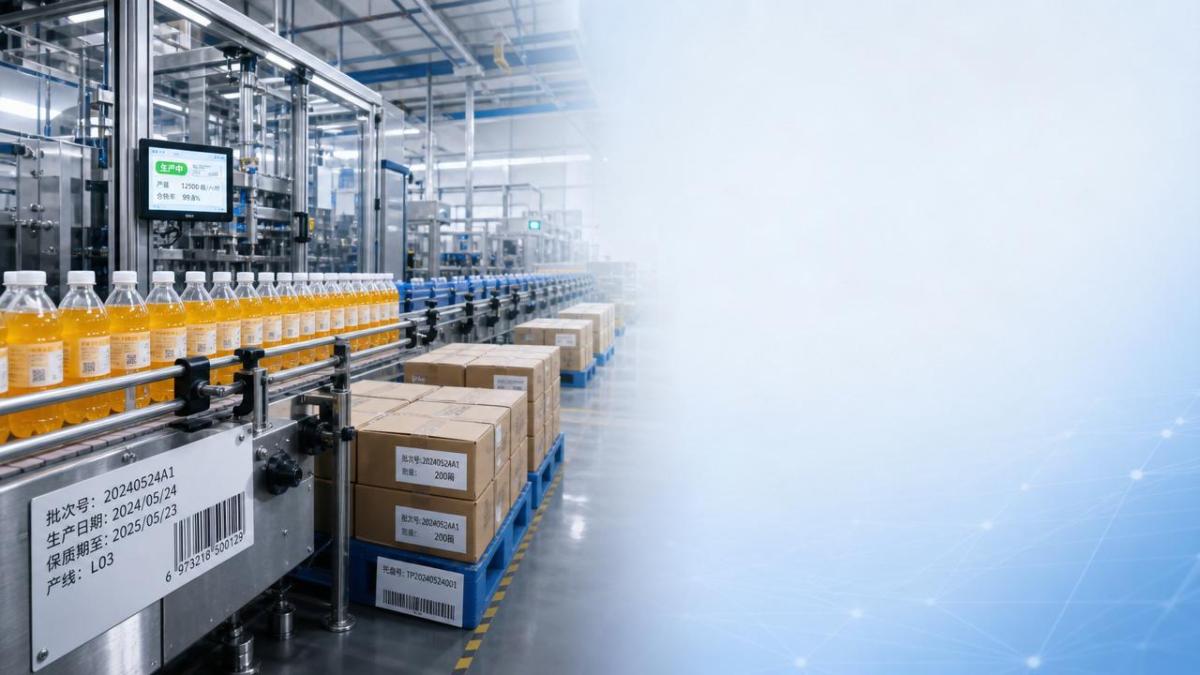
Food beverage traceability software is a digital system that records how ingredients, materials, batches, and finished goods move across the supply chain.
It links receiving, storage, formulation, production, packaging, warehouse handling, and outbound distribution using time-stamped records.
The main objective is simple: identify where a product came from, where it went, and what changed in between.
A strong platform does more than store data. It preserves chain-of-custody logic and supports rapid backward and forward tracing.
This matters because recalls rarely fail from lack of concern. They fail when records are scattered across spreadsheets, paper logs, and disconnected systems.
Core data captured by traceability systems
- Supplier identity, ingredient lot, and certificate references
- Receiving date, quantity, storage zone, and status changes
- Batch formulation, process steps, operator events, and equipment links
- Packaging materials, label versions, and allergen declarations
- Shipment records, customer destination, and return handling
Why the Recall Gap Still Exists
The recall gap is the distance between a detected issue and a confident containment decision.
In many facilities, that gap remains wide because operational data is fragmented by department, software stack, and supplier maturity.
Manual reconciliation introduces uncertainty. Teams may know a problem exists, yet still struggle to isolate affected lots with precision.
That leads to broader recalls, slower notices, higher disposal costs, and avoidable damage to trust.
Food beverage traceability software addresses these weak points by making trace links machine-readable, searchable, and auditable.
Industry Drivers Behind Traceability Investment
Traceability pressure is no longer limited to regulatory compliance. It now reflects broader operational complexity across the combined food system.
Global sourcing, shorter product cycles, private labeling, and allergen sensitivity all increase the need for data discipline.
The beverage segment adds more variables, including blending, seasonal raw materials, and packaging line changeovers.
Key industry drivers
- Rising scrutiny on food safety documentation
- Faster recall communication expectations
- Complex co-manufacturing and multi-site production
- Expansion of direct distribution and omnichannel fulfillment
- Need for proof across sustainability and origin claims
From the TSV perspective, the challenge is not visibility alone. The challenge is engineering-grade confidence in the accuracy of trace records.
Parameters matter here too. Timestamp fidelity, batch granularity, and event linkage determine whether traceability works under pressure.
Business Value of Food Beverage Traceability Software
The value of food beverage traceability software becomes most visible when an exception occurs, but its benefits begin long before a recall.
It reduces search time, improves production accountability, and helps contain deviations before they become public incidents.
Operational gains
- Faster lot isolation during contamination events
- Better inventory rotation and expiration control
- Improved verification of rework and hold-release steps
- Reduced manual effort in audit preparation
Strategic gains
- Higher confidence in supplier qualification
- Stronger evidence for customer and regulatory inquiries
- Lower recall scope through precise forward tracing
- Better protection of brand credibility
A robust food beverage traceability software platform also supports analytics. Repeated deviations can be mapped to specific inputs, shifts, machines, or suppliers.
That turns traceability from a defensive function into a source of process intelligence.
Typical Traceability Scenarios Across Food and Beverage Operations
Different product categories expose different trace risks. Software design should reflect those operational patterns rather than force one generic workflow.
In each case, food beverage traceability software should preserve one source of truth from inbound material to outbound unit movement.
Implementation Priorities and Data Discipline
Successful adoption depends less on interface appearance and more on data architecture.
If key events are optional, delayed, or manually edited without control, traceability confidence declines immediately.
Practical implementation priorities
- Define batch and lot granularity before software configuration.
- Map every handoff point across receiving, processing, packaging, and dispatch.
- Standardize supplier identifiers and material naming conventions.
- Integrate quality events, hold status, and release authorization.
- Test mock recalls using real production data, not training examples.
Food beverage traceability software performs best when digital records mirror physical reality with minimal lag and minimal ambiguity.
That requires disciplined scanning, controlled data entry, and clear ownership of exceptions.
Evaluation Criteria for a Reliable Traceability Platform
Not every system labeled as food beverage traceability software can support high-speed recall decisions.
Evaluation should focus on evidence, structure, and recoverability.
- Can the platform complete backward and forward trace in minutes, not hours?
- Does it preserve audit history for edits, overrides, and approvals?
- Can it connect supplier records with production and shipment events?
- Does it support multi-site and co-manufacturing environments?
- Are reports usable during regulatory review and internal investigation?
In a data-driven operating model, traceability must be tested like any other critical control function.
The system should prove consistency under real production pressure, not only in vendor demonstrations.
Next-Step Direction for Stronger Recall Readiness
Closing the recall gap starts with one measurable question: how fast can affected lots be identified with defensible certainty?
If the answer depends on emails, spreadsheets, and memory, the traceability model is already under strain.
A stronger path is to review current trace links, run a live mock recall, and identify every missing data point.
Food beverage traceability software should then be evaluated against actual workflow complexity, not generic feature lists.
For organizations seeking engineering-level operational truth, the objective is clear: create a verified chain of data before the next incident demands it.
Search News
Hot Articles
- Carbon Fiber StructuresHow to Specify Aerospace Carbon Fiber Assemblies for Lightweight, Load-Bearing PartsJul 11, 2026
- Machine VisionXiaomi, Alibaba DAMO Academy Drive Open-Source Robotics Model Ecosystem, Lowering Algorithm Development Barriers for Overseas SMEs Adopting Chinese Robotics SolutionsMar 30, 2026
- Cobots & ArmsShanxi 'AI+' Conference Showcases Embodied Intelligence with Multinational Buyer Engagement: Key Industry ImplicationsMar 30, 2026
Popular Tags
Recommended News
 Jul 11, 2026How to Specify Aerospace Carbon Fiber Assemblies for Lightweight, Load-Bearing PartsAerospace carbon fiber assemblies: learn how to specify laminate design, load data, joining methods, and inspection controls for lighter, reliable load-bearing aerospace parts.Elena Rostova (UAV Systems Researcher)
 Mar 30, 2026Xiaomi, Alibaba DAMO Academy Drive Open-Source Robotics Model Ecosystem, Lowering Algorithm Development Barriers for Overseas SMEs Adopting Chinese Robotics SolutionsXiaomi & Alibaba DAMO Academy's open-source robotics models lower algorithm barriers for global SMEs. Boost efficiency in manufacturing, logistics & smart retail with ROS 2 compatible solutions.TSV Data Lab
 Mar 30, 2026Shanxi 'AI+' Conference Showcases Embodied Intelligence with Multinational Buyer Engagement: Key Industry ImplicationsShanxi 'AI+' Conference highlights embodied intelligence with Tesla, Ubtech & Jiantao showcasing multimodal robotics. 40+ global buyers validated tech on-site, creating new B2B channels for industrial automation & AI solutions.Chen Wei (Automation Lead Engineer)
 Mar 30, 2026Zhongguancun Unveils 6G Integrated Sensing-Computing-Intelligence Platform to Empower Embodied Robots for Global Industrial ApplicationsZhongguancun's new 6G platform revolutionizes industrial robotics with <10ms latency, empowering global automotive, logistics & port automation. Discover how this tech boosts China's smart manufacturing exports.TSV Data Lab
 Mar 30, 2026Mech-Mind Tianjin Embodied Intelligence R&D and Production Base Goes Live, Cutting Delivery Time by 20%–30% for Global Customized AMR+Vision SolutionsMech-Mind's Tianjin AMR+Vision production base cuts delivery time by 20%-30% for欧美 & Latin American markets. Discover how this PLd-certified facility accelerates customized robotics solutions for smart manufacturing and logistics.Chen Wei (Automation Lead Engineer)
 Mar 30, 2026Boao Forum Reveals 'Co-evolution of Big and Small Brains' Trend in Humanoid Robots, China's Embodied Intelligence Accelerates Adaptation to Overseas Manufacturing Service ScenariosDiscover how China's humanoid robots, featuring 'Co-evolution of Big and Small Brains,' are revolutionizing global manufacturing. Learn about Embodied Tian Gong 3.0's ISO compliance and overseas deployment at Boao Forum 2026.Chen Wei (Automation Lead Engineer)
 Mar 30, 2026China Railway Industrial Secures Patent for Embodied Robotics in Material Handling, Boosting High-Precision Delivery Capabilities for Overseas Infrastructure and Manufacturing ProjectsChina Railway Industrial's new patent for embodied robotics in material handling boosts high-precision delivery for global infrastructure & manufacturing. Discover how this innovation enhances logistics accuracy in automotive, rail transit & EPC projects.Chen Wei (Automation Lead Engineer)
 Sep 28, 2026Spindle Runout Measurement in Germany: DIN Standards, Methods, and Acceptance LimitsSpindle runout measurement Germany: explore DIN standards, proven methods, acceptance limits, and audit-ready practices for reliable machining quality.Dr. Marcus Vance
 Sep 27, 2026How to Select Wall-Mount Edge Devices for Space-Constrained Factory NetworksWall mount edge devices for space-constrained factories: evaluate workload, thermal design, power resilience, cable access, and network reliability for smarter deployments.TSV Data Lab
 Sep 26, 2026Machining Tolerance Analysis: How to Set Limits That Meet Function and Cost TargetsMachining tolerance analysis: learn how to set functional limits, control tolerance stacks, reduce inspection risk, and balance precision with production cost.Dr. Marcus Vance
 Sep 25, 2026How to Evaluate an Industrial Infrastructure Data Platform for Multi-Site OperationsIndustrial infrastructure data platform evaluation guide for multi-site operations: compare data quality, edge resilience, interoperability, governance, and scalable proof-of-value criteria.Victor Lin (Chief Software Architect)
 Sep 24, 2026How to Select Machine Vision Optics for Accurate Inspection at Different Working DistancesMachine vision optics selection guide for accurate inspection at every working distance. Compare FOV, pixel scale, DOF, distortion, lighting, and telecentric options.TSV Data Lab
 Sep 23, 2026How to Evaluate a Machine Vision System Integrator for High-Speed Inspection LinesChoose a machine vision system integrator with proven expertise in high-speed inspection, reliable reject timing, robust optics, and measurable acceptance criteria.TSV Data Lab
 Sep 28, 2026When is a SCADA API the right choice for connecting plant systems?SCADA API guide: learn when governed plant data integration improves traceability, security, and scalability—without compromising real-time control.Victor Lin (Chief Software Architect)
 Sep 27, 2026How SCADA data integration improves traceability across production linesSCADA data integration connects production-line data to improve traceability, accelerate quality investigations, and strengthen safety decisions.Victor Lin (Chief Software Architect)
 Sep 26, 2026What to define before starting SCADA integration planningSCADA integration planning starts with clear scope, control boundaries, data models, cybersecurity, and testing. Discover the definitions that reduce risk and costly rework.Victor Lin (Chief Software Architect)
 Sep 25, 2026How a smart factory with Industrial IoT reduces production blind spotsDiscover how a smart factory with Industrial IoT turns real-time machine, quality, and workflow data into actionable insights that reduce production blind spots and delivery risks.Victor Lin (Chief Software Architect)
 Sep 24, 2026When does Industrial IoT make smart manufacturing easier to scale?Smart manufacturing Industrial IoT scales when trusted data, interoperable systems, and secure workflows turn connected assets into measurable gains.TSV Data Lab
 Sep 23, 2026What drives ultra-precision machining cost at 1-micron tolerance?Ultra precision machining cost per part at 1 micron tolerance depends on process, material, metrology, and yield. Learn how to compare quotes confidently.Dr. Marcus Vance
 Sep 22, 2026Drone Engine-T550CC Applications: Build the UAV Power System Around the MissionAn application guide for Drone Engine-T550CC integration, covering payload planning, airframe matching, cooling, fuel, vibration, test procedures, documentation, and service preparation.Elena Rostova (UAV Systems Researcher)
 Sep 22, 2026How to Evaluate Industrial Edge Computing Vendors for Factory DeploymentIndustrial edge computing vendor evaluation guide for factories: compare latency, protocol fit, reliability, security, and lifecycle support before deployment.TSV Data Lab
 Sep 21, 2026Drone Payload Integration: Matching Power, Data, and Center of Gravity for Reliable FlightsDrone payload integration made practical: balance power, data, center of gravity, and endurance to build safer, more reliable mission-ready flights.Elena Rostova (UAV Systems Researcher)
 Sep 20, 2026Autonomous Navigation Pricing: Cost Drivers and Budget Benchmarks for AMR ProjectsAutonomous navigation price explained: compare AMR cost drivers, software, sensors, integration, safety, and lifecycle budgets to build a scalable project plan.Chen Wei (Automation Lead Engineer)
 Sep 19, 2026How to Scope Automation Integration Services for Multi-System Factory ProjectsAutomation integration services: learn how to scope multi-system factory projects with clear workflows, interface contracts, safety boundaries, and acceptance criteria.Victor Lin (Chief Software Architect)