When Robotic Welding Offline Programming Cuts Cycle Time
Publication Date
author
For project teams chasing shorter takt time, robotic welding offline programming can remove a major hidden delay from production. It shifts path creation, simulation, and error checking away from the cell. That change helps reduce line stoppages, improve program accuracy, and cut cycle time without sacrificing weld consistency.
What is robotic welding offline programming, and why does it affect cycle time?
Robotic welding offline programming means building and testing robot weld programs in virtual software instead of on the live production line.
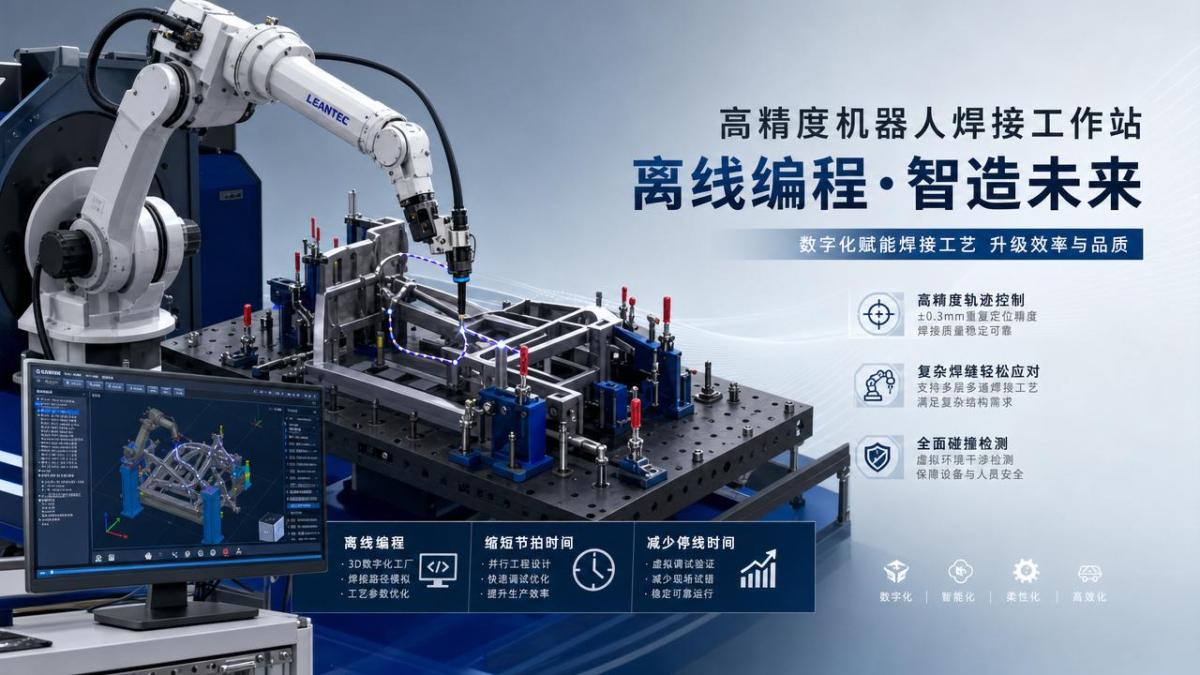
A digital model of the robot, fixture, workpiece, torch, and surrounding equipment is used to create paths and validate motion.
Cycle time improves because the robot spends less real-world time waiting for manual teaching, touch-ups, and collision recovery.
In conventional online teaching, every path adjustment may stop production. That delay grows quickly across multi-part assemblies or high-mix welding cells.
With robotic welding offline programming, teams can optimize travel moves, torch angles, and sequencing before the first live arc starts.
This matters in general industry because many operations run mixed batches, changing fixtures, and variable weld lengths.
A better program reduces air-cut motion, shortens repositioning, and supports steadier arc-on time. Those are direct contributors to lower cycle time.
How the time savings usually appear
- Less downtime during new product introduction
- Faster changeovers between similar parts
- Fewer manual teach points on the shop floor
- Reduced collision risk and rework
- Better motion efficiency between weld seams
When does robotic welding offline programming deliver the biggest cycle time gains?
The biggest gains appear when welding tasks are complex enough that manual teaching becomes slow, repetitive, or inconsistent.
Large fabricated structures are a strong fit. Long reach moves, awkward torch access, and many seams create many opportunities for virtual optimization.
High-mix, low-volume production also benefits. Repeatedly teaching similar parts on the floor consumes time that offline tools can compress.
Multi-robot cells gain even more. Robotic welding offline programming can coordinate robot timing, shared zones, and positioner movement before launch.
Short product life cycles are another strong case. If part designs change often, virtual updates are easier than full re-teaching at the cell.
Typical application scenarios
- Heavy equipment frames and brackets
- Automotive subassemblies and exhaust systems
- Steel furniture, cabinets, and enclosures
- Agricultural machinery weldments
- Contract fabrication with frequent part turnover
Simple, repetitive parts may still benefit, but the return is often smaller if manual programming is already quick and stable.
How does robotic welding offline programming differ from online teach programming?
Online teaching happens at the robot. An operator jogs the arm, records points, checks access, and edits the program while the cell is occupied.
Offline programming happens in software. The robot path is built from CAD data and process rules, then transferred to the controller.
The key difference is where the trial-and-error occurs. Online methods consume production time. Robotic welding offline programming moves that effort upstream.
That said, offline work is not magic. Final touch-up is still common because fixture tolerances, part variation, and thermal distortion exist in real production.
Quick comparison table
What factors determine whether robotic welding offline programming will really cut cycle time?
The first factor is digital accuracy. If CAD models, tool center points, and fixture layouts are wrong, simulation gains disappear during commissioning.
The second factor is weld process integration. Motion alone is not enough. Travel speed, wire feed, approach sequence, and weld order must align.
The third factor is part consistency. Robotic welding offline programming performs best when fixtures control location and gaps within predictable limits.
The fourth factor is software capability. Some platforms offer advanced cycle analysis, singularity detection, and synchronized positioner logic.
The fifth factor is team workflow. Engineering, welding, and production data must connect. Isolated files and unclear revision control cause delays.
Practical evaluation checklist
- Are CAD models current and manufacturable?
- Is the robot cell modeled with exact reach limits?
- Are fixtures repeatable enough for virtual paths?
- Can the software export controller-ready code?
- Is there a process for quick shop-floor touch-up?
What risks and common mistakes can reduce the value of robotic welding offline programming?
A common mistake is treating simulation as a perfect substitute for process knowledge. Good software cannot fix poor weld sequencing or unstable joint design.
Another mistake is ignoring tolerances. Small fixture offsets can create torch angle errors, missed joints, or access failures during live runs.
Some teams overfocus on robot speed settings. True cycle time reduction often comes from smoother path logic and less non-value-added movement.
There is also a data management risk. If revisions are uncontrolled, the wrong part model may generate the wrong weld path.
Robotic welding offline programming should be paired with disciplined benchmarking. Parameters, tolerances, and actual runtime data must validate the model.
Warning signs during implementation
- Frequent manual edits after every download
- Mismatch between simulated and real cycle time
- Unexpected torch collisions near clamps
- High dependence on one programmer’s memory
- No feedback loop from actual weld quality data
How should implementation be planned for faster results and lower disruption?
Start with one representative cell, not the entire welding operation. Choose a part family with moderate complexity and measurable downtime pain.
Define success before launch. Track setup hours, arc-on ratio, total cycle time, collision events, and number of floor-side edits.
Build the digital cell carefully. Include robot base position, torch geometry, cable routing limits, fixtures, clamps, and part datum references.
Then simulate the complete welding sequence. Optimize weld order, robot approach, part repositioning, and safe clearance zones.
After commissioning, compare simulated data with actual runtime. Robotic welding offline programming improves fastest when the digital model learns from production.
Suggested rollout sequence
- Audit current welding cell losses
- Validate CAD and fixture accuracy
- Create a pilot offline program
- Run virtual collision and reach checks
- Download, touch up, and benchmark live results
- Standardize proven programming templates
FAQ summary: how to judge fit, risk, and expected return
Robotic welding offline programming is most valuable when engineering data is trusted, welding logic is standardized, and shop-floor feedback is captured quickly.
A practical next step is to benchmark one cell, map current losses, and test whether virtual programming can remove avoidable downtime.
In hard-tech operations, claims should be tested against measurable output. Robotic welding offline programming earns its place when cycle time falls and repeatability rises.
Search News
Hot Articles
- Carbon Fiber StructuresHow to Specify Aerospace Carbon Fiber Assemblies for Lightweight, Load-Bearing PartsJul 11, 2026
- Machine VisionXiaomi, Alibaba DAMO Academy Drive Open-Source Robotics Model Ecosystem, Lowering Algorithm Development Barriers for Overseas SMEs Adopting Chinese Robotics SolutionsMar 30, 2026
- Cobots & ArmsShanxi 'AI+' Conference Showcases Embodied Intelligence with Multinational Buyer Engagement: Key Industry ImplicationsMar 30, 2026
Popular Tags
Recommended News
 Jul 11, 2026How to Specify Aerospace Carbon Fiber Assemblies for Lightweight, Load-Bearing PartsAerospace carbon fiber assemblies: learn how to specify laminate design, load data, joining methods, and inspection controls for lighter, reliable load-bearing aerospace parts.Elena Rostova (UAV Systems Researcher)
 Mar 30, 2026Xiaomi, Alibaba DAMO Academy Drive Open-Source Robotics Model Ecosystem, Lowering Algorithm Development Barriers for Overseas SMEs Adopting Chinese Robotics SolutionsXiaomi & Alibaba DAMO Academy's open-source robotics models lower algorithm barriers for global SMEs. Boost efficiency in manufacturing, logistics & smart retail with ROS 2 compatible solutions.TSV Data Lab
 Mar 30, 2026Shanxi 'AI+' Conference Showcases Embodied Intelligence with Multinational Buyer Engagement: Key Industry ImplicationsShanxi 'AI+' Conference highlights embodied intelligence with Tesla, Ubtech & Jiantao showcasing multimodal robotics. 40+ global buyers validated tech on-site, creating new B2B channels for industrial automation & AI solutions.Chen Wei (Automation Lead Engineer)
 Mar 30, 2026Zhongguancun Unveils 6G Integrated Sensing-Computing-Intelligence Platform to Empower Embodied Robots for Global Industrial ApplicationsZhongguancun's new 6G platform revolutionizes industrial robotics with <10ms latency, empowering global automotive, logistics & port automation. Discover how this tech boosts China's smart manufacturing exports.TSV Data Lab
 Mar 30, 2026Mech-Mind Tianjin Embodied Intelligence R&D and Production Base Goes Live, Cutting Delivery Time by 20%–30% for Global Customized AMR+Vision SolutionsMech-Mind's Tianjin AMR+Vision production base cuts delivery time by 20%-30% for欧美 & Latin American markets. Discover how this PLd-certified facility accelerates customized robotics solutions for smart manufacturing and logistics.Chen Wei (Automation Lead Engineer)
 Mar 30, 2026Boao Forum Reveals 'Co-evolution of Big and Small Brains' Trend in Humanoid Robots, China's Embodied Intelligence Accelerates Adaptation to Overseas Manufacturing Service ScenariosDiscover how China's humanoid robots, featuring 'Co-evolution of Big and Small Brains,' are revolutionizing global manufacturing. Learn about Embodied Tian Gong 3.0's ISO compliance and overseas deployment at Boao Forum 2026.Chen Wei (Automation Lead Engineer)
 Mar 30, 2026China Railway Industrial Secures Patent for Embodied Robotics in Material Handling, Boosting High-Precision Delivery Capabilities for Overseas Infrastructure and Manufacturing ProjectsChina Railway Industrial's new patent for embodied robotics in material handling boosts high-precision delivery for global infrastructure & manufacturing. Discover how this innovation enhances logistics accuracy in automotive, rail transit & EPC projects.Chen Wei (Automation Lead Engineer)
 Sep 28, 2026Spindle Runout Measurement in Germany: DIN Standards, Methods, and Acceptance LimitsSpindle runout measurement Germany: explore DIN standards, proven methods, acceptance limits, and audit-ready practices for reliable machining quality.Dr. Marcus Vance
 Sep 27, 2026How to Select Wall-Mount Edge Devices for Space-Constrained Factory NetworksWall mount edge devices for space-constrained factories: evaluate workload, thermal design, power resilience, cable access, and network reliability for smarter deployments.TSV Data Lab
 Sep 26, 2026Machining Tolerance Analysis: How to Set Limits That Meet Function and Cost TargetsMachining tolerance analysis: learn how to set functional limits, control tolerance stacks, reduce inspection risk, and balance precision with production cost.Dr. Marcus Vance
 Sep 25, 2026How to Evaluate an Industrial Infrastructure Data Platform for Multi-Site OperationsIndustrial infrastructure data platform evaluation guide for multi-site operations: compare data quality, edge resilience, interoperability, governance, and scalable proof-of-value criteria.Victor Lin (Chief Software Architect)
 Sep 24, 2026How to Select Machine Vision Optics for Accurate Inspection at Different Working DistancesMachine vision optics selection guide for accurate inspection at every working distance. Compare FOV, pixel scale, DOF, distortion, lighting, and telecentric options.TSV Data Lab
 Sep 23, 2026How to Evaluate a Machine Vision System Integrator for High-Speed Inspection LinesChoose a machine vision system integrator with proven expertise in high-speed inspection, reliable reject timing, robust optics, and measurable acceptance criteria.TSV Data Lab
 Sep 28, 2026When is a SCADA API the right choice for connecting plant systems?SCADA API guide: learn when governed plant data integration improves traceability, security, and scalability—without compromising real-time control.Victor Lin (Chief Software Architect)
 Sep 27, 2026How SCADA data integration improves traceability across production linesSCADA data integration connects production-line data to improve traceability, accelerate quality investigations, and strengthen safety decisions.Victor Lin (Chief Software Architect)
 Sep 26, 2026What to define before starting SCADA integration planningSCADA integration planning starts with clear scope, control boundaries, data models, cybersecurity, and testing. Discover the definitions that reduce risk and costly rework.Victor Lin (Chief Software Architect)
 Sep 25, 2026How a smart factory with Industrial IoT reduces production blind spotsDiscover how a smart factory with Industrial IoT turns real-time machine, quality, and workflow data into actionable insights that reduce production blind spots and delivery risks.Victor Lin (Chief Software Architect)
 Sep 24, 2026When does Industrial IoT make smart manufacturing easier to scale?Smart manufacturing Industrial IoT scales when trusted data, interoperable systems, and secure workflows turn connected assets into measurable gains.TSV Data Lab
 Sep 23, 2026What drives ultra-precision machining cost at 1-micron tolerance?Ultra precision machining cost per part at 1 micron tolerance depends on process, material, metrology, and yield. Learn how to compare quotes confidently.Dr. Marcus Vance
 Sep 22, 2026Drone Engine-T550CC Applications: Build the UAV Power System Around the MissionAn application guide for Drone Engine-T550CC integration, covering payload planning, airframe matching, cooling, fuel, vibration, test procedures, documentation, and service preparation.Elena Rostova (UAV Systems Researcher)
 Sep 22, 2026How to Evaluate Industrial Edge Computing Vendors for Factory DeploymentIndustrial edge computing vendor evaluation guide for factories: compare latency, protocol fit, reliability, security, and lifecycle support before deployment.TSV Data Lab
 Sep 21, 2026Drone Payload Integration: Matching Power, Data, and Center of Gravity for Reliable FlightsDrone payload integration made practical: balance power, data, center of gravity, and endurance to build safer, more reliable mission-ready flights.Elena Rostova (UAV Systems Researcher)
 Sep 20, 2026Autonomous Navigation Pricing: Cost Drivers and Budget Benchmarks for AMR ProjectsAutonomous navigation price explained: compare AMR cost drivers, software, sensors, integration, safety, and lifecycle budgets to build a scalable project plan.Chen Wei (Automation Lead Engineer)
 Sep 19, 2026How to Scope Automation Integration Services for Multi-System Factory ProjectsAutomation integration services: learn how to scope multi-system factory projects with clear workflows, interface contracts, safety boundaries, and acceptance criteria.Victor Lin (Chief Software Architect)