What Fails First in a Semiconductor Cleanroom Monitoring System
Publication Date
author
In a semiconductor cleanroom monitoring system, failure rarely starts with visible alarms or dramatic shutdowns. It usually starts quietly, through sensor drift, unstable communication, missed calibration, or weak maintenance routines.
These early faults matter because cleanrooms depend on precise control of particles, pressure, temperature, humidity, airflow, and chemical conditions. When the monitoring layer weakens, process stability weakens next.
This guide explains what fails first in a semiconductor cleanroom monitoring system, why it happens, how to detect it early, and which maintenance actions reduce contamination risk, yield loss, and downtime.
What usually fails first in a semiconductor cleanroom monitoring system?
The first failure is often not the controller, software platform, or alarm horn. In most facilities, the earliest weakness appears at the field level.
That means sensing points, transmitters, cables, connectors, power supplies, and local calibration records. These elements age faster because they live closest to actual operating stress.
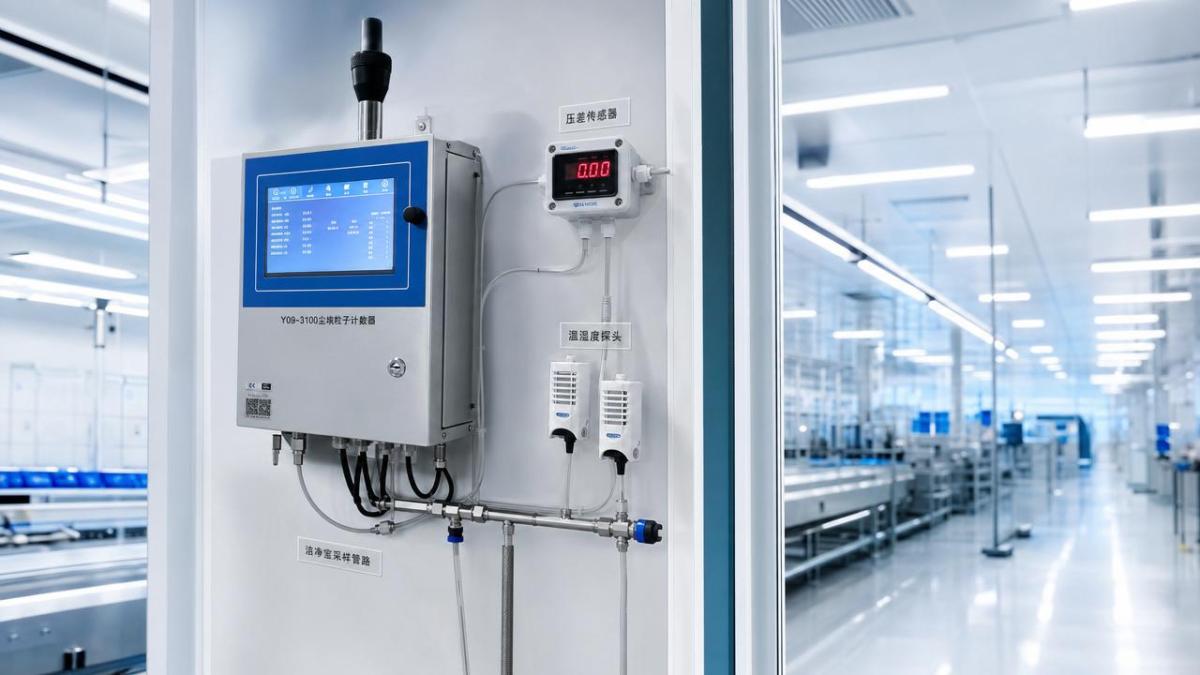
In a semiconductor cleanroom monitoring system, the most common first-fail items include:
- Differential pressure sensors drifting out of tolerance
- Particle counters showing inaccurate baselines
- Temperature and humidity probes losing calibration stability
- Communication nodes dropping packets intermittently
- Power conditioning devices causing brief signal interruptions
- Sampling lines clogging, leaking, or responding too slowly
These failures are dangerous because they do not always trigger a clear fault. A drifting reading can still look reasonable while process control is already compromised.
That is why a semiconductor cleanroom monitoring system should be treated as a chain. The chain usually weakens at the smallest link, not the largest dashboard.
Why do sensors and sampling points degrade before central software?
Field devices face continuous exposure to airflow variation, vibration, cleaning chemicals, maintenance handling, and electrical noise. Central software does not experience these stresses in the same way.
Pressure sensors are a good example. In a semiconductor cleanroom monitoring system, differential pressure values may shift because of tubing contamination, filter loading, reference side issues, or membrane aging.
Particle counters also fail gradually. Their optics can become contaminated. Internal flow control can deviate. Sampling pumps may weaken. That changes count accuracy before a total failure appears.
Temperature and humidity probes often show another pattern. They may still communicate correctly, yet their readings slowly separate from reference instruments after repeated sterilization or washdown cycles.
Sampling infrastructure is equally important. Bent tubes, hidden leaks, poor routing, and delayed transport times can distort what the instrument thinks the room condition really is.
So when asking what fails first in a semiconductor cleanroom monitoring system, the practical answer is simple: measurement integrity fails before display visibility.
How can early failure be detected before alarms go off?
The best method is trend-based verification, not alarm-based reaction. Alarms only catch major excursions. Early failure appears as subtle inconsistency.
Look for slow baseline drift across similar zones. Compare rooms with matched airflow design. Check whether pressure recovery time after door opening is getting longer.
In a semiconductor cleanroom monitoring system, these signals often appear first:
- One sensor trends steadily away from nearby redundant points
- Particle counts fluctuate more than historical control bands
- Data gaps occur at fixed times or during equipment starts
- Calibration intervals shorten unexpectedly
- Alarm frequency drops suspiciously despite known process variation
The last point is often ignored. A system that never alarms is not automatically healthy. It may be under-reporting because sensors are slow, capped, or badly configured.
Cross-checks are essential. Use portable references, manual spot readings, and periodic smoke visualization. The semiconductor cleanroom monitoring system should confirm room behavior, not replace physical verification.
Which failures create the highest contamination and yield risk?
Not every component failure carries the same consequence. Some faults inconvenience maintenance. Others directly raise contamination exposure and process variation.
The highest-risk failures usually involve invisible control loss. Examples include pressure monitoring drift between adjacent cleanliness zones, missed particle spikes, and false-normal airflow indications.
A semiconductor cleanroom monitoring system becomes especially risky when data remains available but no longer trustworthy. Operators may continue production based on incorrect environmental assumptions.
High-risk situations include:
- Pressure cascade reversal between gowning, buffer, and process spaces
- Undetected particle increases near lithography or inspection areas
- Humidity bias affecting electrostatic sensitivity and material stability
- Temperature offsets impacting tool repeatability
- Communication delays masking transient contamination events
By contrast, a visible software interface glitch may be inconvenient, but it is often less dangerous than a stable-looking bad sensor in the field.
How should a semiconductor cleanroom monitoring system be evaluated during maintenance?
Evaluation should focus on traceability, response behavior, and recovery consistency. A semiconductor cleanroom monitoring system is only as strong as its verified measurement path.
Start with a structured review:
Maintenance should also include challenge testing. Open a door under controlled conditions. Observe pressure recovery. Simulate communication interruption. Confirm event logging and alert timing.
Without functional tests, a semiconductor cleanroom monitoring system may appear compliant on paper while failing under real disturbance.
What are the most common mistakes when troubleshooting first failures?
The biggest mistake is replacing visible hardware before confirming root cause. A new sensor will not fix bad tubing, electrical interference, or incorrect scaling.
Another mistake is trusting a single parameter. Cleanroom conditions are linked. Pressure, airflow, particles, and occupancy behavior should be reviewed together.
Common troubleshooting errors include:
- Assuming software trends are correct without field verification
- Ignoring intermittent faults because they disappear quickly
- Skipping timestamp checks across different devices
- Using calibration certificates without reviewing drift patterns
- Treating nuisance alarms as normal instead of diagnosing them
A semiconductor cleanroom monitoring system should be diagnosed like a measurement network, not a single device. Root cause usually sits between components, not only inside one component.
How can early-stage failure be prevented with a practical service plan?
Prevention depends on disciplined intervals, trend review, and proof testing. Reactive repair alone is too late for a semiconductor cleanroom monitoring system.
A practical service plan should include quarterly data review, scheduled calibration by risk level, sampling path inspection, communication health checks, and annual functional challenge tests.
It is also useful to classify points by criticality. Pressure cascades near process transitions deserve tighter verification than less sensitive support spaces.
The table below summarizes first-failure priorities:
The strongest approach combines engineering fundamentals with evidence-based maintenance. That aligns with TSV’s principle that parameters, tolerances, and traceable data matter more than broad marketing claims.
If a semiconductor cleanroom monitoring system shows small but recurring deviation, treat it as an early warning. Review drift history, verify the field path, test alarms, and document recovery behavior.
Small failures become expensive only when they stay invisible. A disciplined inspection plan keeps the monitoring system credible, the cleanroom stable, and the process protected before contamination reaches production impact.
Search News
Hot Articles
- Carbon Fiber StructuresHow to Specify Aerospace Carbon Fiber Assemblies for Lightweight, Load-Bearing PartsJul 11, 2026
- Machine VisionXiaomi, Alibaba DAMO Academy Drive Open-Source Robotics Model Ecosystem, Lowering Algorithm Development Barriers for Overseas SMEs Adopting Chinese Robotics SolutionsMar 30, 2026
- Cobots & ArmsShanxi 'AI+' Conference Showcases Embodied Intelligence with Multinational Buyer Engagement: Key Industry ImplicationsMar 30, 2026
Popular Tags
Recommended News
 Jul 11, 2026How to Specify Aerospace Carbon Fiber Assemblies for Lightweight, Load-Bearing PartsAerospace carbon fiber assemblies: learn how to specify laminate design, load data, joining methods, and inspection controls for lighter, reliable load-bearing aerospace parts.Elena Rostova (UAV Systems Researcher)
 Mar 30, 2026Xiaomi, Alibaba DAMO Academy Drive Open-Source Robotics Model Ecosystem, Lowering Algorithm Development Barriers for Overseas SMEs Adopting Chinese Robotics SolutionsXiaomi & Alibaba DAMO Academy's open-source robotics models lower algorithm barriers for global SMEs. Boost efficiency in manufacturing, logistics & smart retail with ROS 2 compatible solutions.TSV Data Lab
 Mar 30, 2026Shanxi 'AI+' Conference Showcases Embodied Intelligence with Multinational Buyer Engagement: Key Industry ImplicationsShanxi 'AI+' Conference highlights embodied intelligence with Tesla, Ubtech & Jiantao showcasing multimodal robotics. 40+ global buyers validated tech on-site, creating new B2B channels for industrial automation & AI solutions.Chen Wei (Automation Lead Engineer)
 Mar 30, 2026Zhongguancun Unveils 6G Integrated Sensing-Computing-Intelligence Platform to Empower Embodied Robots for Global Industrial ApplicationsZhongguancun's new 6G platform revolutionizes industrial robotics with <10ms latency, empowering global automotive, logistics & port automation. Discover how this tech boosts China's smart manufacturing exports.TSV Data Lab
 Mar 30, 2026Mech-Mind Tianjin Embodied Intelligence R&D and Production Base Goes Live, Cutting Delivery Time by 20%–30% for Global Customized AMR+Vision SolutionsMech-Mind's Tianjin AMR+Vision production base cuts delivery time by 20%-30% for欧美 & Latin American markets. Discover how this PLd-certified facility accelerates customized robotics solutions for smart manufacturing and logistics.Chen Wei (Automation Lead Engineer)
 Mar 30, 2026Boao Forum Reveals 'Co-evolution of Big and Small Brains' Trend in Humanoid Robots, China's Embodied Intelligence Accelerates Adaptation to Overseas Manufacturing Service ScenariosDiscover how China's humanoid robots, featuring 'Co-evolution of Big and Small Brains,' are revolutionizing global manufacturing. Learn about Embodied Tian Gong 3.0's ISO compliance and overseas deployment at Boao Forum 2026.Chen Wei (Automation Lead Engineer)
 Mar 30, 2026China Railway Industrial Secures Patent for Embodied Robotics in Material Handling, Boosting High-Precision Delivery Capabilities for Overseas Infrastructure and Manufacturing ProjectsChina Railway Industrial's new patent for embodied robotics in material handling boosts high-precision delivery for global infrastructure & manufacturing. Discover how this innovation enhances logistics accuracy in automotive, rail transit & EPC projects.Chen Wei (Automation Lead Engineer)
 Sep 28, 2026Spindle Runout Measurement in Germany: DIN Standards, Methods, and Acceptance LimitsSpindle runout measurement Germany: explore DIN standards, proven methods, acceptance limits, and audit-ready practices for reliable machining quality.Dr. Marcus Vance
 Sep 27, 2026How to Select Wall-Mount Edge Devices for Space-Constrained Factory NetworksWall mount edge devices for space-constrained factories: evaluate workload, thermal design, power resilience, cable access, and network reliability for smarter deployments.TSV Data Lab
 Sep 26, 2026Machining Tolerance Analysis: How to Set Limits That Meet Function and Cost TargetsMachining tolerance analysis: learn how to set functional limits, control tolerance stacks, reduce inspection risk, and balance precision with production cost.Dr. Marcus Vance
 Sep 25, 2026How to Evaluate an Industrial Infrastructure Data Platform for Multi-Site OperationsIndustrial infrastructure data platform evaluation guide for multi-site operations: compare data quality, edge resilience, interoperability, governance, and scalable proof-of-value criteria.Victor Lin (Chief Software Architect)
 Sep 24, 2026How to Select Machine Vision Optics for Accurate Inspection at Different Working DistancesMachine vision optics selection guide for accurate inspection at every working distance. Compare FOV, pixel scale, DOF, distortion, lighting, and telecentric options.TSV Data Lab
 Sep 23, 2026How to Evaluate a Machine Vision System Integrator for High-Speed Inspection LinesChoose a machine vision system integrator with proven expertise in high-speed inspection, reliable reject timing, robust optics, and measurable acceptance criteria.TSV Data Lab
 Sep 28, 2026When is a SCADA API the right choice for connecting plant systems?SCADA API guide: learn when governed plant data integration improves traceability, security, and scalability—without compromising real-time control.Victor Lin (Chief Software Architect)
 Sep 27, 2026How SCADA data integration improves traceability across production linesSCADA data integration connects production-line data to improve traceability, accelerate quality investigations, and strengthen safety decisions.Victor Lin (Chief Software Architect)
 Sep 26, 2026What to define before starting SCADA integration planningSCADA integration planning starts with clear scope, control boundaries, data models, cybersecurity, and testing. Discover the definitions that reduce risk and costly rework.Victor Lin (Chief Software Architect)
 Sep 25, 2026How a smart factory with Industrial IoT reduces production blind spotsDiscover how a smart factory with Industrial IoT turns real-time machine, quality, and workflow data into actionable insights that reduce production blind spots and delivery risks.Victor Lin (Chief Software Architect)
 Sep 24, 2026When does Industrial IoT make smart manufacturing easier to scale?Smart manufacturing Industrial IoT scales when trusted data, interoperable systems, and secure workflows turn connected assets into measurable gains.TSV Data Lab
 Sep 23, 2026What drives ultra-precision machining cost at 1-micron tolerance?Ultra precision machining cost per part at 1 micron tolerance depends on process, material, metrology, and yield. Learn how to compare quotes confidently.Dr. Marcus Vance
 Sep 22, 2026Drone Engine-T550CC Applications: Build the UAV Power System Around the MissionAn application guide for Drone Engine-T550CC integration, covering payload planning, airframe matching, cooling, fuel, vibration, test procedures, documentation, and service preparation.Elena Rostova (UAV Systems Researcher)
 Sep 22, 2026How to Evaluate Industrial Edge Computing Vendors for Factory DeploymentIndustrial edge computing vendor evaluation guide for factories: compare latency, protocol fit, reliability, security, and lifecycle support before deployment.TSV Data Lab
 Sep 21, 2026Drone Payload Integration: Matching Power, Data, and Center of Gravity for Reliable FlightsDrone payload integration made practical: balance power, data, center of gravity, and endurance to build safer, more reliable mission-ready flights.Elena Rostova (UAV Systems Researcher)
 Sep 20, 2026Autonomous Navigation Pricing: Cost Drivers and Budget Benchmarks for AMR ProjectsAutonomous navigation price explained: compare AMR cost drivers, software, sensors, integration, safety, and lifecycle budgets to build a scalable project plan.Chen Wei (Automation Lead Engineer)
 Sep 19, 2026How to Scope Automation Integration Services for Multi-System Factory ProjectsAutomation integration services: learn how to scope multi-system factory projects with clear workflows, interface contracts, safety boundaries, and acceptance criteria.Victor Lin (Chief Software Architect)