Servo motors high torque density: heat is the tradeoff to watch
Publication Date
author
Servo motors high torque density can unlock faster dynamics and smaller machine footprints, but the thermal penalty is often where real engineering risk begins. For technical evaluators comparing motion platforms, peak torque figures alone are not enough. This article examines how heat buildup affects efficiency, duty cycle, insulation life, and long-term reliability—so procurement and R&D teams can judge performance beyond marketing claims.
Why the market is rethinking servo motors high torque density
Across robotics, machine tools, semiconductor handling, packaging systems, UAV subsystems, and compact industrial automation, the design direction is clear: more output from less volume. This shift has made servo motors high torque density a top search term and a real specification priority. Engineers want faster acceleration, smaller joints, lighter axes, and tighter machine envelopes. Procurement teams want the same performance with fewer components and lower system footprint. Yet this trend is changing how servo motors should be evaluated.
The old comparison method—checking rated torque, peak torque, and frame size—no longer captures the full risk picture. As electromagnetic loading rises and packaging becomes more compact, the thermal margin often shrinks faster than the torque number grows. In practical terms, that means a motor that looks superior on a datasheet can become limited by winding temperature, case temperature, demagnetization risk, or controller derating when exposed to realistic duty cycles.
This is why technical evaluators are shifting from headline output claims to thermal sustainability questions. Servo motors high torque density are not just a motor-selection topic anymore; they are now a system-level design issue affecting gearbox life, encoder stability, cabinet cooling, energy consumption, maintenance scheduling, and even supplier qualification criteria.
The strongest trend signal: compactness is rising faster than heat can be ignored
Several industry signals are converging. First, end users are demanding more machine throughput in the same factory space. Second, lightweight moving axes are becoming more valuable because they improve dynamic response and reduce structural inertia. Third, electrification and precision automation are spreading into applications that once tolerated larger safety margins. These changes increase demand for servo motors high torque density, but they also make heat rejection more difficult because enclosure space, airflow, and passive cooling area are constrained.
In many modern architectures, engineers are intentionally moving motors into tighter spaces: robot joints, sealed washdown machines, battery-powered mobile platforms, and integrated actuator modules. That reduces cable complexity and can improve packaging efficiency, but it often weakens thermal dissipation paths. The result is a market where torque density is easy to advertise and thermal stability is harder to prove.
For TSV-style technical assessment, the lesson is simple: when servo motors high torque density are promoted as a design advantage, evaluators should immediately ask what thermal evidence supports the claim under realistic ambient and duty conditions.
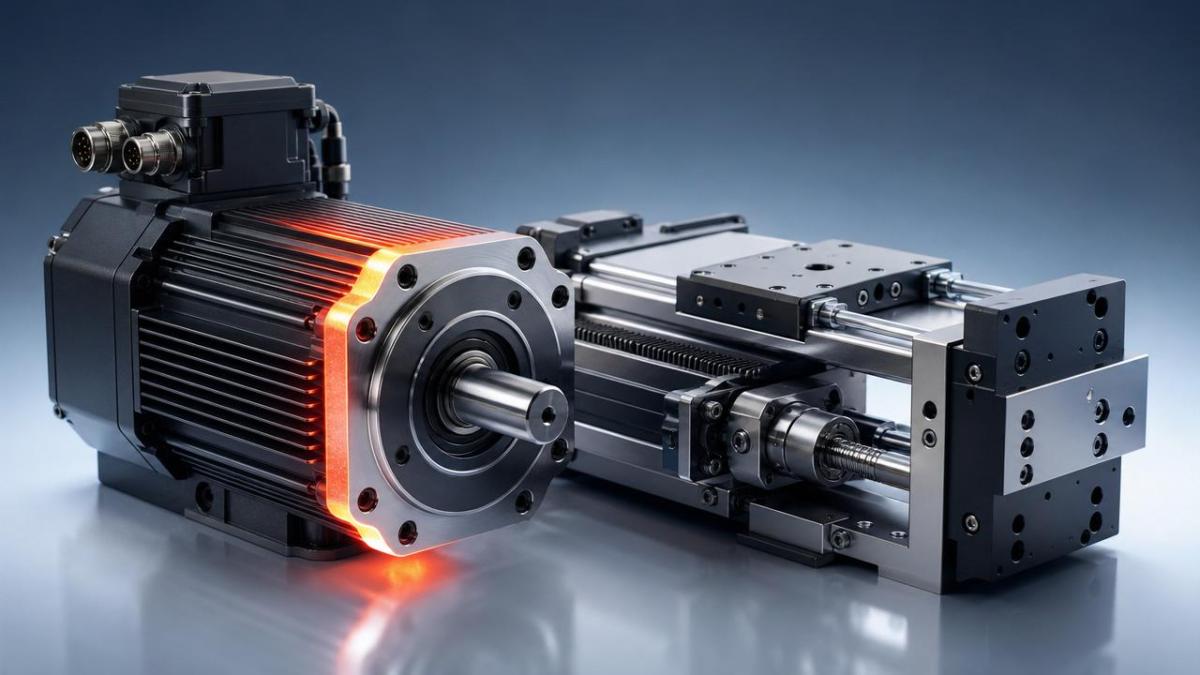
What is driving the shift toward higher torque density
The push is not driven by marketing alone. There are legitimate engineering reasons behind it. Improved magnetic materials, better winding strategies, stronger electromagnetic design software, tighter manufacturing tolerances, and more advanced current control have all made servo motors high torque density more achievable. In addition, many machine builders are under pressure to differentiate with faster motion, reduced installation space, and cleaner integrated designs.
At the same time, application requirements have evolved. Collaborative robots need lighter joints. Electronics assembly systems need high acceleration with high positional precision. Aerospace and UAV support equipment increasingly values mass reduction. Precision machining automation wants response speed without excessive floor space. In each of these cases, torque density creates real value, but only if the motor can sustain required output without thermal drift or unacceptable derating.
This is where the procurement landscape is changing. Buyers are no longer only comparing nominal specification tables. They are asking for thermal curves, continuous torque at elevated ambient temperature, insulation class details, cooling assumptions, and evidence of performance after repeated thermal cycling. That represents a healthy move from output-centric selection to reliability-centric selection.
Heat is becoming the real differentiator, not peak torque
A motor can achieve impressive torque density by accepting higher copper losses, operating closer to magnetic saturation, or concentrating more performance in a compact structure. None of those approaches are inherently wrong. The problem appears when the generated heat cannot be removed at the same rate. Then efficiency falls, winding resistance rises, and the practical torque envelope narrows. What looks like a strong torque-dense design may become a motor that spends too much time near thermal limits.
For technical evaluators, servo motors high torque density should therefore be judged through thermal consequences across four dimensions. First is duty cycle: can the motor hold required RMS torque over the full cycle, not just during short bursts? Second is insulation and material life: repeated operation near upper temperature limits accelerates degradation. Third is precision stability: heat can influence encoder accuracy, bearing preload behavior, lubricant condition, and mechanical alignment. Fourth is service economics: hotter systems can demand more cooling infrastructure and may shorten maintenance intervals.
This is particularly important in sealed or contaminated environments where designers cannot depend on ideal airflow. In washdown food equipment, dusty processing lines, compact robot wrists, or enclosed electronics handling modules, temperature rise is not a secondary issue. It is often the constraint that decides whether the motion platform is truly production-ready.
Who feels the impact most across the value chain
The thermal tradeoff behind servo motors high torque density does not affect only motor designers. It changes decisions at multiple business and engineering points. That is why trend monitoring should not stop at component performance headlines.
For each stakeholder, the same pattern appears: the value of servo motors high torque density is real, but the decision quality depends on whether heat has been quantified rather than assumed away.
The new evaluation standard: from headline specs to thermal evidence
A clear industry change is underway. In earlier purchasing cycles, a supplier could win attention with compact dimensions and high peak torque. Now more serious buyers want application-specific evidence. They ask what ambient temperature was used, whether mounting to a heatsinking structure was assumed, what the temperature rise is at continuous rated load, and how much performance shifts once the system reaches thermal equilibrium.
Technical evaluators should also separate short-duration laboratory capability from production capability. Servo motors high torque density may perform well in a brief benchmark and still become unsuitable in sustained cycles involving rapid reversals, vertical holding torque, or repeated overload events. If the motor relies on optimistic cooling assumptions, the whole platform can be mis-specified.
A stronger evaluation framework includes thermal imaging during representative motion sequences, winding temperature trend data, efficiency mapping across the operating range, and confirmation of how thermal protection logic interacts with the machine’s throughput target. If these details are missing, the buyer is effectively selecting on promise rather than engineering truth.
Signals worth tracking over the next buying cycles
Several signals deserve attention as the market matures. One is how openly suppliers publish continuous torque under elevated ambient conditions rather than only nominal room-temperature values. Another is whether vendors provide clear derating curves and thermal time constants. A third is the rise of integrated cooling approaches, including improved housing conduction paths, liquid-assisted designs in specialized systems, and smarter drive tuning that reduces unnecessary thermal stress.
Another important signal is test traceability. As advanced manufacturing buyers become more rigorous, they are increasingly skeptical of broad claims around servo motors high torque density unless those claims are paired with conditions, limits, and repeatable measurement methods. Suppliers that can show transparent thermal benchmarking are likely to gain trust faster than those relying on adjectives and isolated peak values.
There is also a likely shift in system design philosophy. Instead of always maximizing torque density at the component level, some engineering teams may optimize for balanced density at the module level. That means accepting a slightly larger motor if it improves thermal headroom, extends service life, and reduces cooling complexity. In cost-sensitive or uptime-critical sectors, that can be the smarter business decision.
What companies should do now when comparing servo motors high torque density
The right response is not to avoid high torque density motors. It is to evaluate them with discipline. Companies should first define the real duty profile, including acceleration peaks, dwell periods, holding loads, ambient conditions, enclosure effects, and worst-case repetition. Second, they should request continuous performance evidence, not only peak output data. Third, they should verify how motor heat influences adjacent components such as feedback devices, gear units, nearby electronics, and lubrication systems.
Fourth, teams should compare more than one path to the same machine objective. In some cases, gearing changes, load balancing, improved motion planning, or better mechanical efficiency may reduce the need to push servo motors high torque density to their thermal edge. Fifth, supplier discussions should include field service assumptions: if thermal limits are frequently approached, what is the expected impact on maintenance intervals, warranty boundaries, and spares planning?
A practical outlook for technical evaluators
The next phase of motion-system competition will not be won by the most aggressive torque claim alone. It will be won by designs that convert compact performance into stable output across real thermal conditions. For that reason, servo motors high torque density should be treated as a strategic opportunity with an engineering caveat: heat determines whether the advantage is sustainable.
For organizations that follow TSV’s data-first philosophy, the most useful next step is to build an internal comparison sheet that ranks candidate motors on continuous torque versus temperature, thermal time constant, cooling dependency, derating transparency, and projected reliability under the intended duty cycle. This kind of benchmark cuts through vague positioning and aligns selection with engineering fundamentals.
If your team is currently assessing servo motors high torque density, the most important questions are not “Which motor is smallest?” or “Which peak number is highest?” They are “Where is the thermal limit under our real cycle?” “How much performance margin remains after heat equilibrium?” and “Does the supplier provide traceable data we can trust?” Those are the questions that reduce trial-and-error cost, shorten qualification time, and support better long-term decisions.
Search News
Hot Articles
- Carbon Fiber StructuresHow to Specify Aerospace Carbon Fiber Assemblies for Lightweight, Load-Bearing PartsJul 11, 2026
- Machine VisionXiaomi, Alibaba DAMO Academy Drive Open-Source Robotics Model Ecosystem, Lowering Algorithm Development Barriers for Overseas SMEs Adopting Chinese Robotics SolutionsMar 30, 2026
- Cobots & ArmsShanxi 'AI+' Conference Showcases Embodied Intelligence with Multinational Buyer Engagement: Key Industry ImplicationsMar 30, 2026
Popular Tags
Recommended News
 Jul 11, 2026How to Specify Aerospace Carbon Fiber Assemblies for Lightweight, Load-Bearing PartsAerospace carbon fiber assemblies: learn how to specify laminate design, load data, joining methods, and inspection controls for lighter, reliable load-bearing aerospace parts.Elena Rostova (UAV Systems Researcher)
 Mar 30, 2026Xiaomi, Alibaba DAMO Academy Drive Open-Source Robotics Model Ecosystem, Lowering Algorithm Development Barriers for Overseas SMEs Adopting Chinese Robotics SolutionsXiaomi & Alibaba DAMO Academy's open-source robotics models lower algorithm barriers for global SMEs. Boost efficiency in manufacturing, logistics & smart retail with ROS 2 compatible solutions.TSV Data Lab
 Mar 30, 2026Shanxi 'AI+' Conference Showcases Embodied Intelligence with Multinational Buyer Engagement: Key Industry ImplicationsShanxi 'AI+' Conference highlights embodied intelligence with Tesla, Ubtech & Jiantao showcasing multimodal robotics. 40+ global buyers validated tech on-site, creating new B2B channels for industrial automation & AI solutions.Chen Wei (Automation Lead Engineer)
 Mar 30, 2026Zhongguancun Unveils 6G Integrated Sensing-Computing-Intelligence Platform to Empower Embodied Robots for Global Industrial ApplicationsZhongguancun's new 6G platform revolutionizes industrial robotics with <10ms latency, empowering global automotive, logistics & port automation. Discover how this tech boosts China's smart manufacturing exports.TSV Data Lab
 Mar 30, 2026Mech-Mind Tianjin Embodied Intelligence R&D and Production Base Goes Live, Cutting Delivery Time by 20%–30% for Global Customized AMR+Vision SolutionsMech-Mind's Tianjin AMR+Vision production base cuts delivery time by 20%-30% for欧美 & Latin American markets. Discover how this PLd-certified facility accelerates customized robotics solutions for smart manufacturing and logistics.Chen Wei (Automation Lead Engineer)
 Mar 30, 2026Boao Forum Reveals 'Co-evolution of Big and Small Brains' Trend in Humanoid Robots, China's Embodied Intelligence Accelerates Adaptation to Overseas Manufacturing Service ScenariosDiscover how China's humanoid robots, featuring 'Co-evolution of Big and Small Brains,' are revolutionizing global manufacturing. Learn about Embodied Tian Gong 3.0's ISO compliance and overseas deployment at Boao Forum 2026.Chen Wei (Automation Lead Engineer)
 Mar 30, 2026China Railway Industrial Secures Patent for Embodied Robotics in Material Handling, Boosting High-Precision Delivery Capabilities for Overseas Infrastructure and Manufacturing ProjectsChina Railway Industrial's new patent for embodied robotics in material handling boosts high-precision delivery for global infrastructure & manufacturing. Discover how this innovation enhances logistics accuracy in automotive, rail transit & EPC projects.Chen Wei (Automation Lead Engineer)
 Sep 29, 2026ISO 9283 Repeatability: How to Evaluate Cobot Positioning PerformanceISO 9283 cobot repeatability explained: learn how payload, reach, approach direction, and test conditions affect positioning performance and cell capability.Chen Wei (Automation Lead Engineer)
 Sep 28, 2026Spindle Runout Measurement in Germany: DIN Standards, Methods, and Acceptance LimitsSpindle runout measurement Germany: explore DIN standards, proven methods, acceptance limits, and audit-ready practices for reliable machining quality.Dr. Marcus Vance
 Sep 27, 2026How to Select Wall-Mount Edge Devices for Space-Constrained Factory NetworksWall mount edge devices for space-constrained factories: evaluate workload, thermal design, power resilience, cable access, and network reliability for smarter deployments.TSV Data Lab
 Sep 26, 2026Machining Tolerance Analysis: How to Set Limits That Meet Function and Cost TargetsMachining tolerance analysis: learn how to set functional limits, control tolerance stacks, reduce inspection risk, and balance precision with production cost.Dr. Marcus Vance
 Sep 25, 2026How to Evaluate an Industrial Infrastructure Data Platform for Multi-Site OperationsIndustrial infrastructure data platform evaluation guide for multi-site operations: compare data quality, edge resilience, interoperability, governance, and scalable proof-of-value criteria.Victor Lin (Chief Software Architect)
 Sep 24, 2026How to Select Machine Vision Optics for Accurate Inspection at Different Working DistancesMachine vision optics selection guide for accurate inspection at every working distance. Compare FOV, pixel scale, DOF, distortion, lighting, and telecentric options.TSV Data Lab
 Sep 23, 2026How to Evaluate a Machine Vision System Integrator for High-Speed Inspection LinesChoose a machine vision system integrator with proven expertise in high-speed inspection, reliable reject timing, robust optics, and measurable acceptance criteria.TSV Data Lab
 Sep 28, 2026When is a SCADA API the right choice for connecting plant systems?SCADA API guide: learn when governed plant data integration improves traceability, security, and scalability—without compromising real-time control.Victor Lin (Chief Software Architect)
 Sep 27, 2026How SCADA data integration improves traceability across production linesSCADA data integration connects production-line data to improve traceability, accelerate quality investigations, and strengthen safety decisions.Victor Lin (Chief Software Architect)
 Sep 26, 2026What to define before starting SCADA integration planningSCADA integration planning starts with clear scope, control boundaries, data models, cybersecurity, and testing. Discover the definitions that reduce risk and costly rework.Victor Lin (Chief Software Architect)
 Sep 25, 2026How a smart factory with Industrial IoT reduces production blind spotsDiscover how a smart factory with Industrial IoT turns real-time machine, quality, and workflow data into actionable insights that reduce production blind spots and delivery risks.Victor Lin (Chief Software Architect)
 Sep 24, 2026When does Industrial IoT make smart manufacturing easier to scale?Smart manufacturing Industrial IoT scales when trusted data, interoperable systems, and secure workflows turn connected assets into measurable gains.TSV Data Lab
 Sep 23, 2026What drives ultra-precision machining cost at 1-micron tolerance?Ultra precision machining cost per part at 1 micron tolerance depends on process, material, metrology, and yield. Learn how to compare quotes confidently.Dr. Marcus Vance
 Sep 22, 2026Drone Engine-T550CC Applications: Build the UAV Power System Around the MissionAn application guide for Drone Engine-T550CC integration, covering payload planning, airframe matching, cooling, fuel, vibration, test procedures, documentation, and service preparation.Elena Rostova (UAV Systems Researcher)
 Sep 22, 2026How to Evaluate Industrial Edge Computing Vendors for Factory DeploymentIndustrial edge computing vendor evaluation guide for factories: compare latency, protocol fit, reliability, security, and lifecycle support before deployment.TSV Data Lab
 Sep 21, 2026Drone Payload Integration: Matching Power, Data, and Center of Gravity for Reliable FlightsDrone payload integration made practical: balance power, data, center of gravity, and endurance to build safer, more reliable mission-ready flights.Elena Rostova (UAV Systems Researcher)
 Sep 20, 2026Autonomous Navigation Pricing: Cost Drivers and Budget Benchmarks for AMR ProjectsAutonomous navigation price explained: compare AMR cost drivers, software, sensors, integration, safety, and lifecycle budgets to build a scalable project plan.Chen Wei (Automation Lead Engineer)