Servo motors for CNC machine tools: stiffness matters more than peak torque
Publication Date
author
When selecting servo motors for CNC machine tools, peak torque often gets the spotlight—but stiffness is what truly shapes machining accuracy, surface finish, and dynamic stability. For operators and production teams, understanding this difference is critical to reducing chatter, holding tight tolerances, and improving real-world cutting performance. This article explains why stiffness deserves more attention in servo selection.
Why scenario differences matter more than brochure numbers
In daily production, servo motors for CNC machine tools are rarely judged in a vacuum. A motor that looks impressive on a datasheet may perform poorly once it is installed on a high-speed machining center, a heavy-duty horizontal boring machine, or a compact precision lathe. The reason is simple: machining performance is shaped by the entire motion loop, not by peak torque alone. Motor stiffness, coupling rigidity, ball screw characteristics, structural damping, encoder resolution, drive tuning, and the cutting process all interact.
For operators, the practical question is not “Which servo motor has the biggest short-term torque spike?” but “Which servo system keeps the axis stable under my actual cutting loads, acceleration profile, toolpath changes, and tolerance targets?” In many real workshops, chatter marks, corner overshoot, dimensional drift, and inconsistent finishes are caused more by weak dynamic stiffness than by a lack of peak torque.
This is especially important in mixed-production environments. A shop cutting aluminum housings at high feed rates does not stress the machine in the same way as a mold shop finishing hardened steel, or a subcontractor roughing large cast iron parts. The best servo motors for CNC machine tools in one case may be a poor fit in another. That is why stiffness must be evaluated in context.
What stiffness means in real machining terms
In practical CNC use, stiffness refers to how strongly the servo axis resists deflection, lag, and oscillation when load changes occur. It is not just motor shaft rigidity. It includes the servo motor’s electromagnetic response, rotor inertia relationship, control loop bandwidth, encoder feedback quality, mechanical transmission rigidity, and the machine structure itself. A stiff axis holds position better when the tool enters material, changes direction, or encounters variable cutting forces.
Peak torque still matters, but mainly as a short-duration reserve. If the axis can deliver a brief torque burst yet flexes, rings, or settles slowly, the machine may still miss tolerance or leave visible marks. Operators often notice this during rapid contouring, pocket corners, interrupted cuts, or long tools where vibration sensitivity rises quickly. In such situations, servo motors for CNC machine tools with higher effective stiffness usually deliver better path control than motors selected mainly for peak torque headlines.
Application scenarios where stiffness clearly outranks peak torque
High-speed mold and die finishing
In mold finishing, the machine is constantly making small, fast directional changes across complex 3D surfaces. The goal is not just material removal; it is smooth blending, clean edges, and minimal hand polishing afterward. Here, axis stiffness is critical because even small following errors can create witness lines, waviness, or corner mismatch. Peak torque may help with brief accelerations, but if stiffness is low, the axis can overshoot and settle too slowly, leaving a visible finish defect.
Precision medical and electronics parts
Small features, thin walls, and tight geometric tolerances make precision parts highly sensitive to servo behavior. In these jobs, the cutting load is often not huge, so selecting oversized motors based on torque can miss the real issue. A stiffer servo system provides more repeatable micro-movements, better interpolation accuracy, and stronger resistance to positional drift. For operators trying to hold circularity, slot width, or bore location, stiffness usually has more value than extra short-term torque.
Aerospace structural machining
Aerospace components often involve thin ribs, deep pockets, and expensive materials. These parts are vulnerable to chatter because the workpiece itself may lack rigidity. In this scenario, the machine’s servo stiffness becomes part of the stability strategy. When the axis remains firm under changing load, the process window widens and tool engagement becomes more predictable. Servo motors for CNC machine tools that maintain strong dynamic stiffness can reduce the risk of chatter-driven scrap on high-value parts.
Heavy roughing of castings or steel blocks
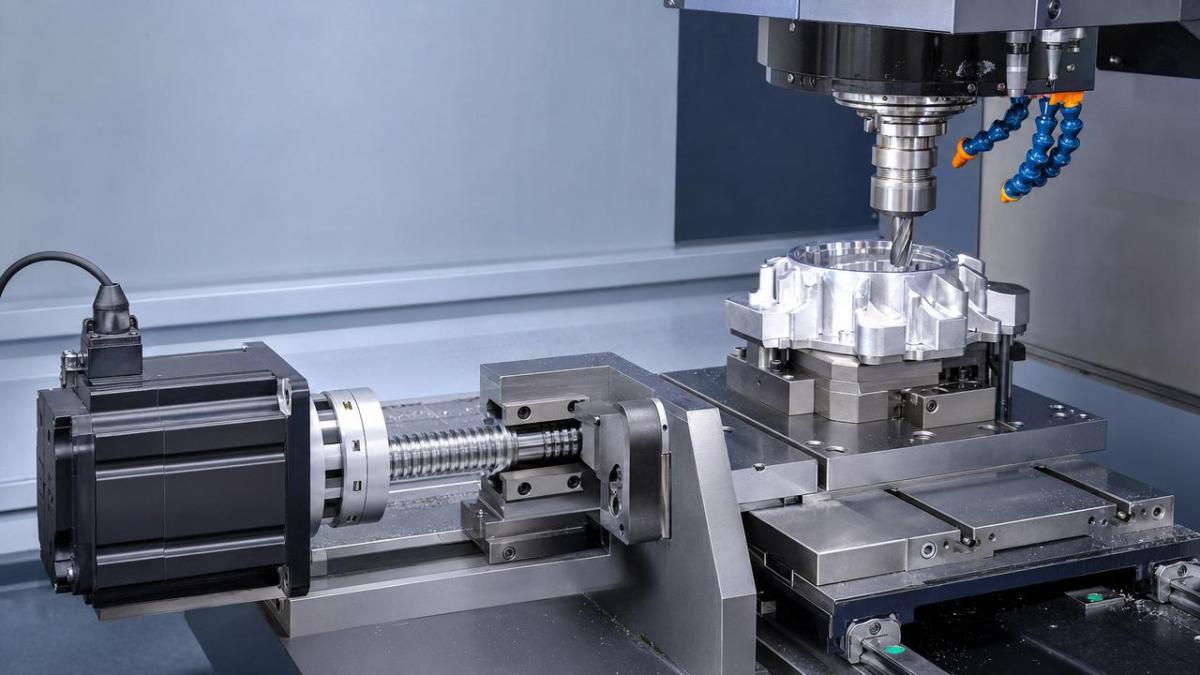
This is the scenario where many people assume peak torque dominates. It certainly matters, because roughing generates high cutting forces and repeated load shocks. Yet stiffness still cannot be ignored. If the drive train twists or the control loop cannot hold the axis firmly, the machine may lose stability under entry and exit impacts, producing uneven load, poor tool life, and vibration. In roughing, the best answer is often balanced selection: enough continuous and peak torque, but with strong axis stiffness and tuning margin.
General job-shop mixed production
Job shops rarely run one ideal part all week. They switch between aluminum, stainless steel, plastics, prototypes, and short batches. Because the cutting conditions vary so much, operators benefit more from servo behavior that stays stable across many tasks than from a motor optimized for isolated torque peaks. Stiff servo motors for CNC machine tools usually make the machine easier to tune, easier to trust, and less likely to produce surprise finish problems during setup changes.
Scenario comparison: what to prioritize
The table below helps operators and production teams match application type with the right servo focus.
How operators can judge stiffness in the field
Many users do not have access to deep design data, but they can still assess whether servo motors for CNC machine tools are delivering enough stiffness. The first signs usually appear on the part and in the sound of the cut. If corners show slight marks, if circular interpolation looks uneven, if chatter appears only during quick direction changes, or if finish quality changes after acceleration increases, stiffness may be the hidden limit.
Operators should also watch servo following error, settling time after rapid moves, vibration at axis reversal points, and consistency between the first part and the tenth. A machine that seems powerful but behaves nervously under contouring may be torque-rich yet stiffness-poor. By contrast, a machine with well-matched servo stiffness often feels calm, predictable, and easier to optimize across different tools and programs.
Common selection mistakes in servo motors for CNC machine tools
One frequent mistake is treating peak torque as a shortcut for performance. Peak torque values are easy to advertise and easy to compare, but they do not reveal how the axis behaves during continuous contouring or under repeated disturbance. Another mistake is oversizing the motor without checking inertia matching or machine structure. An oversized motor can create its own tuning challenges and may not improve finish if the rest of the axis lacks rigidity.
A third mistake is ignoring the full transmission path. Even excellent servo motors for CNC machine tools cannot compensate for weak couplings, backlash issues, flexible mounting, poor lubrication, or worn ball screws. Finally, some teams focus on spindle power and cutting data while neglecting servo tuning quality. In real production, good tuning can unlock stiffness that was already available but not properly used.
Scenario-based selection advice for different users
For machine operators
If your daily work centers on finish quality, contour accuracy, or difficult thin-wall parts, ask for evidence of axis stiffness performance, not just torque ratings. Pay attention to how the machine behaves during direction changes, small-radius moves, and long cycle runs. Your goal is repeatable motion stability.
For process engineers
Map the servo requirement to the dominant cutting scenario. If most cycle time is spent on precision contouring, prioritize stiffness, loop response, and low following error. If roughing dominates, maintain enough torque reserve but verify that the axis remains stable under shock loads and does not amplify chatter.
For production and procurement teams
Ask suppliers for application-specific data: contouring accuracy, step response, vibration behavior, axis settling time, and demonstrated part results in similar materials. The best supplier conversation is not “How much peak torque?” but “How does this servo system perform on my machining profile?” That approach aligns with TSV’s principle that engineering truth comes from measurable behavior, not marketing adjectives.
FAQ: practical questions about stiffness and torque
Does peak torque still matter?
Yes. Peak torque matters for acceleration, transient overloads, and heavy cutting events. But it should not be treated as the main indicator of machining accuracy or finish quality.
Can a stiff servo system reduce chatter?
Often yes, especially when chatter is linked to axis compliance, reversal behavior, or poor load response. It will not solve every vibration problem, but it improves the machine’s resistance to disturbance.
Are servo motors for CNC machine tools with higher power always better?
No. Higher power without proper stiffness, tuning, and mechanical matching may add cost without improving parts. Fit to scenario matters more than headline size.
Final decision guide: match the servo to the job, not the brochure
The best servo motors for CNC machine tools are chosen by application reality. If your work depends on precision contouring, high finish quality, thin-wall stability, or reliable tolerance control, stiffness deserves more attention than peak torque. If your process is dominated by aggressive roughing, torque remains important, but only as part of a balanced motion system.
Before making a selection or judging an installed machine, define your dominant cutting scenarios, identify where vibration or accuracy losses occur, and ask for measurable axis performance data. That is the practical path to better machining results: less noise, more evidence, and servo choices grounded in engineering truth.
Search News
Hot Articles
- Carbon Fiber StructuresHow to Specify Aerospace Carbon Fiber Assemblies for Lightweight, Load-Bearing PartsJul 11, 2026
- Machine VisionXiaomi, Alibaba DAMO Academy Drive Open-Source Robotics Model Ecosystem, Lowering Algorithm Development Barriers for Overseas SMEs Adopting Chinese Robotics SolutionsMar 30, 2026
- Cobots & ArmsShanxi 'AI+' Conference Showcases Embodied Intelligence with Multinational Buyer Engagement: Key Industry ImplicationsMar 30, 2026
Popular Tags
Recommended News
 Jul 11, 2026How to Specify Aerospace Carbon Fiber Assemblies for Lightweight, Load-Bearing PartsAerospace carbon fiber assemblies: learn how to specify laminate design, load data, joining methods, and inspection controls for lighter, reliable load-bearing aerospace parts.Elena Rostova (UAV Systems Researcher)
 Mar 30, 2026Xiaomi, Alibaba DAMO Academy Drive Open-Source Robotics Model Ecosystem, Lowering Algorithm Development Barriers for Overseas SMEs Adopting Chinese Robotics SolutionsXiaomi & Alibaba DAMO Academy's open-source robotics models lower algorithm barriers for global SMEs. Boost efficiency in manufacturing, logistics & smart retail with ROS 2 compatible solutions.TSV Data Lab
 Mar 30, 2026Shanxi 'AI+' Conference Showcases Embodied Intelligence with Multinational Buyer Engagement: Key Industry ImplicationsShanxi 'AI+' Conference highlights embodied intelligence with Tesla, Ubtech & Jiantao showcasing multimodal robotics. 40+ global buyers validated tech on-site, creating new B2B channels for industrial automation & AI solutions.Chen Wei (Automation Lead Engineer)
 Mar 30, 2026Zhongguancun Unveils 6G Integrated Sensing-Computing-Intelligence Platform to Empower Embodied Robots for Global Industrial ApplicationsZhongguancun's new 6G platform revolutionizes industrial robotics with <10ms latency, empowering global automotive, logistics & port automation. Discover how this tech boosts China's smart manufacturing exports.TSV Data Lab
 Mar 30, 2026Mech-Mind Tianjin Embodied Intelligence R&D and Production Base Goes Live, Cutting Delivery Time by 20%–30% for Global Customized AMR+Vision SolutionsMech-Mind's Tianjin AMR+Vision production base cuts delivery time by 20%-30% for欧美 & Latin American markets. Discover how this PLd-certified facility accelerates customized robotics solutions for smart manufacturing and logistics.Chen Wei (Automation Lead Engineer)
 Mar 30, 2026Boao Forum Reveals 'Co-evolution of Big and Small Brains' Trend in Humanoid Robots, China's Embodied Intelligence Accelerates Adaptation to Overseas Manufacturing Service ScenariosDiscover how China's humanoid robots, featuring 'Co-evolution of Big and Small Brains,' are revolutionizing global manufacturing. Learn about Embodied Tian Gong 3.0's ISO compliance and overseas deployment at Boao Forum 2026.Chen Wei (Automation Lead Engineer)
 Mar 30, 2026China Railway Industrial Secures Patent for Embodied Robotics in Material Handling, Boosting High-Precision Delivery Capabilities for Overseas Infrastructure and Manufacturing ProjectsChina Railway Industrial's new patent for embodied robotics in material handling boosts high-precision delivery for global infrastructure & manufacturing. Discover how this innovation enhances logistics accuracy in automotive, rail transit & EPC projects.Chen Wei (Automation Lead Engineer)
 Sep 28, 2026Spindle Runout Measurement in Germany: DIN Standards, Methods, and Acceptance LimitsSpindle runout measurement Germany: explore DIN standards, proven methods, acceptance limits, and audit-ready practices for reliable machining quality.Dr. Marcus Vance
 Sep 27, 2026How to Select Wall-Mount Edge Devices for Space-Constrained Factory NetworksWall mount edge devices for space-constrained factories: evaluate workload, thermal design, power resilience, cable access, and network reliability for smarter deployments.TSV Data Lab
 Sep 26, 2026Machining Tolerance Analysis: How to Set Limits That Meet Function and Cost TargetsMachining tolerance analysis: learn how to set functional limits, control tolerance stacks, reduce inspection risk, and balance precision with production cost.Dr. Marcus Vance
 Sep 25, 2026How to Evaluate an Industrial Infrastructure Data Platform for Multi-Site OperationsIndustrial infrastructure data platform evaluation guide for multi-site operations: compare data quality, edge resilience, interoperability, governance, and scalable proof-of-value criteria.Victor Lin (Chief Software Architect)
 Sep 24, 2026How to Select Machine Vision Optics for Accurate Inspection at Different Working DistancesMachine vision optics selection guide for accurate inspection at every working distance. Compare FOV, pixel scale, DOF, distortion, lighting, and telecentric options.TSV Data Lab
 Sep 23, 2026How to Evaluate a Machine Vision System Integrator for High-Speed Inspection LinesChoose a machine vision system integrator with proven expertise in high-speed inspection, reliable reject timing, robust optics, and measurable acceptance criteria.TSV Data Lab
 Sep 28, 2026When is a SCADA API the right choice for connecting plant systems?SCADA API guide: learn when governed plant data integration improves traceability, security, and scalability—without compromising real-time control.Victor Lin (Chief Software Architect)
 Sep 27, 2026How SCADA data integration improves traceability across production linesSCADA data integration connects production-line data to improve traceability, accelerate quality investigations, and strengthen safety decisions.Victor Lin (Chief Software Architect)
 Sep 26, 2026What to define before starting SCADA integration planningSCADA integration planning starts with clear scope, control boundaries, data models, cybersecurity, and testing. Discover the definitions that reduce risk and costly rework.Victor Lin (Chief Software Architect)
 Sep 25, 2026How a smart factory with Industrial IoT reduces production blind spotsDiscover how a smart factory with Industrial IoT turns real-time machine, quality, and workflow data into actionable insights that reduce production blind spots and delivery risks.Victor Lin (Chief Software Architect)
 Sep 24, 2026When does Industrial IoT make smart manufacturing easier to scale?Smart manufacturing Industrial IoT scales when trusted data, interoperable systems, and secure workflows turn connected assets into measurable gains.TSV Data Lab
 Sep 23, 2026What drives ultra-precision machining cost at 1-micron tolerance?Ultra precision machining cost per part at 1 micron tolerance depends on process, material, metrology, and yield. Learn how to compare quotes confidently.Dr. Marcus Vance
 Sep 22, 2026Drone Engine-T550CC Applications: Build the UAV Power System Around the MissionAn application guide for Drone Engine-T550CC integration, covering payload planning, airframe matching, cooling, fuel, vibration, test procedures, documentation, and service preparation.Elena Rostova (UAV Systems Researcher)
 Sep 22, 2026How to Evaluate Industrial Edge Computing Vendors for Factory DeploymentIndustrial edge computing vendor evaluation guide for factories: compare latency, protocol fit, reliability, security, and lifecycle support before deployment.TSV Data Lab
 Sep 21, 2026Drone Payload Integration: Matching Power, Data, and Center of Gravity for Reliable FlightsDrone payload integration made practical: balance power, data, center of gravity, and endurance to build safer, more reliable mission-ready flights.Elena Rostova (UAV Systems Researcher)
 Sep 20, 2026Autonomous Navigation Pricing: Cost Drivers and Budget Benchmarks for AMR ProjectsAutonomous navigation price explained: compare AMR cost drivers, software, sensors, integration, safety, and lifecycle budgets to build a scalable project plan.Chen Wei (Automation Lead Engineer)
 Sep 19, 2026How to Scope Automation Integration Services for Multi-System Factory ProjectsAutomation integration services: learn how to scope multi-system factory projects with clear workflows, interface contracts, safety boundaries, and acceptance criteria.Victor Lin (Chief Software Architect)