Why robot welding aluminum profiles often fails at consistency
Publication Date
author
In modern fabrication, robot welding aluminum profiles promises speed and repeatability, yet many operators still face unstable bead shape, inconsistent penetration, and frequent rework. Why does automation struggle with a material so common in lightweight manufacturing? To answer that, we need to look beyond surface-level settings and examine the real engineering variables that quietly undermine consistency.
When robot welding aluminum profiles looks stable but drifts in production
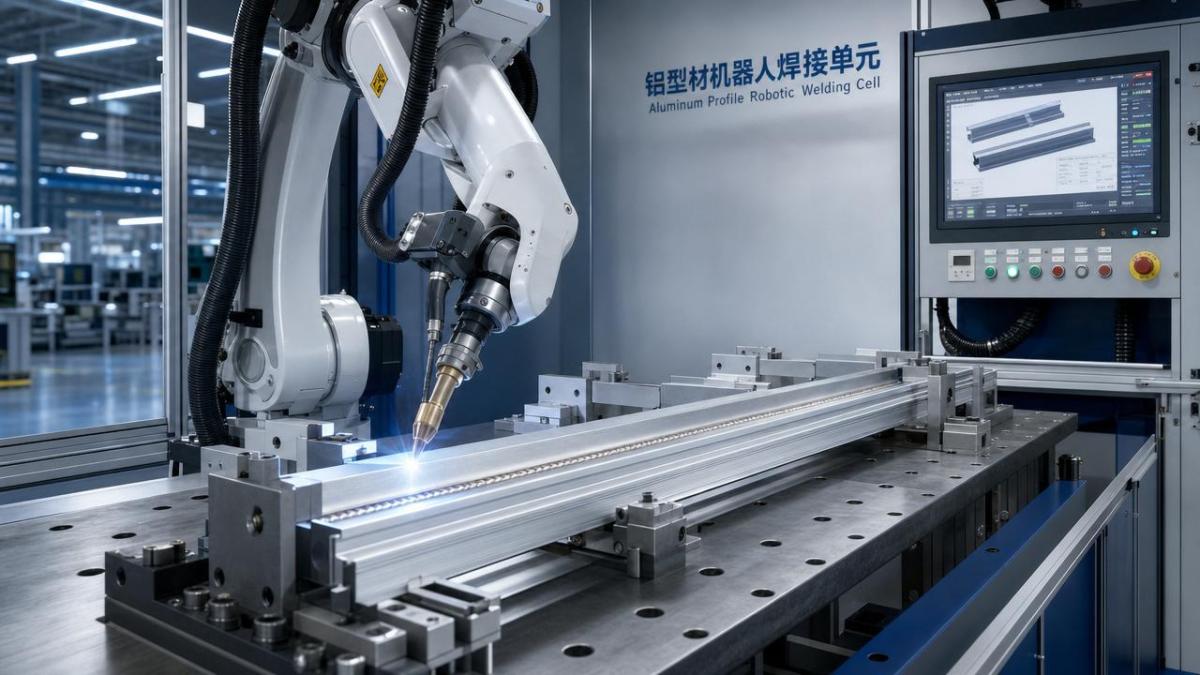
At first glance, robot welding aluminum profiles seems ideal for automation. Aluminum extrusions are widely used, joints are repetitive, and cycle time targets are clear.
Yet consistency fails when the process window is narrow and hidden variables change faster than the program can compensate.
The biggest mistake is treating aluminum profile welding like mild steel welding with different wire and gas. That assumption causes unstable results.
Robot welding aluminum profiles depends on material condition, joint fit-up, thermal balance, wire feeding behavior, and motion calibration working together.
If one variable drifts, the robot repeats the error perfectly. Automation amplifies process weakness instead of removing it.
Why different production scenes create different consistency risks
Not every aluminum welding line fails for the same reason. The failure pattern depends on product geometry, profile thickness, batch variation, and takt time pressure.
A frame for industrial equipment behaves differently from a thin enclosure, a battery tray, or a transport structure.
Scene 1: Thin-wall decorative or enclosure profiles
Thin sections react quickly to heat. Small arc length changes can create burn-through, undercut, or visible distortion.
In this scene, robot welding aluminum profiles often fails because visual quality matters as much as strength. Minor inconsistency becomes a reject.
Scene 2: Structural frames with medium wall thickness
These parts demand balanced penetration and dimensional stability. Welds must be strong without pulling the frame out of tolerance.
Here, robot welding aluminum profiles becomes sensitive to clamping sequence, heat accumulation, and corner joint variation.
Scene 3: Long profiles with repeated seams
Long seams expose torch angle drift, wire cast variation, and robot path accuracy problems. Early welds may pass while later welds degrade.
This is common when cycle optimization reduces dwell time and thermal control disappears.
Scene 4: Safety-critical assemblies
Some applications prioritize fatigue life over appearance. Surface acceptance alone is not enough.
In these cases, robot welding aluminum profiles fails at consistency when internal fusion varies between shifts, batches, or fixture conditions.
The real engineering causes behind unstable robot welding aluminum profiles
Oxide layer and surface contamination
Aluminum oxide melts at a much higher temperature than the base metal. Oil, coolant residue, and handling contamination further narrow the process window.
If cleaning varies by operator, shift, or storage time, robot welding aluminum profiles will show inconsistent arc start and wetting behavior.
Gap variation and profile dimensional drift
Extruded profiles rarely arrive with perfect consistency. Straightness, twist, cut quality, and wall thickness all influence joint fit.
A robot follows a taught path. It cannot naturally adapt to random gaps without sensing, seam tracking, or adaptive control.
Heat input instability across batches
Aluminum conducts heat rapidly. Part temperature changes quickly during continuous production.
Cold starts, warm fixtures, and sequential weld order all shift penetration behavior. One fixed program rarely covers every thermal state.
Wire feeding and soft wire behavior
Aluminum wire is softer than steel wire. Feed instability causes arc fluctuation, birdnesting, and inconsistent deposition.
Poor liner condition, worn drive rolls, incorrect spool setup, or long conduit routing can destabilize robot welding aluminum profiles.
Torch access and angle inconsistency
Profile geometries often include corners, channels, and internal cavities. A good lab sample may hide poor real access on production parts.
When push angle and stick-out vary along the seam, the weld profile changes even if current and speed remain unchanged.
Fixture design that solves location but not thermal movement
Many fixtures hold the part, yet fail to control expansion and shrinkage. Clamps may force fit-up before welding, then release stress after welding.
That creates a false sense of process control. Robot welding aluminum profiles needs fixtures designed for both repeatability and heat behavior.
How scene-specific needs change the right process decisions
This comparison shows why robot welding aluminum profiles cannot be standardized by one universal recipe.
The right answer depends on whether appearance, throughput, fatigue resistance, or dimensional control carries the highest penalty.
Practical recommendations for more consistent robot welding aluminum profiles
- Separate incoming profile inspection from welding setup approval.
- Measure gap, straightness, and cut-face variation before blaming robot parameters.
- Standardize cleaning time, storage condition, and pre-weld handling.
- Use push-pull systems or spool guns where wire feed length creates instability.
- Track contact tip wear, liner condition, and drive roll performance by shift hours.
- Validate torch TCP and angle at scheduled intervals, not only after collision alarms.
- Control part and fixture temperature when production runs are long.
- Review weld sequence to reduce distortion before increasing clamp force.
- Add seam finding or arc sensing when profile variation exceeds teaching tolerance.
- Confirm internal quality with macro sections, not appearance alone.
These actions improve robot welding aluminum profiles because they address process capability, not just machine programming.
Common misjudgments that keep consistency problems alive
One common error is increasing current to fix lack of fusion without checking gap change or oxide contamination first.
Another mistake is assuming a successful sample run proves production readiness. Short trials rarely reveal thermal drift or consumable wear patterns.
Some lines invest heavily in robots but neglect fixture redesign. Robot welding aluminum profiles then inherits mechanical inconsistency from the upstream process.
There is also overreliance on appearance. A smooth bead may still hide unstable penetration, porosity, or insufficient sidewall fusion.
Finally, teams often optimize speed before establishing a verified process window. Throughput gains vanish when rework and scrap increase.
A data-first next step for stabilizing aluminum welding automation
The fastest way to improve robot welding aluminum profiles is to map inconsistency by scene, not by guesswork.
Start with four checkpoints: material condition, fit-up variation, thermal state, and wire delivery stability.
Then connect those findings to weld defects, dimensional results, and cycle data. Patterns usually appear quickly.
For organizations seeking engineering truth over marketing claims, this is where a benchmark mindset matters.
At TechStat Vanguard, process evaluation begins with measurable variables, tolerance windows, and traceable failure causes.
If robot welding aluminum profiles continues to fail at consistency, the solution is rarely a single setting. It is a disciplined, data-driven process audit.
Use that audit to decide whether the priority is better extrusion control, smarter sensing, improved fixturing, or tighter welding validation.
When those decisions are grounded in real parameters, aluminum automation becomes repeatable, scalable, and commercially reliable.
Search News
Hot Articles
- Carbon Fiber StructuresHow to Specify Aerospace Carbon Fiber Assemblies for Lightweight, Load-Bearing PartsJul 11, 2026
- Machine VisionXiaomi, Alibaba DAMO Academy Drive Open-Source Robotics Model Ecosystem, Lowering Algorithm Development Barriers for Overseas SMEs Adopting Chinese Robotics SolutionsMar 30, 2026
- Cobots & ArmsShanxi 'AI+' Conference Showcases Embodied Intelligence with Multinational Buyer Engagement: Key Industry ImplicationsMar 30, 2026
Popular Tags
Recommended News
 Jul 11, 2026How to Specify Aerospace Carbon Fiber Assemblies for Lightweight, Load-Bearing PartsAerospace carbon fiber assemblies: learn how to specify laminate design, load data, joining methods, and inspection controls for lighter, reliable load-bearing aerospace parts.Elena Rostova (UAV Systems Researcher)
 Mar 30, 2026Xiaomi, Alibaba DAMO Academy Drive Open-Source Robotics Model Ecosystem, Lowering Algorithm Development Barriers for Overseas SMEs Adopting Chinese Robotics SolutionsXiaomi & Alibaba DAMO Academy's open-source robotics models lower algorithm barriers for global SMEs. Boost efficiency in manufacturing, logistics & smart retail with ROS 2 compatible solutions.TSV Data Lab
 Mar 30, 2026Shanxi 'AI+' Conference Showcases Embodied Intelligence with Multinational Buyer Engagement: Key Industry ImplicationsShanxi 'AI+' Conference highlights embodied intelligence with Tesla, Ubtech & Jiantao showcasing multimodal robotics. 40+ global buyers validated tech on-site, creating new B2B channels for industrial automation & AI solutions.Chen Wei (Automation Lead Engineer)
 Mar 30, 2026Zhongguancun Unveils 6G Integrated Sensing-Computing-Intelligence Platform to Empower Embodied Robots for Global Industrial ApplicationsZhongguancun's new 6G platform revolutionizes industrial robotics with <10ms latency, empowering global automotive, logistics & port automation. Discover how this tech boosts China's smart manufacturing exports.TSV Data Lab
 Mar 30, 2026Mech-Mind Tianjin Embodied Intelligence R&D and Production Base Goes Live, Cutting Delivery Time by 20%–30% for Global Customized AMR+Vision SolutionsMech-Mind's Tianjin AMR+Vision production base cuts delivery time by 20%-30% for欧美 & Latin American markets. Discover how this PLd-certified facility accelerates customized robotics solutions for smart manufacturing and logistics.Chen Wei (Automation Lead Engineer)
 Mar 30, 2026Boao Forum Reveals 'Co-evolution of Big and Small Brains' Trend in Humanoid Robots, China's Embodied Intelligence Accelerates Adaptation to Overseas Manufacturing Service ScenariosDiscover how China's humanoid robots, featuring 'Co-evolution of Big and Small Brains,' are revolutionizing global manufacturing. Learn about Embodied Tian Gong 3.0's ISO compliance and overseas deployment at Boao Forum 2026.Chen Wei (Automation Lead Engineer)
 Mar 30, 2026China Railway Industrial Secures Patent for Embodied Robotics in Material Handling, Boosting High-Precision Delivery Capabilities for Overseas Infrastructure and Manufacturing ProjectsChina Railway Industrial's new patent for embodied robotics in material handling boosts high-precision delivery for global infrastructure & manufacturing. Discover how this innovation enhances logistics accuracy in automotive, rail transit & EPC projects.Chen Wei (Automation Lead Engineer)
 Oct 04, 2026CAD/CAM Benchmarking in the GCC: What Manufacturers Should Ask a ConsultantCAD CAM benchmark consultant GCC guide: learn the key questions manufacturers should ask to validate post-processors, workflows, machine performance, and production risk.Victor Lin (Chief Software Architect)
 Oct 03, 2026Selecting Automotive Radar Sensor Modules for ADAS Range, Resolution, and IntegrationAutomotive radar sensor module selection guide for ADAS: compare range, resolution, field of view, latency, and integration to build safer, reliable vehicle systems.TSV Data Lab
 Oct 02, 2026How to Qualify Machined Parts Suppliers for Hard Tech ProgramsHard tech supply chain machined parts demand rigorous supplier qualification. Learn how to assess capability, traceability, quality controls, and delivery resilience.Dr. Marcus Vance
 Oct 01, 2026How to Select an Outdoor Security Radar Sensor for Perimeter Detection?Outdoor security radar sensor selection guide: compare range, accuracy, false-alarm control, integration, and field testing for reliable perimeter detection.TSV Data Lab
 Sep 30, 2026How to Evaluate Solid-State LiDAR Hardware for Outdoor Autonomous VehiclesSolid state LiDAR hardware evaluation guide for outdoor autonomous vehicles—compare range, point-cloud quality, environmental resilience, integration, and safety.TSV Data Lab
 Sep 29, 2026ISO 9283 Repeatability: How to Evaluate Cobot Positioning PerformanceISO 9283 cobot repeatability explained: learn how payload, reach, approach direction, and test conditions affect positioning performance and cell capability.Chen Wei (Automation Lead Engineer)
 Oct 04, 2026How Should You Compare 5-Axis CNC Machine Accuracy Claims?How do I compare 5-axis CNC machine accuracy claims? Learn how to assess standards, thermal stability, TCP accuracy, and real-world test evidence.Dr. Marcus Vance
 Oct 03, 2026Is Edge Computing Necessary for Real-Time Quality Inspection?Is industrial edge computing necessary for real-time quality inspection? Explore how latency, data volume, reliability, and control integration shape the right architecture.TSV Data Lab
 Oct 02, 2026What Documents Prove a Precision Machining Supplier Can Hold Tolerance?What documents prove a precision machining supplier can hold tolerance? Explore certificates, FAI reports, calibration, SPC, and traceability evidence to qualify suppliers with confidence.Dr. Marcus Vance
 Oct 01, 2026Can a Machining Supplier Meet Aerospace Fatigue Testing Requirements?Can a machining supplier meet aerospace fatigue testing requirements? Learn the traceability, process control, and test evidence needed for reliable aerospace parts.Dr. Marcus Vance
 Sep 30, 2026Which Industrial Robot Specifications Matter for High-Precision Assembly?Which industrial robot specifications matter most for high-precision assembly? Explore repeatability, accuracy, stiffness, vibration, calibration, and force control for reliable yields.Chen Wei (Automation Lead Engineer)
 Sep 29, 2026How Do You Verify Servo Motor Torque Under Continuous Load?How do I verify servo motor torque under continuous load? Learn RMS torque checks, torque-speed limits, thermal derating, and real-machine testing.Chen Wei (Automation Lead Engineer)
 Oct 02, 2026ZD330 Software Configuration: Verifying Cut-List Import Before PurchaseZD330 software and machine configuration: verify cut-list imports, data mapping, labels, and workflow before purchase to reduce errors and choose with confidence.Victor Lin (Chief Software Architect)
 Sep 28, 2026Spindle Runout Measurement in Germany: DIN Standards, Methods, and Acceptance LimitsSpindle runout measurement Germany: explore DIN standards, proven methods, acceptance limits, and audit-ready practices for reliable machining quality.Dr. Marcus Vance
 Sep 27, 2026How to Select Wall-Mount Edge Devices for Space-Constrained Factory NetworksWall mount edge devices for space-constrained factories: evaluate workload, thermal design, power resilience, cable access, and network reliability for smarter deployments.TSV Data Lab
 Sep 26, 2026Machining Tolerance Analysis: How to Set Limits That Meet Function and Cost TargetsMachining tolerance analysis: learn how to set functional limits, control tolerance stacks, reduce inspection risk, and balance precision with production cost.Dr. Marcus Vance
 Sep 25, 2026How to Evaluate an Industrial Infrastructure Data Platform for Multi-Site OperationsIndustrial infrastructure data platform evaluation guide for multi-site operations: compare data quality, edge resilience, interoperability, governance, and scalable proof-of-value criteria.Victor Lin (Chief Software Architect)