Where Industrial Robots Add the Most Value in Auto Assembly
Publication Date
author
In modern vehicle production, industrial robots for automotive assembly create the greatest value where precision, repeatability, and cycle-time stability directly affect cost, quality, and throughput. For enterprise decision-makers, understanding which assembly stages benefit most from robotic deployment is essential to reducing operational risk, improving engineering consistency, and making smarter capital investments across an increasingly data-driven manufacturing landscape.
Understanding where robots matter most in automotive assembly
Industrial robots for automotive assembly are no longer limited to simple high-volume welding cells. In today’s vehicle plants, they operate across body-in-white, paint, powertrain, battery pack integration, final assembly support, inspection, and intralogistics. Their core value is not automation for its own sake. It is the ability to hold process capability within tight engineering windows while sustaining output under demanding production schedules.
For decision-makers, the key question is not whether robots are useful, but where they produce the highest return. The answer depends on a combination of takt time pressure, defect sensitivity, worker safety, product complexity, and the cost of variation. In auto assembly, the greatest robotic value usually appears where the process is physically repetitive, quality-critical, ergonomically difficult, or highly data-dependent.
This is why a data-first perspective matters. At TechStat Vanguard, the relevant evaluation criteria are not generic claims about “smart factories.” They are measurable factors such as repeatability, uptime, gripper reliability, path accuracy, process drift, changeover time, and integration stability with vision systems, PLCs, torque tools, and MES layers. Parameters do not lie, and in automotive manufacturing, small deviations scale into major cost exposure.
Why the automotive industry focuses so heavily on robotic deployment
Automotive manufacturing is one of the most demanding industrial environments because it combines mass production economics with engineering precision. A vehicle program may involve thousands of joining points, strict dimensional targets, traceable fastening operations, paint quality constraints, and increasingly complex electronic and battery-related subsystems. Any instability in one stage can ripple through upstream and downstream operations.
The growing product mix adds pressure. Manufacturers now build internal combustion vehicles, hybrids, and EV variants across shared or semi-shared platforms. That means production systems must support both high throughput and flexible reconfiguration. Industrial robots for automotive assembly are especially valuable here because they can be reprogrammed, instrumented, and monitored more effectively than fixed hard automation in many variable-production contexts.
Another reason for intense focus is labor risk. Some assembly tasks remain physically taxing, dangerous, or difficult to staff consistently. Robots reduce exposure in welding fumes, paint environments, high-temperature sealing, heavy-part handling, and repetitive overhead operations. From an executive standpoint, this translates into lower injury risk, more stable staffing, and improved compliance.
A practical overview of high-value robotic zones
Not every assembly step benefits equally from robotic investment. The table below shows where industrial robots for automotive assembly typically add the most value and what business outcomes they influence.
Body-in-white: the highest concentration of robotic value
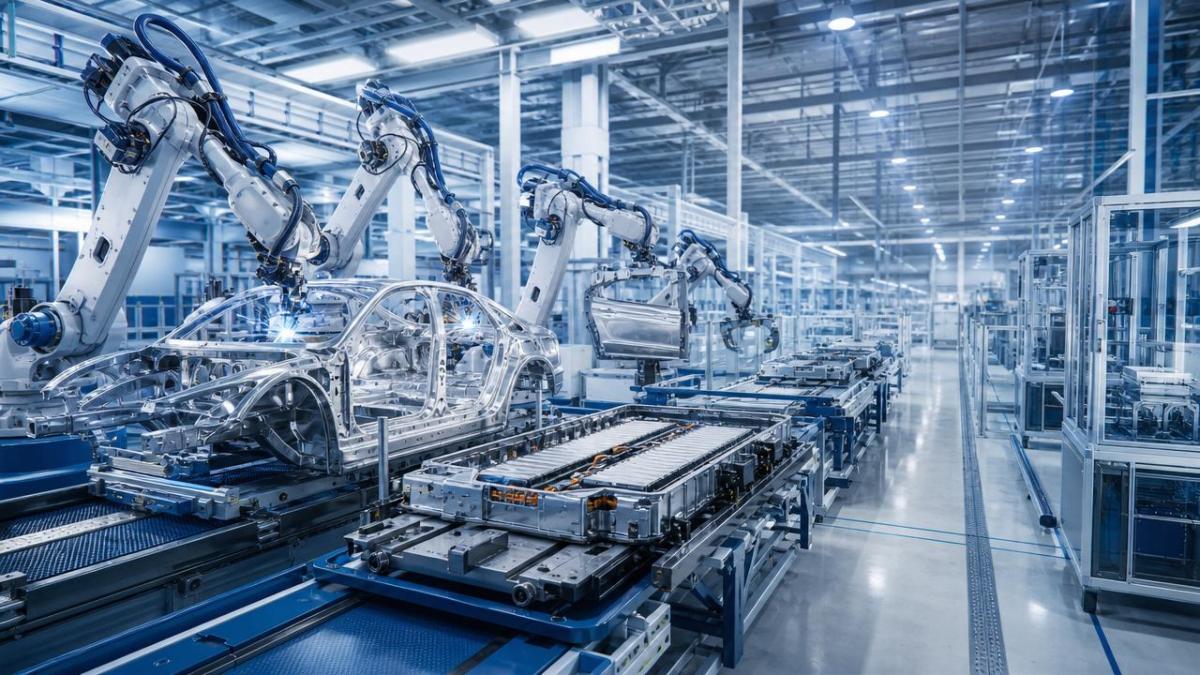
If one area most clearly demonstrates the value of industrial robots for automotive assembly, it is body-in-white. This stage requires thousands of welds and tightly controlled geometric relationships across structural panels. Variation here directly affects downstream fit, door alignment, NVH behavior, and crash-related dimensional integrity.
Robots dominate because they can execute repeatable weld paths at speed and maintain consistent tool presentation under complex motion sequences. The business case is strong: lower rework, fewer dimensional escapes, and more predictable takt performance. In high-volume vehicle programs, even minor weld inconsistency can multiply into major quality costs. Robotic cells reduce that exposure when paired with fixture control, gun maintenance discipline, and real-time weld monitoring.
For executives evaluating value, body-in-white is often the first place where automation maturity, line architecture, and maintenance quality are easiest to connect to measurable plant economics.
Paint, sealing, and surface treatment: quality and material efficiency
Paint operations are another major value zone because finish quality is highly visible to customers and expensive to correct. Robots in paint shops deliver controlled paths, stable spray angles, and repeatable coating thickness. This improves appearance while reducing over-application and material waste. In many plants, robotic painting is not just a labor-saving step; it is a process control strategy.
The same logic applies to adhesive dispensing and seam sealing. Inconsistent bead geometry can create water ingress, corrosion risk, NVH issues, or structural performance variation. Industrial robots for automotive assembly help maintain application quality when paired with process monitoring on pressure, flow, and nozzle condition. The result is a more stable quality envelope and less dependence on operator variability.
Powertrain and EV battery assembly: value rises with complexity
As powertrain systems evolve, robotic value increases. Traditional engine and transmission lines already benefit from robotic handling, precision insertion, and automated fastening. However, the rise of EV production has made battery pack assembly one of the most strategically important robotic applications in the automotive sector.
Battery systems demand tight control over positioning, joining, insulation, cleanliness, and traceability. Errors are costly because they can affect safety, thermal performance, warranty risk, and regulatory exposure. Robots are well suited for module handling, thermal interface material dispensing, laser-based processes, fastening verification, and pack enclosure operations. In these environments, repeatability and data capture matter as much as pure speed.
For enterprise leaders, this is a critical insight: the more technically sensitive the assembly content, the more likely industrial robots for automotive assembly will generate value through risk reduction rather than labor substitution alone.
Final assembly support: selective automation creates the best outcome
Final assembly is more variable than body shop or paint, which means full robotic replacement is not always the best answer. Still, there are high-value use cases. Windshield installation, heavy-seat handling, wheel mounting assistance, instrument panel presentation, and collaborative screwdriving or fastening can all improve ergonomics and takt consistency.
Here, selective automation often outperforms over-automation. Cobots, intelligent assist systems, and robot-guided part delivery can stabilize the line without reducing flexibility. For mixed-model production, that matters. Decision-makers should view final assembly robotics as a precision support layer that removes bottlenecks and ergonomic risk while preserving human adaptability where judgment and variation handling remain essential.
Inspection, intralogistics, and digital integration
A growing share of value comes from systems around the assembly process rather than only within it. Vision-guided robots can inspect gap and flush, bead presence, weld completeness, label accuracy, and component orientation. AGVs and AMRs support synchronized material flow. Together, these systems reduce line starvation, handling errors, and hidden losses caused by poor internal logistics.
What separates strong implementations from weak ones is integration quality. Industrial robots for automotive assembly perform best when connected to torque traceability, vision feedback, predictive maintenance analytics, and manufacturing execution systems. This creates closed-loop visibility, allowing teams to catch drift early and improve process capability over time. In a data-driven factory, robotic value expands when engineering and information systems are aligned.
How decision-makers should evaluate value beyond headline ROI
Capital approval decisions often focus on labor savings, but that lens is too narrow for modern vehicle manufacturing. A better framework considers at least five dimensions: quality cost, throughput stability, safety exposure, changeover flexibility, and data traceability. In many cases, the strongest return comes from avoiding disruptions and warranty issues rather than simply removing headcount.
Leaders should also differentiate between tasks that are automation-compatible and tasks that are automation-ready. A process may look repetitive, but if parts arrive with large upstream variation, if fixturing is unstable, or if engineering standards are poorly controlled, a robot can simply reproduce instability more quickly. That is why TSV’s engineering-first view emphasizes baseline capability before deployment. Tolerance discipline and process consistency must come first.
Practical guidance for implementing industrial robots for automotive assembly
Companies planning new deployments should begin with process mapping, not vendor claims. Identify stations where defects are expensive, cycle variation is chronic, or safety risks are elevated. Then assess the technical fit: payload, reach, repeatability, end-effector requirements, sensing needs, maintainability, and software interoperability. The best results come from matching robot capability to process physics, not from treating every station as a generic automation opportunity.
Second, use pilot data to validate assumptions. Measure actual OEE improvement, not just theoretical output. Track downtime causes, tool wear, quality escapes, and programming change effort. Third, ensure cross-functional ownership. Production, maintenance, quality, controls engineering, and EHS should all influence the decision because robotic value depends on sustained operational discipline.
Finally, prioritize suppliers and system partners that can prove technical performance with real benchmark data. For high-stakes manufacturing, broad marketing language is not enough. Decision-makers should ask for cycle studies, repeatability under load, MTBF history, integration references, and evidence of stable performance in similar vehicle programs.
Conclusion: value is highest where precision and variability collide
The greatest value from industrial robots for automotive assembly appears in operations where process precision, defect sensitivity, and production pressure intersect. Body-in-white, paint, sealing, powertrain, battery pack assembly, inspection, and targeted final assembly support are the most important zones because they turn robotic repeatability into measurable business outcomes.
For enterprise decision-makers, the real strategic question is not how many robots a factory has, but whether those robots are deployed in the highest-value process windows and governed by sound engineering data. In a market shaped by tighter quality expectations, EV complexity, and constant throughput pressure, the most competitive manufacturers will be the ones that use robotics not as a symbol of modernization, but as a disciplined instrument of process truth.
If your organization is assessing industrial robots for automotive assembly, start with the stations where variation is expensive, quality is visible, and downtime is unacceptable. That is where automation usually adds the most value—and where data-backed engineering decisions create the strongest long-term advantage.
Search News
Hot Articles
- Carbon Fiber StructuresHow to Specify Aerospace Carbon Fiber Assemblies for Lightweight, Load-Bearing PartsJul 11, 2026
- Machine VisionXiaomi, Alibaba DAMO Academy Drive Open-Source Robotics Model Ecosystem, Lowering Algorithm Development Barriers for Overseas SMEs Adopting Chinese Robotics SolutionsMar 30, 2026
- Cobots & ArmsShanxi 'AI+' Conference Showcases Embodied Intelligence with Multinational Buyer Engagement: Key Industry ImplicationsMar 30, 2026
Popular Tags
Recommended News
 Jul 11, 2026How to Specify Aerospace Carbon Fiber Assemblies for Lightweight, Load-Bearing PartsAerospace carbon fiber assemblies: learn how to specify laminate design, load data, joining methods, and inspection controls for lighter, reliable load-bearing aerospace parts.Elena Rostova (UAV Systems Researcher)
 Mar 30, 2026Xiaomi, Alibaba DAMO Academy Drive Open-Source Robotics Model Ecosystem, Lowering Algorithm Development Barriers for Overseas SMEs Adopting Chinese Robotics SolutionsXiaomi & Alibaba DAMO Academy's open-source robotics models lower algorithm barriers for global SMEs. Boost efficiency in manufacturing, logistics & smart retail with ROS 2 compatible solutions.TSV Data Lab
 Mar 30, 2026Shanxi 'AI+' Conference Showcases Embodied Intelligence with Multinational Buyer Engagement: Key Industry ImplicationsShanxi 'AI+' Conference highlights embodied intelligence with Tesla, Ubtech & Jiantao showcasing multimodal robotics. 40+ global buyers validated tech on-site, creating new B2B channels for industrial automation & AI solutions.Chen Wei (Automation Lead Engineer)
 Mar 30, 2026Zhongguancun Unveils 6G Integrated Sensing-Computing-Intelligence Platform to Empower Embodied Robots for Global Industrial ApplicationsZhongguancun's new 6G platform revolutionizes industrial robotics with <10ms latency, empowering global automotive, logistics & port automation. Discover how this tech boosts China's smart manufacturing exports.TSV Data Lab
 Mar 30, 2026Mech-Mind Tianjin Embodied Intelligence R&D and Production Base Goes Live, Cutting Delivery Time by 20%–30% for Global Customized AMR+Vision SolutionsMech-Mind's Tianjin AMR+Vision production base cuts delivery time by 20%-30% for欧美 & Latin American markets. Discover how this PLd-certified facility accelerates customized robotics solutions for smart manufacturing and logistics.Chen Wei (Automation Lead Engineer)
 Mar 30, 2026Boao Forum Reveals 'Co-evolution of Big and Small Brains' Trend in Humanoid Robots, China's Embodied Intelligence Accelerates Adaptation to Overseas Manufacturing Service ScenariosDiscover how China's humanoid robots, featuring 'Co-evolution of Big and Small Brains,' are revolutionizing global manufacturing. Learn about Embodied Tian Gong 3.0's ISO compliance and overseas deployment at Boao Forum 2026.Chen Wei (Automation Lead Engineer)
 Mar 30, 2026China Railway Industrial Secures Patent for Embodied Robotics in Material Handling, Boosting High-Precision Delivery Capabilities for Overseas Infrastructure and Manufacturing ProjectsChina Railway Industrial's new patent for embodied robotics in material handling boosts high-precision delivery for global infrastructure & manufacturing. Discover how this innovation enhances logistics accuracy in automotive, rail transit & EPC projects.Chen Wei (Automation Lead Engineer)
 Sep 29, 2026ISO 9283 Repeatability: How to Evaluate Cobot Positioning PerformanceISO 9283 cobot repeatability explained: learn how payload, reach, approach direction, and test conditions affect positioning performance and cell capability.Chen Wei (Automation Lead Engineer)
 Sep 29, 2026How Do You Verify Servo Motor Torque Under Continuous Load?How do I verify servo motor torque under continuous load? Learn RMS torque checks, torque-speed limits, thermal derating, and real-machine testing.Chen Wei (Automation Lead Engineer)
 Sep 28, 2026Spindle Runout Measurement in Germany: DIN Standards, Methods, and Acceptance LimitsSpindle runout measurement Germany: explore DIN standards, proven methods, acceptance limits, and audit-ready practices for reliable machining quality.Dr. Marcus Vance
 Sep 27, 2026How to Select Wall-Mount Edge Devices for Space-Constrained Factory NetworksWall mount edge devices for space-constrained factories: evaluate workload, thermal design, power resilience, cable access, and network reliability for smarter deployments.TSV Data Lab
 Sep 26, 2026Machining Tolerance Analysis: How to Set Limits That Meet Function and Cost TargetsMachining tolerance analysis: learn how to set functional limits, control tolerance stacks, reduce inspection risk, and balance precision with production cost.Dr. Marcus Vance
 Sep 25, 2026How to Evaluate an Industrial Infrastructure Data Platform for Multi-Site OperationsIndustrial infrastructure data platform evaluation guide for multi-site operations: compare data quality, edge resilience, interoperability, governance, and scalable proof-of-value criteria.Victor Lin (Chief Software Architect)
 Sep 24, 2026How to Select Machine Vision Optics for Accurate Inspection at Different Working DistancesMachine vision optics selection guide for accurate inspection at every working distance. Compare FOV, pixel scale, DOF, distortion, lighting, and telecentric options.TSV Data Lab
 Sep 23, 2026How to Evaluate a Machine Vision System Integrator for High-Speed Inspection LinesChoose a machine vision system integrator with proven expertise in high-speed inspection, reliable reject timing, robust optics, and measurable acceptance criteria.TSV Data Lab
 Sep 29, 2026How MES and OEE work together to identify production lossesMES and OEE work together to uncover hidden production losses, connect downtime, speed, and quality data, and drive smarter shop-floor improvements.Victor Lin (Chief Software Architect)
 Sep 28, 2026When is a SCADA API the right choice for connecting plant systems?SCADA API guide: learn when governed plant data integration improves traceability, security, and scalability—without compromising real-time control.Victor Lin (Chief Software Architect)
 Sep 27, 2026How SCADA data integration improves traceability across production linesSCADA data integration connects production-line data to improve traceability, accelerate quality investigations, and strengthen safety decisions.Victor Lin (Chief Software Architect)
 Sep 26, 2026What to define before starting SCADA integration planningSCADA integration planning starts with clear scope, control boundaries, data models, cybersecurity, and testing. Discover the definitions that reduce risk and costly rework.Victor Lin (Chief Software Architect)
 Sep 25, 2026How a smart factory with Industrial IoT reduces production blind spotsDiscover how a smart factory with Industrial IoT turns real-time machine, quality, and workflow data into actionable insights that reduce production blind spots and delivery risks.Victor Lin (Chief Software Architect)
 Sep 24, 2026When does Industrial IoT make smart manufacturing easier to scale?Smart manufacturing Industrial IoT scales when trusted data, interoperable systems, and secure workflows turn connected assets into measurable gains.TSV Data Lab
 Sep 23, 2026What drives ultra-precision machining cost at 1-micron tolerance?Ultra precision machining cost per part at 1 micron tolerance depends on process, material, metrology, and yield. Learn how to compare quotes confidently.Dr. Marcus Vance
 Sep 22, 2026Drone Engine-T550CC Applications: Build the UAV Power System Around the MissionAn application guide for Drone Engine-T550CC integration, covering payload planning, airframe matching, cooling, fuel, vibration, test procedures, documentation, and service preparation.Elena Rostova (UAV Systems Researcher)
 Sep 22, 2026How to Evaluate Industrial Edge Computing Vendors for Factory DeploymentIndustrial edge computing vendor evaluation guide for factories: compare latency, protocol fit, reliability, security, and lifecycle support before deployment.TSV Data Lab