Why Some AGV Path Planning Models Break in Mixed Traffic
Publication Date
author
In real factories, AGV AMR path planning algorithms often perform well in simulation yet fail when pedestrians, forklifts, and manual carts share the same aisle. Mixed traffic introduces uncertainty, delayed reactions, and dynamic conflicts that expose weak modeling assumptions. This article examines why some path planning models break down, what operators should watch for, and how data-driven evaluation can reveal the gap between theoretical routing performance and real-world navigation reliability.
If you operate or supervise AGVs or AMRs on a live shop floor, the main answer is simple: many path planning models break because they were designed for predictable movement, but mixed traffic is not predictable. People hesitate, forklifts cut corners, carts stop in blind spots, and temporary obstacles appear without warning. A model that looks efficient on a clean digital map can become unstable, overly conservative, or unsafe when it faces these real behaviors.
For operators, this is not just a software theory issue. It directly affects stoppages, detours, traffic jams, battery usage, task completion time, and near-miss events. The real question is not whether a vendor claims strong navigation, but whether the AGV AMR path planning algorithms remain reliable when traffic is dense, visibility is partial, and motion rules are constantly violated by reality.
What users are really trying to understand when path planning fails
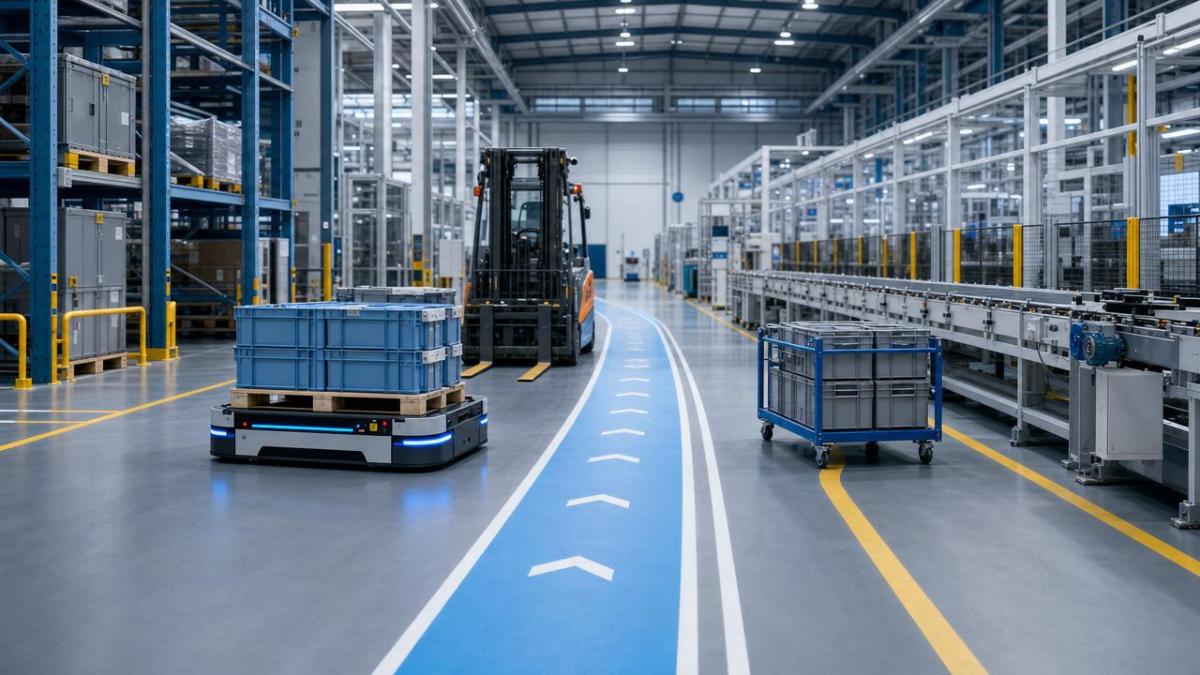
Most users searching for this topic are not looking for a textbook definition of path planning. They want to know why a vehicle that worked during testing now pauses too often, chooses strange routes, blocks aisles, or loses efficiency once the site becomes busy. They also want to know whether the problem comes from the algorithm, the sensors, the site layout, the traffic policy, or poor deployment settings.
That is why the most useful way to evaluate path planning is not to ask whether the robot can reach a destination. Almost every modern system can do that in a controlled environment. The better question is whether it can do so consistently, safely, and with acceptable delay in mixed traffic. Reliability under disruption matters more than ideal-route elegance.
In practical terms, operators care about a few specific outcomes: fewer emergency stops, fewer deadlocks, predictable travel times, low interference with human work, and stable performance across shifts. If a planning model cannot maintain those outcomes, its theoretical sophistication does not help much on the floor.
Why simulation results often look good while real performance degrades
Simulation usually simplifies behavior. Virtual pedestrians move according to neat rules. Forklifts may be modeled with fixed speed envelopes. Obstacles often appear in limited patterns. The map is usually accurate, sensor noise is reduced, and localization is assumed to be clean enough. Under those conditions, path planning models can appear highly efficient.
Real plants are different. Human movement is erratic. Operators may carry long loads that change their body footprint. A forklift driver may reverse unexpectedly, stop to speak to a coworker, or enter an aisle while partially blocking it. A hand cart may remain parked for three minutes in a space that should stay clear. None of these events is rare in real operations.
Many AGV AMR path planning algorithms rely on assumptions about obstacle motion, reaction time, and free-space continuity. Once those assumptions fail, the system may oscillate between choices, brake too aggressively, or replan so often that throughput collapses. The model did not necessarily “crash” in a software sense. It failed because its assumptions no longer matched the environment.
The biggest modeling assumptions that break in mixed traffic
One common weakness is assuming that moving obstacles follow smooth, predictable trajectories. In mixed traffic, people do not move like mathematical agents. They pause, step sideways, accelerate suddenly, and change direction when they notice a robot. Forklifts are even harder because they have large turning radii, load-dependent visibility, and operator-dependent behavior.
Another weak assumption is that local avoidance can always solve short-term conflict. In reality, local planning may work for one obstacle but create a downstream conflict with another. A robot that detours to avoid a pedestrian may drift into a forklift path or block a manual cart lane. Local success can create system-level failure.
A third issue is assuming that all obstacles are equally negotiable. They are not. A standing worker near a workstation is different from a crossing pedestrian. A forklift carrying a pallet is different from an empty tugger. A manual cart parked near a corner creates visibility problems that a moving person does not. If the planner treats these cases too similarly, its decisions become inefficient or risky.
There is also the assumption of accurate, low-latency perception. In mixed traffic, occlusion is a major problem. A forklift, pallet stack, rack edge, or machine frame can hide motion until the last second. If sensor fusion and prediction are delayed or noisy, the planning layer is making decisions on stale information. Even a strong algorithm will underperform when its inputs are late or incomplete.
How aisle geometry and floor rules create hidden failure points
Some path planning failures are blamed on algorithms when the site itself creates the problem. Narrow aisles, blind corners, uneven floor markings, shared intersections, and ad hoc parking areas can make navigation unstable. A planner may be mathematically sound, but if the operating space gives it no safe margin, the vehicle will stop frequently or choose inefficient detours.
Mixed traffic becomes especially difficult where formal and informal movement patterns overlap. For example, a mapped pedestrian crossing may work most of the day, but if workers also cut through the adjacent corner during shift changes, the planner sees inconsistent flow. The robot may become overly cautious because the environment no longer matches the site rules used during commissioning.
Operators should also look at traffic governance. Are there enforced one-way rules for forklifts? Are cart staging zones clearly separated from robot travel lanes? Are temporary pallets routinely left in buffer areas that the digital map marks as free space? Many path planning breakdowns are not pure software defects. They are operations-policy problems revealed by the robot.
What path planning failure looks like on the floor
In practice, breakdown rarely appears as one dramatic event. It usually shows up as repeated small symptoms. The robot slows too often near intersections. It stops with no visible obstruction. It enters a route, reverses, and tries another route. It hesitates behind pedestrians longer than expected. It creates queues during busy windows. These are early warning signals.
Another sign is inconsistency. If travel time between the same two points varies sharply by shift, traffic density, or operator group, the issue may be planning robustness rather than mechanical performance. Good AGV AMR path planning algorithms should not deliver identical times in all conditions, but they should remain within a manageable range.
Watch for behavior that suggests the planner is trapped between safety and productivity. If the vehicle is technically safe but operationally disruptive, the planning model may be overconservative for the real environment. If it moves efficiently but generates repeated near-misses or hard braking events, it may be underestimating dynamic risk.
Why local planners, global planners, and rule layers can conflict
Many mobile robot systems combine a global planner, a local planner, and a traffic or behavior rule layer. On paper, this is sensible. The global planner chooses the route, the local planner handles immediate obstacles, and the rule layer enforces priorities and safety logic. In mixed traffic, however, these layers can interfere with one another.
For example, the global planner may prefer the shortest aisle route. The local planner may repeatedly avoid people by moving toward the aisle edge. The rule layer may then interpret that position as a yield state near a crossing, causing a stop. After waiting, the system replans and repeats the same logic. The vehicle is not lost, but the stack behaves inefficiently.
This is why operators should avoid judging performance by route maps alone. The visible route may look reasonable, while the interaction among software layers creates hesitation loops. What matters is not only route selection but how the full decision chain behaves under live traffic stress.
What operators should measure instead of trusting vendor demos
If you want to know whether a path planning model is suitable for mixed traffic, ask for evidence beyond average speed or successful mission completion. The more useful metrics are interruption rate, replanning frequency, deadlock recovery time, near-miss count, stop duration distribution, and mission delay under peak traffic windows.
It is also important to compare performance across traffic conditions. A model that works well at 15% aisle occupancy may degrade sharply at 35%. That curve matters. Many deployments fail because the system was validated under light traffic but never benchmarked during realistic shift overlap, replenishment peaks, or forklift-heavy periods.
From a data-driven perspective, operators should request segmented analysis: pedestrian zones, forklift crossings, shared intersections, blind corners, and narrow aisles. Overall fleet averages can hide weak points. A planner may appear acceptable at site level while failing repeatedly in two or three critical micro-zones.
How to tell whether the issue is the algorithm, the sensors, or the environment
A useful troubleshooting method is to separate decision failure from perception failure. If the robot does not detect obstacles consistently, the planning problem starts upstream. Check sensor placement, occlusion patterns, reflective surfaces, dust, vibration, and fusion latency. A planning algorithm cannot compensate for poor situational awareness forever.
If detection is stable but navigation still becomes erratic, then study the planner’s behavior logic. Does it replan too often? Does it classify uncertain space too conservatively? Does it overreact to short-lived movement? Does it fail to account for human unpredictability near workstations? These are signs of mismatch between model assumptions and actual traffic behavior.
Then review the environment itself. If operators constantly improvise movement paths, if aisles are multipurpose, or if temporary storage spills into travel lanes, the site may be demanding more than the robot stack was designed to handle. In such cases, improving floor discipline can sometimes deliver more benefit than replacing the core planner.
What stronger mixed-traffic path planning usually includes
More robust systems usually combine several strengths rather than one “smart” algorithm. They use prediction that tolerates irregular motion, not only ideal trajectories. They classify obstacle types differently. They manage uncertainty explicitly instead of assuming clean visibility. They also incorporate site-specific traffic rules that reflect actual operations, not just map geometry.
Good mixed-traffic behavior also depends on graceful degradation. When uncertainty rises, the system should not jump immediately from smooth travel to paralysis. It should have intermediate strategies such as controlled slowing, zone-based yielding, alternate corridor selection, or coordinated intersection logic. The best real-world planning is not only efficient when conditions are easy; it remains usable when conditions become messy.
Just as important, stronger systems are continuously benchmarked after deployment. TSV’s engineering view is straightforward: parameters do not lie. If a planner’s interruption rate, delay spread, and recovery time worsen after layout or workflow changes, that should trigger re-evaluation. Mixed traffic is dynamic, so validation cannot be a one-time acceptance test.
A practical checklist for operators evaluating AGV AMR path planning algorithms
First, identify the real conflict zones on your floor rather than reviewing only the digital map. Mark blind corners, forklift merge points, pedestrian cut-through areas, temporary staging zones, and narrow two-way aisles. These are the places where path planning models reveal their true limits.
Second, observe the robot during peak operational windows, not quiet periods. A planner that looks smooth at mid-shift may struggle badly during shift handover, material replenishment, or loading bursts. Live evaluation under stress is essential.
Third, ask for event-level logs. You want to see why the robot stopped, how often it replanned, which obstacle class triggered the behavior, and how long recovery took. Without event data, it is easy to misdiagnose path planning problems as random operational noise.
Fourth, compare mission predictability, not only average mission time. If one task takes four minutes on one run and nine minutes on the next under similar conditions, the planning stack may be unstable. Predictability is often more valuable to operations than occasional top speed.
Fifth, review whether human traffic rules are realistic. If workers and forklifts regularly ignore the intended flow design, the robot system needs either stronger adaptation or stronger site control. Planning cannot be evaluated honestly without considering real human compliance.
Final takeaway: the real test is not route finding, but traffic resilience
Some AGV path planning models break in mixed traffic because they are optimized for clean maps, predictable movement, and simplified interactions. Real factories are not like that. They contain uncertainty, visibility gaps, inconsistent human behavior, and operational shortcuts that expose weak assumptions quickly.
For operators, the key lesson is to judge AGV AMR path planning algorithms by resilience, not by demo performance. Ask how they behave when forklifts block sightlines, when pedestrians hesitate, when carts appear where they should not, and when congestion rises beyond planned levels. Those conditions define the true value of navigation.
A good planning model is not the one that finds the shortest path in theory. It is the one that maintains safe, stable, and predictable movement when reality gets in the way. In mixed traffic, that difference is everything.
Search News
Hot Articles
- Carbon Fiber StructuresHow to Specify Aerospace Carbon Fiber Assemblies for Lightweight, Load-Bearing PartsJul 11, 2026
- Machine VisionXiaomi, Alibaba DAMO Academy Drive Open-Source Robotics Model Ecosystem, Lowering Algorithm Development Barriers for Overseas SMEs Adopting Chinese Robotics SolutionsMar 30, 2026
- Cobots & ArmsShanxi 'AI+' Conference Showcases Embodied Intelligence with Multinational Buyer Engagement: Key Industry ImplicationsMar 30, 2026
Popular Tags
Recommended News
 Jul 11, 2026How to Specify Aerospace Carbon Fiber Assemblies for Lightweight, Load-Bearing PartsAerospace carbon fiber assemblies: learn how to specify laminate design, load data, joining methods, and inspection controls for lighter, reliable load-bearing aerospace parts.Elena Rostova (UAV Systems Researcher)
 Mar 30, 2026Xiaomi, Alibaba DAMO Academy Drive Open-Source Robotics Model Ecosystem, Lowering Algorithm Development Barriers for Overseas SMEs Adopting Chinese Robotics SolutionsXiaomi & Alibaba DAMO Academy's open-source robotics models lower algorithm barriers for global SMEs. Boost efficiency in manufacturing, logistics & smart retail with ROS 2 compatible solutions.TSV Data Lab
 Mar 30, 2026Shanxi 'AI+' Conference Showcases Embodied Intelligence with Multinational Buyer Engagement: Key Industry ImplicationsShanxi 'AI+' Conference highlights embodied intelligence with Tesla, Ubtech & Jiantao showcasing multimodal robotics. 40+ global buyers validated tech on-site, creating new B2B channels for industrial automation & AI solutions.Chen Wei (Automation Lead Engineer)
 Mar 30, 2026Zhongguancun Unveils 6G Integrated Sensing-Computing-Intelligence Platform to Empower Embodied Robots for Global Industrial ApplicationsZhongguancun's new 6G platform revolutionizes industrial robotics with <10ms latency, empowering global automotive, logistics & port automation. Discover how this tech boosts China's smart manufacturing exports.TSV Data Lab
 Mar 30, 2026Mech-Mind Tianjin Embodied Intelligence R&D and Production Base Goes Live, Cutting Delivery Time by 20%–30% for Global Customized AMR+Vision SolutionsMech-Mind's Tianjin AMR+Vision production base cuts delivery time by 20%-30% for欧美 & Latin American markets. Discover how this PLd-certified facility accelerates customized robotics solutions for smart manufacturing and logistics.Chen Wei (Automation Lead Engineer)
 Mar 30, 2026Boao Forum Reveals 'Co-evolution of Big and Small Brains' Trend in Humanoid Robots, China's Embodied Intelligence Accelerates Adaptation to Overseas Manufacturing Service ScenariosDiscover how China's humanoid robots, featuring 'Co-evolution of Big and Small Brains,' are revolutionizing global manufacturing. Learn about Embodied Tian Gong 3.0's ISO compliance and overseas deployment at Boao Forum 2026.Chen Wei (Automation Lead Engineer)
 Mar 30, 2026China Railway Industrial Secures Patent for Embodied Robotics in Material Handling, Boosting High-Precision Delivery Capabilities for Overseas Infrastructure and Manufacturing ProjectsChina Railway Industrial's new patent for embodied robotics in material handling boosts high-precision delivery for global infrastructure & manufacturing. Discover how this innovation enhances logistics accuracy in automotive, rail transit & EPC projects.Chen Wei (Automation Lead Engineer)
 Sep 28, 2026Spindle Runout Measurement in Germany: DIN Standards, Methods, and Acceptance LimitsSpindle runout measurement Germany: explore DIN standards, proven methods, acceptance limits, and audit-ready practices for reliable machining quality.Dr. Marcus Vance
 Sep 27, 2026How to Select Wall-Mount Edge Devices for Space-Constrained Factory NetworksWall mount edge devices for space-constrained factories: evaluate workload, thermal design, power resilience, cable access, and network reliability for smarter deployments.TSV Data Lab
 Sep 26, 2026Machining Tolerance Analysis: How to Set Limits That Meet Function and Cost TargetsMachining tolerance analysis: learn how to set functional limits, control tolerance stacks, reduce inspection risk, and balance precision with production cost.Dr. Marcus Vance
 Sep 25, 2026How to Evaluate an Industrial Infrastructure Data Platform for Multi-Site OperationsIndustrial infrastructure data platform evaluation guide for multi-site operations: compare data quality, edge resilience, interoperability, governance, and scalable proof-of-value criteria.Victor Lin (Chief Software Architect)
 Sep 24, 2026How to Select Machine Vision Optics for Accurate Inspection at Different Working DistancesMachine vision optics selection guide for accurate inspection at every working distance. Compare FOV, pixel scale, DOF, distortion, lighting, and telecentric options.TSV Data Lab
 Sep 23, 2026How to Evaluate a Machine Vision System Integrator for High-Speed Inspection LinesChoose a machine vision system integrator with proven expertise in high-speed inspection, reliable reject timing, robust optics, and measurable acceptance criteria.TSV Data Lab
 Sep 28, 2026When is a SCADA API the right choice for connecting plant systems?SCADA API guide: learn when governed plant data integration improves traceability, security, and scalability—without compromising real-time control.Victor Lin (Chief Software Architect)
 Sep 27, 2026How SCADA data integration improves traceability across production linesSCADA data integration connects production-line data to improve traceability, accelerate quality investigations, and strengthen safety decisions.Victor Lin (Chief Software Architect)
 Sep 26, 2026What to define before starting SCADA integration planningSCADA integration planning starts with clear scope, control boundaries, data models, cybersecurity, and testing. Discover the definitions that reduce risk and costly rework.Victor Lin (Chief Software Architect)
 Sep 25, 2026How a smart factory with Industrial IoT reduces production blind spotsDiscover how a smart factory with Industrial IoT turns real-time machine, quality, and workflow data into actionable insights that reduce production blind spots and delivery risks.Victor Lin (Chief Software Architect)
 Sep 24, 2026When does Industrial IoT make smart manufacturing easier to scale?Smart manufacturing Industrial IoT scales when trusted data, interoperable systems, and secure workflows turn connected assets into measurable gains.TSV Data Lab
 Sep 23, 2026What drives ultra-precision machining cost at 1-micron tolerance?Ultra precision machining cost per part at 1 micron tolerance depends on process, material, metrology, and yield. Learn how to compare quotes confidently.Dr. Marcus Vance
 Sep 22, 2026Drone Engine-T550CC Applications: Build the UAV Power System Around the MissionAn application guide for Drone Engine-T550CC integration, covering payload planning, airframe matching, cooling, fuel, vibration, test procedures, documentation, and service preparation.Elena Rostova (UAV Systems Researcher)
 Sep 22, 2026How to Evaluate Industrial Edge Computing Vendors for Factory DeploymentIndustrial edge computing vendor evaluation guide for factories: compare latency, protocol fit, reliability, security, and lifecycle support before deployment.TSV Data Lab
 Sep 21, 2026Drone Payload Integration: Matching Power, Data, and Center of Gravity for Reliable FlightsDrone payload integration made practical: balance power, data, center of gravity, and endurance to build safer, more reliable mission-ready flights.Elena Rostova (UAV Systems Researcher)
 Sep 20, 2026Autonomous Navigation Pricing: Cost Drivers and Budget Benchmarks for AMR ProjectsAutonomous navigation price explained: compare AMR cost drivers, software, sensors, integration, safety, and lifecycle budgets to build a scalable project plan.Chen Wei (Automation Lead Engineer)
 Sep 19, 2026How to Scope Automation Integration Services for Multi-System Factory ProjectsAutomation integration services: learn how to scope multi-system factory projects with clear workflows, interface contracts, safety boundaries, and acceptance criteria.Victor Lin (Chief Software Architect)