When Cobot Payload Limits Start Slowing Down Production
Publication Date
author
When collaborative robots payload capacity no longer matches real production demands, throughput drops, cycle times stretch, and automation ROI starts to erode. For enterprise decision-makers, this is not just a technical limitation but a strategic sourcing and scaling issue. This article examines how payload constraints quietly slow down modern manufacturing and what engineering data should guide smarter cobot selection.
Understanding payload limits in collaborative automation
In practical terms, payload is the maximum mass a cobot can handle while still meeting its rated performance, repeatability, and safety envelope. Yet in production environments, the true burden on the robot is rarely just the workpiece. End-of-arm tooling, grippers, vacuum systems, cable drag, adapters, vision modules, and dynamic motion forces all consume part of the available capacity. That is why collaborative robots payload capacity should be viewed as an operating budget, not a marketing number.
This distinction matters because a cobot that appears suitable on paper may operate near its limit once the real application is installed. As the usable capacity shrinks, acceleration often has to be reduced, cycle times increase, and the robot may lose consistency during higher-speed moves. In delicate assembly, machine tending, packaging, and palletizing, those few extra seconds per cycle multiply into visible losses in daily output.
For decision-makers, the issue is not simply whether the robot can lift an item once. The real question is whether it can sustain the required takt time, maintain repeatability, and survive continuous shifts without premature wear. This engineering-centered view aligns with TSV’s principle that parameters, thresholds, and operating tolerances matter more than broad claims.
Why the industry is paying closer attention now
Across modern manufacturing, production lines are becoming more mixed, more data-driven, and more sensitive to uptime. Product variety is rising, SKU changes are faster, and labor availability remains uneven. These pressures have made cobots attractive because they are flexible and easier to redeploy than traditional industrial robots. However, flexibility can create a hidden sizing problem: one platform may be asked to handle multiple tools, products, and line configurations over time.
As a result, collaborative robots payload capacity has become a board-level discussion in factories seeking scalable automation. A cobot selected for today’s lightweight assembly may be expected tomorrow to support vision-guided inspection, dual grippers, larger parts, or denser packaging formats. If there is little payload headroom, every process change becomes constrained. The robot no longer acts as a flexible asset; it becomes a bottleneck.
Another reason for rising attention is the growing gap between headline specifications and real operating performance. A payload rating taken under ideal mounting, reach, and speed conditions does not automatically represent performance at full extension, with off-center loads, frequent starts and stops, or multi-shift duty cycles. Engineering teams now need better benchmarking data to avoid underestimating these factors during supplier evaluation.
How payload constraints quietly slow down production
Payload limitations usually do not stop a line dramatically on day one. More often, they create a sequence of subtle compromises. To prevent overload alarms or unstable motion, integrators lower acceleration. To maintain safe operation, they restrict reach or simplify gripping. To protect repeatability, they avoid heavier product variants or reduce tray count per cycle. Each adjustment seems manageable in isolation, but together they reduce line efficiency.
The most common productivity effects include longer cycle times, lower pick rates, reduced machine utilization, and delayed return on automation investment. In machine tending, for example, a heavier gripper or part may force slower insertion and extraction motions, which directly affects spindle uptime. In end-of-line packaging, insufficient payload can prevent multi-pack handling, increasing the number of robot movements required per case.
There is also a quality dimension. When a cobot runs too close to its practical limit, positional variation may increase during fast or repeated movement. This can affect fit-up accuracy, adhesive placement, screwdriving consistency, or sensor alignment. What appears to be a payload issue may later surface as scrap, rework, or maintenance downtime.
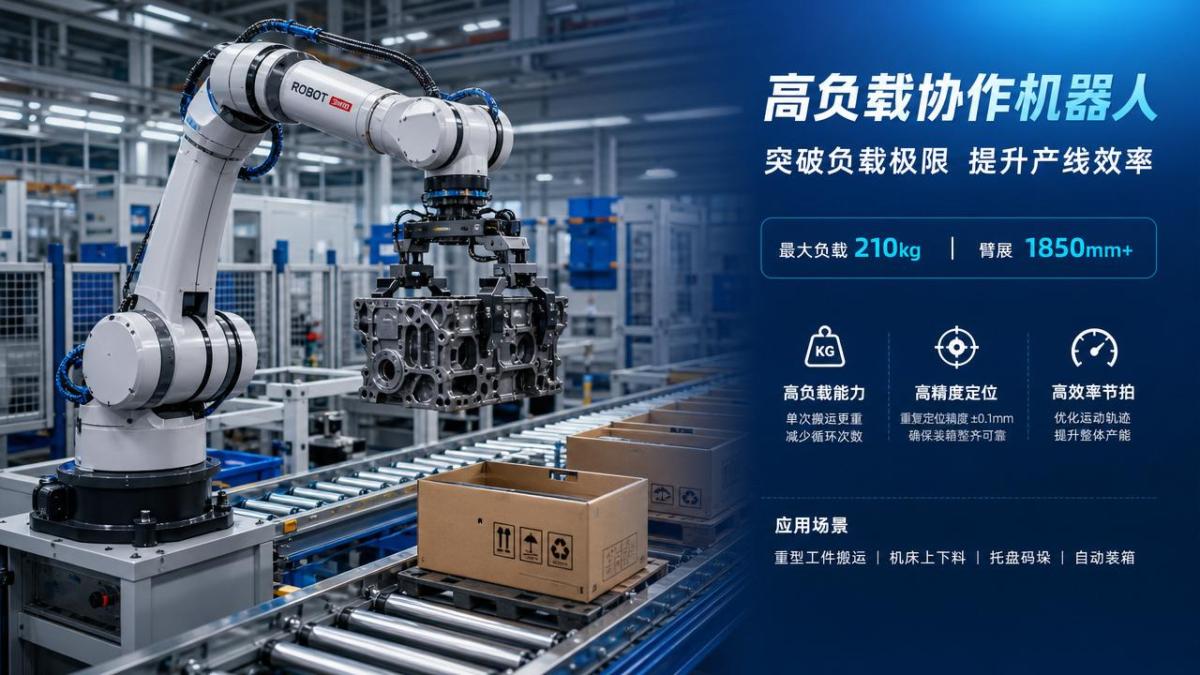
A practical overview of payload-related production risks
The table below summarizes how payload sizing decisions influence production outcomes across common evaluation areas.
Where collaborative robots payload capacity matters most
Not every cobot application is equally sensitive to payload. Some tasks remain viable with modest capacity, while others become uneconomical if the robot lacks reserve. Enterprise leaders should map payload importance to process type rather than relying only on generic vendor segmentation.
The engineering data leaders should ask for
If decision-makers want to assess collaborative robots payload capacity properly, they should move beyond a single rated number. Supplier discussions should include repeatability at different payload levels, performance at various reaches, allowable wrist moments, acceleration under realistic duty conditions, and thermal behavior over long shifts. These data points reveal whether the robot can maintain output, not just complete a demonstration.
It is also important to validate the full application mass model. That means measuring part weight variation, tooling mass, center-of-gravity offset, vacuum generator placement, cable drag effects, and any future sensor additions. In many deployments, the difference between a stable cell and an underperforming one is not the nominal payload rating but the unaccounted mass around the flange.
From a procurement and strategy perspective, leaders should request benchmark scenarios rather than brochure claims. For example, how does the cobot perform with a specific end effector at a defined reach and cycle target? What is the expected throughput over an eight-hour or twenty-four-hour operating pattern? Data-framed questions reduce ambiguity and shorten qualification cycles.
Why payload headroom is a strategic asset
Buying too much robot can waste capital, but buying too little can trap a factory in permanent compromise. A sensible payload margin gives manufacturers room for product changeovers, heavier packaging formats, upgraded tooling, and process redesign. It also improves resilience when demand shifts toward larger components or higher output targets.
This is especially relevant for multisite enterprises and contract manufacturers. Standardizing on cobot platforms with limited reserve may simplify initial rollout, yet it can create hidden fragmentation later when some sites outgrow the specification. Additional robot variants, retraining, spare parts complexity, and revalidation work then raise the total cost of ownership.
In this sense, collaborative robots payload capacity is not merely a mechanical parameter. It is part of a broader capacity-planning decision that affects flexibility, line balancing, and future automation architecture.
Practical evaluation steps before selecting a cobot
A disciplined selection process starts with application definition. Enterprises should document real payload composition, target cycle time, reach profile, workpiece orientation, operating hours, and anticipated process changes over the next three to five years. This prevents teams from optimizing only for present-day conditions.
Next, compare candidate robots under scenario-based testing. The useful question is not which model has the highest published figure, but which one maintains speed, repeatability, and stable operation under the exact loads your line will experience. Independent benchmarking, pilot cells, and acceptance testing are particularly valuable here.
Finally, align engineering and commercial decisions. Procurement may focus on unit price, but operations care about uptime, and engineering cares about performance margins. The strongest automation decisions come when these groups evaluate payload, tool mass, and cycle demands together rather than in separate stages.
A data-first path forward
For enterprise decision-makers, the lesson is clear: when cobots begin to slow production, the cause is often not automation itself but an incomplete understanding of usable capacity. A robot near its real payload threshold can still operate, yet it may do so with lower speed, reduced flexibility, and weaker economics.
Organizations that treat collaborative robots payload capacity as a data-driven engineering variable gain a better foundation for scaling automation. They ask for operating envelopes, not slogans; application benchmarks, not assumptions; and future headroom, not just present fit. That approach reduces trial-and-error costs, supports cleaner supplier qualification, and protects long-term ROI.
At TSV, this is exactly the lens that matters: strip away vague claims, examine the performance thresholds, and make decisions based on engineering truth. If your production line is losing speed as product mix evolves, payload analysis is one of the first places to look.
Search News
Hot Articles
- Carbon Fiber StructuresHow to Specify Aerospace Carbon Fiber Assemblies for Lightweight, Load-Bearing PartsJul 11, 2026
- Machine VisionXiaomi, Alibaba DAMO Academy Drive Open-Source Robotics Model Ecosystem, Lowering Algorithm Development Barriers for Overseas SMEs Adopting Chinese Robotics SolutionsMar 30, 2026
- Cobots & ArmsShanxi 'AI+' Conference Showcases Embodied Intelligence with Multinational Buyer Engagement: Key Industry ImplicationsMar 30, 2026
Popular Tags
Recommended News
 Jul 11, 2026How to Specify Aerospace Carbon Fiber Assemblies for Lightweight, Load-Bearing PartsAerospace carbon fiber assemblies: learn how to specify laminate design, load data, joining methods, and inspection controls for lighter, reliable load-bearing aerospace parts.Elena Rostova (UAV Systems Researcher)
 Mar 30, 2026Xiaomi, Alibaba DAMO Academy Drive Open-Source Robotics Model Ecosystem, Lowering Algorithm Development Barriers for Overseas SMEs Adopting Chinese Robotics SolutionsXiaomi & Alibaba DAMO Academy's open-source robotics models lower algorithm barriers for global SMEs. Boost efficiency in manufacturing, logistics & smart retail with ROS 2 compatible solutions.TSV Data Lab
 Mar 30, 2026Shanxi 'AI+' Conference Showcases Embodied Intelligence with Multinational Buyer Engagement: Key Industry ImplicationsShanxi 'AI+' Conference highlights embodied intelligence with Tesla, Ubtech & Jiantao showcasing multimodal robotics. 40+ global buyers validated tech on-site, creating new B2B channels for industrial automation & AI solutions.Chen Wei (Automation Lead Engineer)
 Mar 30, 2026Zhongguancun Unveils 6G Integrated Sensing-Computing-Intelligence Platform to Empower Embodied Robots for Global Industrial ApplicationsZhongguancun's new 6G platform revolutionizes industrial robotics with <10ms latency, empowering global automotive, logistics & port automation. Discover how this tech boosts China's smart manufacturing exports.TSV Data Lab
 Mar 30, 2026Mech-Mind Tianjin Embodied Intelligence R&D and Production Base Goes Live, Cutting Delivery Time by 20%–30% for Global Customized AMR+Vision SolutionsMech-Mind's Tianjin AMR+Vision production base cuts delivery time by 20%-30% for欧美 & Latin American markets. Discover how this PLd-certified facility accelerates customized robotics solutions for smart manufacturing and logistics.Chen Wei (Automation Lead Engineer)
 Mar 30, 2026Boao Forum Reveals 'Co-evolution of Big and Small Brains' Trend in Humanoid Robots, China's Embodied Intelligence Accelerates Adaptation to Overseas Manufacturing Service ScenariosDiscover how China's humanoid robots, featuring 'Co-evolution of Big and Small Brains,' are revolutionizing global manufacturing. Learn about Embodied Tian Gong 3.0's ISO compliance and overseas deployment at Boao Forum 2026.Chen Wei (Automation Lead Engineer)
 Mar 30, 2026China Railway Industrial Secures Patent for Embodied Robotics in Material Handling, Boosting High-Precision Delivery Capabilities for Overseas Infrastructure and Manufacturing ProjectsChina Railway Industrial's new patent for embodied robotics in material handling boosts high-precision delivery for global infrastructure & manufacturing. Discover how this innovation enhances logistics accuracy in automotive, rail transit & EPC projects.Chen Wei (Automation Lead Engineer)
 Sep 29, 2026ISO 9283 Repeatability: How to Evaluate Cobot Positioning PerformanceISO 9283 cobot repeatability explained: learn how payload, reach, approach direction, and test conditions affect positioning performance and cell capability.Chen Wei (Automation Lead Engineer)
 Sep 28, 2026Spindle Runout Measurement in Germany: DIN Standards, Methods, and Acceptance LimitsSpindle runout measurement Germany: explore DIN standards, proven methods, acceptance limits, and audit-ready practices for reliable machining quality.Dr. Marcus Vance
 Sep 27, 2026How to Select Wall-Mount Edge Devices for Space-Constrained Factory NetworksWall mount edge devices for space-constrained factories: evaluate workload, thermal design, power resilience, cable access, and network reliability for smarter deployments.TSV Data Lab
 Sep 26, 2026Machining Tolerance Analysis: How to Set Limits That Meet Function and Cost TargetsMachining tolerance analysis: learn how to set functional limits, control tolerance stacks, reduce inspection risk, and balance precision with production cost.Dr. Marcus Vance
 Sep 25, 2026How to Evaluate an Industrial Infrastructure Data Platform for Multi-Site OperationsIndustrial infrastructure data platform evaluation guide for multi-site operations: compare data quality, edge resilience, interoperability, governance, and scalable proof-of-value criteria.Victor Lin (Chief Software Architect)
 Sep 24, 2026How to Select Machine Vision Optics for Accurate Inspection at Different Working DistancesMachine vision optics selection guide for accurate inspection at every working distance. Compare FOV, pixel scale, DOF, distortion, lighting, and telecentric options.TSV Data Lab
 Sep 23, 2026How to Evaluate a Machine Vision System Integrator for High-Speed Inspection LinesChoose a machine vision system integrator with proven expertise in high-speed inspection, reliable reject timing, robust optics, and measurable acceptance criteria.TSV Data Lab
 Sep 28, 2026When is a SCADA API the right choice for connecting plant systems?SCADA API guide: learn when governed plant data integration improves traceability, security, and scalability—without compromising real-time control.Victor Lin (Chief Software Architect)
 Sep 27, 2026How SCADA data integration improves traceability across production linesSCADA data integration connects production-line data to improve traceability, accelerate quality investigations, and strengthen safety decisions.Victor Lin (Chief Software Architect)
 Sep 26, 2026What to define before starting SCADA integration planningSCADA integration planning starts with clear scope, control boundaries, data models, cybersecurity, and testing. Discover the definitions that reduce risk and costly rework.Victor Lin (Chief Software Architect)
 Sep 25, 2026How a smart factory with Industrial IoT reduces production blind spotsDiscover how a smart factory with Industrial IoT turns real-time machine, quality, and workflow data into actionable insights that reduce production blind spots and delivery risks.Victor Lin (Chief Software Architect)
 Sep 24, 2026When does Industrial IoT make smart manufacturing easier to scale?Smart manufacturing Industrial IoT scales when trusted data, interoperable systems, and secure workflows turn connected assets into measurable gains.TSV Data Lab
 Sep 23, 2026What drives ultra-precision machining cost at 1-micron tolerance?Ultra precision machining cost per part at 1 micron tolerance depends on process, material, metrology, and yield. Learn how to compare quotes confidently.Dr. Marcus Vance
 Sep 22, 2026Drone Engine-T550CC Applications: Build the UAV Power System Around the MissionAn application guide for Drone Engine-T550CC integration, covering payload planning, airframe matching, cooling, fuel, vibration, test procedures, documentation, and service preparation.Elena Rostova (UAV Systems Researcher)
 Sep 22, 2026How to Evaluate Industrial Edge Computing Vendors for Factory DeploymentIndustrial edge computing vendor evaluation guide for factories: compare latency, protocol fit, reliability, security, and lifecycle support before deployment.TSV Data Lab
 Sep 21, 2026Drone Payload Integration: Matching Power, Data, and Center of Gravity for Reliable FlightsDrone payload integration made practical: balance power, data, center of gravity, and endurance to build safer, more reliable mission-ready flights.Elena Rostova (UAV Systems Researcher)
 Sep 20, 2026Autonomous Navigation Pricing: Cost Drivers and Budget Benchmarks for AMR ProjectsAutonomous navigation price explained: compare AMR cost drivers, software, sensors, integration, safety, and lifecycle budgets to build a scalable project plan.Chen Wei (Automation Lead Engineer)