How Much Payload Is Enough for a Collaborative Robot?
Publication Date
author
Choosing the right payload is one of the most critical steps in cobot selection. Collaborative robots payload capacity directly affects cycle time, end-effector compatibility, safety margins, and long-term reliability. For technical evaluators, the real question is not simply how much a robot can lift, but how much payload is enough under actual operating conditions, duty cycles, and precision requirements.
Understanding payload in collaborative robot selection
In collaborative automation, payload is often treated as a headline specification, yet it is frequently misunderstood. A cobot payload rating does not only represent the mass of a part. It usually includes the workpiece, gripper, adapter plate, sensor cable drag, air fittings, tool changers, and in some cases the dynamic force generated by acceleration and deceleration. That is why collaborative robots payload capacity should be evaluated as a system parameter rather than a single number on a brochure.
For technical evaluation teams, this matters because cobots operate close to people, often in flexible workcells with changing tasks. A robot that appears adequate on paper may become unstable, slower, or less precise when the true load stack is calculated. A robot with excess payload, on the other hand, may cost more, occupy more space, and trigger stricter safety measures. The engineering objective is not maximum lifting power. It is the minimum payload that still preserves process reliability, quality, and safety margin.
Why the industry pays close attention to collaborative robots payload capacity
Across advanced manufacturing, payload decisions now influence more than mechanical fit. They affect throughput modeling, return on automation, validation time, and supplier risk. As factories move toward mixed-product lines and shorter production runs, collaborative robots payload capacity becomes a strategic variable in deployment flexibility.
This is especially relevant in sectors tracked by data-driven engineering organizations such as TechStat Vanguard, where decision-makers value actual performance under duty-cycle conditions over broad marketing claims. A payload rating without context says little about repeatability at full reach, wrist torque utilization, thermal behavior, or sustained operation across shifts. Engineers increasingly want traceable, benchmark-style answers: What is the real payload at the intended reach? How does cycle time change near the upper limit? What safety speed reductions are required when the load increases?
In practice, payload is one of the earliest filters used to narrow a robot shortlist. It shapes whether a cobot can support machine tending, screwdriving, dispensing, inspection, packaging, or palletizing. It also affects integration choices upstream and downstream, including vision, fixture design, conveyors, and workstation ergonomics.
What “enough payload” really means
Enough payload means the cobot can execute the target motion profile with the full tool-and-part stack, at the required reach, while maintaining acceptable repeatability, speed, and service life. It is not the same as matching the nominal payload to the nominal part weight.
A practical evaluation usually includes five factors:
- Static load: total mass mounted on the robot flange.
- Dynamic load: inertial forces created by acceleration, stopping, and directional changes.
- Moment load: the effect of center-of-gravity offset from the wrist.
- Reach dependency: payload performance often changes near maximum extension.
- Duty cycle: a cobot may tolerate a load occasionally but not continuously over long shifts.
This is why experienced evaluators rarely design to 100% of stated capacity. They account for payload reserve, especially where precision placement, vertical lifting, or high acceleration is involved.
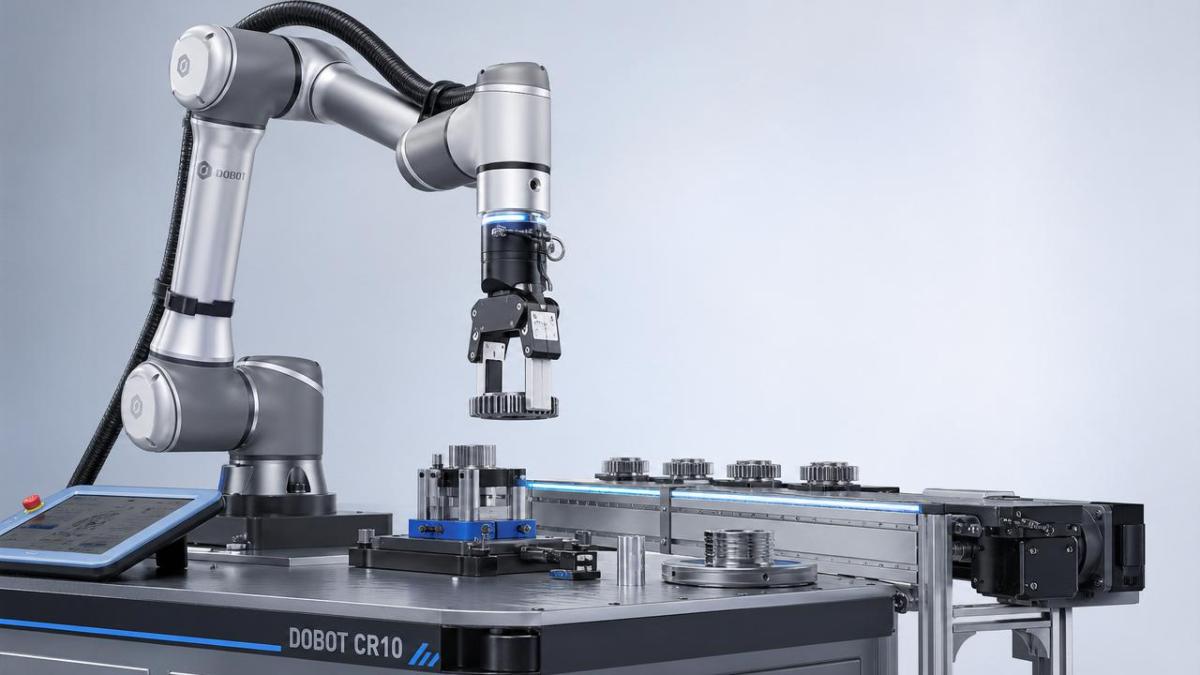
Industry overview: how payload demand changes by application
Payload requirements vary significantly by task type. The table below provides a practical overview for technical assessors comparing common collaborative automation use cases.
This overview shows why collaborative robots payload capacity cannot be judged in isolation. A lightweight inspection tool may demand extremely stable motion, while a heavier palletizing load may allow wider positional tolerance. The “right” payload depends on process intent.
The hidden variables behind payload ratings
Several hidden variables explain why two cobots with similar payload ratings can perform very differently in the field. The first is center of gravity. If a gripper extends far from the flange, the wrist experiences a much larger moment than the total mass alone suggests. The second is acceleration profile. Fast pick-and-place programs can create inertial peaks that exceed nominal design assumptions.
The third variable is reach. Many collaborative robots payload capacity figures are tied to test conditions that do not fully represent worst-case extension. At long reach, arm stiffness, vibration damping, and axis torque utilization become more important. The fourth is mounting orientation. Wall-mounted or angled installations may shift load effects across joints in ways that differ from floor mounting.
Finally, thermal and lifecycle effects should not be overlooked. Running near maximum load all day can increase wear, reduce speed, or require more conservative motion tuning. From a benchmarking perspective, this is where precise data matters more than generic quality claims.
How to estimate the payload your application actually needs
A robust estimate starts by calculating the full end-of-arm load. Include the gripper body, brackets, fingers, sensors, cables, vacuum hardware, and the heaviest expected workpiece. Then locate the combined center of gravity relative to the robot flange. If this information is unavailable from the tooling vendor, request it. Missing CG data is a common source of mis-sizing.
Next, define the motion envelope and cycle target. A cobot moving slowly between stations may handle a given mass comfortably, while the same cobot running a fast takt-time application may not. Technical evaluators should also consider payload variability. If the robot handles multiple SKUs, design for the heaviest and most unstable case, not the average case.
As a rule of thumb, many engineering teams reserve additional payload headroom rather than selecting a robot at the exact theoretical limit. The amount of reserve depends on precision requirements, acceleration, and shift pattern. High-duty, high-mix environments usually justify more margin than occasional handling tasks.
Application value across the broader industrial landscape
The business value of properly sizing collaborative robots payload capacity extends well beyond successful installation. For R&D teams, it reduces redesign loops around fixtures, tools, and software. For procurement and supplier qualification teams, it improves comparability between vendors by forcing discussions around usable payload rather than abstract specification sheets. For operations teams, it protects uptime and cycle consistency.
In a broad industrial context, payload sizing also supports modular automation strategy. Facilities increasingly want one robot platform to cover several adjacent tasks. Selecting a payload class with documented operating margin can make redeployment easier when products change. That flexibility has measurable value, particularly where capital equipment must serve multiple programs over time.
For organizations aligned with data-first engineering principles, the lesson is clear: payload is not merely a marketing metric. It is a proxy for how honestly a robot platform is characterized under real conditions. The more transparent the supplier is about load curves, wrist moments, speed limits, and repeatability under load, the lower the evaluation risk.
Common sizing mistakes technical evaluators should avoid
One common mistake is equating part weight with total payload. Another is ignoring tool growth over the project lifecycle. A gripper may start simple and become heavier after sensors, compliance devices, or dual-action mechanisms are added. A third mistake is neglecting the center-of-gravity shift that occurs when parts are irregular, porous, or asymmetrical.
Teams also sometimes overestimate the benefit of buying the highest payload available. Larger payload cobots can be slower in collaborative mode, require a larger safety envelope, or introduce unnecessary cost. The goal is not to oversize by default, but to match collaborative robots payload capacity to validated process conditions with appropriate engineering margin.
A practical framework for evaluation and benchmarking
A structured review process helps technical assessors compare options consistently. Start with a baseline load model covering mass, CG, reach, and motion profile. Then request vendor data for payload-related limits, including wrist moment, recommended acceleration, and repeatability at representative load. If possible, test a real tool or a mass-equivalent mockup in a timed application.
It is also useful to document performance at several operating points: nominal load, peak load, and a future-state load if tooling expands. This creates a clearer investment picture and aligns with the engineering benchmarking mindset promoted by organizations focused on measurable truth rather than vague positioning. When parameters are explicit, internal approval becomes easier and deployment risk declines.
Conclusion and next-step guidance
Determining how much payload is enough for a collaborative robot is ultimately an exercise in engineering realism. Collaborative robots payload capacity must be interpreted through the lens of total end-effector mass, center of gravity, reach, acceleration, safety mode behavior, and expected duty cycle. The right answer is rarely the maximum number on a datasheet and rarely the lightest possible option either.
For technical evaluators, the best path is to translate the application into measurable parameters, benchmark those parameters against real supplier data, and preserve adequate margin for quality and lifecycle reliability. In a market crowded with overstated claims, careful payload assessment remains one of the clearest ways to separate a workable cobot deployment from an expensive automation compromise. If your team is building selection criteria, start with the load model, validate it with duty-cycle assumptions, and use collaborative robots payload capacity as a performance metric—not just a catalog filter.
Search News
Hot Articles
- Carbon Fiber StructuresHow to Specify Aerospace Carbon Fiber Assemblies for Lightweight, Load-Bearing PartsJul 11, 2026
- Machine VisionXiaomi, Alibaba DAMO Academy Drive Open-Source Robotics Model Ecosystem, Lowering Algorithm Development Barriers for Overseas SMEs Adopting Chinese Robotics SolutionsMar 30, 2026
- Cobots & ArmsShanxi 'AI+' Conference Showcases Embodied Intelligence with Multinational Buyer Engagement: Key Industry ImplicationsMar 30, 2026
Popular Tags
Recommended News
 Jul 11, 2026How to Specify Aerospace Carbon Fiber Assemblies for Lightweight, Load-Bearing PartsAerospace carbon fiber assemblies: learn how to specify laminate design, load data, joining methods, and inspection controls for lighter, reliable load-bearing aerospace parts.Elena Rostova (UAV Systems Researcher)
 Mar 30, 2026Xiaomi, Alibaba DAMO Academy Drive Open-Source Robotics Model Ecosystem, Lowering Algorithm Development Barriers for Overseas SMEs Adopting Chinese Robotics SolutionsXiaomi & Alibaba DAMO Academy's open-source robotics models lower algorithm barriers for global SMEs. Boost efficiency in manufacturing, logistics & smart retail with ROS 2 compatible solutions.TSV Data Lab
 Mar 30, 2026Shanxi 'AI+' Conference Showcases Embodied Intelligence with Multinational Buyer Engagement: Key Industry ImplicationsShanxi 'AI+' Conference highlights embodied intelligence with Tesla, Ubtech & Jiantao showcasing multimodal robotics. 40+ global buyers validated tech on-site, creating new B2B channels for industrial automation & AI solutions.Chen Wei (Automation Lead Engineer)
 Mar 30, 2026Zhongguancun Unveils 6G Integrated Sensing-Computing-Intelligence Platform to Empower Embodied Robots for Global Industrial ApplicationsZhongguancun's new 6G platform revolutionizes industrial robotics with <10ms latency, empowering global automotive, logistics & port automation. Discover how this tech boosts China's smart manufacturing exports.TSV Data Lab
 Mar 30, 2026Mech-Mind Tianjin Embodied Intelligence R&D and Production Base Goes Live, Cutting Delivery Time by 20%–30% for Global Customized AMR+Vision SolutionsMech-Mind's Tianjin AMR+Vision production base cuts delivery time by 20%-30% for欧美 & Latin American markets. Discover how this PLd-certified facility accelerates customized robotics solutions for smart manufacturing and logistics.Chen Wei (Automation Lead Engineer)
 Mar 30, 2026Boao Forum Reveals 'Co-evolution of Big and Small Brains' Trend in Humanoid Robots, China's Embodied Intelligence Accelerates Adaptation to Overseas Manufacturing Service ScenariosDiscover how China's humanoid robots, featuring 'Co-evolution of Big and Small Brains,' are revolutionizing global manufacturing. Learn about Embodied Tian Gong 3.0's ISO compliance and overseas deployment at Boao Forum 2026.Chen Wei (Automation Lead Engineer)
 Mar 30, 2026China Railway Industrial Secures Patent for Embodied Robotics in Material Handling, Boosting High-Precision Delivery Capabilities for Overseas Infrastructure and Manufacturing ProjectsChina Railway Industrial's new patent for embodied robotics in material handling boosts high-precision delivery for global infrastructure & manufacturing. Discover how this innovation enhances logistics accuracy in automotive, rail transit & EPC projects.Chen Wei (Automation Lead Engineer)
 Sep 29, 2026ISO 9283 Repeatability: How to Evaluate Cobot Positioning PerformanceISO 9283 cobot repeatability explained: learn how payload, reach, approach direction, and test conditions affect positioning performance and cell capability.Chen Wei (Automation Lead Engineer)
 Sep 28, 2026Spindle Runout Measurement in Germany: DIN Standards, Methods, and Acceptance LimitsSpindle runout measurement Germany: explore DIN standards, proven methods, acceptance limits, and audit-ready practices for reliable machining quality.Dr. Marcus Vance
 Sep 27, 2026How to Select Wall-Mount Edge Devices for Space-Constrained Factory NetworksWall mount edge devices for space-constrained factories: evaluate workload, thermal design, power resilience, cable access, and network reliability for smarter deployments.TSV Data Lab
 Sep 26, 2026Machining Tolerance Analysis: How to Set Limits That Meet Function and Cost TargetsMachining tolerance analysis: learn how to set functional limits, control tolerance stacks, reduce inspection risk, and balance precision with production cost.Dr. Marcus Vance
 Sep 25, 2026How to Evaluate an Industrial Infrastructure Data Platform for Multi-Site OperationsIndustrial infrastructure data platform evaluation guide for multi-site operations: compare data quality, edge resilience, interoperability, governance, and scalable proof-of-value criteria.Victor Lin (Chief Software Architect)
 Sep 24, 2026How to Select Machine Vision Optics for Accurate Inspection at Different Working DistancesMachine vision optics selection guide for accurate inspection at every working distance. Compare FOV, pixel scale, DOF, distortion, lighting, and telecentric options.TSV Data Lab
 Sep 23, 2026How to Evaluate a Machine Vision System Integrator for High-Speed Inspection LinesChoose a machine vision system integrator with proven expertise in high-speed inspection, reliable reject timing, robust optics, and measurable acceptance criteria.TSV Data Lab
 Sep 28, 2026When is a SCADA API the right choice for connecting plant systems?SCADA API guide: learn when governed plant data integration improves traceability, security, and scalability—without compromising real-time control.Victor Lin (Chief Software Architect)
 Sep 27, 2026How SCADA data integration improves traceability across production linesSCADA data integration connects production-line data to improve traceability, accelerate quality investigations, and strengthen safety decisions.Victor Lin (Chief Software Architect)
 Sep 26, 2026What to define before starting SCADA integration planningSCADA integration planning starts with clear scope, control boundaries, data models, cybersecurity, and testing. Discover the definitions that reduce risk and costly rework.Victor Lin (Chief Software Architect)
 Sep 25, 2026How a smart factory with Industrial IoT reduces production blind spotsDiscover how a smart factory with Industrial IoT turns real-time machine, quality, and workflow data into actionable insights that reduce production blind spots and delivery risks.Victor Lin (Chief Software Architect)
 Sep 24, 2026When does Industrial IoT make smart manufacturing easier to scale?Smart manufacturing Industrial IoT scales when trusted data, interoperable systems, and secure workflows turn connected assets into measurable gains.TSV Data Lab
 Sep 23, 2026What drives ultra-precision machining cost at 1-micron tolerance?Ultra precision machining cost per part at 1 micron tolerance depends on process, material, metrology, and yield. Learn how to compare quotes confidently.Dr. Marcus Vance
 Sep 22, 2026Drone Engine-T550CC Applications: Build the UAV Power System Around the MissionAn application guide for Drone Engine-T550CC integration, covering payload planning, airframe matching, cooling, fuel, vibration, test procedures, documentation, and service preparation.Elena Rostova (UAV Systems Researcher)
 Sep 22, 2026How to Evaluate Industrial Edge Computing Vendors for Factory DeploymentIndustrial edge computing vendor evaluation guide for factories: compare latency, protocol fit, reliability, security, and lifecycle support before deployment.TSV Data Lab
 Sep 21, 2026Drone Payload Integration: Matching Power, Data, and Center of Gravity for Reliable FlightsDrone payload integration made practical: balance power, data, center of gravity, and endurance to build safer, more reliable mission-ready flights.Elena Rostova (UAV Systems Researcher)
 Sep 20, 2026Autonomous Navigation Pricing: Cost Drivers and Budget Benchmarks for AMR ProjectsAutonomous navigation price explained: compare AMR cost drivers, software, sensors, integration, safety, and lifecycle budgets to build a scalable project plan.Chen Wei (Automation Lead Engineer)