
What ISO TS 15066 Really Changes in Cobot Safety Planning
Publication Date
author
ISO/TS 15066 changes more than compliance checklists—it changes how collaborative robot cells are actually planned, justified, and operated. For most teams, the biggest shift is this: cobot safety can no longer be treated as a generic “inherently safe” assumption. Instead, safety planning must be built around task-specific risk assessment, validated force and pressure limits, stopping behavior, tool design, payload behavior, operator interaction, and real operating conditions. In practice, that affects layout decisions, end-of-arm tooling, speed settings, safeguarding strategy, commissioning time, and even ROI expectations for palletizing and other shared-workspace applications.
For engineers, integrators, procurement teams, and plant leaders, the real question is not whether ISO/TS 15066 exists—it is how it changes deployment logic. This article explains what the standard actually changes in cobot safety planning, where teams still make costly mistakes, and how to evaluate a cobot project with more technical clarity.
What ISO/TS 15066 really changes in cobot safety planning
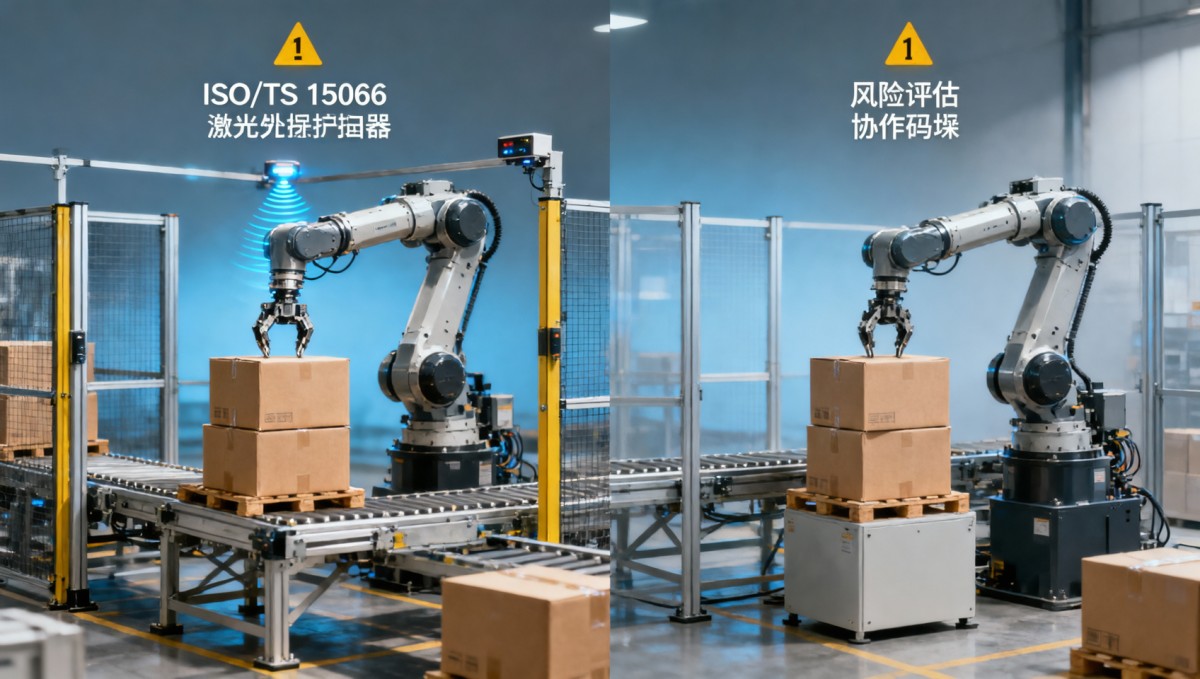
The practical impact of ISO/TS 15066 is that collaborative robot safety planning becomes far more evidence-based and application-specific than many buyers initially expect. Before this guidance became central to cobot integration, many organizations treated collaborative robots as safer industrial robots with simpler guarding requirements. That mindset is no longer enough.
The standard pushes teams to answer a more demanding set of questions:
- What exact human-robot interaction can occur during normal operation, setup, cleaning, fault recovery, and maintenance?
- What body regions may be exposed during contact?
- What forces, pressures, speeds, and stopping distances are acceptable for the specific application?
- Does the tool, workpiece, payload, or pallet pattern introduce hazards beyond the robot arm itself?
- Can the claimed collaborative mode actually be validated in the real cell layout?
In other words, ISO/TS 15066 does not simply tell companies to “use cobots safely.” It changes the planning model from robot-centered thinking to task-centered risk engineering.
That is especially important in palletizing, machine tending, assembly assistance, packaging, and mixed human-robot workstations. The standard forces planners to move beyond vendor marketing and into measurable safety behavior.
Why the standard matters to buyers, engineers, and plant leaders
Different stakeholders care about ISO/TS 15066 for different reasons, but the standard affects all of them.
For engineering and automation teams, it changes design assumptions. A cobot is not automatically safe just because it has force-limiting functions. The total system must be evaluated, including grippers, payload inertia, pinch points, sharp edges, product geometry, and unexpected operator motion.
For operators and production users, it affects how safe the cell feels in real use. A system that is compliant on paper but poorly configured may stop too often, move unpredictably near shared zones, or create uncomfortable close-contact conditions that reduce trust and productivity.
For procurement teams, it changes supplier evaluation. The right question is no longer just payload, reach, and cycle time. Buyers should also ask how the supplier validates collaborative operation, documents residual risks, measures stopping performance, and supports application-specific risk assessment.
For business leaders, the standard changes cost and schedule expectations. If a cobot project requires speed reduction, safety sensors, fencing in partial zones, or tooling redesign to meet acceptable risk levels, then the original ROI model may need revision. A cell sold as “fenceless” may end up hybrid-guarded in practice.
This is why ISO/TS 15066 is strategically important. It does not just regulate safety; it affects specification quality, vendor selection, deployment speed, utilization, and long-term productivity.
The biggest misconception: a cobot is not automatically safe without full risk assessment
One of the most common market misunderstandings is the idea that collaborative robots remove the need for rigorous safeguarding decisions. They do not.
ISO/TS 15066 works alongside broader machinery safety frameworks and collaborative operation principles. It supports the idea that collaborative operation can be achieved in several modes, but those modes must be properly selected and implemented. These commonly include:
- Safety-rated monitored stop
- Hand guiding
- Speed and separation monitoring
- Power and force limiting
The mistake many teams make is assuming that if a robot supports one or more of these modes, the application is automatically compliant. In reality, compliance depends on how those functions interact with the actual task.
For example, in a palletizing cell:
- A robot arm may be collaborative, but the box corners may create impact or abrasion risks.
- A gripper may be certified for collaborative use, but the payload may still exceed safe contact conditions.
- The robot may stop within specification, but the stopping distance may still be unacceptable in the available aisle layout.
- Operators may enter the shared zone during exceptions more often than the original design assumed.
So what changes under ISO/TS 15066 is not the idea that cobots can work near people. What changes is the threshold for proving that the interaction is acceptably safe in context.
How ISO/TS 15066 changes cobot palletizing and layout decisions
Cobot palletizing is one of the clearest examples of how the standard reshapes planning. On paper, palletizing seems ideal for collaborative automation: repetitive, physically demanding, and often labor-constrained. But once safety planning becomes application-specific, layout trade-offs become more visible.
Key planning changes often include:
1. Shared-space assumptions must be tested.
If operators need to replenish pallets, clear misaligned cartons, inspect labels, or remove damaged loads near robot motion, the real human-robot interaction frequency may be much higher than expected.
2. End-of-arm tooling becomes a safety-critical decision.
Vacuum tools, clamp grippers, custom forks, and box-handling attachments all affect pinch risk, edge profile, and effective contact behavior. A safe robot arm paired with an aggressive tool may undermine the collaborative concept.
3. Payload and inertia matter as much as robot specifications.
The relevant issue is not just nominal payload capacity. It is total moving mass, speed, acceleration, and the consequences of unintended contact.
4. Throughput may require hybrid safeguarding.
Some teams discover that to hit target cycle time, they must run at speeds or trajectories that no longer support open collaborative access. In those cases, area scanners, restricted zones, light curtains, or partial fencing may be the more realistic design.
5. Pallet pattern geometry affects safety exposure.
High stacks, deep reaches, side access points, and constrained operator walkways all influence where contact can occur and how recovery tasks are handled.
For decision-makers, this means the phrase “cobot palletizing solution” should never be accepted as a complete answer. The better question is: Under what exact operating conditions can this palletizing cell remain collaborative, and where does it require additional safeguarding or speed limitation?
What engineers should validate before approving a cobot ISO/TS 15066 safety standard approach
Teams evaluating a cobot ISO/TS 15066 safety standard approach should focus less on broad claims and more on validation evidence. Several technical checkpoints are especially important.
- Task-based risk assessment: Has the integrator documented normal operation, foreseeable misuse, interventions, jams, cleaning, maintenance, and restart scenarios?
- Contact analysis: Has the application been assessed for transient and quasi-static contact risks, including likely body regions exposed?
- Tool and payload review: Do the EOAT, product shape, load stability, and fixture design create hazards not covered by robot specifications?
- Stopping and speed behavior: Are stopping times and separation distances validated in the installed cell rather than assumed from brochure values?
- Safety function performance: Are safety-rated functions integrated correctly with scanners, interlocks, emergency stops, and PLC logic where required?
- Residual risk documentation: Is there clear documentation of what risks remain and what training or procedures are required to control them?
- Change management: If payload, carton size, gripper type, or line speed changes later, is there a documented process for reassessment?
This validation mindset is where advanced manufacturers separate serious deployments from superficial ones. A mature cobot safety plan should be measurable, reviewable, and maintainable—not dependent on informal operator habits.
How ISO/TS 15066 affects ROI, implementation time, and supplier comparison
From a business perspective, ISO/TS 15066 often changes project economics in ways that are not visible in early sales discussions.
Implementation time may increase because more detailed risk assessment, tool review, and validation are required. This is not inefficiency; it is part of reducing downstream failure and retrofit cost.
Capital cost may shift because some applications need more than a standalone robot arm. Safety scanners, collaborative grippers, mechanical redesign, validated software logic, and commissioning support can materially affect total cost of ownership.
Expected throughput may need recalibration if safe collaborative operation requires reduced speed or zoned access logic. In some use cases, a traditional industrial robot with clear guarding may outperform a cobot on both output and safety simplicity.
Supplier comparison becomes more technical. The strongest vendors are usually the ones that can show:
- application-specific risk assessment capability
- clear documentation methodology
- proven safety validation process
- transparent assumptions behind cycle-time claims
- experience with similar payloads, tools, and operator interaction models
For procurement and leadership teams, the lesson is straightforward: do not compare cobot suppliers only by robot brand or unit price. Compare them by how rigorously they can engineer, validate, and document safe production performance.
When a cobot is the right choice—and when it is not
ISO/TS 15066 also helps teams make a better strategic choice between collaborative and conventional automation.
A cobot is often a strong fit when:
- human interaction is frequent and operationally necessary
- payloads are moderate
- cycle-time demands are achievable within safe collaborative limits
- the task mix changes often and flexibility has high value
- floor space is constrained and full fencing is undesirable
A cobot may be a weaker fit when:
- throughput targets require consistently high speed
- payloads or workpiece geometry increase contact severity
- the process can be fully isolated with little human interaction
- the application creates persistent pinch, crush, or sharp-edge hazards
- the “collaborative” requirement is driven more by marketing than operations
This is one of the most useful ways to apply the standard in planning: not as a checkbox after choosing the robot, but as a decision framework before locking in the automation architecture.
Practical questions to ask before deploying a collaborative robot cell
If your team is evaluating a new deployment, these questions can quickly reveal whether the safety plan is robust:
- Exactly where will operators and robot paths overlap during normal and abnormal conditions?
- What is the maximum speed and payload in collaborative mode?
- How were force and pressure risks evaluated for this tool and product combination?
- What changes if cycle-time targets increase six months after installation?
- Which safeguards are active during setup, production, jam clearing, and maintenance?
- Has the integrator validated the installed cell, or only the generic robot platform?
- What documentation supports future audits, modifications, and retraining?
These questions are especially valuable for cross-functional review between engineering, EHS, procurement, and operations. They turn abstract compliance language into a concrete deployment standard.
Conclusion: ISO/TS 15066 changes planning by replacing assumptions with validated engineering
The real change introduced by ISO/TS 15066 is not simply stricter cobot safety language. It is a deeper shift in how collaborative automation should be planned, justified, and maintained. The standard makes it clear that safe cobot deployment depends on the total application—not just the robot model.
For operators, that means safer and more predictable interaction. For engineers, it means more rigorous task-based validation. For procurement teams, it means comparing suppliers on technical credibility rather than marketing language. And for business leaders, it means making more realistic decisions about layout, throughput, risk, and return on investment.
If there is one takeaway, it is this: ISO/TS 15066 does not merely change compliance paperwork—it changes what good cobot planning looks like. Teams that understand that early make better automation decisions, avoid expensive redesigns, and build collaborative cells that are both safer and more operationally credible.
Search News
Hot Articles
- Carbon Fiber StructuresHow to Specify Aerospace Carbon Fiber Assemblies for Lightweight, Load-Bearing PartsJul 11, 2026
- Machine VisionXiaomi, Alibaba DAMO Academy Drive Open-Source Robotics Model Ecosystem, Lowering Algorithm Development Barriers for Overseas SMEs Adopting Chinese Robotics SolutionsMar 30, 2026
- Cobots & ArmsShanxi 'AI+' Conference Showcases Embodied Intelligence with Multinational Buyer Engagement: Key Industry ImplicationsMar 30, 2026
Popular Tags
Recommended News
 Jul 11, 2026How to Specify Aerospace Carbon Fiber Assemblies for Lightweight, Load-Bearing PartsAerospace carbon fiber assemblies: learn how to specify laminate design, load data, joining methods, and inspection controls for lighter, reliable load-bearing aerospace parts.Elena Rostova (UAV Systems Researcher)
 Mar 30, 2026Xiaomi, Alibaba DAMO Academy Drive Open-Source Robotics Model Ecosystem, Lowering Algorithm Development Barriers for Overseas SMEs Adopting Chinese Robotics SolutionsXiaomi & Alibaba DAMO Academy's open-source robotics models lower algorithm barriers for global SMEs. Boost efficiency in manufacturing, logistics & smart retail with ROS 2 compatible solutions.TSV Data Lab
 Mar 30, 2026Shanxi 'AI+' Conference Showcases Embodied Intelligence with Multinational Buyer Engagement: Key Industry ImplicationsShanxi 'AI+' Conference highlights embodied intelligence with Tesla, Ubtech & Jiantao showcasing multimodal robotics. 40+ global buyers validated tech on-site, creating new B2B channels for industrial automation & AI solutions.Chen Wei (Automation Lead Engineer)
 Mar 30, 2026Zhongguancun Unveils 6G Integrated Sensing-Computing-Intelligence Platform to Empower Embodied Robots for Global Industrial ApplicationsZhongguancun's new 6G platform revolutionizes industrial robotics with <10ms latency, empowering global automotive, logistics & port automation. Discover how this tech boosts China's smart manufacturing exports.TSV Data Lab
 Mar 30, 2026Mech-Mind Tianjin Embodied Intelligence R&D and Production Base Goes Live, Cutting Delivery Time by 20%–30% for Global Customized AMR+Vision SolutionsMech-Mind's Tianjin AMR+Vision production base cuts delivery time by 20%-30% for欧美 & Latin American markets. Discover how this PLd-certified facility accelerates customized robotics solutions for smart manufacturing and logistics.Chen Wei (Automation Lead Engineer)
 Mar 30, 2026Boao Forum Reveals 'Co-evolution of Big and Small Brains' Trend in Humanoid Robots, China's Embodied Intelligence Accelerates Adaptation to Overseas Manufacturing Service ScenariosDiscover how China's humanoid robots, featuring 'Co-evolution of Big and Small Brains,' are revolutionizing global manufacturing. Learn about Embodied Tian Gong 3.0's ISO compliance and overseas deployment at Boao Forum 2026.Chen Wei (Automation Lead Engineer)
 Mar 30, 2026China Railway Industrial Secures Patent for Embodied Robotics in Material Handling, Boosting High-Precision Delivery Capabilities for Overseas Infrastructure and Manufacturing ProjectsChina Railway Industrial's new patent for embodied robotics in material handling boosts high-precision delivery for global infrastructure & manufacturing. Discover how this innovation enhances logistics accuracy in automotive, rail transit & EPC projects.Chen Wei (Automation Lead Engineer)
 Oct 15, 2026R&D Cost Reduction Services: How to Evaluate Fees, Savings, and ROIEvaluate R&D cost reduction services with confidence. Compare fees, verify savings, and calculate ROI without compromising performance. Discover how to choose a provider that delivers real value.Chen Wei (Automation Lead Engineer)
 Oct 14, 2026Drone Frame Composites: Carbon Fiber vs. Fiberglass for Weight and StiffnessExplore drone structural materials composites: compare carbon fiber and fiberglass for weight, stiffness, cost, and antenna compatibility. Find the right material for your drone frame.Elena Rostova (UAV Systems Researcher)
 Oct 13, 2026Smart Cameras vs. PC-Based Machine Vision: Which Fits High-Speed Inspection?This industrial product comparison for machine vision weighs smart cameras vs. PC-based systems on latency, throughput, and cost. Discover your best fit for high-speed inspection.TSV Data Lab
 Oct 12, 2026How to Verify RoHS Compliance in Industrial Sensing Systems Before DeploymentRoHS compliant sensing systems: learn how to verify materials, supplier declarations, testing, and configuration controls before industrial deployment.TSV Data Lab
 Oct 11, 2026How Procurement-Oriented Content Taxonomy Improves B2B Buying JourneysProcurement-oriented content taxonomy streamlines B2B buying journeys with clearer evidence, supplier comparisons, risk visibility, and faster approvals.TSV Data Lab
 Oct 10, 2026How to Select a Machine Performance Monitoring Platform for OEE and Downtime ReductionMachine performance monitoring platform selection guide: validate machine states, OEE data, downtime reasons, integrations, and scalability to reduce losses with confidence.TSV Data Lab
 Oct 08, 2026How to Machine Inconel 625 Blades Without Heat Cracks or Edge ChippingInconel 625 blade machining guide: prevent heat cracks, edge chipping, chatter, and work hardening with proven tooling, cooling, fixturing, and inspection strategies.Dr. Marcus Vance
 Oct 07, 2026How to Evaluate an HMI Panel Distributor for Industrial Automation ProjectsHMI panel distributor evaluation guide: verify technical compatibility, traceability, supply reliability, lifecycle support, and total cost for automation projects.Victor Lin (Chief Software Architect)
 Oct 06, 2026Navigation Fault Tolerance Standards for AMRs: What Safety Teams Must VerifyNavigation fault tolerance standards: learn what AMR safety teams must verify, from localization loss and sensor faults to stopping distance, safe restart, and site-specific validation.Chen Wei (Automation Lead Engineer)
 Oct 05, 2026Calculating Edge Computing Total Cost of Ownership Across Distributed SitesEdge computing ownership cost explained: calculate deployment, energy, connectivity, security, remote support, and refresh costs across distributed sites.TSV Data Lab
 Oct 04, 2026CAD/CAM Benchmarking in the GCC: What Manufacturers Should Ask a ConsultantCAD CAM benchmark consultant GCC guide: learn the key questions manufacturers should ask to validate post-processors, workflows, machine performance, and production risk.Victor Lin (Chief Software Architect)
 Oct 03, 2026Selecting Automotive Radar Sensor Modules for ADAS Range, Resolution, and IntegrationAutomotive radar sensor module selection guide for ADAS: compare range, resolution, field of view, latency, and integration to build safer, reliable vehicle systems.TSV Data Lab
 Oct 02, 2026How to Qualify Machined Parts Suppliers for Hard Tech ProgramsHard tech supply chain machined parts demand rigorous supplier qualification. Learn how to assess capability, traceability, quality controls, and delivery resilience.Dr. Marcus Vance
 Oct 01, 2026How to Select an Outdoor Security Radar Sensor for Perimeter Detection?Outdoor security radar sensor selection guide: compare range, accuracy, false-alarm control, integration, and field testing for reliable perimeter detection.TSV Data Lab
 Sep 30, 2026How to Evaluate Solid-State LiDAR Hardware for Outdoor Autonomous VehiclesSolid state LiDAR hardware evaluation guide for outdoor autonomous vehicles—compare range, point-cloud quality, environmental resilience, integration, and safety.TSV Data Lab
 Sep 29, 2026ISO 9283 Repeatability: How to Evaluate Cobot Positioning PerformanceISO 9283 cobot repeatability explained: learn how payload, reach, approach direction, and test conditions affect positioning performance and cell capability.Chen Wei (Automation Lead Engineer)
 Oct 14, 2026How tight can micro machining aerospace tolerances be in production?Micro machining aerospace tolerances can reach low-micron levels in production. Learn what controls repeatability, inspection confidence, and flight-critical quality.Dr. Marcus Vance























